-
-
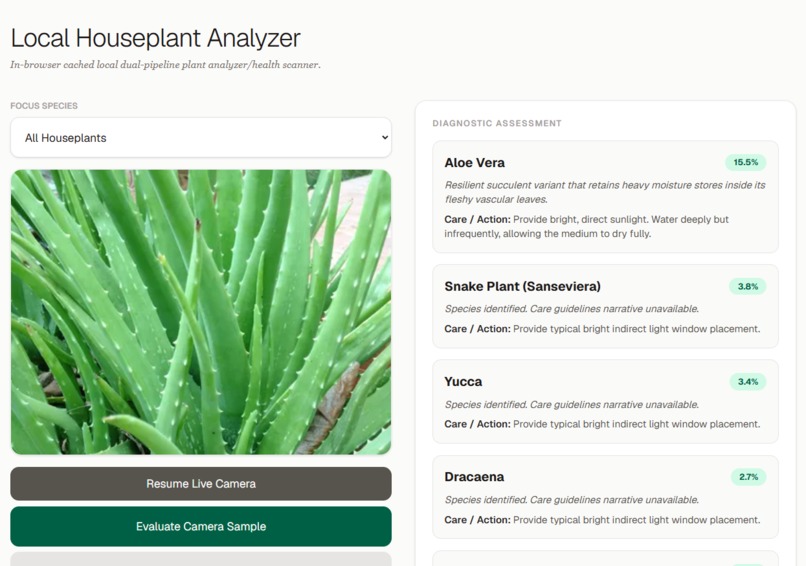
Analyzation in Action
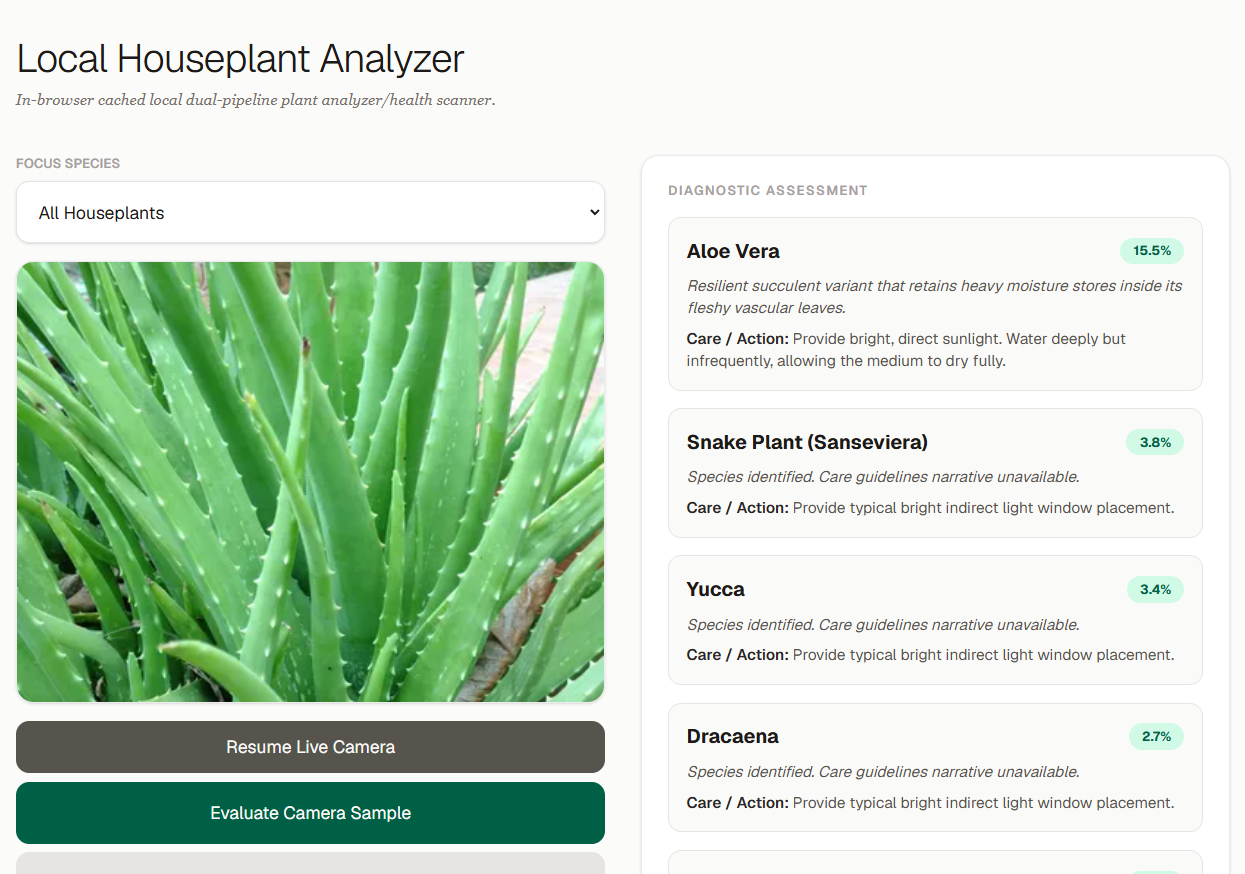
Inspiration
The project grew out of an earlier agricultural plant identification tool. The goal was to adapt that framework into a dedicated household plant assistant that prioritizes user privacy and instant performance by moving computational processing away from external cloud servers and directly onto the user's local device.
What it does
Houseplant Analyzer is an edge-computed indoor plant identification and care assistant that runs entirely inside your web browser.
- Local Processing: Analyzes uploaded plant images directly on your device using ONNX runtime execution without sending visual data to external servers.
- Privacy & Speed: Ensures maximum user privacy with zero network latency.
- Offline Access: Functions fully without an active internet connection.
- Diagnosis & Care: Identifies common household plants and offers medical/health condition diagnoses.
How we built it
- Framework Adaptation: Borrowed and modified core framework code from a previous agricultural plant identification project.
- Model Execution: Integrated quantized ONNX model files (
model_quantized.onnx) optimized for in-browser execution via ONNX Runtime. - System Updates: Updated UI components, model pipelines, and repository documentation (
READMEfiles) to align with household plant identification and health diagnosis.
Challenges we ran into
- Model Size Restrictions: Browser execution required strict file size limits, making model quantization essential.
- Debugging Quantized Models: Encountered issues while integrating and running multiple quantized ONNX files simultaneously (specifically balancing the primary plant identification model alongside the secondary plant health model).
Accomplishments that we're proud of
- Rapid Prototyping: Successfully built and deployed edge-computed inference in under 1 hour of total logged development time.
- Multi-Model Setup: Successfully integrated a second quantized ONNX model specifically tailored to analyze plant health conditions locally.
- Zero Latency: Achieved full offline capability with complete privacy and instant local response times.
What we learned
- Techniques for debugging and managing runtime restrictions for quantized
.onnxfiles in web browsers. - Best practices for re-using modular machine learning framework code from past projects to rapidly prototype new edge-AI applications.
What's next for Houseplant Local Analyzer
- Adding additional quantized ONNX models to cover a broader range of plant medical conditions, plant diseases, and household species.
- Continuing to optimize model sizes and performance for faster execution across mobile and desktop browser environments.
Built With
- css
- javascript
- markdown
- next.js
- onnx


Log in or sign up for Devpost to join the conversation.