Inspiration
Every household has one: the drawer — or these days, the scan folder — where bills, insurance policies, warranties, and IDs pile up. The paperwork lands on the NAS and then just... sits there. Meanwhile Americans waste roughly $200 a year on unused subscriptions alone (CNET, 2025), renewals slip by unnoticed, and the document you need is always the one that's missing.
We asked a simple question:
the NAS already stores the family's paperwork — why doesn't it work on it? Financial documents are exactly the data people refuse to upload to cloud AI, which makes a NAS the only home where this intelligence is acceptable: private, always present, and already holding the files. That's the inspiration — turn storage into an active household steward.
What it does
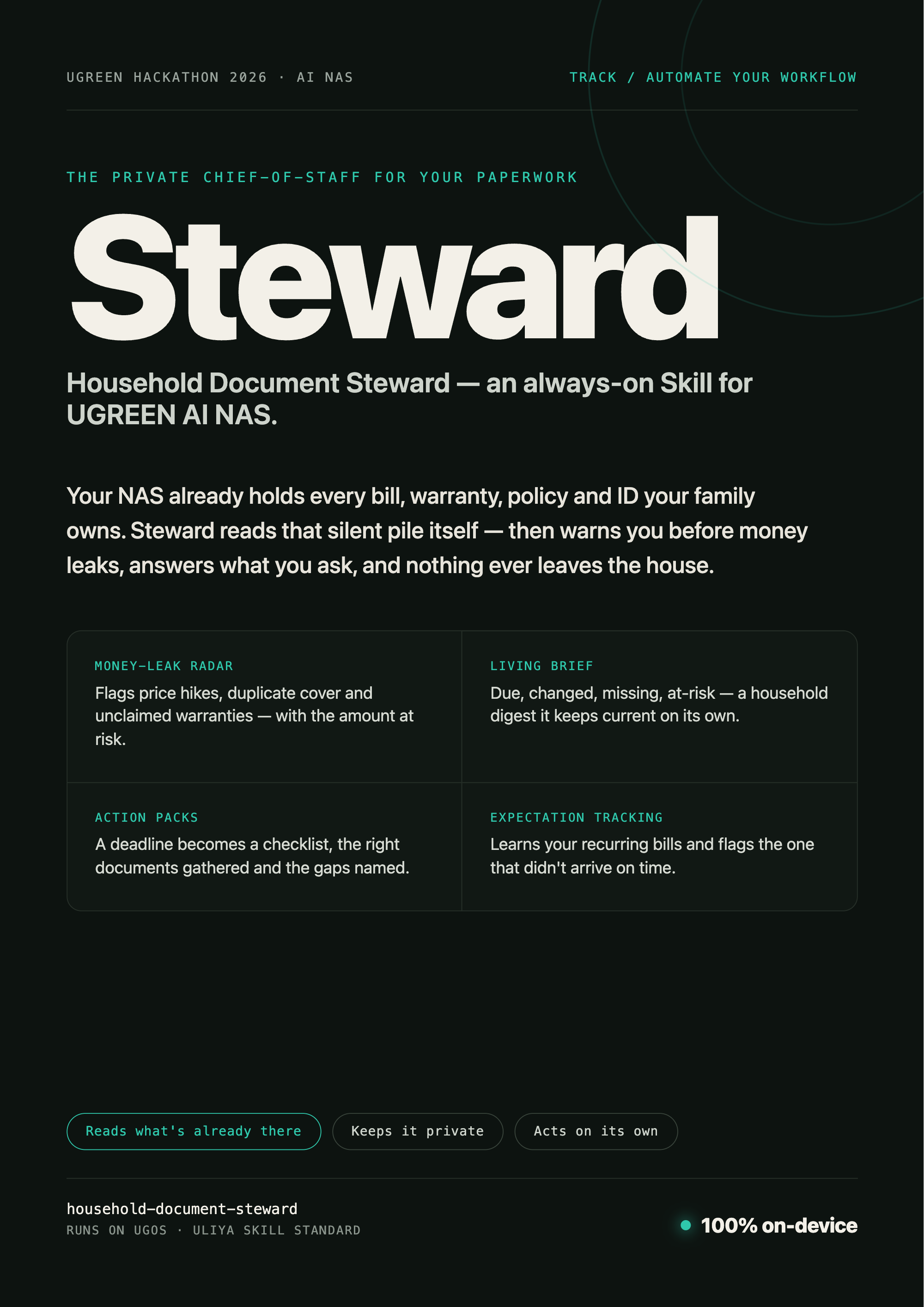
Household Document Steward ("Steward") is a fully local Uliya skill that turns the documents already on a UGREEN AI NAS into an active household brief.
Reads and remembers: every session it sweeps the authorized folder, extracting each document's facts — type, issuer, dates, amounts. Reconciles across documents: price or term changes versus prior documents, duplicate or overlapping cover, claimable warranties, upcoming auto-renewals, and recurring bills that should have arrived but haven't. Every finding carries an estimated amount and its source documents. Keeps a live brief: due soon, changed, missing, at risk — with amounts. Answers with citations: "what's our home-insurance deductible?" gets the figure and the document it came from, or an honest "couldn't find it." Assembles action packs: an expiring passport or a life event (moving, new baby, buying a car, tax season) becomes a checklist plus the documents already on hand and the ones still missing, copied to an output folder. All on-device. No uploads, no account linking, no manual data entry.
How we built it
Steward is a Markdown-defined Uliya skill built to the official Uliya Skill Development Standard — SKILL.md as the entry point, four linked references, no scripts or executables, per the standard. We drafted it with the official UGOS Skill Creation Tool and an AI coding assistant.
The architecture is "the model proposes, rules dispose." Eight expert roles — Scan, Extract, Librarian, Reminder Planner, Analyst, Briefer, Assistant, Assembler — follow workflow rules in which explicit validation logic, not free-form model output, owns every fact: ISO date normalization, a 0.7 confidence gate (below it, nothing is scheduled or alerted), reminder math (due date minus lead times), cadence inference (median interval between same-issuer documents → monthly/quarterly/annual, with grace windows), a supersede rule (a renewed policy's later date wins, and the difference is surfaced as a finding), and deduplication.
Every step maps to documented UGOS capability areas: Files (sweep, find, tag, copy), Documents (read, extract information, translate, reconcile), and Knowledge (save the records and the live brief). The Analyst reconciles the compact records store rather than re-reading raw text, so cost stays flat as the library grows. The full data model, workflow, capability map, and test plan ship as linked references in the skill package.
Challenges we ran into
The standard forbids custom runtimes. Our first sketch leaned on OCR engines and cron-style schedulers — none of that is supported in a Uliya skill. We redesigned around the documented capability areas, replacing the scheduler with a refresh sweep that opens every session; background triggers are now an explicit NAS-validation item the design survives without. Can an LLM be trusted with money figures? A hallucinated deductible or a misread date could drive a false "you're overpaying" alert. That pushed us to the evidence-gate design: findings must cite sources, and low-confidence facts surface for confirmation instead of acting. "Always-on" honesty. Without guaranteed background triggers, we made the honest version of proactive: value between questions, delivered in the session-opening sweep and the live brief. 500 words. The proposal's ten answers had to fit in 500 words total. Cutting to the essentials took more rewrites than any technical decision.
Accomplishments that we're proud of
A complete, standards-compliant Round 1 package — SKILL.md plus four linked references — programmatically validated against every requirement: limits, frontmatter, reference links, disclosures, no placeholders, no credentials. An architecture where no money figure or alert ever rests on unverified model output. Trust is designed in, not promised. Genuine differentiation: cross-document reconciliation with amounts attached, expectation tracking for missing paperwork, and rule-table life-event packs — none of which passive archives (Paperless-ngx-class), cloud chat assistants, or bank-connected budget apps offer, and all fully local.
What we learned
The Uliya standard's constraints are a feature. Capability-first design forces realism: every workflow step must map to a real, documented NAS capability, which kills hand-waving early. The hard problems aren't extraction — they're trust and state: conflicting documents, inferred cadences, evidence thresholds, and what to do when a date is ambiguous. We spent most of our design time there, and it shows in the rule set. Local-first isn't a limitation, it's the product. Privacy is the reason this intelligence can exist over financial documents at all — the NAS is the enabler, not just the host. Writing deterministic rules down forced clarity about every failure path: unreadable files, late documents, duplicates, thin evidence. Failures are now first-class citizens, not afterthoughts.
What's next for Household Document Steward
If we become finalists: validate on the iDX6011 Pro — extraction accuracy on real scans, sweep performance on large folders, and whether scheduled triggers and notifications are exposed. Then polish and record the demo on real hardware. After the hackathon: a Skills Hub release, household-member profiles, more life-event packs (school enrollment, medical, retirement), renewal negotiation prompts with the numbers attached, and multilingual households via the Documents translate capability.
Built with:
UGOS capabilities (Files, Documents, Knowledge), Uliya on-device AI, the official UGOS Skill Creation Tool, and Markdown.
Built With
- agents
- ai
- automation
- bills
- documents
- family
- finance
- home
- household
- insurance
- local
- markdown
- nas
- organization
- privacy
- productivity
- reminders
- selfhosted
- skills
- ugos
- ugreen
- uliya
- warranties

Log in or sign up for Devpost to join the conversation.