-
-
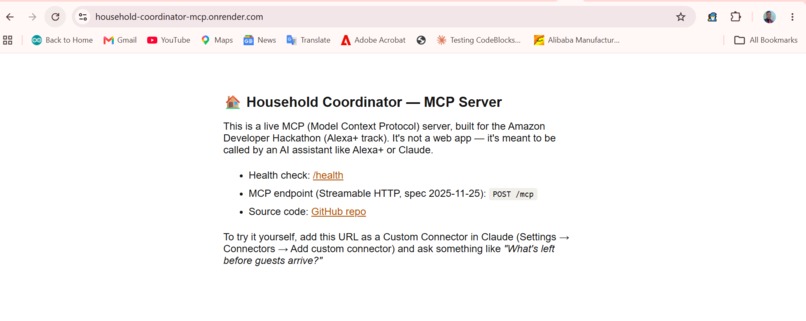
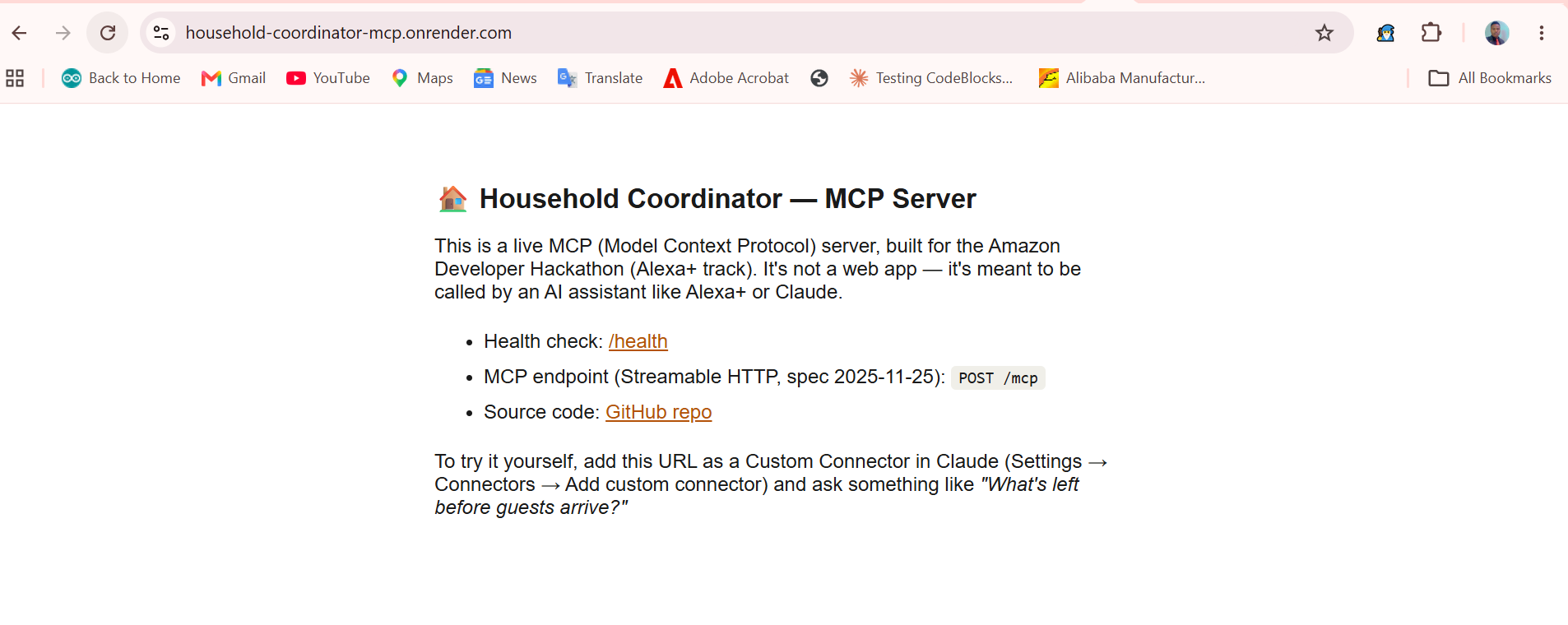
A screenshot of your server's landing page
-
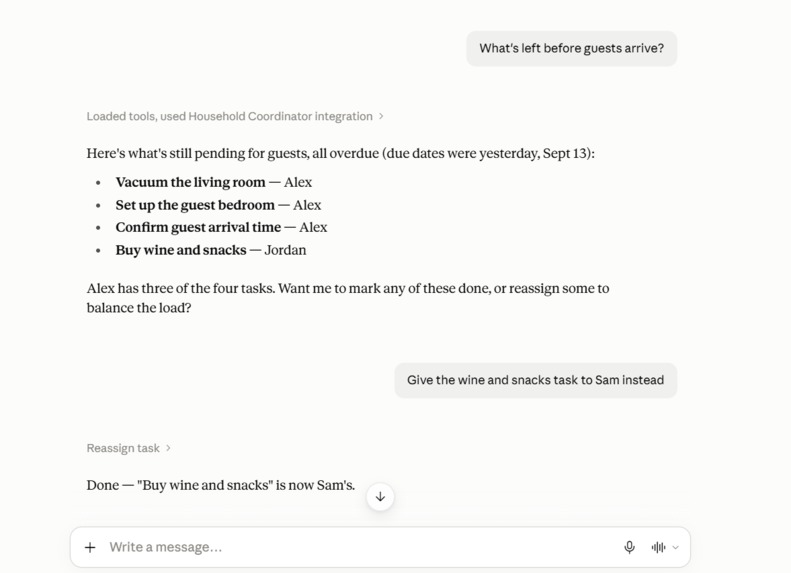
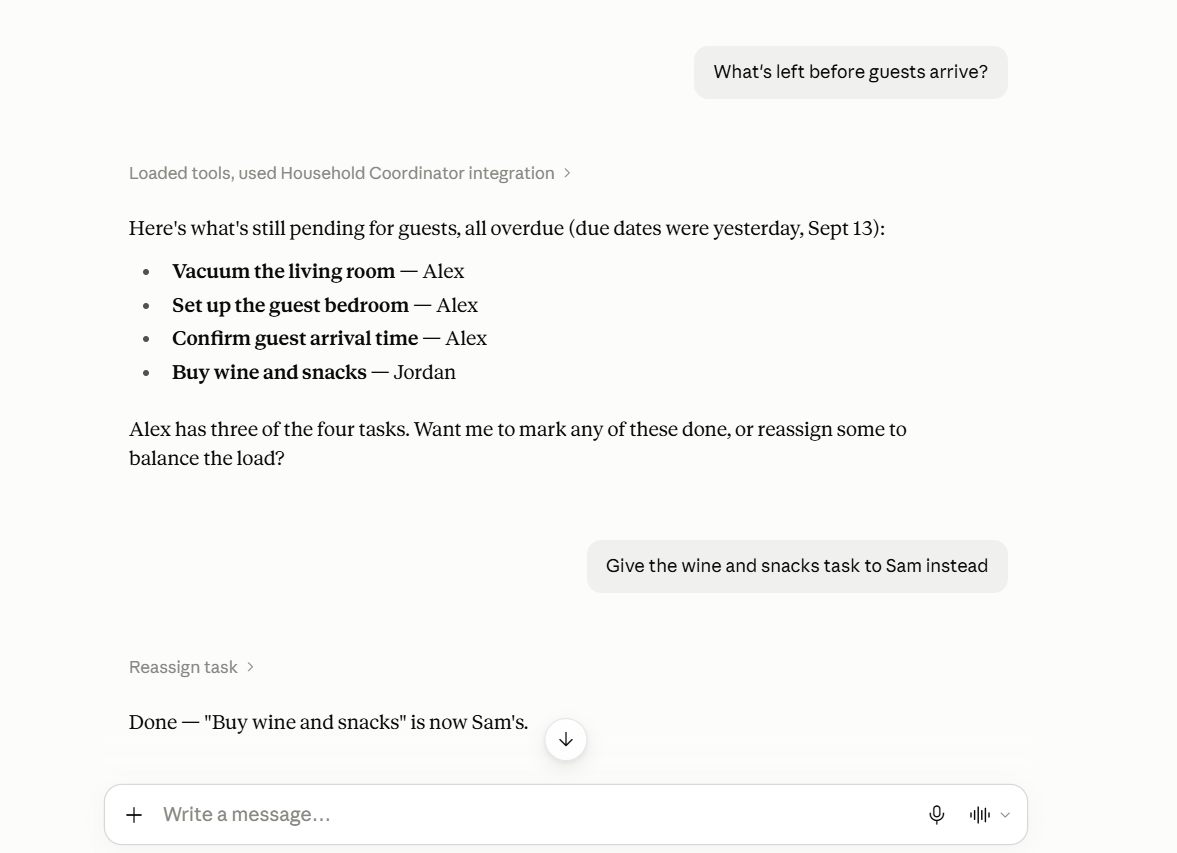
A screenshot of one of your working Claude chat conversations
-
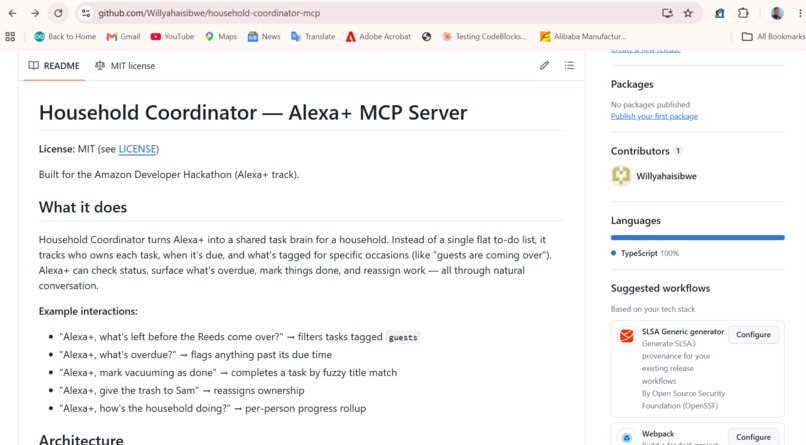
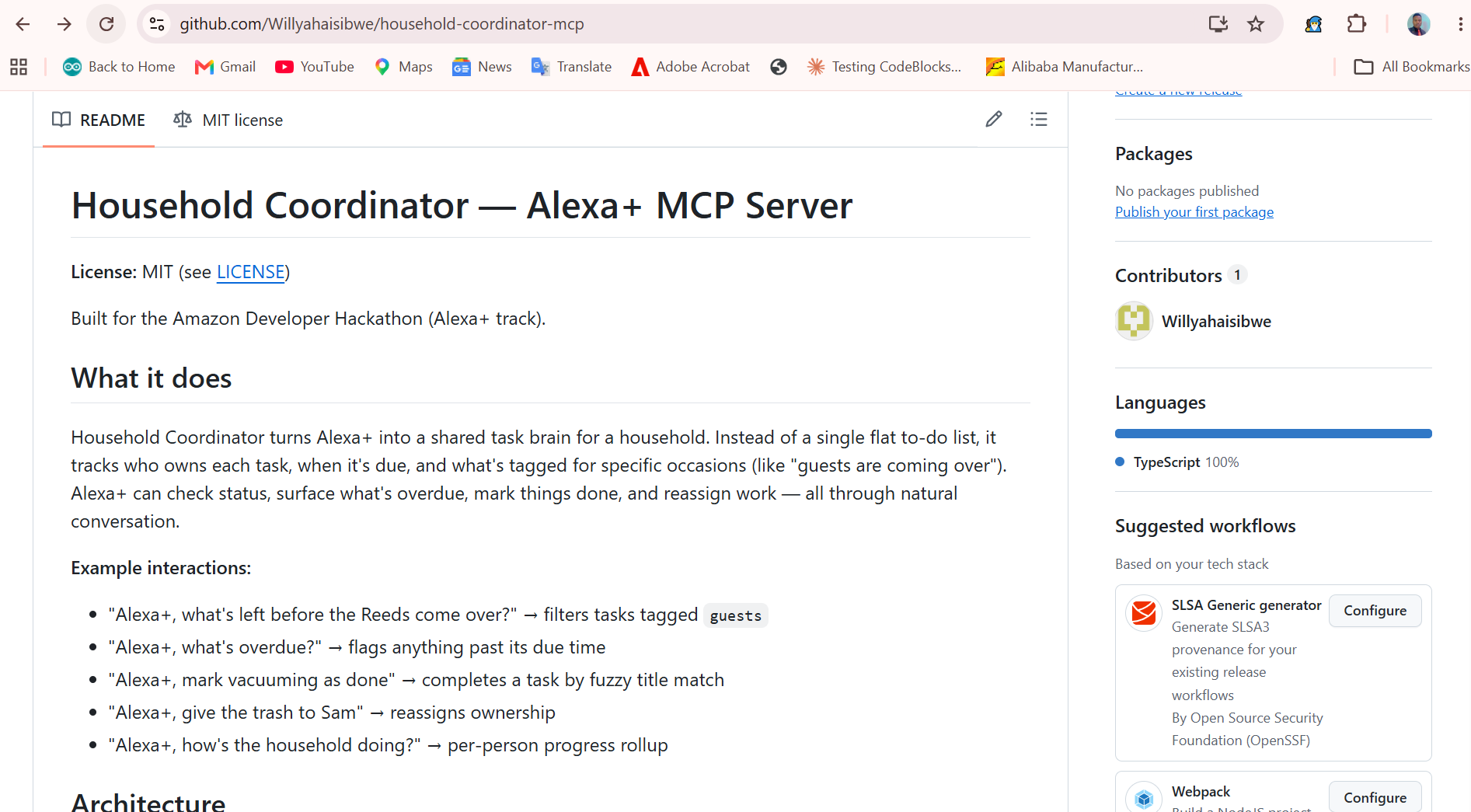
A screenshot of your GitHub repo page showing the MIT license and file structure
Inspiration
Coordinating a household before guests arrive — or just day to day — means juggling who's doing what, usually across a chore chart nobody checks or a group chat that gets buried. With Alexa+ adopting MCP, I saw a chance to make that coordination happen through natural conversation instead of another app: ask what's left, mark something done, hand off a task, all by just talking.
What it does
Household Coordinator turns Alexa+ into a shared task brain for a household. It tracks who owns each task, when it's due, and what's tagged for specific occasions (like "guests are coming over"). Through natural conversation, it can:
- Surface what's left before an event ("What's left before guests arrive?")
- Flag what's overdue
- Mark tasks complete by fuzzy title match ("Mark vacuuming as done")
- Reassign ownership ("Give the wine and snacks task to Sam")
- Roll up household-wide progress, per person
How I built it
The core is a self-hosted MCP server built with Node.js and TypeScript, using the official MCP SDK's Streamable HTTP transport on spec 2025-11-25 — the version Alexa+ requires. It exposes six tools backed by a lightweight JSON data store (deliberately avoiding native dependencies, since those caused real friction during development — more below). The server is deployed publicly on Render and connects as a custom MCP connector, letting a real conversational client call it and ground its answers in live data.
Challenges I ran into
- Native dependencies on Windows. My first data layer used
better-sqlite3, which needs to compile native code — that failed on Windows without Visual Studio Build Tools installed. I replaced it with a plain JSON-file store, which turned out to be a better choice anyway: zero native dependencies means anyone can clone and run this without extra setup. - Testing a custom MCP server through an AI API. I first tried wiring my server into an API call's
mcp_serversparameter directly, expecting it to just work. It silently failed — turns out arbitrary custom MCP URLs aren't allowed that way; they need to be registered as a proper Custom Connector first. Once I switched to that path, it worked immediately, chaining multiple real tool calls across a natural conversation. - Real Alexa+ device access. The actual Alexa+ add-on system isn't publicly open yet — it's currently limited to a small set of partner brands. I verified my server against the real Alexa+ MCP spec (2025-11-25, Streamable HTTP) and demoed it through a connected AI client capable of calling custom MCP tools, which exercises the exact same integration surface Alexa+ itself would use.
Accomplishments that I'm proud of
- A fully working, end-to-end MCP server verified against the live deployment — not just a local prototype, but something anyone (including judges) can independently test right now, with instructions built directly into the server's landing page.
- Turning a setup failure (the Windows native-dependency issue) into a better architectural decision rather than just working around it.
- Getting all six tools chaining together correctly in a single natural conversation — listing tasks, reassigning one, marking another done, then summarizing household-wide progress — with each step reflecting the real effects of the step before it.
What I learned
Building for a protocol as new as Alexa+'s MCP integration means a lot of the friction isn't in your own code — it's in figuring out which parts of the ecosystem are actually open yet, and which paths only look open. Documenting that friction honestly turned out to be as valuable as the working code itself.
What's next for Household Coordinator
- Multi-household support with proper authentication, rather than the single shared household this demo uses.
- Richer scheduling — recurring tasks, smarter due-date suggestions based on task history.
- Once Alexa+'s add-on tooling opens beyond partner brands, migrating from the current connector-based integration to a native Alexa+ add-on.
Built With
- alexa+
- express.js
- json
- mcp
- node.js
- render
- typescript


Log in or sign up for Devpost to join the conversation.