-
-
homepage
-
Thumbnail
-
VisualSummary
Inspiration
What it does
Inspiration
Every home runs on rules that live in one person's head: which child is allergic to peanuts, where the main water valve is, how much oil the cook should use, what to pay the water-tanker driver. When that person is at work or travelling, the cook, the babysitter, visiting grandparents and the plumber all call, or they guess. Guessing is how a peanut ends up in the wrong lunchbox.
In Indian homes this is harder still, because the people who help run the house often speak a different language from the people who own it. We wanted Alexa+ to hold that knowledge, share it in each person's own language, and know who is allowed to hear what.
What it does
House Brain is a self-hosted MCP server that gives Alexa+ a memory of the home, with rules about who gets to know what.
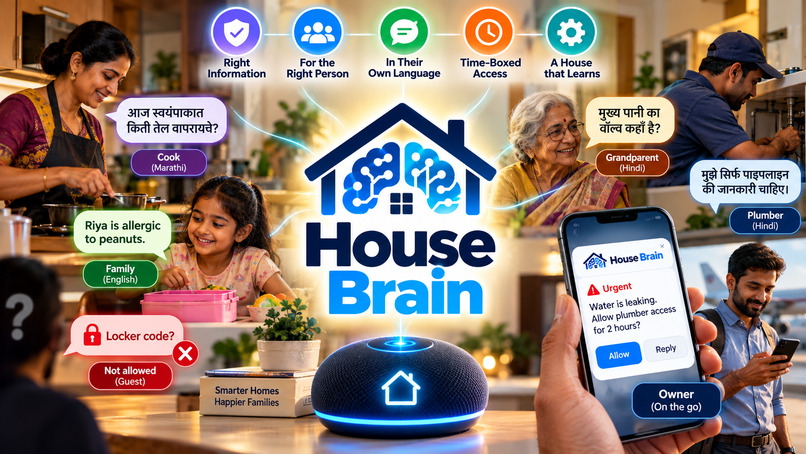
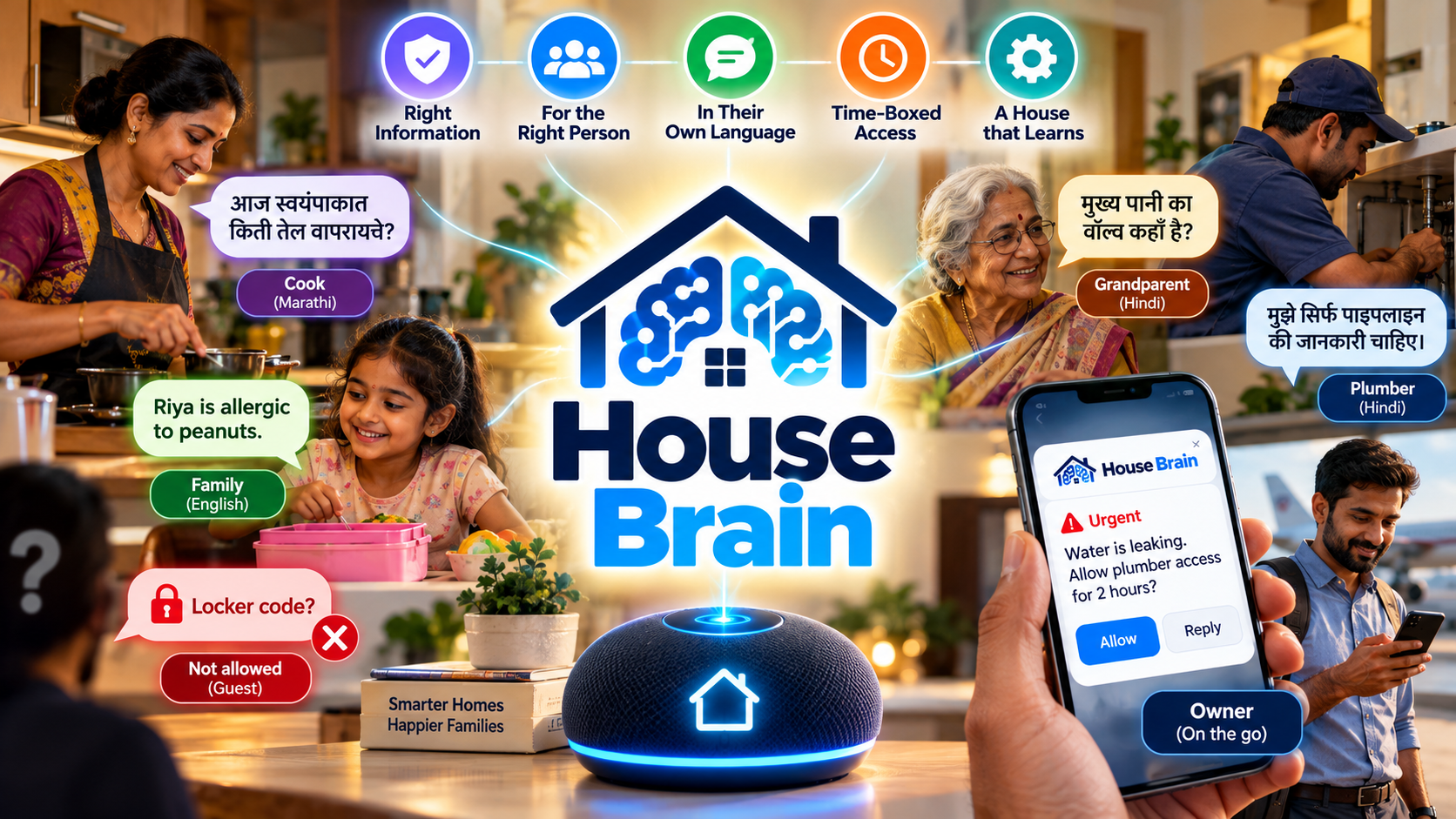
- Teach by voice. The owner says "Remember, Riya is allergic to peanuts." The fact is saved with a topic and a sensitivity level: guest, household or private.
- Role-scoped answers. Cook, babysitter, family, house-sitter, guest, plumber and electrician each see a different slice. The check runs on the server inside the
ask_housetool, so private facts like the locker code are never sent to the model at all. - Language bridge. The owner teaches in English. Sunita, the cook, asks in Marathi and hears the answer in Marathi; Nani asks in Hindi.
- A house that learns. When the house doesn't know an answer, it escalates to the owner's phone, marked urgent if a child is unwell or something is leaking. The owner's reply is saved as a new rule, so the next person gets it instantly.
- Time-boxed access. "Give the plumber Raju access for 2 hours" grants plumbing-only answers that expire on their own.
- Cards. A welcome card for each new helper in their language, and a "Today at home" summary for the owner.
How we built it
- MCP server: TypeScript with the official MCP SDK, implementing spec 2025-11-25 over Streamable HTTP with stateful sessions. It has 11 tools, server instructions and structured tool output.
- State: SQLite, using Node's built-in
node:sqlite, for facts, members, access windows, escalations and an activity log. - Brain: Claude on Amazon Bedrock through the Converse API with tool use. The simulator lists the MCP tools, passes them to Claude as Converse tools, runs the tool calls Claude asks for against the MCP server, and loops until Claude gives a short spoken reply in the speaker's language. An offline rule-based brain keeps the demo working without AWS credentials.
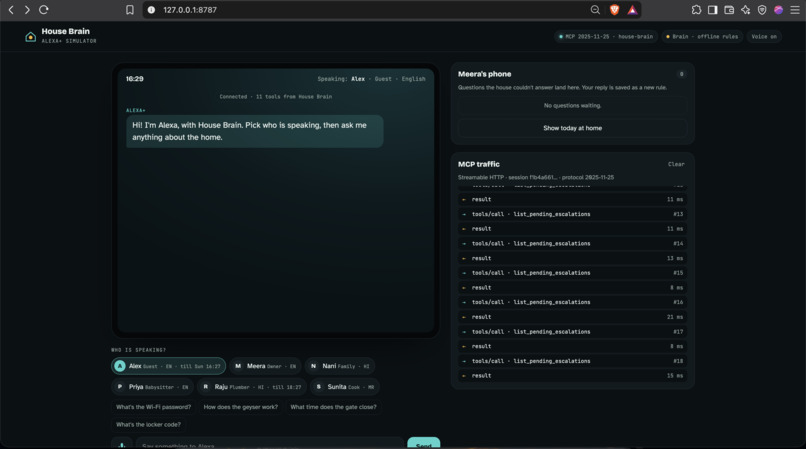
- Alexa+ simulator: Alexa+ add-on tooling is limited to select partners, so, as the hackathon FAQ recommends, we built a web simulator that is a real MCP client (
initialize,tools/listandtools/callover Streamable HTTP). It has voice in and out, a speaker switcher, the owner's phone, and a live panel showing every MCP message. - Identity: the speaker (
as_member) is injected by the client and removed from the schema the model sees, so the model can't pretend to be the owner. - Tests: end-to-end tests with the official MCP client cover the Marathi answer, the refusal (checking that the locker code never appears in the response), an escalation becoming a rule, and access expiry.
Challenges we ran into
- No real Alexa+ device or toolkit access. We designed around what Alexa+ would plausibly pass to a server (who is speaking, their language) and wrote those assumptions down.
- Matching questions across English, Hindi and Marathi without a vector database. Normal tokenizers split Devanagari words at the vowel signs. We kept combining marks together, used prefix matching for word endings, and stored keywords in several languages for each fact.
- Deciding where the permission check belongs. Telling the model "don't share the locker code" isn't safe. The check has to live inside the tool, so the model never receives what it shouldn't say.
Accomplishments that we're proud of
- A cook can ask in Marathi and get a correct Marathi answer, and can't get the locker code however she phrases the question.
- The house gets smarter on its own: one reply from the owner answers that question for every future helper.
- Everything runs locally with one command, and the full demo story is covered by automated tests.
What we learned
- MCP tools are the right place to enforce policy: the model gets less data, not more instructions.
- Voice-first design means short answers, the listener's own language, and asking the owner instead of guessing.
What's next for House Brain
- Serve the cards as MCP Apps so any MCP Apps host, including Alexa+ screen devices, can render them.
- Gentle reminders to keep facts current ("You said the milkman charges ₹1,200. Still right?").
- Connect to a real Alexa+ account as soon as add-on tooling opens to independent developers. ## How we built it
Challenges we ran into
Accomplishments that we're proud of
What we learned
What's next for House Brain
Built With
- amazon-bedrock
- amazon-web-services
- claude
- css3
- express.js
- html5
- javascript
- model-context-protocol
- node.js
- sqlite
- typescript
- web-speech-api

Log in or sign up for Devpost to join the conversation.