-
-
Hourtime logo
-
Hourtime ADV
The problem
COVID-19 crisis has changed everything. In a matter of a few weeks, our habits, our work, our social interactions – our lives – have been completely knocked over. Also the mark of time has taken a different shape. That’s why we decided to focus on TIME. There are currently around 40 million people aged over 65 living alone across Europe. Additionally, it is estimated that around 25% of the oldest population feel lonely.
Since the beginning of the COVID-19 crisis, only in Italy, more than 21.000 people (average age 74yy) – often with limited access to technology – called the Italian Red Cross just to exchange a few words with other human beings and receive emotional support. This makes clear that for those forced to physical and social loneliness because considered particularly at risk, even just simple actions like hearing a voice over the phone can be extremely important. At the same time, we see many young people with access to technology that are driven by the desire to help their communities, making a good use of the time that the lockdown gave them back, but they don’t know how. Not only individuals want to give their contribution, but an increasing number of companies wants to have a role in supporting those communities hit by the crisis, demonstrating their social responsibility during this difficult time.
Currently, these 3 realities are disconnected. Hourtime was born to bring them together.
Hourtime does not simply support help, but promotes TIME TOGETHER.
The solution
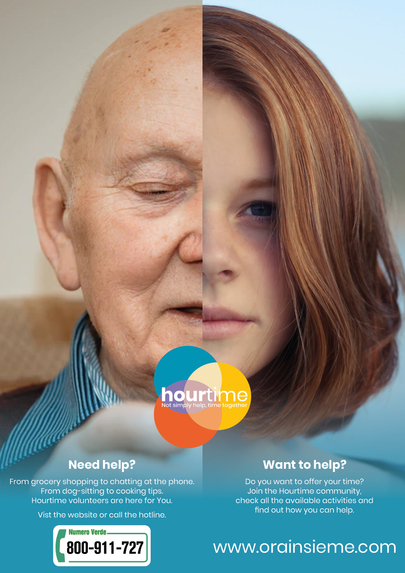
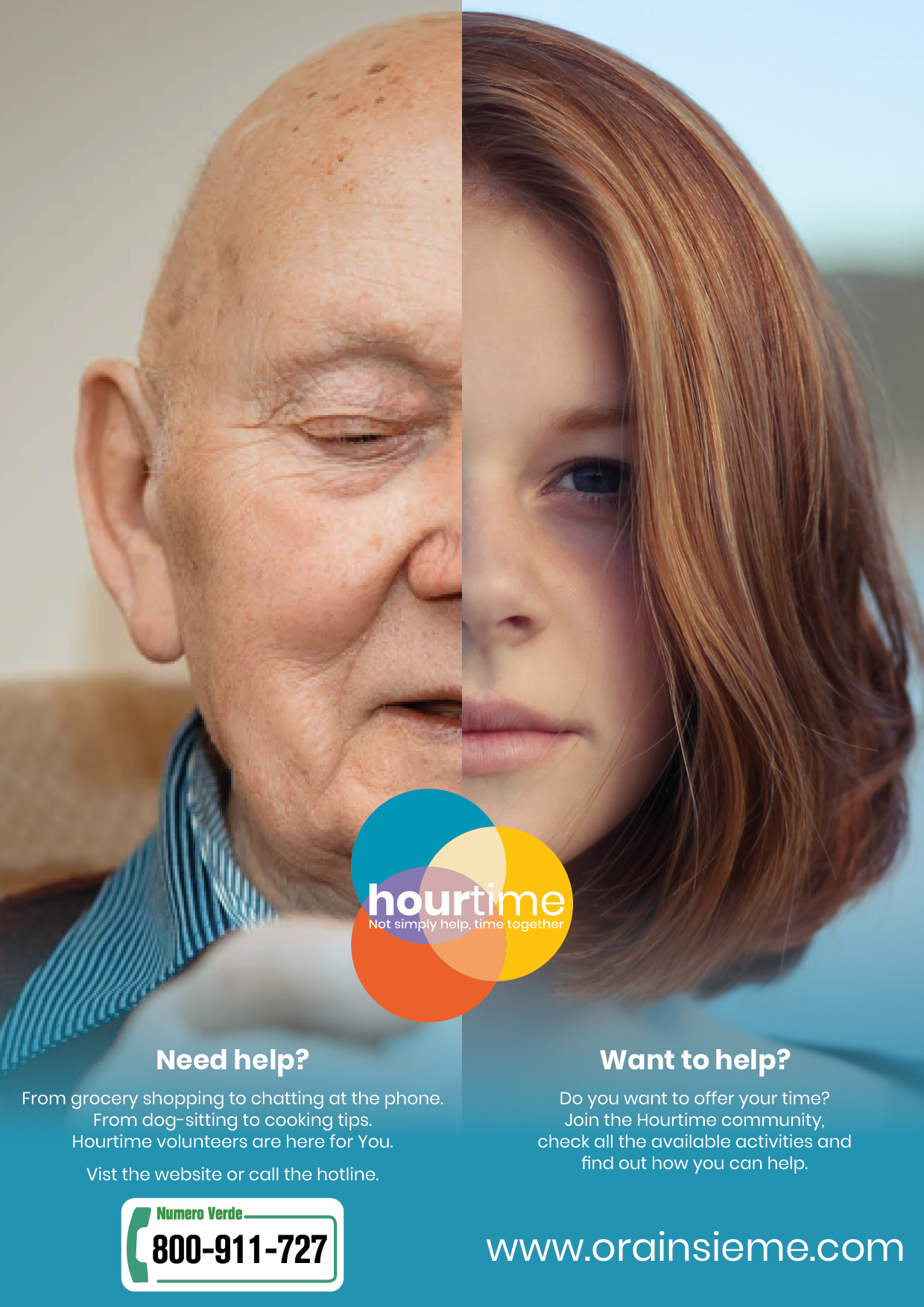
Hourtime is a free online platform accessible by phone or internet which allows those in need to connect to a volunteer base. This creates an intergenerational dialogue where young people can provide emotional support and their skills (e.g. technology) and the elderly can share their wisdom – like how to make an awesome lasagna - by spending their time together. In such a way, all the users, elderly included, are active parts of the system, emphasizing on the contribution that each individual can give to another. The activities offered in the platform can either involve errands, such as dog-walk out, flower shopping, grocery shopping, etc., or experiences at the phone, such as books discussion, news updates, cooking tips, etc. In the first phase, we will focus only on the second type of activities (the “experiences”), which do not require physical proximity, as we won’t need a large user base to make the system work. Later, when we will have a solid user base of volunteers with a spread geographical distribution, we will extend the service also to errands-like activities.
The system encourages users to continue sharing their time by leveraging on gamification mechanisms, which allow users to gain rewards, such as coupons or discounts, promoted by third parties. Third parties can sponsor the platform by purchasing different offers (i.g. standard, premium, gold), with the purpose of (i.) motivating volunteers to continue spending their time on it; (ii.) promoting company’s support to social cohesion activities and having access to personalized marketing assets (e.g. Personalized video, gadgets, etc.); (iii.) supporting the revenue stream of Hourtime. The incentive mechanism promoted by third parties will not only be valuable for volunteers that have recently lost their jobs by having a way to invest their time and cheer up, but will also ensure the sustainability of the system over time.
Hourtime leverages also on strategic partnerships, such as with no-profit organizations and local institutions, in order to reach a higher number of volunteers and persons in need, boost visibility, and reciprocally support on activities completion.
The idea was born a month ago during the Hack For Italy event during which we came together as a team and brainstorm ways to help populations at risk that not only struggle with social isolation during the COVID-19 crisis, but also before and will after. We placed 1st at the Hack For Italy and 4th at the Global Hack.
What we have done during the weekend
The EU hackathon was an unparalleled opportunity for validating the cross-boundary application of the project and to validate the importance of intergenerational exchange. To do so, we leveraged on the EUvsVirus Hack community to conduct a user validation survey. We collected data from 150 participants between 18-55 yy from 20 European countries. We found out that more than 90% of respondents would be willing to volunteer right now and 70% would be available to give their time in activities such as talking on the phone with the elderly. This further testifies how strong is the sense of solidarity across Europe.
We focused on the design of the third parties engagement scheme and business plan which will allow platform sustainability even when the crisis will be over. The same were additionally validated with the help of 10 different mentors working in large enterprises (e.g. Global Marketing & Strategy and CEO) that gave us their positive feedback.
The platform has been live for a week, yet we had several improvements to work on. During the hack, we (I.) developed a dedicated backend that serves as the main control panel to manage tasks performed and created; (II.) created and polished the overall user interface; (III.) created a multilanguage version of the platform (Italian and English).
Ultimately, in the last 3 days, even without any investment in marketing activities, already 50 volunteers and 70 elderly in need have subscribed to be part of the first test run of the platform. Additionally, we already closed 4 partnership agreements.
The solution's impact to the crisis
Hourtime focuses on sharing the time and skills of all stakeholders to meet various tasks and establishes the foundations for an intergenerational relationship beyond the simple need.
Impact on Users. Fear and anxiety about a disease can be overwhelming and increase the risk of developing mental health disorders or worsen pre-existing ones. Research studies in the Chinese population during the COVID-19 emergency (N = 53000) found out that 35% of the respondents (age range: 28-51) experienced psychological distress. On one side, volunteering could be a way to occupy time for those subjects that lost their job or cannot travel to visit their friends and family, creating a new routine and protecting them from the outbreak of anxiety and depression symptoms. Furthermore, the financial incentives sponsored by the third parties can also help to support themselves. On the other side, through Hourtime, the basic needs of the elderly (e.g. delivery of food or other goods) can be fulfilled, but also their emotional distress due to loneliness can be improved thanks to the remote presence of a volunteer. There are in fact several evidences that social isolation in elderly population is associated to negative physical and mental health outcomes including heart disease, depression, suicide and dementia. Furthermore, families, when present but far away, could diminish their sense of guilt caused by the impossibility to help their old ones. Finally, Hourtime will also be of help for associations of social services, as the Italian Red Cross, in lightening their workload, particularly for tasks that do not need specialized skills, if not time to offer.
Impact on Enterprises. More than 200 companies joined the COVID-19 action plan of the Word Economic Forum and 7 of the main tech companies donate more than 1.5bn $ for supporting the communities during COVID-19 emergency, numbers confirming how social responsibility is relevant and how many firms want to play an active role in this crisis, increasing their brand reputation. Hourtime will allow them to satisfy this need in a simple, yet practical, way.
The necessities in order to continue the project
First of all it would be necessary to collect an amount of €50,000 for the complete development of all the application’s features. On top we’ll need €30,000 to cover the other costs (es. marketing expenses and administrative costs). As for skills, we currently need a legal figure who is able to deal with data management disputes. It would also be very important for us to find sponsors that want to support the initiative by inserting discounts / offers / services. Their benefits will be: • Directly impact the local community. • Increase brand reputation for their customers. • Commitment to Social Responsibility. We are also always active in the search for strategic partnerships that can broaden our reach, improve our service and thus make it more impactful. We are also open to speak with business angels that are willing to invest in our solution. We will work together to sustainably tackle an issue that is important to you, your customers and your partners such as ending loneliness amongst older people, encouraging inter-generational friendship, or strengthening local communities.
The value of our solution after the crisis
These days we hear a lot of the sentence “never let a good crisis go to waste”. When it comes to populations at risk, this sentence becomes particularly appropriate. In fact, this crisis didn’t necessarily change the routine of those persons that are constantly living in isolation, far away from their families or simply without a family. However, it has fostered many EU citizens to see existing problems, often hidden under the surface, and think about solutions that can improve everybody’s lives. Our idea is born from the desire of a more inclusive society, that values the positive resources that both the younger and older generations have to offer each other and those around them. We believe that Hourtime can foster learning by matching different generations and help to develop social cohesion and solidarity in our aging societies also after this crisis. We also believe that supporting third parties to increase their brand reputation and being part of a positive story will allow us to create a triple win for all parties that will be sustainable over time.


Log in or sign up for Devpost to join the conversation.