-
-

-
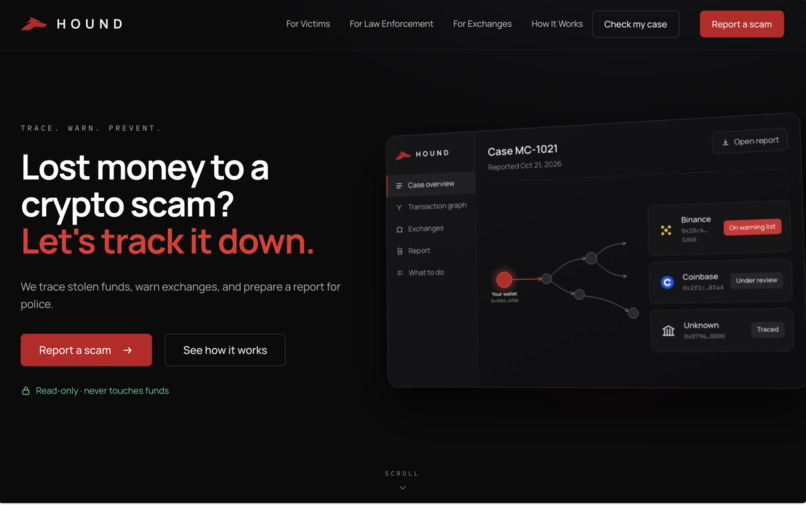
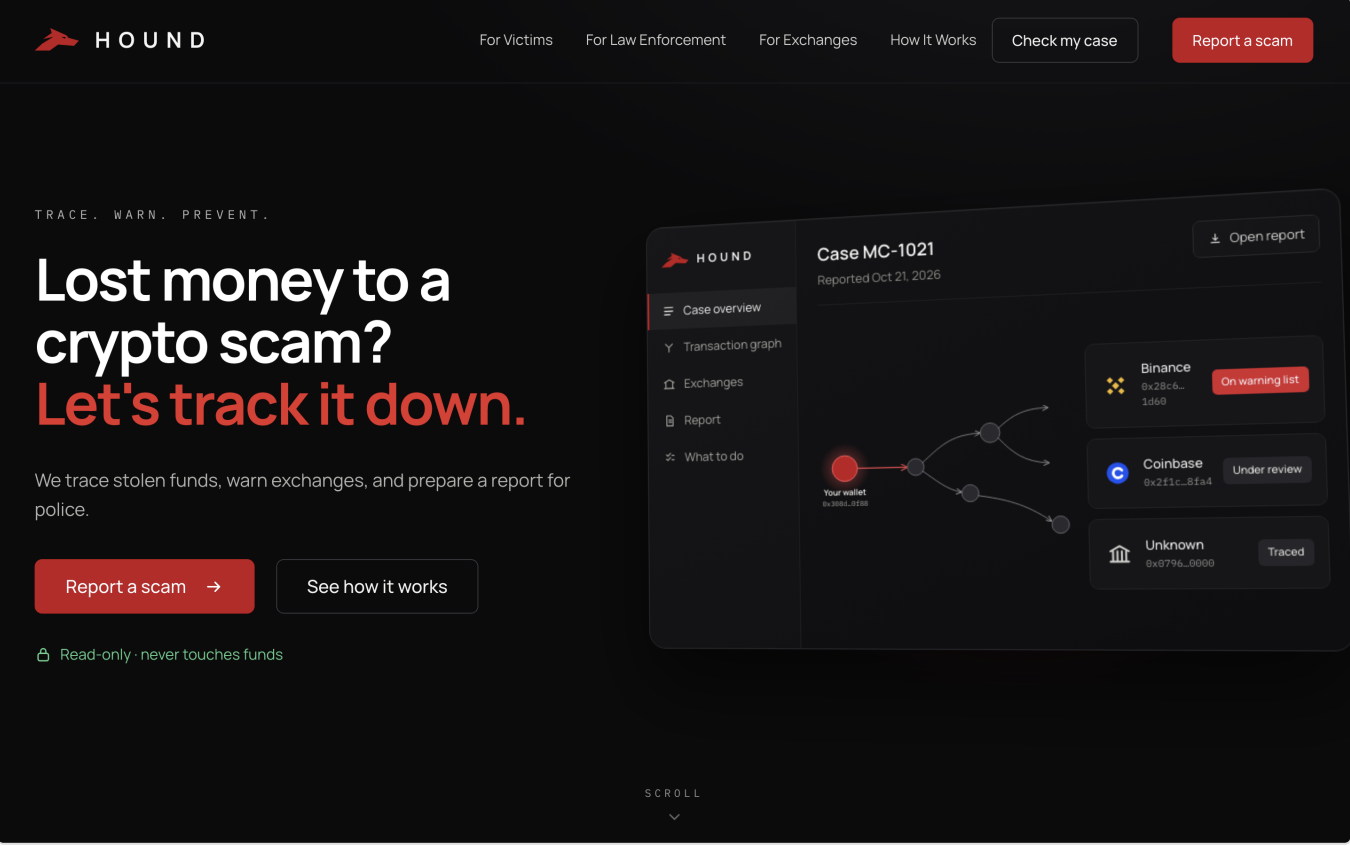
Home Page
-
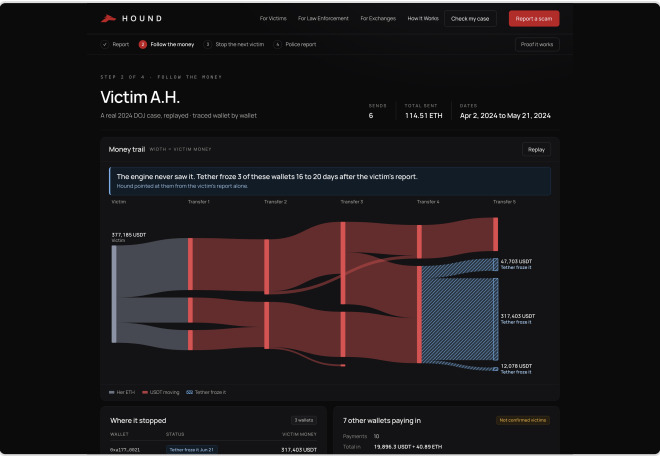
Example Graph

TL;DR: Hound is the 911 call for crypto scam victims. Call (501) 443-1471 or report online, send one screenshot, and Hound follows the stolen money wallet by wallet, warns exchanges, and writes the police report. Proof: run blind on a real DOJ case, it found 3 of 3 wallets the DOJ seized and 8 of 8 the FBI named, from one victim's report, 16 to 20 days before Tether froze them. Live: https://houndhelp.vercel.app
Inspiration: the problem, simply
Americans over 60 lost $4.4 billion to crypto scams last year (FBI IC3, 2025). The usual story: someone builds a fake friendship online, then talks the victim into a fake investment app, and the money vanishes into crypto.
The victim calls the police, who usually can't trace crypto. The tools that can trace it are sold to governments and exchanges, not to victims. Yet the money often still sits in a wallet that Tether can freeze when law enforcement asks. The gap isn't the technology; it's that nobody turns the victim's report into that request in time. In a sample of 192 wallets Tether froze in 2025, the money sat a median 45 days before the freeze, and by then about 44% had already left.
Hound closes that gap: it takes the victim's call, finds the money, tells them who can freeze it, and warns exchanges so the next victim's payment is stopped.
What it does
- Report. A victim calls our phone line (a voice agent built on Cartesia) or reports online. They tell their story in their own words and send one screenshot of their payment. Nobody has to read a long transaction code out loud.
- Follow the money. Hound reads the screenshot, finds the payment on the blockchain, and follows the money wallet by wallet to where it ended up: an exchange, a wallet that can still be frozen, or a wallet Tether already froze.
- Stop the next victim. Every wallet in the trail goes on a warning list. When someone tries to send money from an exchange to one of those wallets, the exchange can check Hound first and hold the payment, with the evidence attached.
- Police report. Hound writes a one-page report for the detective and a plain-language copy for the victim: every transfer, where the money is now, and who to contact (Tether, the exchange, the FBI's IC3).
The victim gets a case code. With it they can come back any time to see what we found, what to do next, and their report. Every payment and wallet links to Etherscan, so they can check it themselves.
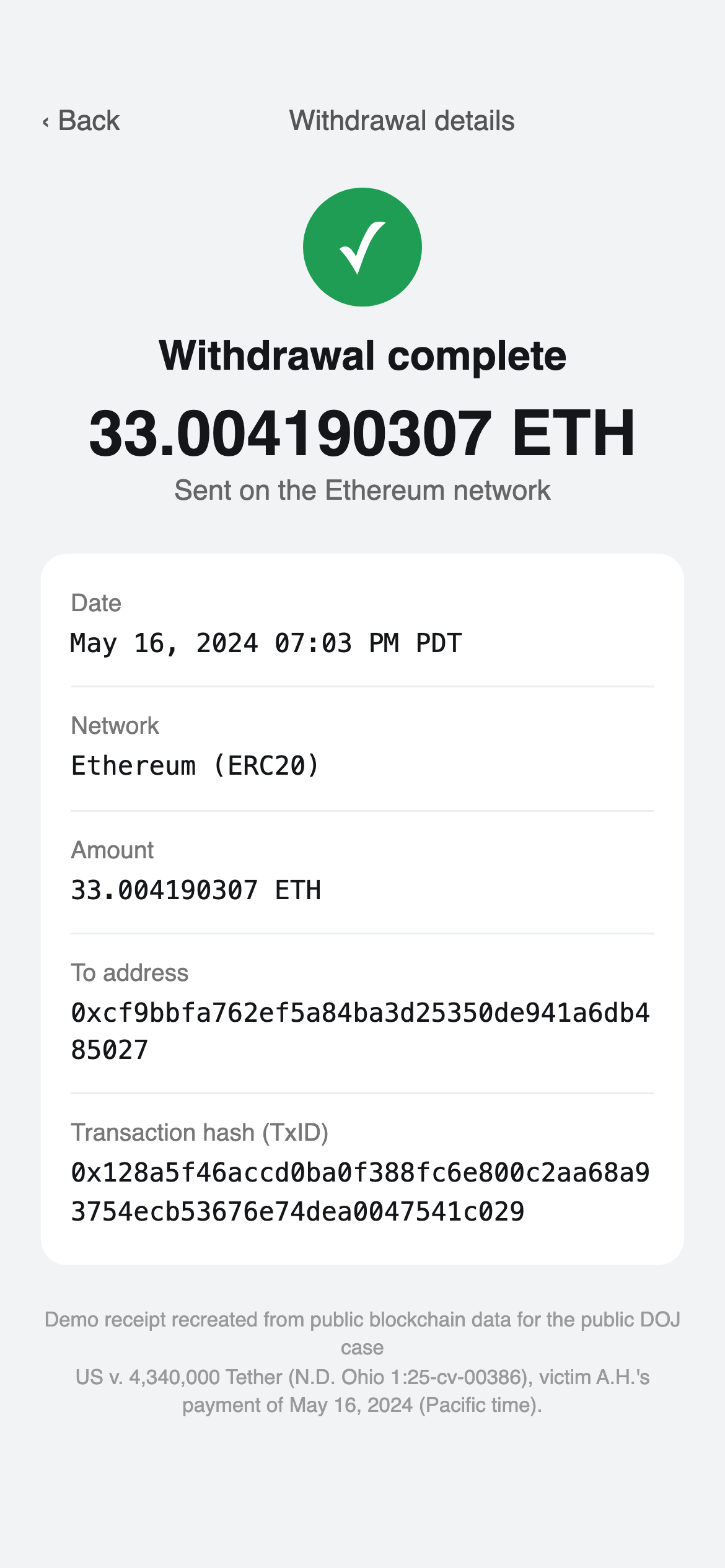
Try it: call (501) 443-1471, or save https://houndhelp.vercel.app/demo/receipt.png (a real payment from the DOJ case) and upload it under Report online.
Results at a glance
| What we measured | Result |
|---|---|
| Wallets the DOJ seized, found blind from one victim's report | 3 of 3 |
| Wallets the FBI named in between, found blind | 8 of 8 |
| Match to the DOJ's amounts for her money (seized wallets) | +0.9%, +1.0%, +10.8% |
| Victim money accounted for | 100%, to the smallest unit |
| Time Tether took to freeze them after her report | 16 to 20 days (Hound points at them on day 0) |
| Reported scam wallets checked this weekend (reported, not proven) | 963, of which 14 still hold 91,218 unfrozen USDT |
| Real transactions we had never seen, traced end to end | 4 of 4 finished (no hangs, no crashes) |
| Automated tests | 570+ passing |
Proof it works: a real DOJ case, run blind
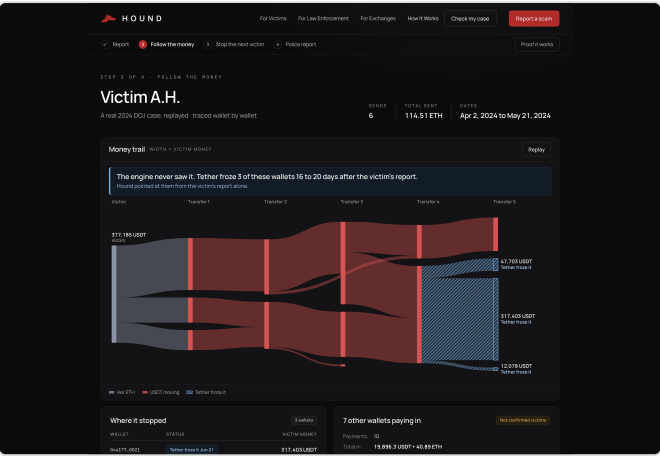
We tested Hound on a real federal case: United States v. 4,340,000 Tether (Northern District of Ohio, 2025). We gave Hound only one victim's six payments and nothing else: no DOJ labels, and Tether's freezes were hidden until after the run.
- Hound reached all 8 wallets the FBI named in between, and all 3 wallets the DOJ seized.
- Its amounts match the DOJ's own numbers within about 1% on two of the seized wallets and 11% on the third.
- Tether froze those wallets 16 to 20 days after the victim reported. Hound points at them from her report alone.
The seat it fills
An exchange's fraud investigator: it takes a victim report, traces the funds, flags the wallets, and hands law enforcement a cited packet. It has limited access (read-only, never touches funds), keeps a clean record (every step in an audit log), and knows when to ask (a human must approve a report before anything is held).
The moment
Hound points at the three wallets the DOJ later seized, from the victim's report alone, while Tether took 16 to 20 days to freeze them.
How it works (technical)
 victim ──call──▶ Cartesia voice agent ──tool: open_case──┐
        ──web───▶ /report form ───────────────────────────┤
                                                          ▼
 screenshot ─▶ Claude vision (extract tx hash / amount / time) ─▶ on-chain validation (receipt or transfer search)
                                                          ▼
                          FIFO taint engine (budget · deadline · audit log)
                                 │                │                 │
                        endpoints + freezes   watchlist        Claude writer
                                 ▼                ▼                 ▼
                         victim case page   exchange /check   police report (cited)
1. Turning a screenshot into a verified payment. Claude's vision model extracts the transaction hash, or failing that the recipient, amount, token and time. Hound never trusts the extraction: it validates against the chain. A hash is checked against its on-chain receipt; a typed amount is matched against the recipient's real transfers in a time window, and the match must be unique. Fake or mistyped payments are rejected with a plain-language retake message, and "the RPC is down" is reported as a retry, never as "your hash is wrong".
2. Following the money: FIFO taint accounting. Each victim payment becomes a seed lot. Every wallet keeps a first-in-first-out queue of lots; each outgoing transfer consumes the oldest lots first, so stolen money is split from clean money exactly the way the DOJ attributes funds for its named victims. Everything is computed in integer base units (USDT's 6 decimals, ETH's 18), ordered by block number and log index, so rounding can never create or lose a cent; a conservation test checks this to the micro-unit.
- Swaps. The DOJ victim paid in ETH, which the scammers swapped to USDT. Hound joins each ETH outflow to the USDT inflow in the same transaction, converts the victim's share at the realised rate, and leaves the rounding remainder untainted.
- Laundering loops. Funds that cycle back through already-visited wallets are re-queued, not double-counted.
- Stopping rules. A branch stops at an exchange, at a wallet Tether froze, at dust, at an exchange-sized address (over 5,000 transfers), or at a cap (max 8 hops, 12 branches per wallet, 400 API calls, 120 s deadline). Every stop is a named reason in the audit log, and an unfinished branch makes the result "partial" rather than silently dropping it.
- No AI in the decisions. Classification is rule-based (labels from public exchange datasets, OFAC, an infrastructure allowlist); Claude only rewords explanations.
3. Proving it blind. We rebuilt US v. 4,340,000 Tether from the court complaint, which prints wallets truncated (0xa17…44f0021). We recovered every full address from public chain data, ruling out deliberate look-alike addresses by amount and date. The engine gets only the victim's six payments. The other DOJ addresses are a holdout: the test suite fails if any of them appears in engine code, the case file or the label database, and Tether's freeze events are hidden until after the run. A data cutoff block replays the case exactly as it stood before the freezes.
4. Warning exchanges, without false accusations. Every wallet in a traced cluster goes on a watchlist served by a /check API that returns hold, warn or allow with evidence. A hold needs a verified case: a phone or web report only counts after a person approves it, and exchanges, routers and bridges are never listed. Live victims' addresses are shortened for anyone but the victim, whose case code unlocks their own data.
5. Where Claude could go wrong, and how we contain it. Claude writes the victim and detective summaries using placeholders, never raw numbers; code fills in the numbers from the trace. A validator rejects any uncited number, promise of recovery, invented identity or accusation next to an address, retries once within a single deadline, and falls back to a deterministic template if Claude fails.
6. The voice line. A Cartesia agent (Claude Haiku) collects the story, infers dates from the current time instead of asking twice, calls an open_case tool on our backend (token-authenticated), reads the case code slowly, walks the caller through the upload, and calls check_upload to confirm the payment before hanging up.
Stack: Python, FastAPI, Next.js 16 on Vercel; Ethereum and Tron data from Etherscan, Blockscout and public RPC nodes with a disk cache and an offline snapshot; Claude (vision + writer); Cartesia (voice). 570+ automated tests plus a 91-check end-to-end run.
Cartesia features used
Managed voice agent on a real phone line · custom tools: open_case (opens the case on our backend, token-authenticated) and check_upload (confirms the screenshot arrived) · system tools: skip_turn (waits when the caller is mid-sentence) and end_call · dynamic variables: caller ID and current time (so it never asks the date twice).
Known limitations
Tracing is most complete on Ethereum; Tron support is partial. The backend runs on our laptop for the demo. Reports from the phone line or the web need a person to approve them before they can trigger a hold. Free-tier blockchain APIs limit how fast large traces run. The DOJ case is a replay with its timing reproduced, not live.
What's real and what's simulated
Real: the DOJ case, every wallet and transaction, Tether's freezes, the phone line, the screenshot reading, the live blockchain checks. Replayed: the timing of the 2024 DOJ case (labelled "replay" on screen). Simulated: the exchange withdrawal screen, which shows how an exchange would use Hound's real check.
Challenges we ran into
- The DOJ blanks out most of each wallet address in court documents (like
0xa17…44f0021), and scammers create look-alike addresses on purpose. We recovered every real address by matching amounts and dates. - Our first version silently lost money when stolen funds looped back through the same wallets. A review caught it, and now we test that every dollar is accounted for.
- Free blockchain APIs sometimes report errors as success. We made sure we never save an error as "this wallet had no transactions".
- Making it usable for an older, scared person. A phone call instead of forms, one screenshot instead of a transaction code, and a voice agent that waits for the caller to finish talking.
Accomplishments we're proud of
- Finding all three wallets the DOJ seized, blind, from one victim's report.
- A complete path for a real victim: phone call, screenshot, tracking, warning and police report.
- Being honest about what we know: every result says "reported, not proven", and every dead end is shown.
What we learned
- The hard part is not tracing; it's getting a victim's report to someone who can freeze the money in time.
- Plain language matters more than features. Our first screens used words like "hops" and "endpoints"; victims need "where your money went" and "what to do now".
Path to production
Free for victims, always. The paying customers are exchanges and banks: under the UK's 2024 rules, banks now reimburse push-payment fraud victims, so stopping the payment before it leaves is cheaper than paying it back. Next: a pilot of the /check API at one exchange or fintech, sending reports straight to Tether and the FBI's IC3, and full Tron coverage, where much of the USDT scam money moves.
Built With
- anthropic-claude
- cartesia
- ethereum
- etherscan
- fastapi
- next.js
- python
- tron
- typescript
- usdt
- vercel



Log in or sign up for Devpost to join the conversation.