-
-
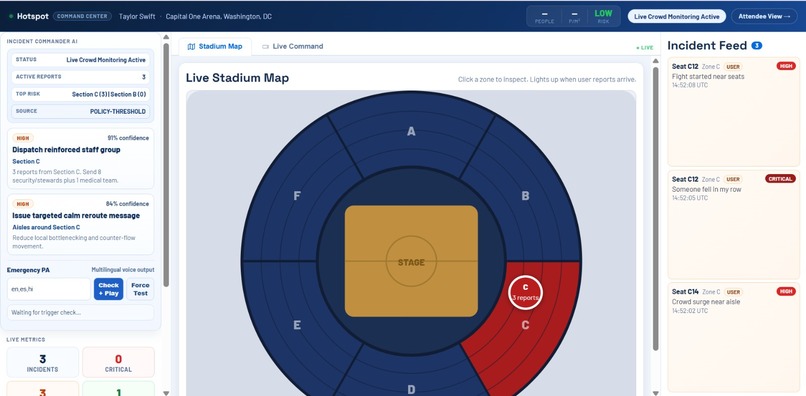
Security Staff View
-
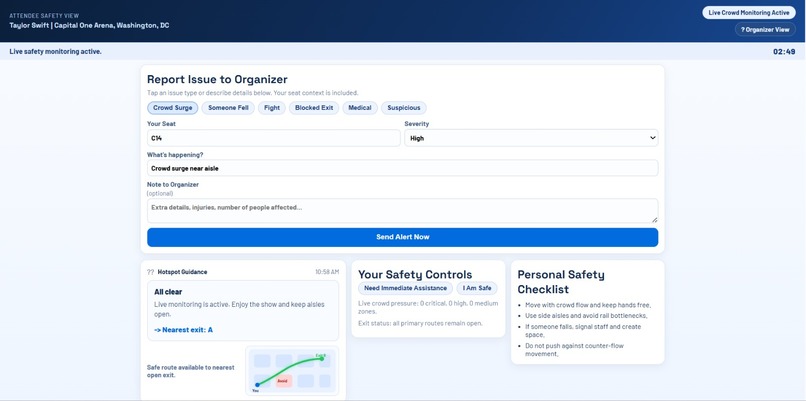
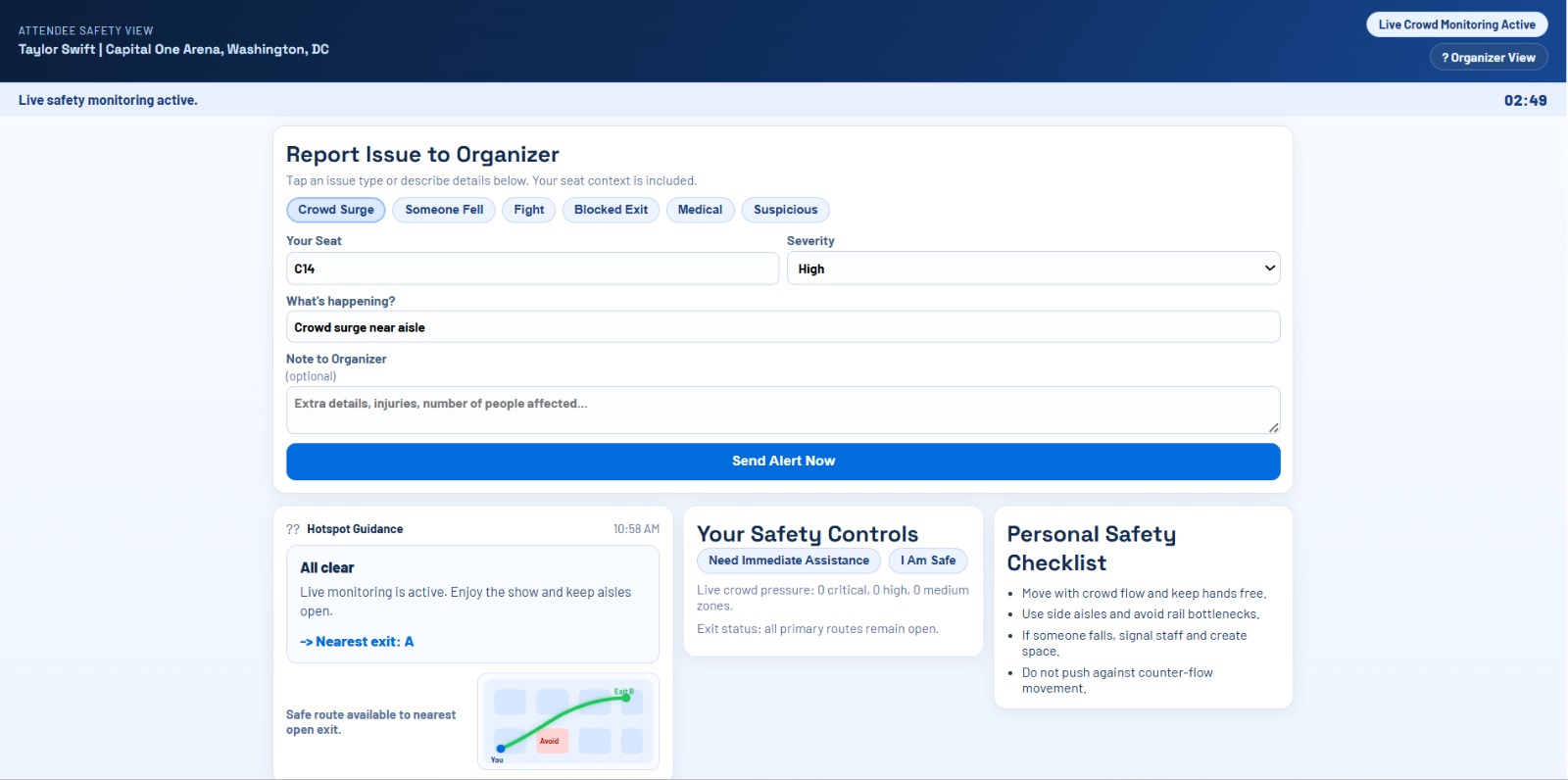
User View
-
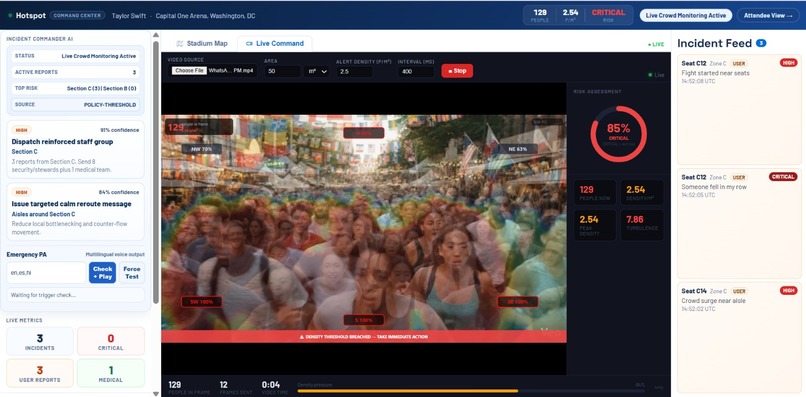
Example of a critical crowd situation
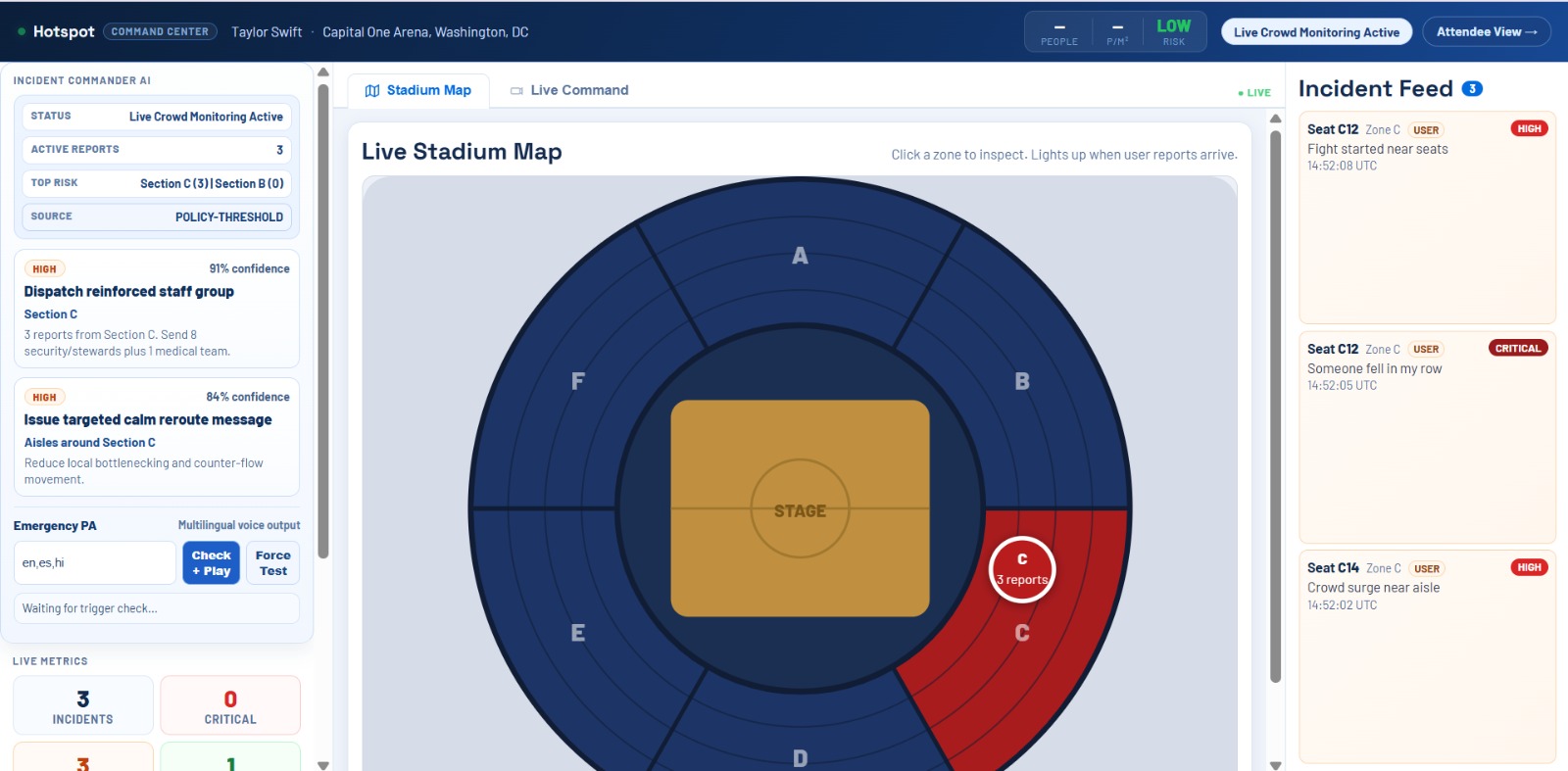

Inspiration
If you’ve ever been in a packed concert or a crowded stadium, you’ve probably felt that moment where things start to feel off. People are pushing a little more, movement becomes unpredictable, and it’s hard to tell if it’s just normal chaos or something more dangerous.
The problem is that by the time security notices something is wrong, the situation has often already escalated. Most systems today rely on people watching dozens of camera feeds and trying to catch issues manually, a method that does not scale in high-density environments.
Before a crowd turns dangerous, there’s a brief window where things start to shift. That’s the moment we’re trying to catch.
What HotSpot does
HotSpot is a crowd monitoring and safety tool designed for large events like concerts and games. The idea is simple: to give both staff and attendees better visibility and faster ways to respond.
For security and staff, we built a system that:
Shows a live video feed of the crowd
Overlays a real-time heatmap of crowd density and movement
Flags areas where movement looks unstable or “turbulent”
AI suggestions like redirecting flow or sending staff to a specific area
Includes an incident feed so nothing gets missed
Automatic emergency alerts, including multilingual voice announcements for faster response in diverse crowds
For attendees, we focused on simple but powerful actions:
The ability to report issues like fights, medical emergencies, or overcrowding
A one-tap “I need help” button to alert security
Quick access to safety tips
The goal here is to create a loop where the crowd and staff are both contributing to overall safety, instead of everything being top-down.
How we built it
We built a real-time computer vision pipeline using OpenCV to process live video streams and detect individuals in the crowd. Frames are streamed via WebSockets for low-latency, frame-by-frame analysis, allowing us to estimate crowd density by partitioning the scene and computing people-per-area metrics.
We also analyze movement across frames to capture crowd flow and identify unstable regions, which we use as a proxy for turbulence. These signals are combined into a dynamic heatmap that updates in real time, using a red-to-green spectrum to highlight high- and low-density areas.
On the backend, we use Lava agentic AI to generate response suggestions based on patterns like repeated attendee-reported incidents. We also integrate ElevenLabs text-to-speech to deliver multilingual emergency alerts.
On the frontend, we built two interfaces (staff view and attendee view) using JavaScript and React, enabling real-time monitoring for staff and quick reporting and alerts for attendees.
Challenges we ran into
The biggest challenge was getting computer vision to work in a real crowd, which is basically the worst-case scenario. People overlap, lighting changes, and movement is unpredictable.
We also struggled with data. We didn’t have access to good labeled datasets, so we relied on public crowd videos online, which were inconsistent in quality and angles. That made it harder to build something reliable and forced us to spend time adapting to messy inputs.
Even small inaccuracies were a problem. Too many false alerts make the system overwhelming, but missing something real defeats the purpose.
Defining something like “turbulence” was also harder than expected. It’s easy to see chaos, but turning that into something measurable and useful took a lot of trial and error.
Finally, we had to make sure everything was easy to understand quickly. In high-pressure situations, no one has time to interpret complex visuals, which is why we added real-time emergency alerts to actively notify users instead of just showing risk.
Accomplishments that we're proud of
We’re proud that we didn’t just build a visualization, but built something that actually acts on what it sees.
In a short amount of time, we were able to:
Turn raw video into a real-time crowd heatmap
Go beyond density and incorporate movement-based signals
Build a system that suggests actions instead of just showing data
Connect both sides of the problem by including attendee reporting and security staff response
Most importantly, we took a problem that’s usually handled reactively and built something that pushes toward early detection and prevention, which is a much harder problem in the real-world.
What we learned
One thing that really hit us was how quickly a “simple idea” stops being simple once you try to make it work in the real world. Detecting crowded areas sounded straightforward at first, but once we started testing, there were so many edge cases (like people overlapping, weird lighting, and inconsistent movement), and that made everything harder than expected.
We also learned that accuracy alone isn’t enough. At one point we had outputs that were technically “correct,” but not actually helpful. If a security team can’t quickly understand what they’re looking at or what to do next, then the system isn’t doing its job. That forced us to think a lot more about clarity and usability, not just performance.
Probably the biggest takeaway was realizing that neither AI nor people are enough on their own. AI can spot patterns, but it misses context. People can report issues, but not always fast enough. Combining both ended up being way more powerful than we expected.
What's next for HotSpot
Looking ahead, our main focus would be improving reliability. We would want to train on more realistic data and use stronger models so it can handle messy, real-world situations more consistently.
We also want to improve the predictive side of the system. Right now, HotSpot can identify early warning signs based on current crowd behavior, but we would like to push that further by forecasting how situations might evolve over time.
Long term, we see HotSpot running quietly in the background at large gatherings, helping prevent situations before they escalate, even if people do not actively notice it.
Future Customers and Integrations
Looking ahead, we see HotSpot integrating with large event platforms like Ticketmaster, Eventbrite, and StubHub. This would allow the system to be embedded directly into the event experience, reaching both attendees and staff at a large scale.
We also see strong potential with venue operators such as Capital One Arena and Madison Square Garden, where real-time crowd insights could directly improve on-site safety and coordination.
Beyond events, this system could extend to public infrastructure like WMATA and the MTA, as well as emergency response organizations such as FEMA, where managing crowd flow is critical in high-density or crisis situations.
Built With
- css
- elevenlabs
- html
- javascript
- lava
- python
- react

Log in or sign up for Devpost to join the conversation.