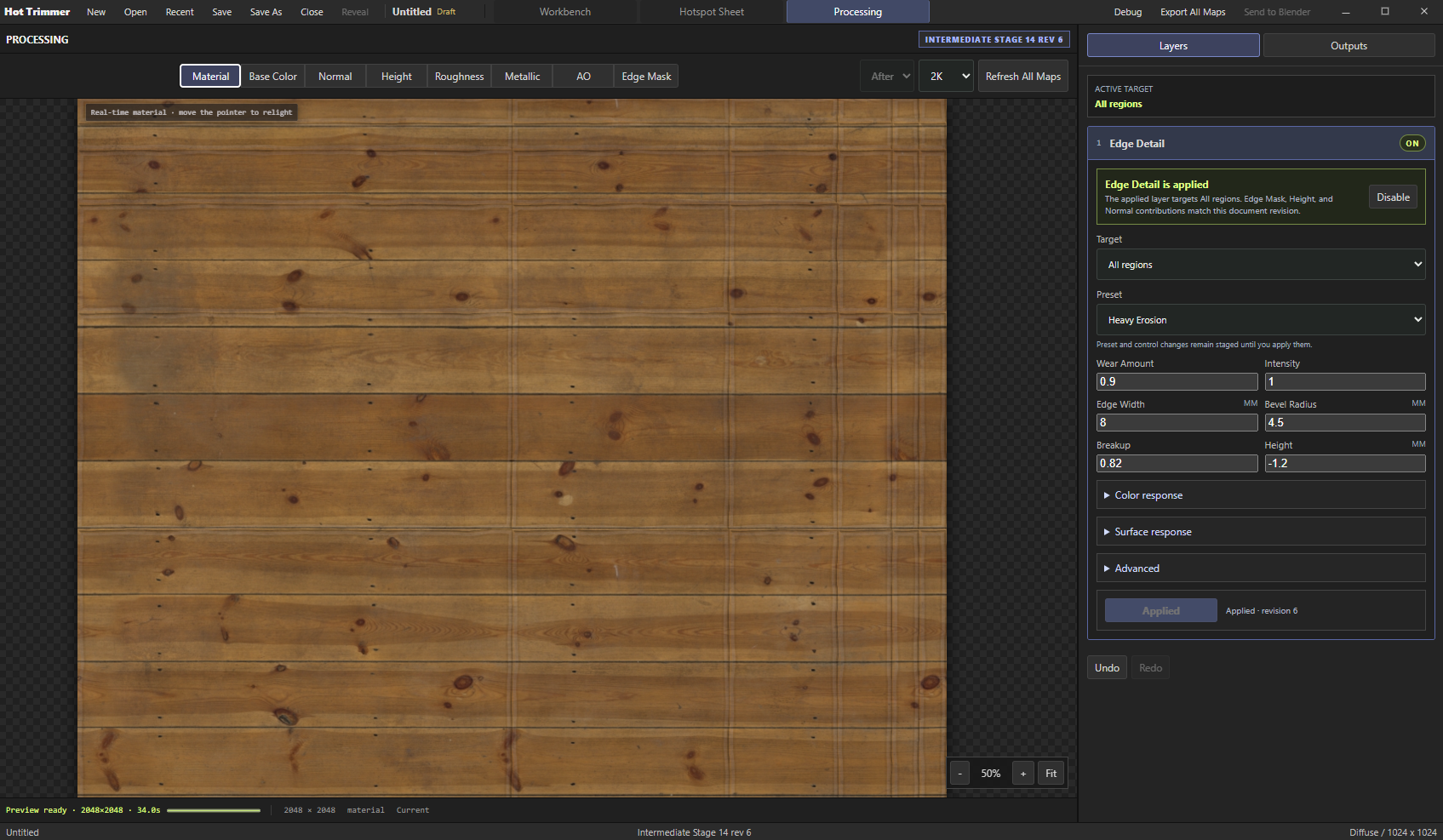
Hot Trimmer is a focused GPU-accelerated desktop application for 3D artists. It turns reference photos and registered material captures into structured trim-sheet assets through a single local workflow: import sources, capture and perspective-correct patches, author trim-sheet regions, inspect generated PBR maps, refine material processing, and export the results.
The application uses a React and TypeScript interface inside a Tauri 2 desktop shell. Rust owns project persistence, geometry, image processing, GPU rendering, and export. A versioned SQLite project format preserves source provenance, authored layout decisions, autosave and recovery state, while wgpu and WGSL provide tile-aware material-map generation and preview.
During OpenAI Build Week, I used Codex with GPT-5.6 as an active engineering collaborator. Codex helped decompose the application into bounded implementation stages, work across the Rust/TypeScript boundary, migrate the renderer from a CPU-bound path to wgpu, implement and debug GPU material processing, and verify behavior through fixtures and focused tests. I retained the product scope, creative workflow, interaction model, acceptance criteria, and final engineering tradeoffs. GPT-5.6 is a development-time collaborator; Hot Trimmer runs locally and does not require an OpenAI API key.
Current capabilities include durable .hottrimmer projects, PNG/JPEG/TIFF import, related PBR input registration, patch authoring, perspective correction, direct/repeating/radial layout behavior, GPU-backed preview, material processing, and material-map export. Windows 10/11 x64 is the currently qualified platform. The Blender handoff and broader platform qualification remain future work.
Built With
- blender-python-api
- codex
- gpt-5.6
- react
- rust
- sqlite
- tauri
- typescript
- vite
- wgpu
- wgsl