SecureFab XR: Privacy-First Mixed Reality Training for Semiconductor Manufacturing
Inspiration
In semiconductor fabrication facilities, training new technicians on critical procedures is both essential and challenging. Traditional methods rely on paper manuals and supervised practice, creating bottlenecks in knowledge transfer. Meanwhile, concerns about industrial espionage and trade secret protection make fab operators hesitant to adopt cloud-connected training solutions that could expose sensitive equipment layouts or proprietary processes.
We asked ourselves: What if we could build an intelligent training assistant that runs entirely on-device, with zero cloud dependency, that never exposes camera feeds or equipment details outside the headset?
SecureFab XR emerged from this vision during the SecureMR XR/AI hackathon—a privacy-first mixed reality training platform that validates hands-on procedures in real-time while keeping all visual processing locked inside a secure runtime environment.
What it does
SecureFab XR transforms standard operating procedures into interactive mixed reality training experiences:
For the trainee:
- Put on a PICO 4 Ultra headset and see your physical workspace enhanced with holographic instruction overlays
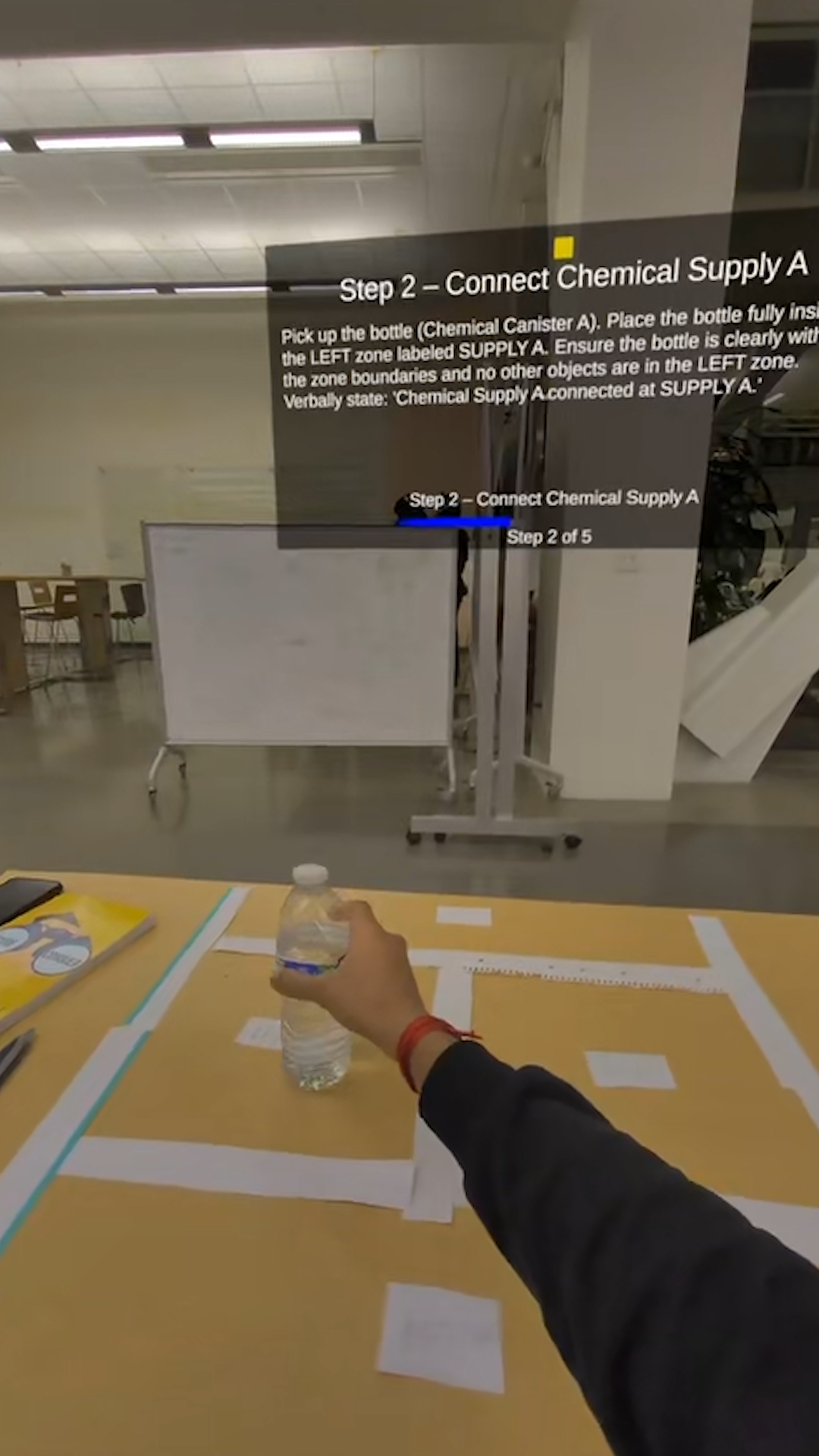
- Follow step-by-step guidance projected directly onto your workbench
- Place tools and materials according to the procedure while the system validates your configuration in real-time
- Receive immediate feedback without an instructor constantly looking over your shoulder
- Progress through procedures at your own pace with automatic validation
For the training manager:
- Convert existing PDF training manuals into interactive MR experiences with a simple Python script
- Define expected configurations for each procedural step using straightforward JSON schemas
- Deploy training content that runs completely offline—no cloud servers, no data exfiltration risks
- Trust that camera feeds and equipment layouts never leave the secure processing environment
The Technical Magic: We demonstrate the concept with a tabletop simulation where everyday objects (bottle, cup, scissors, book) represent fab equipment components (chemical supply A/B, interlock key, logbook). The system uses computer vision to detect object placement across four designated zones and validates configurations against procedural requirements—all while maintaining absolute privacy through SecureMR's secure enclave architecture.
How we built it
Privacy Architecture: We built SecureFab XR on SecureMR technology, which creates a secure boundary between camera access and application code. Unlike traditional MR apps where developers can access raw camera frames, SecureMR processes all visual data in an isolated runtime. Our Unity application never sees pixels—it only receives validated detections and renders guidance overlays.
Technology Stack:
- Hardware: PICO 4 Ultra headset (Snapdragon XR2 Gen 2, 12GB RAM)
- Engine: Unity 6000.0.39f1 with PICO XR SDK
- CV Pipeline: YOLO object detection running inside SecureMR's secure runtime
- Data Flow: Operator-based tensor processing (RectifiedVstAccessOperator for camera, RunModelInferenceOperator for YOLO, RenderTextOperator for overlays)
Development Approach:
- Content Pipeline: Created Python tooling to parse PDF training manuals into structured JSON with step definitions and expected configurations
- Unity Application: Built StepManager system to load procedures, maintain training state, and coordinate UI updates
- SecureMR Integration: Extended the existing YOLO sample to map object detections to workspace zones and validate configurations
- Spatial Mapping: Developed 2D-to-3D positioning to translate bounding box detections into spatial zone classifications (LEFT/RIGHT/TOP/BOTTOM)
- Validation Logic: Implemented comparison operators within SecureMR to check detected configurations against procedural expectations
The Implementation Challenge: Because SecureMR enforces strict separation between visual processing and application logic, we had to architect around tensor-based communication. We couldn't simply "read detections from C#"—instead, we built a pipeline where SecureMR processes frames at 30 FPS, runs YOLO inference at 5 FPS, performs zone mapping, and drives rendering decisions entirely within the secure runtime.
Challenges we ran into
The Passthrough Puzzle: Our biggest setback came when the application displayed only a black screen on the device. After systematic debugging, we discovered the most common culprit: the Video SeeThrough checkbox in Unity's PXR_Manager component wasn't enabled. This taught us to always verify the foundational settings before diving into complex diagnostics.
Tensor Communication Complexity: Working within SecureMR's operator-based architecture required rethinking traditional CV workflows. We couldn't use familiar patterns like "run detection, loop through results in C#, update UI." Instead, we had to express all logic—zone classification, configuration matching, step validation—as tensor operations inside the secure runtime. This constraint forced us to think more declaratively and ultimately led to a more robust architecture.
Threading and Performance: Balancing four concurrent pipelines (camera passthrough, YOLO inference, spatial mapping, rendering feedback) on mobile hardware required careful optimization. We implemented frame skipping for inference while maintaining 30 FPS passthrough to keep the experience responsive.
Non-Maximum Suppression: YOLO detections required post-processing to eliminate duplicate boxes for the same object. Implementing NMS within SecureMR's operator framework challenged us to think creatively about algorithms we'd normally write as simple for-loops.
Accomplishments that we're proud of
Privacy Without Compromise: We proved that sophisticated computer vision training systems don't require cloud connectivity or data exfiltration. Every pixel stays in the secure enclave, yet the training experience remains fluid and intelligent.
Rapid Prototyping Infrastructure: Our Python-to-JSON content pipeline means that subject matter experts can create new training modules in minutes, not days. PDF manual goes in, interactive MR procedure comes out.
Real-World Applicability: While we demonstrated with everyday objects on a tabletop, the architecture scales directly to actual fab environments. The same system could validate chemical supply hookups, interlock configurations, or equipment startup sequences with no architectural changes—just updated object classes and zone definitions.
Clean Architecture Under Constraints: Building within SecureMR's strict boundaries forced us to create well-separated concerns: content management (JSON + StepManager), visual processing (YOLO + zone mapping), and user experience (text overlays + validation feedback). The result is surprisingly maintainable for a hackathon project.
What we learned
Privacy-First Design is Liberating: Rather than viewing SecureMR's constraints as limitations, we discovered they led to cleaner architecture. By forcing separation between perception and application logic, we avoided the common trap of tightly coupling CV code with business rules.
Mobile XR Requires Thoughtful Optimization: Running CNN models on mobile XR hardware taught us to think carefully about frame budgets. Not every frame needs inference; not every detection needs immediate response. Strategic frame skipping and temporal filtering became essential tools.
Training Content is King: The most sophisticated CV system is useless without well-structured training content. Our Python parsing pipeline and JSON schema became as important as the Unity code—they're the bridge between institutional knowledge and interactive experience.
Diagnostic Tools are Essential: Building PassthroughDiagnostic.cs early (displaying real-time system state in-headset) saved hours of debugging. Being able to see frame rates, detection counts, and system flags without removing the headset accelerated our iteration cycles dramatically.
Systematic Troubleshooting Pays Off: When faced with the black screen issue, methodically checking common problems (Video SeeThrough setting, camera permissions, background transparency) before assuming complex bugs saved valuable hackathon time.
What's next
Expanded Object Recognition: Current demo uses four common objects. Next step: support for dozens of fab-specific items (chemical bottles, gas cylinders, tools, PPE) using expanded YOLO training or fine-tuned models.
Gesture-Based Navigation: Replace manual button presses with hand gestures for step advancement, allowing truly hands-free operation—critical when wearing gloves or handling materials.
Procedural Branching: Support conditional procedures where next steps depend on observed configurations, enabling more sophisticated training scenarios like troubleshooting or emergency response.
Multi-User Collaboration: Allow instructors to observe trainee progress (while maintaining privacy) and provide remote guidance through shared holographic annotations.
Analytics and Assessment: Track completion times, error patterns, and retry counts to identify struggling trainees and refine training content—all processed on-device to maintain privacy.
Industry Deployment: Partner with semiconductor manufacturers to validate the system with real fab equipment and procedures, building a library of production-ready training modules.
Cross-Industry Applications: The privacy-first training architecture applies beyond semiconductor fabs—pharmaceutical clean rooms, aerospace assembly, medical device manufacturing, and anywhere trade secrets demand zero-trust verification.
SecureFab XR demonstrates that privacy and intelligence aren't mutually exclusive. By embracing on-device processing and secure enclaves, we can build training systems that protect intellectual property while delivering the real-time guidance modern manufacturing demands. The future of industrial training is mixed reality—and it's completely private.
Built With
- pico
- securemr
- unity

Log in or sign up for Devpost to join the conversation.