-
-
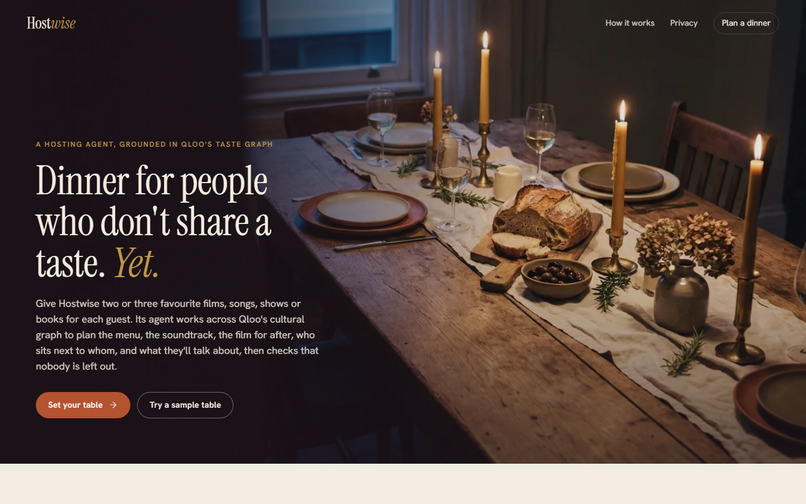
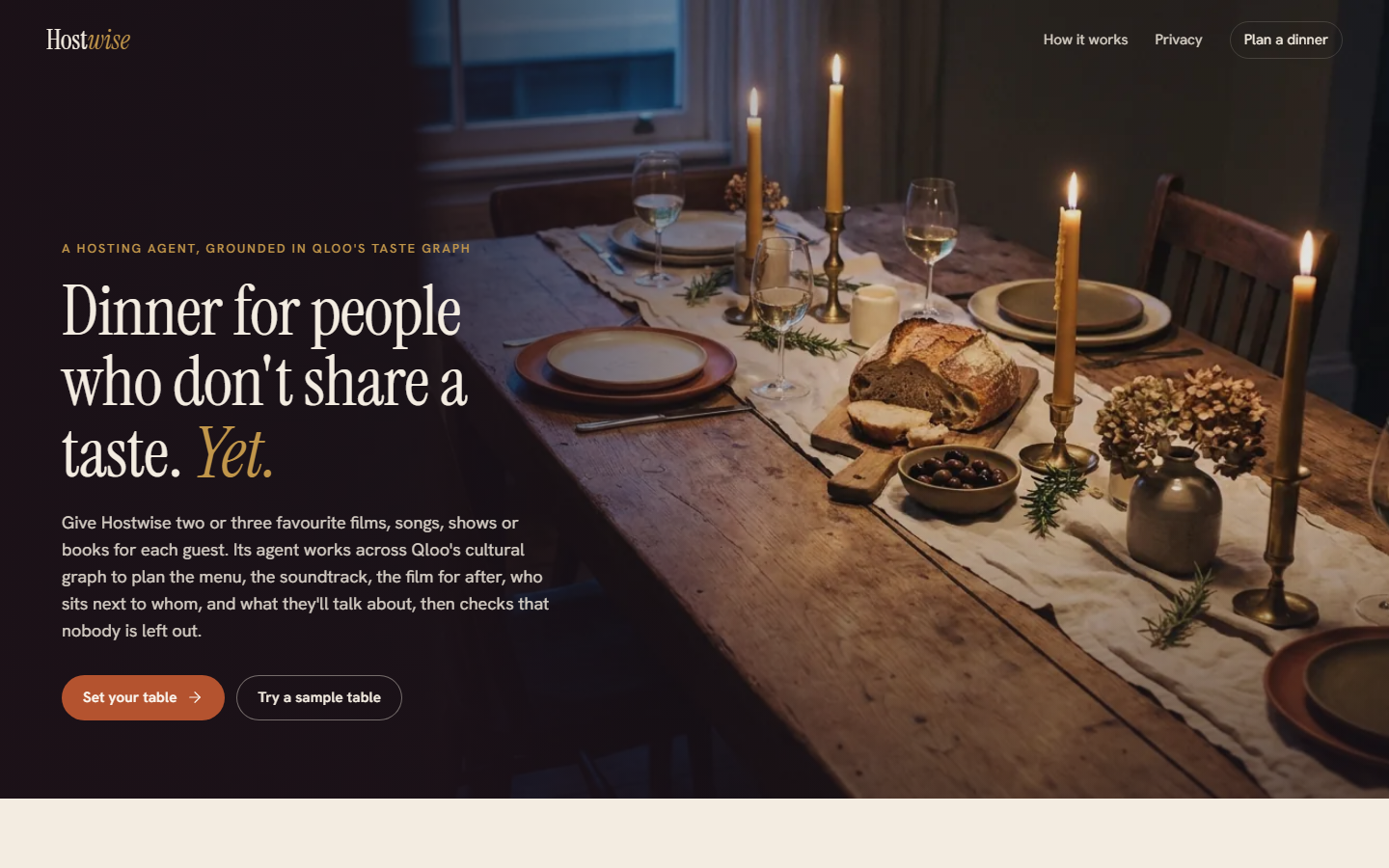
Landing page: dinner for people who don't share a taste.
-
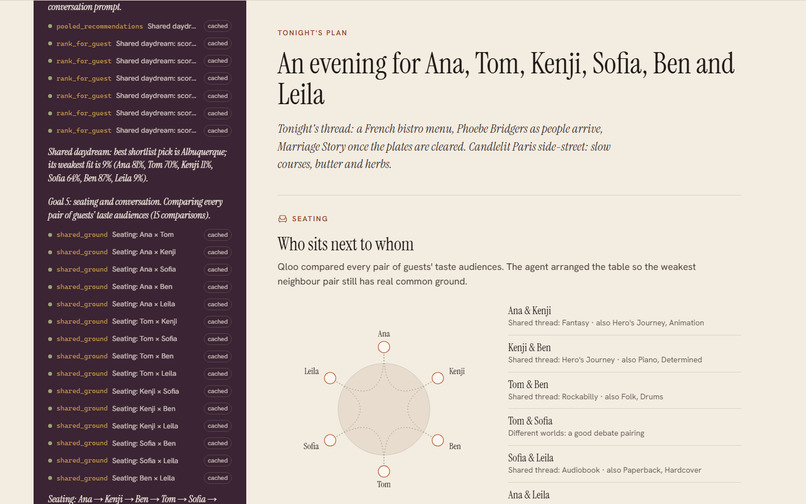
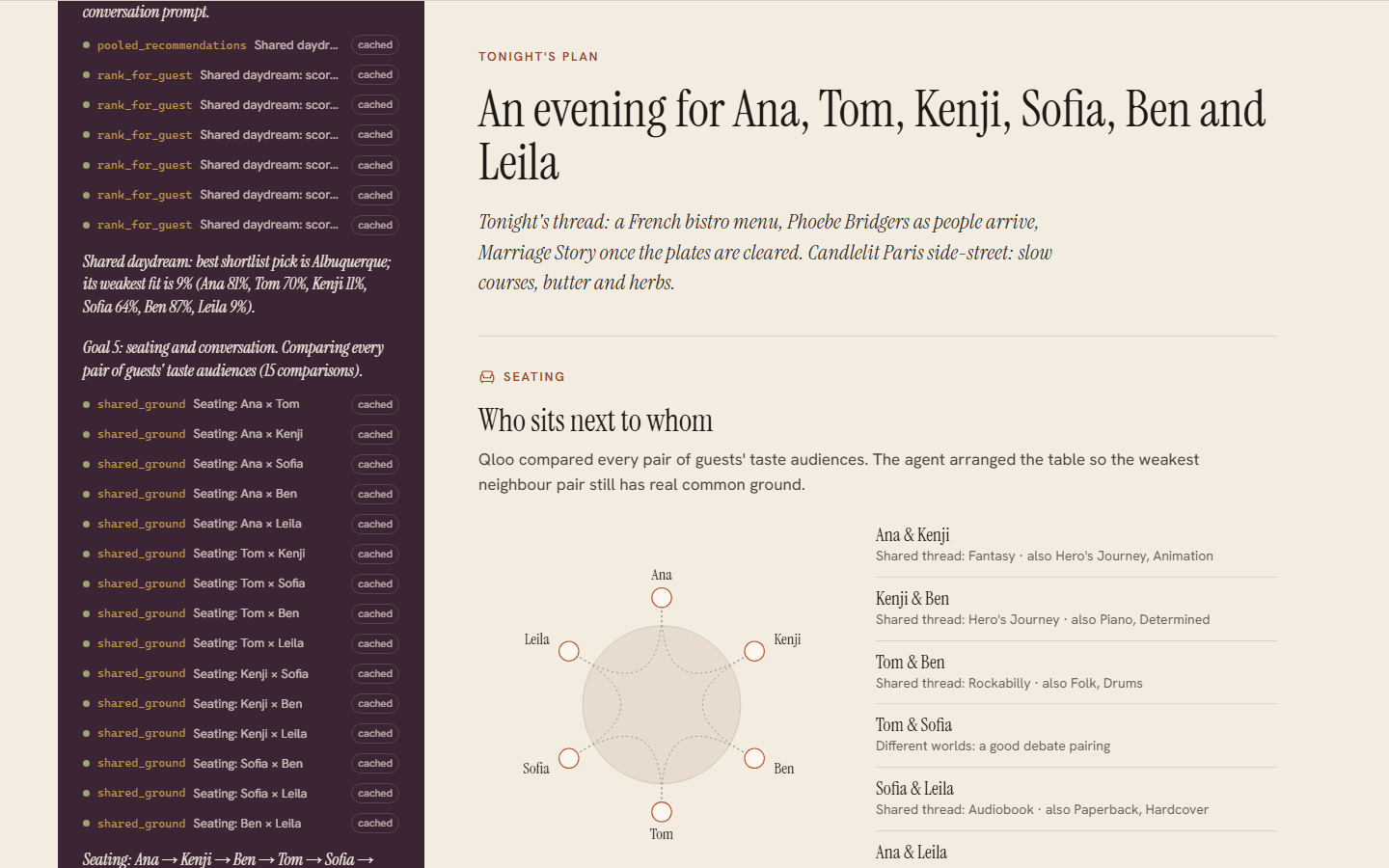
The finished plan, with the agent's trace of Qloo calls, critiques and re-plans alongside.
-
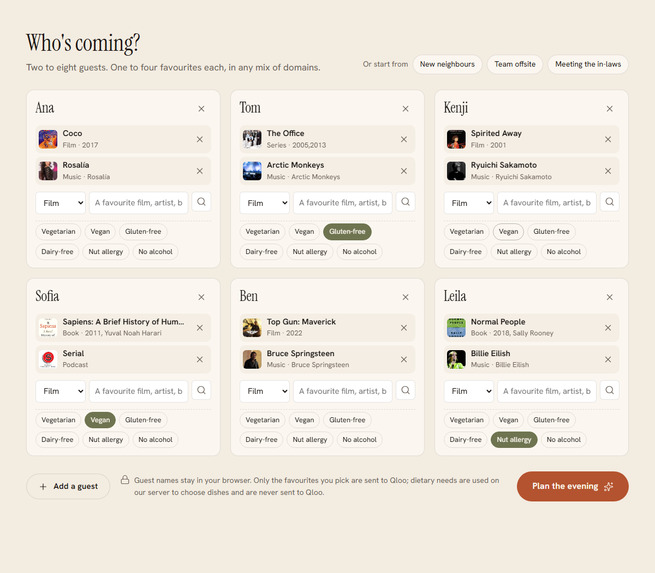
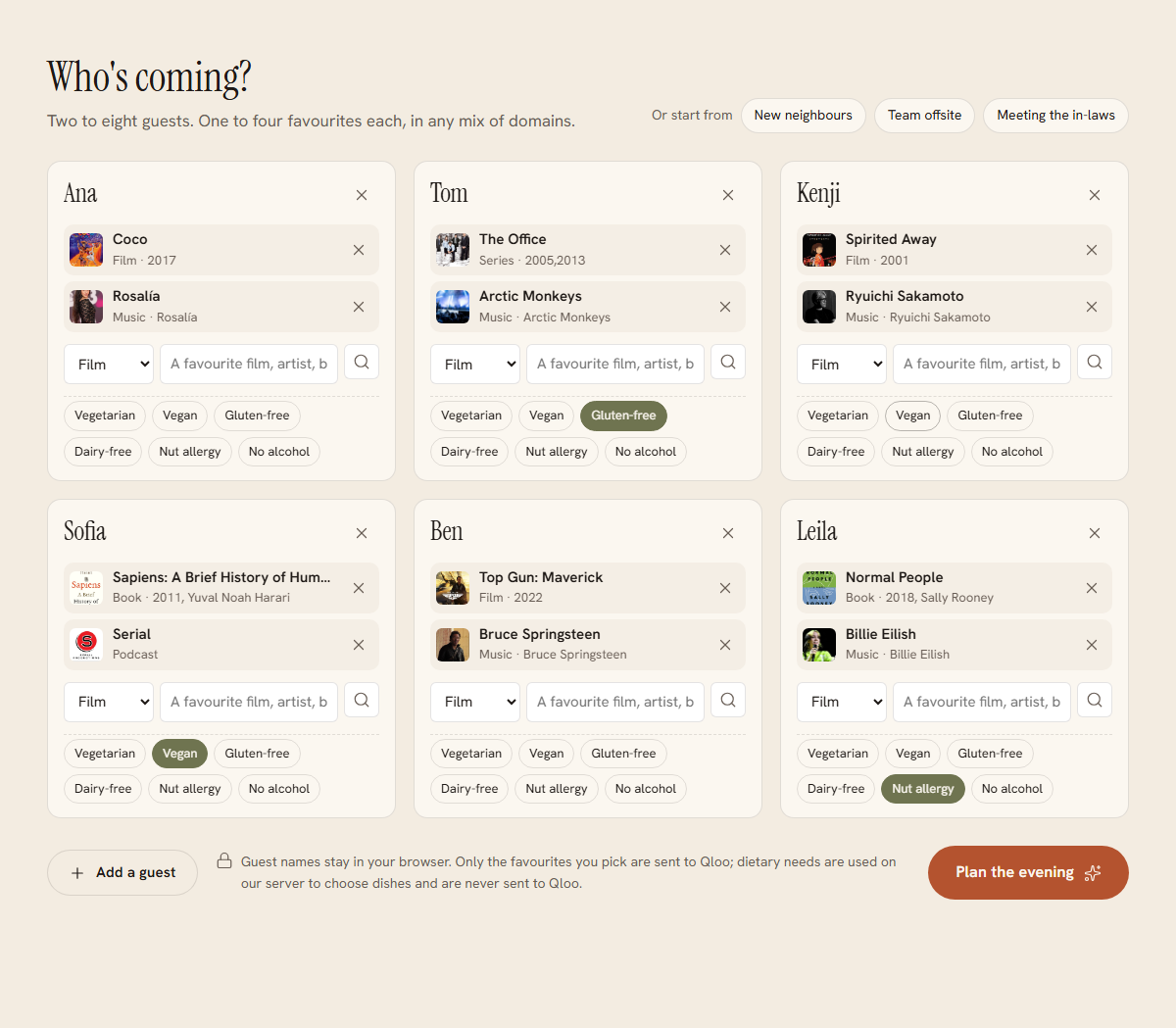
Who's coming: each guest's favourites, matched live in Qloo, plus dietary needs.
-
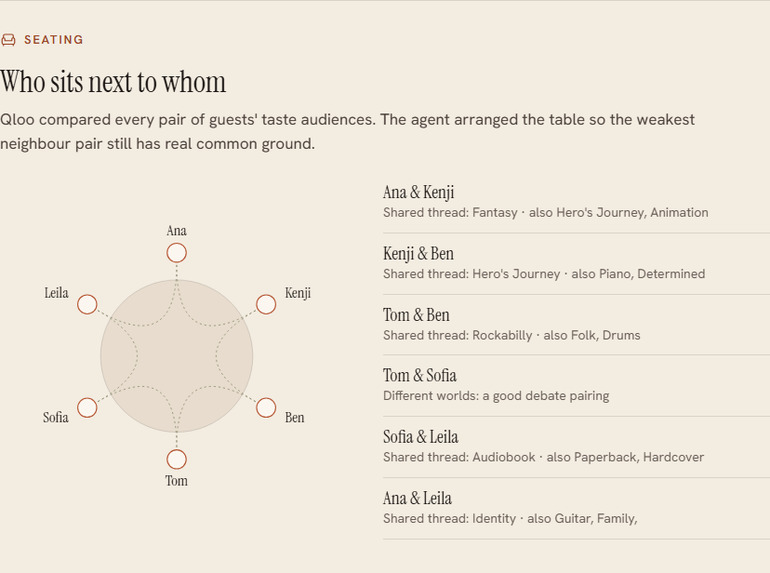
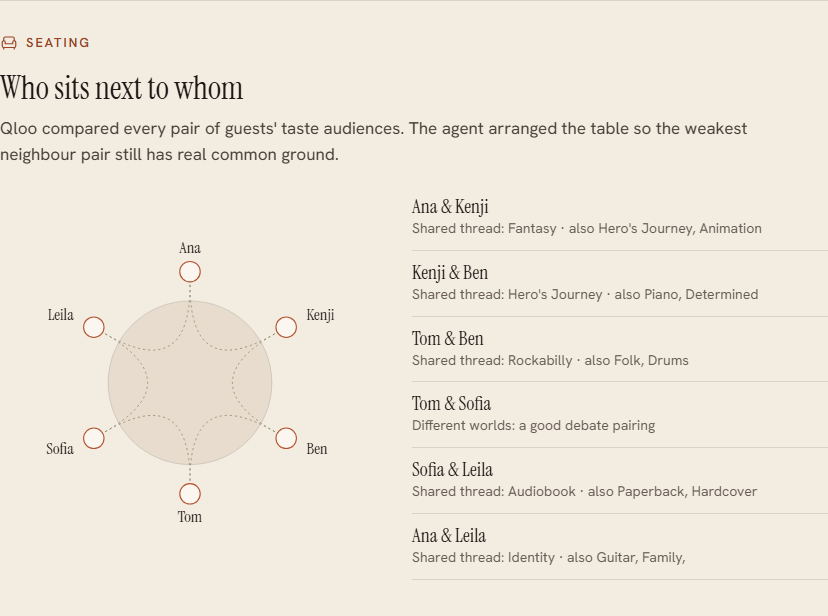
Seating for a round table, chosen so the weakest neighbour pair still shares real common ground.
-
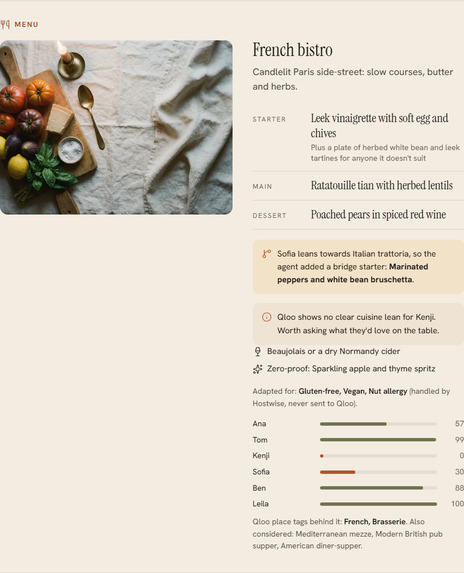
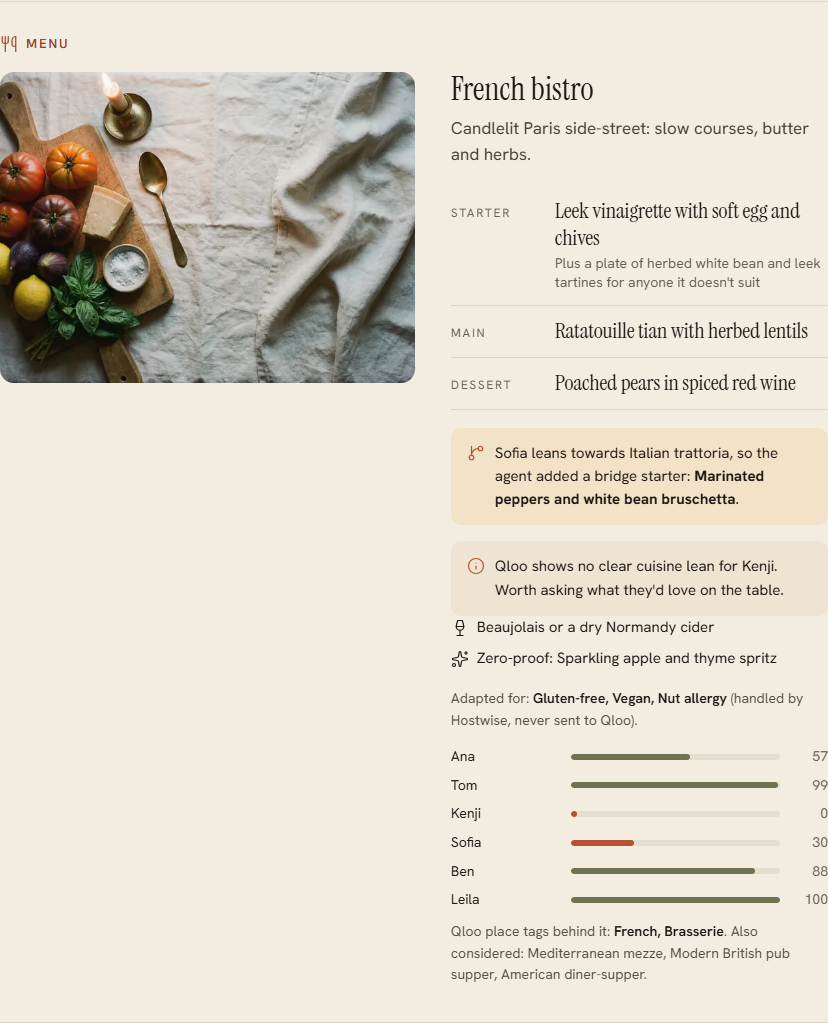
A three-course menu inferred from Qloo cuisine affinities and adapted to dietary needs.
-
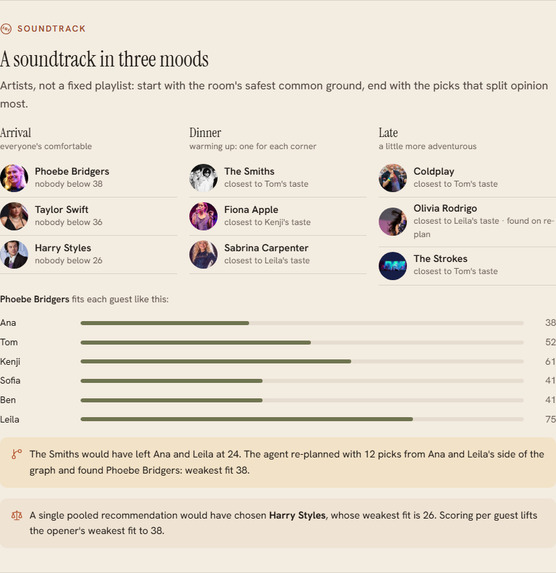
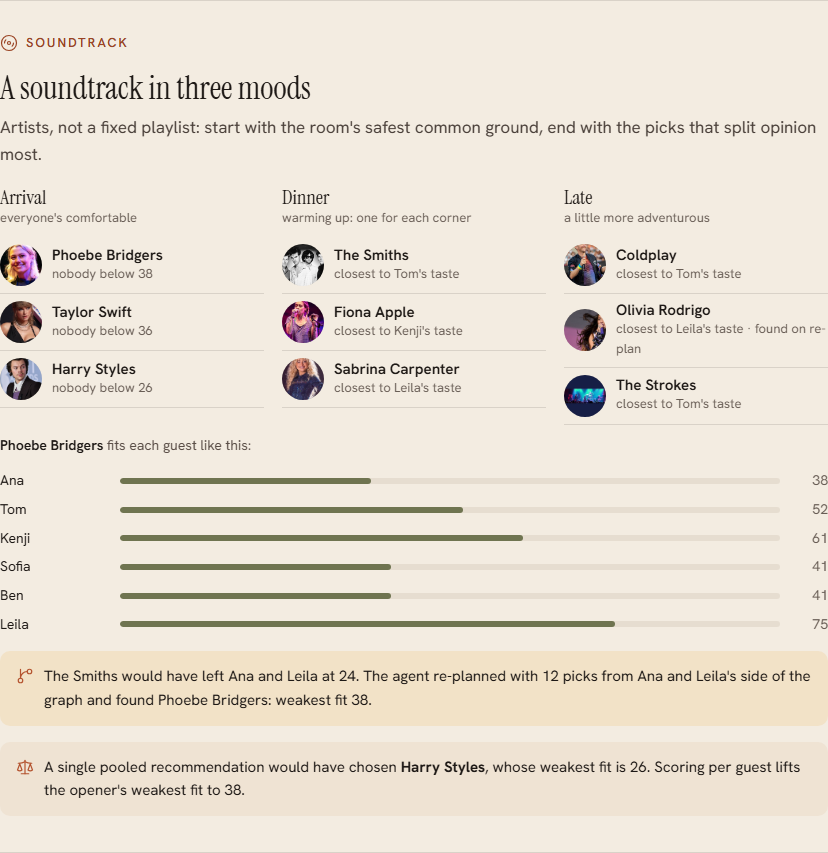
A soundtrack in three moods, with each guest's fit shown for every pick.
-
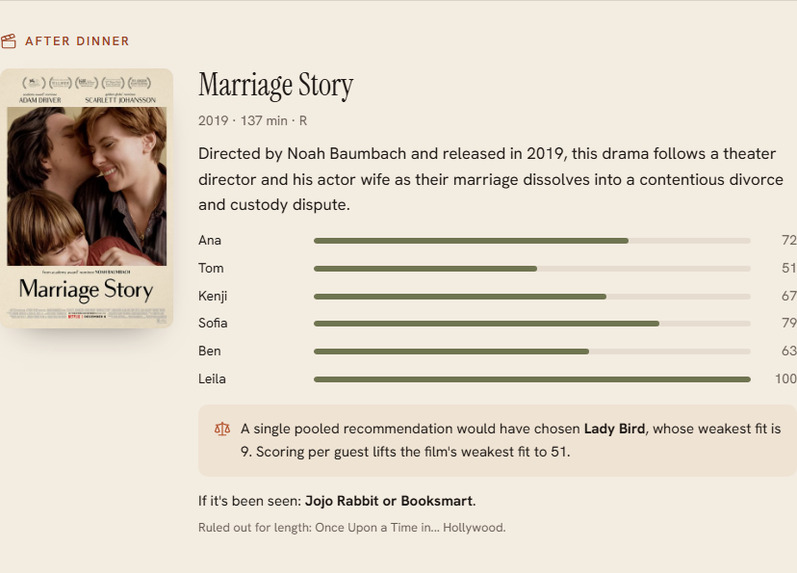
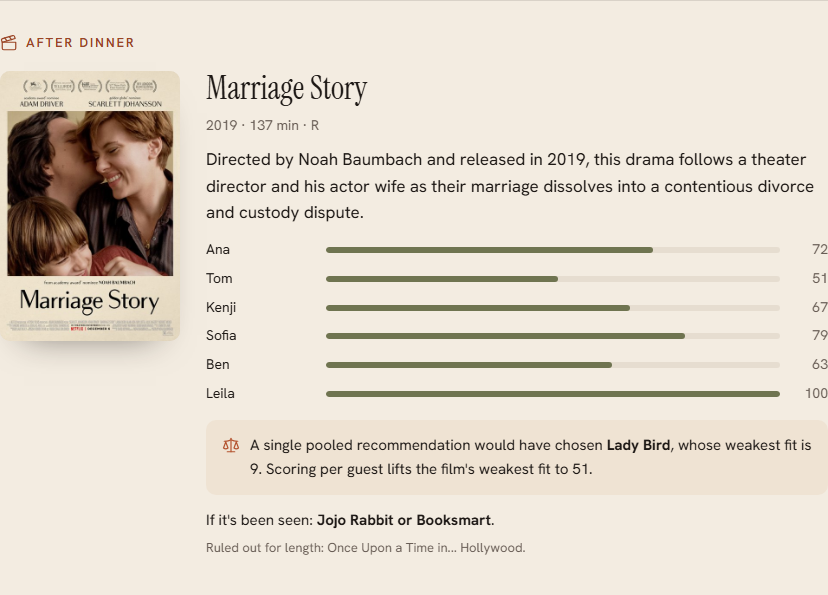
An after-dinner film scored against every guest, and the pooled pick it beat.
-
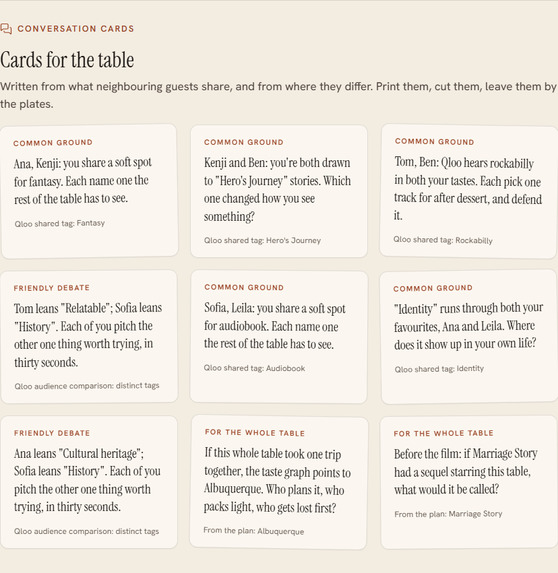
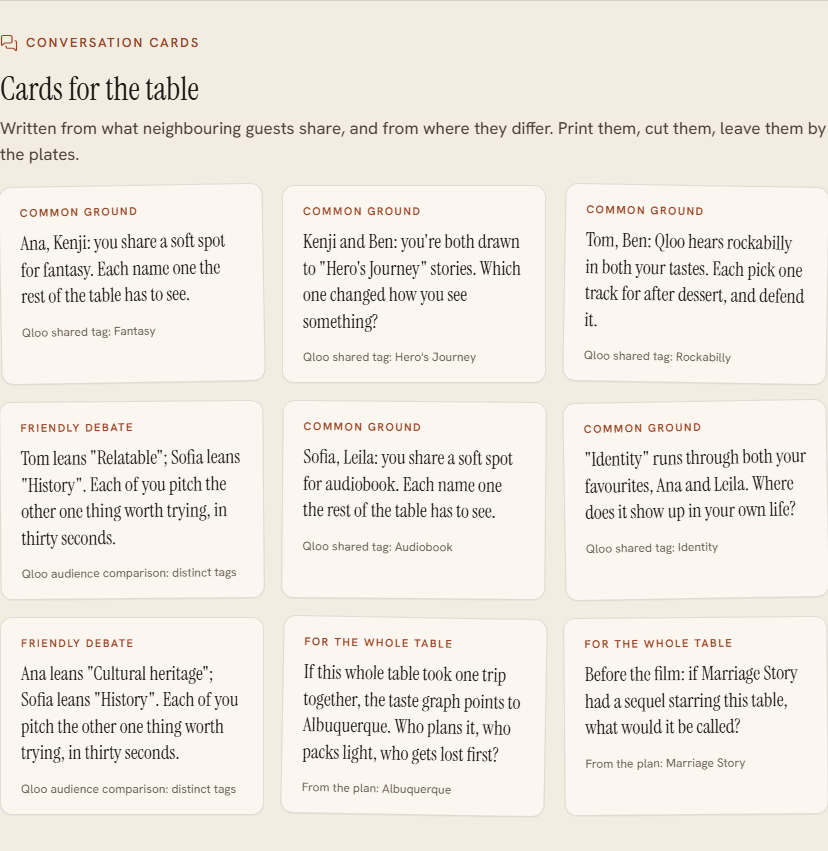
Conversation cards written from Qloo audience comparison: shared tags and friendly debates.
Inspiration
Hosting a mixed table is a taste problem in disguise. New neighbours, a team offsite, meeting the in-laws: people who don't know each other's tastes, and a host who wants nobody to spend the evening being polite. Generic AI answers that problem with averages ("a crowd-pleasing film and some pasta"), and averages are exactly what leaves one person out.
What it does
The host adds each guest and two to four favourites in any domain (films, series, music, books, podcasts, games, places) and ticks dietary needs. Hostwise's agent then plans the evening and streams its reasoning as it goes:
- Seating for a round table, chosen so the weakest neighbour pair still has real common ground, with the shared thread for each pair.
- A menu inferred from cross-domain taste (Qloo place-tag affinities for each guest), turned into a cookable three-course menu with a drink and a zero-proof pairing, adapted to vegetarian, vegan, gluten-free, dairy-free, nut-free and no-alcohol needs.
- A soundtrack in three moods: safest common ground on arrival, one for each corner of the table at dinner, the opinion-splitters late.
- An after-dinner film that fits everyone and runs under 140 minutes.
- Conversation cards written from what neighbours share and where they differ.
Every pick shows its evidence: the fit for each guest, which favourites pulled it in, any re-plan the agent made, and what a single pooled recommendation would have chosen instead.
How we built it (the Qloo-powered part)
The agent is a goal-driven loop over six tools, each a thin wrapper over one Qloo capability. For each goal it:
- Pools the table: one
/v2/insightscall with everyone's entities as signals andfeature.explainability=true, giving candidates plus per-signal contribution scores. - Scores each guest alone:
/v2/insightswith that guest's signals andfilter.entities=<shortlist>, so every candidate gets an affinity per guest. - Critiques its pick with a least-misery test (0.6 × weakest fit + 0.4 × mean, per-guest normalised). Anyone below 35 % is "left out".
- Re-plans: asks Qloo for the left-out guest's own picks, re-scores them for everyone, and keeps the fairest option. In the demo table, The Smiths would have left two guests at 24 %; the re-plan finds Phoebe Bridgers at 38 %. The menu does the same with a bridge starter from the left-out guest's best cuisine.
- Seats and sparks with
/v2/analysis/comparebetween every pair of guests: shared tags become seating similarity and conversation cards; distinct tags become "friendly debate" cards.
Cuisine comes from /v2/insights with filter.type=urn:tag and filter.tag.types=urn:tag:genre:place: Qloo tells us which food cultures a fan of Spirited Away and Ryuichi Sakamoto leans towards; Hostwise maps those tags onto its own 20-cuisine dish library. Favourites are resolved with /search.
A typical six-guest evening takes about 50 tool calls in roughly 30 seconds on a cold cache. The client caches privately on the server, paces requests, retries 429/5xx a bounded number of times, and enforces a daily cap so a public demo can't drain the event quota.
Redacted request-to-result example (one guest scoring step):
GET /v2/insights
  filter.type=urn:entity:movie
  signal.interests.entities=<Coco>,<Rosalía>          (one guest's favourites)
  filter.entities=<15 shortlisted film ids>
  take=15
-> 15 affinities for this guest; repeated for each guest, then normalised and combined
The UI shows this for every call (expand any line in the agent trace); the credential is sent server-side as a header and never displayed.
Responsible data handling
Guest names never leave the browser (the server sees guest indexes; the page fills names into {{g0}} tokens). Only Qloo entity ids, titles and types go to Qloo. Dietary needs are handled by Hostwise's own dish library and never sent to Qloo. Results are presented as aggregate taste affinities, labelled as Qloo evidence and kept separate from Hostwise's interpretation. No Qloo response data is stored in the repository.
Challenges we ran into
- Averages hide people. A single pooled recommendation regularly scored one guest near the bottom of their own taste (Lady Bird would have left one guest of the team-offsite table at 9 %; Hostwise's pick keeps everyone at 51 % or more). Per-guest scoring plus least-misery was the fix, and the counterfactual callout makes the difference visible.
- Generic shared tags. Audience comparison returns honest but bland overlap ("Engaging", "Passionate", "United States"). We weight tags by subtype (archetypes, themes and genres over adjectives) and never reuse a thread at the same table.
- The long tail. One small Scottish town topped the destination list for three unrelated tables;
filter.popularity.minfixed it. - Rate limits. Parallel per-guest scoring triggered 429s; we added request pacing and bounded retries.
Accomplishments that we're proud of
A real agent loop with visible self-critique and re-planning, not a single prompt; every decision traceable to a Qloo measurement; a product that feels like a well-set table rather than a dashboard; and privacy by construction.
What we learned
Cultural taste is most useful as evidence for trade-offs between people. Qloo's per-entity explainability and filter.entities ranking turned out to be the two features that made fairness measurable.
What's next for Hostwise
Invitations that collect each guest's favourites privately, recurring dinner clubs that rotate who gets the "late" playlist, and restaurant mode using Qloo place recommendations with a location filter when the host would rather go out.
AI disclosure
Mood imagery (table photographs with no people or text) was generated with Google Flow (Nano Banana Pro) and graded by hand; narration uses Microsoft Edge neural TTS. The music in the demo video is synthesised in code, and no AI-generated video was used. All product UI, footage, code, copy and the dish library are original. Details: design/GENERATED_ASSETS.md.
Testing instructions
Open https://hostwise.ruicodex.com (no login), click Try a sample table (or Team offsite), then Plan the evening. A first run takes about 30 seconds while the agent makes about 50 Qloo calls; expand any line in the agent trace to see the exact request. Plans are rate-limited per visitor, and the demo has a daily Qloo call cap to protect the event quota.
Links
- Live demo (no login): https://hostwise.ruicodex.com
- Code (MIT): https://github.com/RuiCodex-dev/hostwise
Built by Rui Codex (https://ruicodex.com), Belgium.

Log in or sign up for Devpost to join the conversation.