-
-
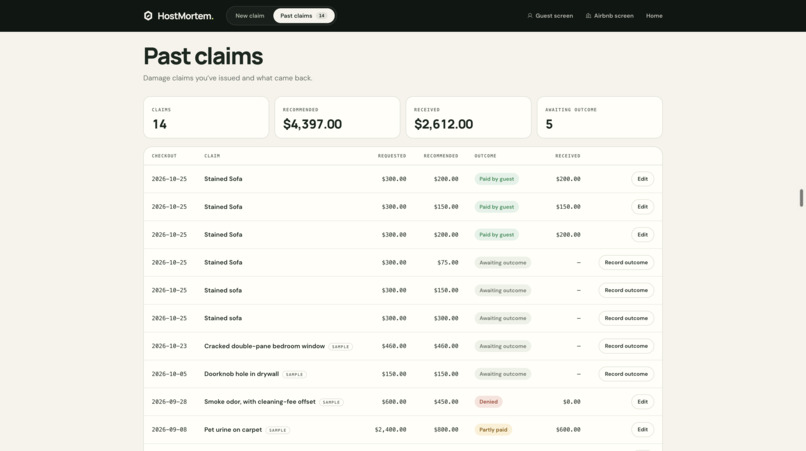
This shows past claims that have been made. It shows all the statuses of money received or not
-
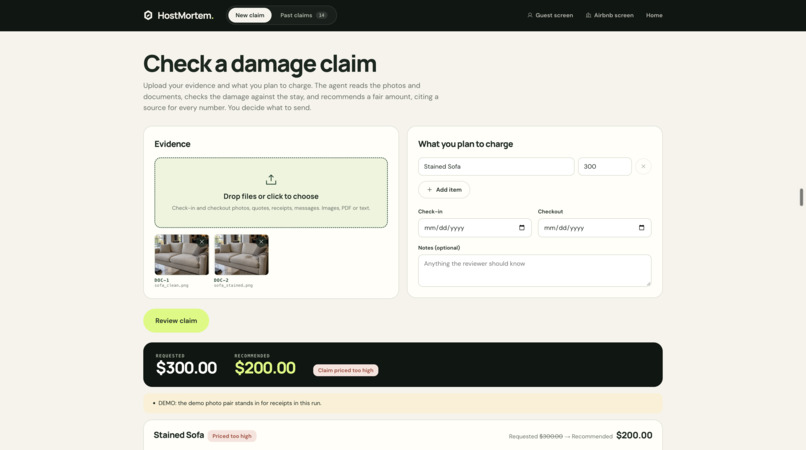
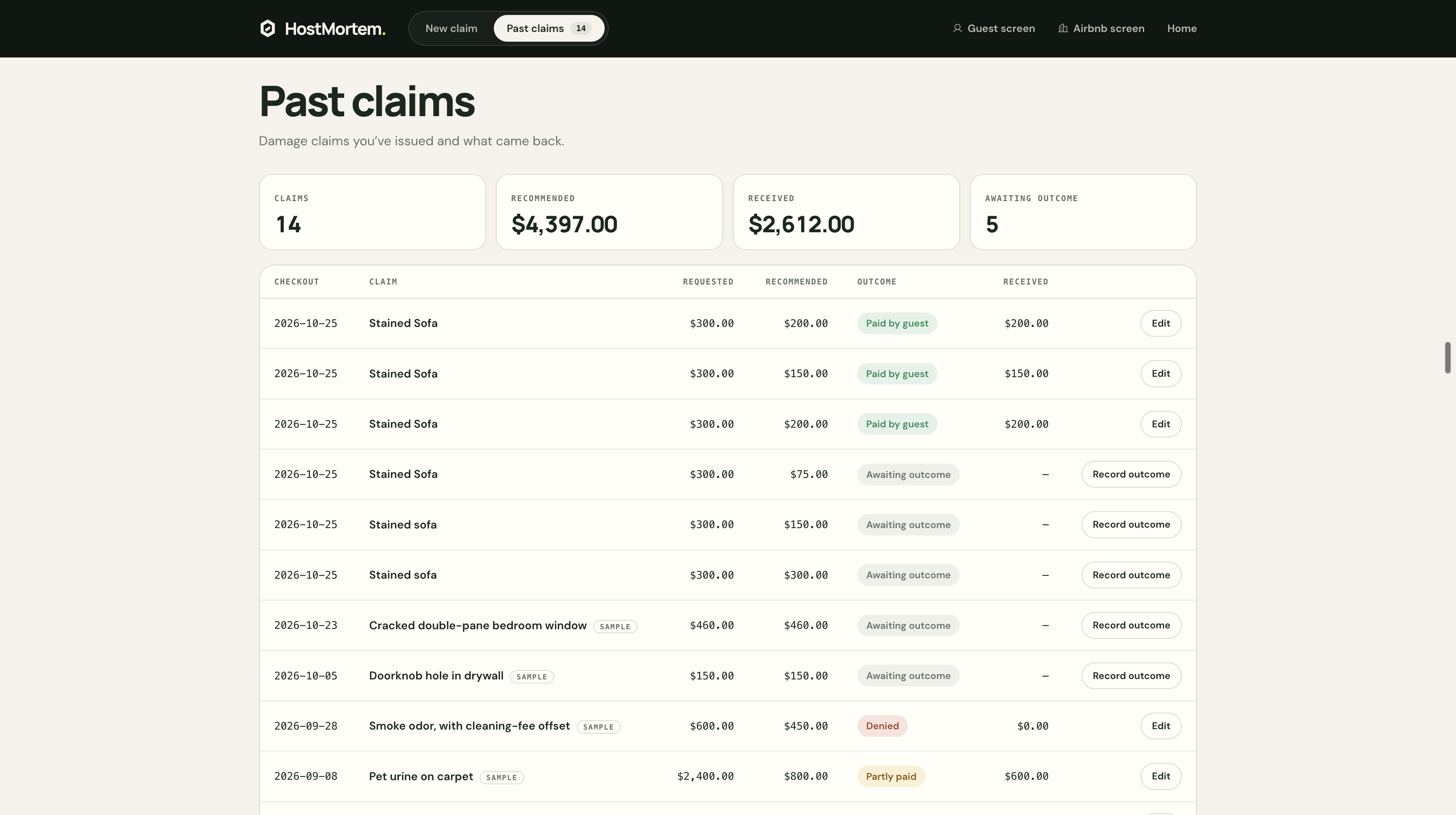
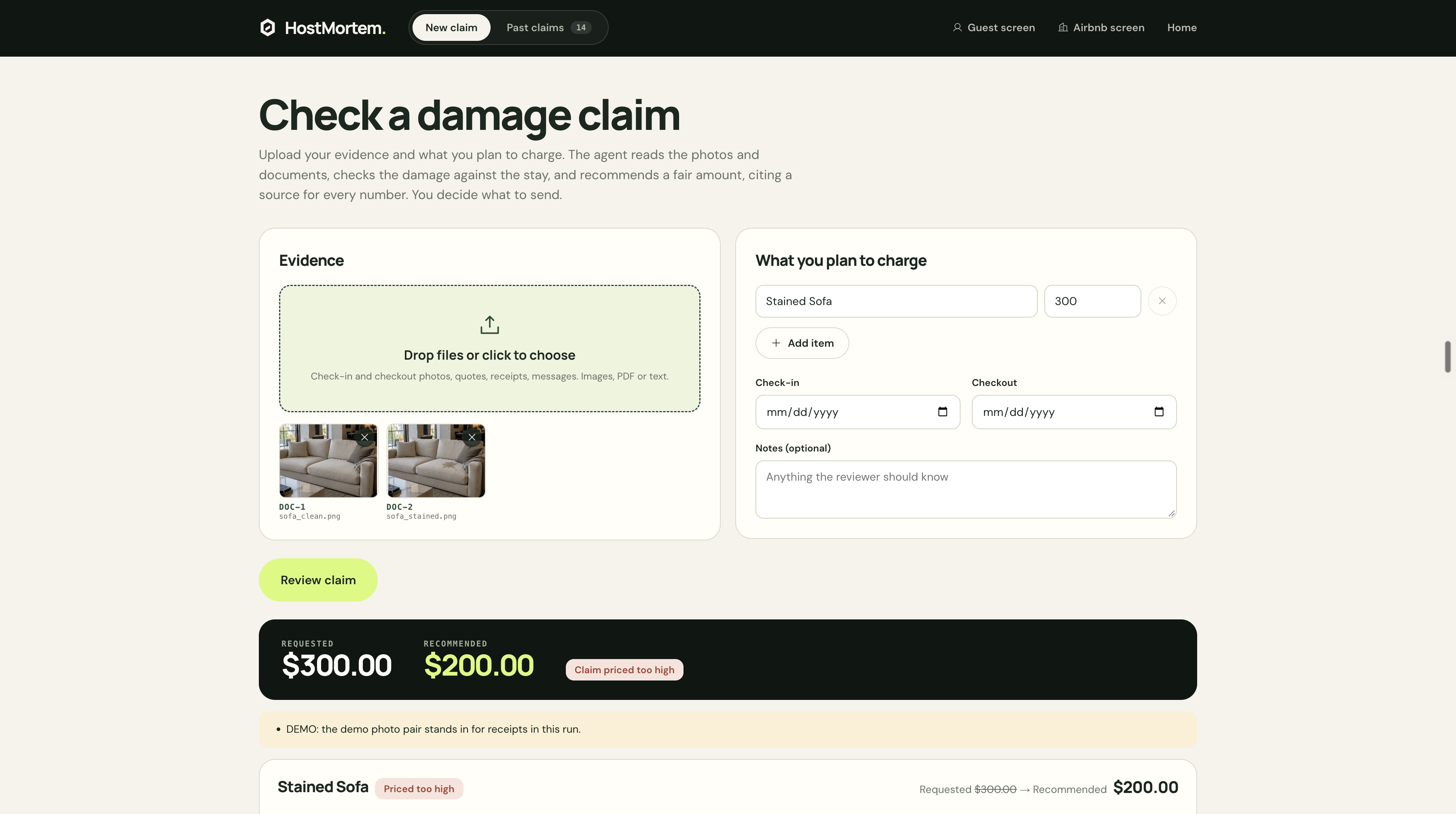
This is main dashboard for the host to see.
-

Company main website

Inspiration
For a property manager, discovering guest damage starts a second job: collecting photos, finding repair quotes, preparing a claim, following up, and checking whether the money arrived.
We saw a gap between documenting damage and managing financial recovery. These steps belong to the same case, yet often involve disconnected tools and repeated manual work.
We asked: What if a host could upload the evidence and follow one clear path from damage to repayment—without giving up control?
What it does
HostMortem brings five specialized agents together around one damage claim:
- Pricing reviewer: examines photos and documents and proposes repair costs backed by citations.
- Evidence investigator: checks supporting records and flags pre-existing damage or uncertainty.
- Claims coordinator: drafts a guest request and a fallback claim for host approval.
- Finance agent: matches incoming payments to agreed recovery and escalates discrepancies.
- Policy agent: reviews completed cases and proposes limited improvements for future claims.
The host approves the amount and exact messages. In our demonstration, the guest can Agree, Disagree, or Send money through a simulated payment. A refusal releases the pre-approved request to a simulated Airbnb desk. The dashboard distinguishes agreed recovery from received money.
Agents propose. Humans decide. Code enforces the rules.
Who it helps
Our initial users are property managers handling multiple short-term rentals, where claims create recurring administrative work across a portfolio.
HostMortem aims to reduce duplicate data entry, make claims easier to review, and provide a reliable account of outstanding recovery.
The same technology and agent workflow could be adapted to car rentals, hotels, equipment leasing, and insurance claims preparation. Each industry has different rules, but the core process remains similar: establish what happened, justify the amount, obtain approval, and reconcile payment.
How we built it
- AI interprets evidence; code validates and calculates. We invoke Claude through the Claude Code CLI running locally to produce structured findings and cited pricing components. Our Python backend validates citations, applies relevant pricing limits and depreciation rules, and computes amounts in integer cents.
- One controlled path for case changes. Human and agent actions pass through backend commands with role checks, revision checks, and duplicate-action protection. Agents cannot approve their own requests. The finance agent can record qualifying receipts within configured limits; exceptions require review.
- A traceable case history. SQLite stores authoritative case records and append-only events, keeping recommendations, approvals, responses, and receipts connected.
- A foundation for real-time coordination. We deployed SpacetimeDB locally and verified a case-summary relay. Full participant-interface integration is ongoing; the current demonstration screens refresh through polling.
- Stack: Claude through the Claude Code CLI, a Python backend with SQLite, a lightweight JavaScript frontend, and SpacetimeDB for real-time case-summary updates.
Designing for the host
We designed the experience around three questions:
- What does the evidence support?
- What needs my decision?
- What has actually been paid?
Hosts review concrete amounts and messages rather than managing agent conversations. The workflow shows who needs to act next, and agent indicators reflect actual server activity.
Separating agreement from payment makes the interface useful beyond filing a claim: it helps hosts understand the financial outcome.
Challenges we ran into
- Making model output dependable. Plausible findings still need validation. We separated interpretation from arithmetic and constrained what agent proposals can change.
- Avoiding unsupported charges. Pre-existing damage and uncertain evidence must remain visible to the reviewer rather than disappear into a confident request.
- Coordinating multiple participants. The host, guest, and simulated Airbnb screens needed to follow the same backend case without drifting into different states.
- Keeping the demonstration transparent. We distinguish actual agent execution from interface animation and label simulated payments, platform interactions, and sample-data shortcuts.
Accomplishments that we're proud of
- A connected local demonstration: upload, AI review, host approval, participant response, and simulated payment reconciliation.
- Five agents sharing one case, each with a clear job and bounded responsibilities.
- Safety backed by tests: approval restrictions, evidence gates, duplicate receipts, financial reconciliation, and agent behavior.
- A workflow that follows the money: continuing after claim preparation to answer did the money arrive?
What we learned
The controls are part of the product. Useful automation reduces paperwork while leaving consequential decisions understandable and reviewable.
We also learned to treat every photo, document, and guest reply as data, not instructions, and to treat an approved claim and a received payment as separate facts.
What's next for HostMortem
We're completing participant-specific SpacetimeDB synchronization, adding authenticated host and guest accounts, and preserving original evidence durably.
Future work includes authorized Airbnb and insurer integrations, bank connections, and split settlements between guests and platforms. Our current prototype demonstrates these interactions locally with simulated participants and payments.
Built With
- anthropic
- claude
- claude-code
- css3
- html5
- javascript
- node.js
- python
- spacetimedb
- sqlite
- typescript


Log in or sign up for Devpost to join the conversation.