-
-
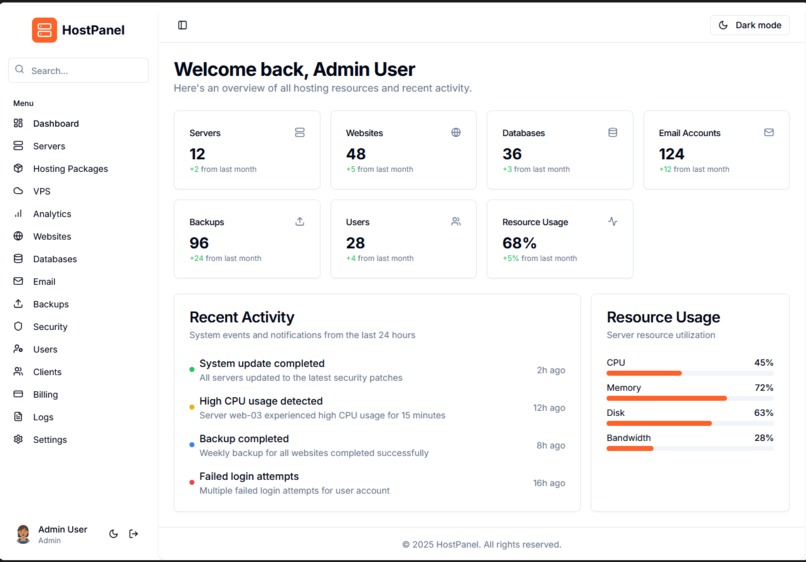
How things looks right now.
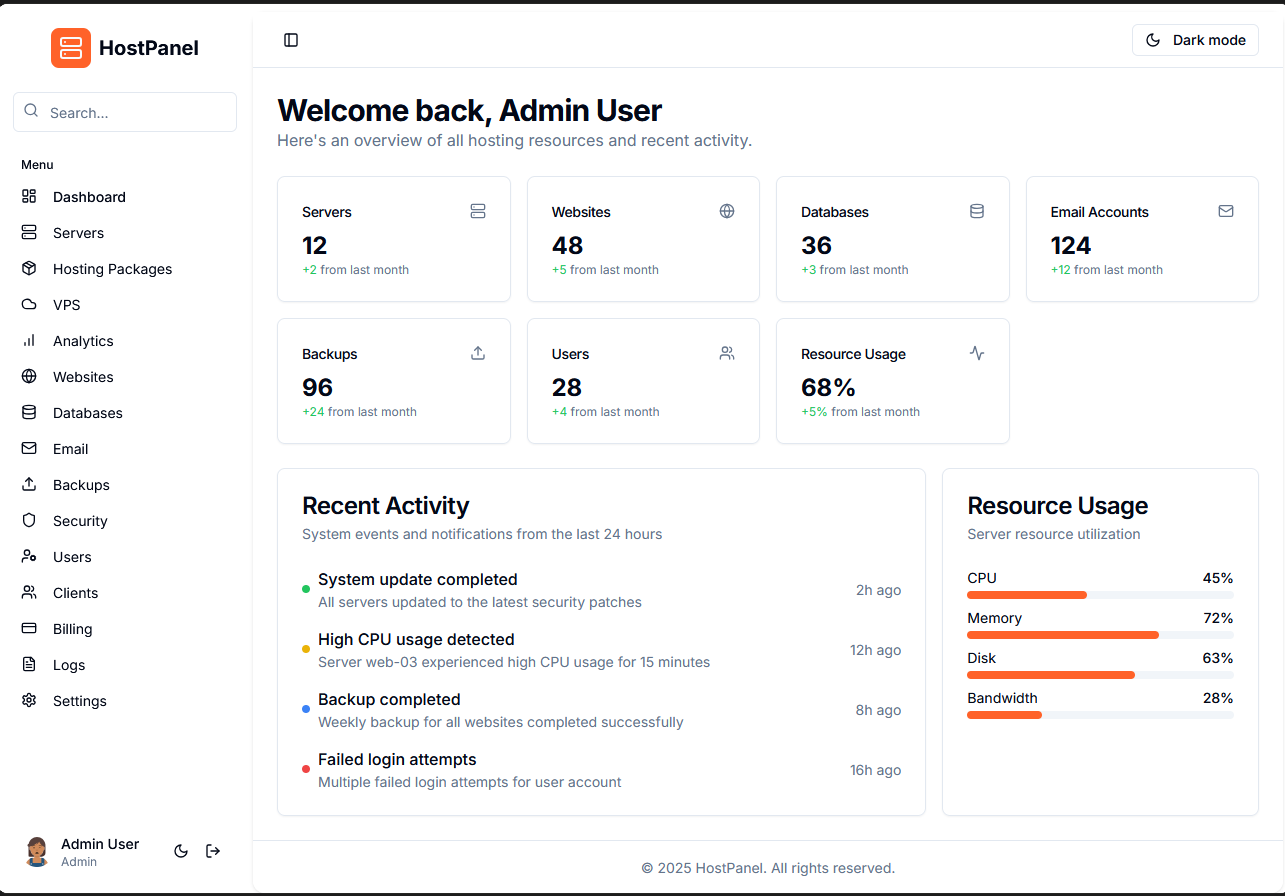
Product Requirements Document (PRD)
1. Project Purpose
To create a modern, lightweight, and self-hosted control panel for a small hosting company. The panel will allow the management of servers, websites, email services, and backups, focusing on speed, flexibility, and minimal reliance on external solutions.
2. Target Audience / Users
- Administrators – infrastructure and client management
- Resellers – selling services to other users
- End Users – managing accounts, websites, databases, email, etc.
3. Key Features
a) General
- Modern, responsive UI (desktop, tablet, mobile)
- Separate dashboards: admin, reseller, user
- Centralized dashboard for all resources
b) Web Hosting
- Support for Laravel, Node.js, React, Magento, Python
- Multi-vhost (each app with its own config)
- Autoinstallers for: Laravel, WordPress, Roundcube, etc.
- Website-level resource usage tracking (CPU, RAM, I/O)
- Automatic alerts for abnormal behavior or infection signs
- Optional isolation/quarantine or auto-suspension of compromised sites
- Behavioral analysis engine to detect common attack patterns, malware signatures, and suspicious activity
- Integrated WordPress management tool: update themes/plugins, enable/disable, uninstall without accessing wp-admin
- Varnish + OPcache support with GUI configuration tools
Support for Node.js applications with per-app configuration
- Compatible with: Strapi v4, Ghost, Nuxt, etc.
- Auto-detection of
package.jsonandecosystem.config.js(if using PM2) - Automatic reverse proxy setup via NGINX/Apache
- Optional subdirectory or subdomain mapping (e.g.,
example.com/blogfor Ghost) - Ability to define Node version per app (via
.nvmrcor settings UI) - Built-in support for PM2 process manager with GUI controls (restart, logs, etc.)
c) Email
- Custom mail server (Postfix or Exim)
- Integrated webmail (e.g. Roundcube)
- High-level anti-spam and security
- Email activity monitoring (volume, spam patterns, blacklisting status)
- Admin alerts on suspicious or excessive outbound mail
d) Backup
- Support for: S3, Bunny, Cloudflare R2, Hetzner Volumes
- Backup management from the dashboard
e) Database
- PostgreSQL with interface via pgAdmin or integrated alternative
- Database access from the dashboard
f) Dev & Stack
- Multi-PHP support
Integrated file manager (lightweight)
- CHMOD functionality for permissions
- File/folder creation, editing, uploading
- Zip/unzip, rename, delete
Crontab / job manager
g) Automation
- Automatic provisioning upon account/server creation
- Billing + invoicing
- Rate limiting
- Resource management with custom rate limiting, inspired by CloudLinux features, including per-user limits for CPU, RAM, I/O, and number of processes, adapted for lightweight environments.
h) Security
- ModSecurity
- SSL management
- Audit trail
- GUI-based integration with CPGuard, Imunify, BitNinja, or other AV/intrusion systems
- ClamAV integration with automatic scanning scheduled during low-resource usage windows
- Two-factor authentication (2FA) via common TOTP apps (Google Authenticator, Authy, Microsoft Authenticator)
- IP restriction for admin/reseller access
- Role-based access control (RBAC)
- Logging and audit events
- Access tokens for secure API access
- Prohibited domain names list
- Brute force protection and rate limiting
- Device/session tracking per user
i) Monitoring (in-house)
- No Netdata, no Docker
- Lightweight internal solution for resource tracking
- Real-time notifications and logging for abuse/infection detection
- Per-client website and email behavior monitoring with configurable thresholds and notifications
j) Account & UI Features
- Customer impersonation (see exact user view without logging out)
- Soft delete with retention window + restore option
- Multi-package support per user
- Unified panel (admins and users see only what’s relevant)
- Multi-language support per login
- Multi-account login support
- Global search bar
- Branding (colors, logo, fonts)
- Dark mode by default (user override allowed)
4. Tech Stack
- Frontend: Vite + SolidJS + TailwindCSS + ShadCN UI + TypeScript
- Backend: Node.js / Go / Rust (for future phases)
- Database: PostgreSQL
- Mail: Postfix / Exim (no Docker)
- Storage: Local + Cloud Buckets (S3, Bunny, R2, Hetzner)
- Node Runtime Management: NVM + PM2 support (non-Docker)
5. MVP (Minimum Viable Product)
- Login/Register + user dashboard
- Website/app creation with configurable vhost
- Functional email + webmail
- Manual backup to S3/Bunny
- Database view and management
- Fully responsive UI
- Basic Node.js app deployment with reverse proxy support and PM2 process start/stop
6. Scalability (Future)
- Cluster management support
- Multi-server UI
- Distributed provisioning scripts and automation
- Instance replication
- Node.js health monitoring and port/socket management
- App templates for common Node stacks (Ghost, Strapi, etc.)
7. Limitations / Exclusions
- No Docker, no Firebase Store
- All data must be 100% portable to self-hosted infrastructure
- No use of external SaaS monitoring tools (e.g. Netdata)
- Exclude Next.js from frontend stack
8. Security Considerations
- Two-factor authentication (2FA) via common TOTP apps (Google Authenticator, Authy, Microsoft Authenticator)
- IP restriction for admin/reseller access
- Role-based access control (RBAC)
- Logging and audit events
- Access tokens for API use
- Device/session tracking and management
9. UI/UX Overview
- Design based on ShadCN UI
- Modular components (cards, tables, modals, sidebar)
- Fast and intuitive navigation
- Dark mode by default
- Fully brandable (logos, styles)
- Global search across resources


Log in or sign up for Devpost to join the conversation.