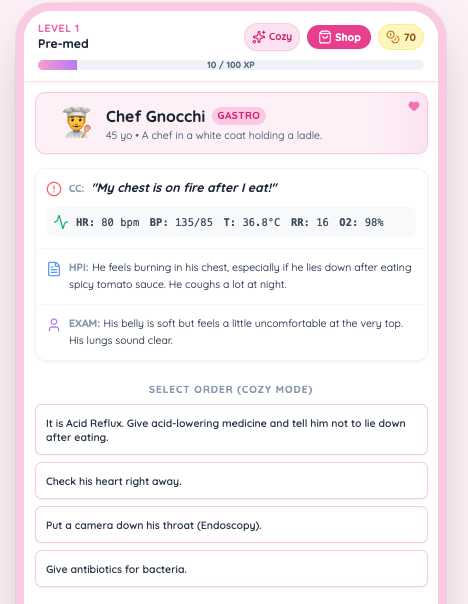
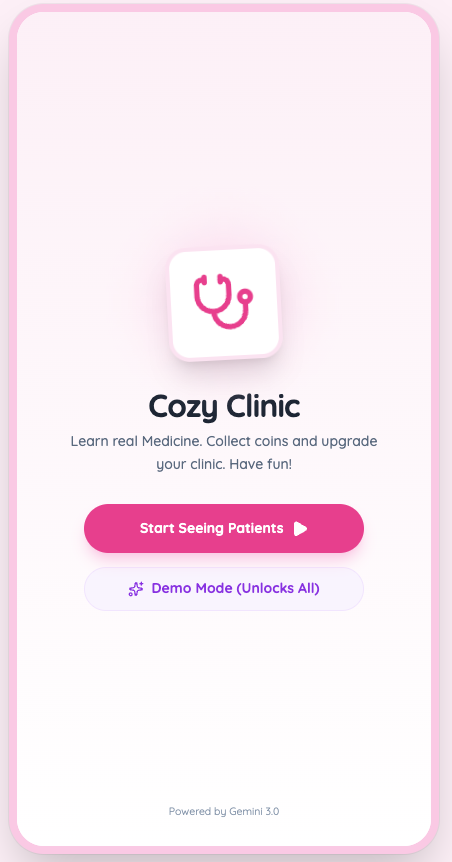
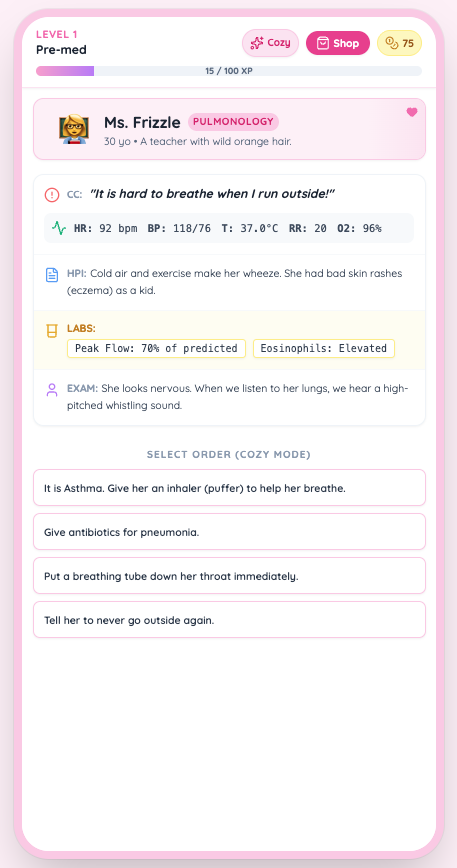
🏥 The Concept: An AI-Powered Casual Game with Real Medical Cases
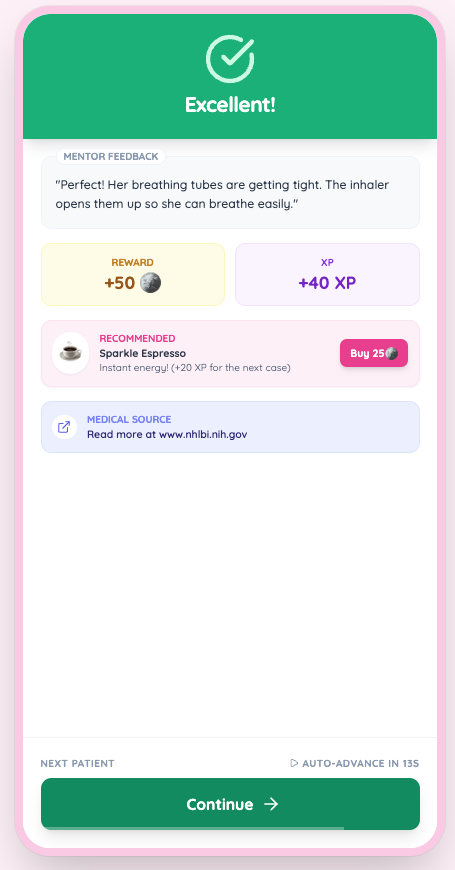
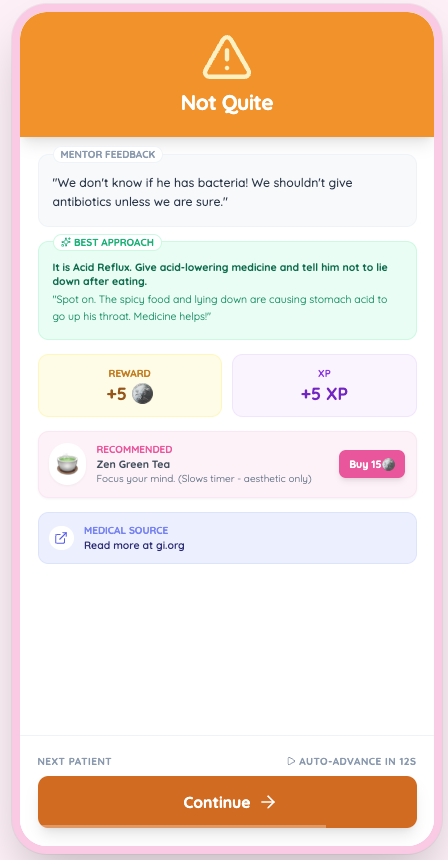
Cozy Clinic is an easy, addictive casual medical simulation game. Gemini 3 creates realistic, accurate clinical scenarios and formats them to be more friendly and easy to understand. Players choose the next best step, and win coins for better answers and harder cases. Every patient's symptoms, history, and personality are uniquely crafted by Gemini 3 AI -- all within a delightful, accessible interface as easy to play as the top-ranking casual mobile games.
A Gemini 3 Vending Bech (literally)
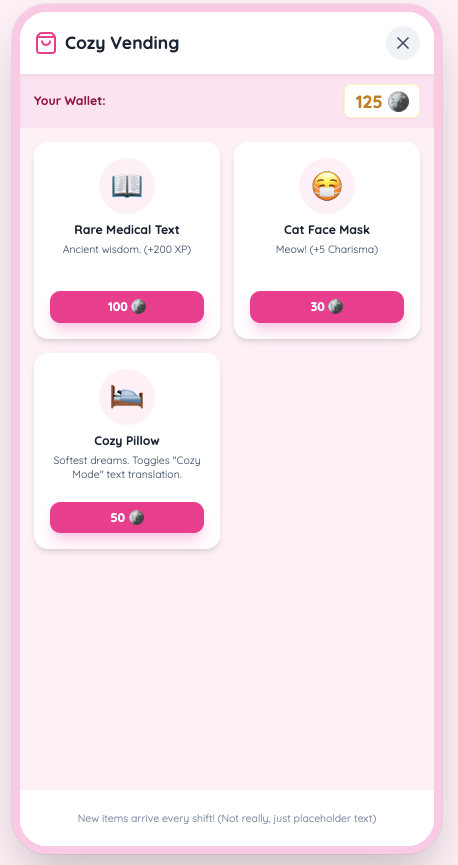
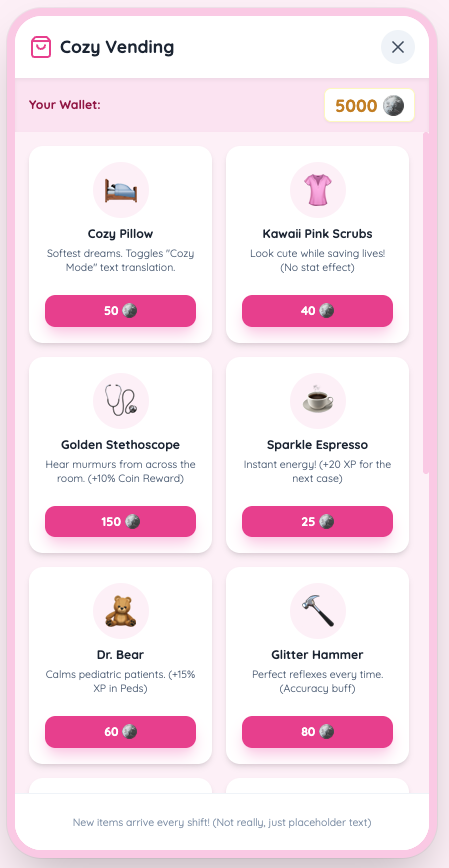
This is a geeky pun but real. [link]Vending Bench(https://andonlabs.com/evals/vending-bench-2) is a family of AI long-term coherence benchmarks which Gemini 3 currently tops. But we literally added a vending machine system into the game, where players can buy upgrades and buffs for their clinic. Gemini 3's long-term coherence manages the vending machine, re-stocking and deciding what else to stock. Also, the Gemini-generated patient case scenarios grow more and more sophisticated as they make use of the new diagnostic equipment, facilities, and other buffs that players may buy in the vending machine as they earn more coins.
✨ Inspiration: Bringing "Cozy" to Biomedical Training
The project was born from a desire to transform biomedical education from a dry, high-pressure exercise into an engaging, casual game that everyone could enjoy -- especially in low-resource countries where medical education is harder to come by, and in populations where children may not always get the chance to dream of becoming doctors. Drawing on Henry's background from being a medical educator at Cornell University / Weill Medical College, and Kimi's experience rapidly having to learn a ton of medical biology for an internship, we wanted to capture the intellectual puzzles of medicine -- but present them in a world that is visually inviting and fun to inhabit for all ages.
🛠️ The Build: Our Tech Stack
Thanks to watching the hackathon video sessions and some Discord posts, and some experiments, we used:
- Google AI Studio : rapid prototyping at first, before we switch to Firebase Studio and then back to AI Studio
- Google Gemini (Chat) : development of game concepts and prompts
- Firebase Studio: was good for additional building but became unwieldy over time. We weren't planning on launch a scaled, shipping game quite yet so we saved our progress and then started over again back in Google AI Studio.
- Firebase: We wanted to use this to manage the back-end and handle user sessions and persistent data, but we'll probably save this for more detailed work where we can build up a more robust data model and think about social features also.
🧠 Lessons: Gemini 3 is pretty amazing at thinking laterally
Clinical Sophistication : Although Google has blogged about Med-PaLM, Gemini 3 is very impressive from a medical accuracy and sophistication perspective. This isn't just because the cases are accurate, but it's also better at translating terms into lay-friendly, and even cozy/cute terms (in earlier prototypes the game was too cute even for really gruesome medical scenarios). So that lateral thinking of how to make cases just accurate enough without scaring users was very special to see Gemini 3 do.
Vending Machine / Vending Bench : Gemini 3 was unusually amazing at balancing an odd combination of needing to have game-like buffs and items to stock in the vending machine, but also making them relevant to medical cases. I have to confess -- it might actually do well in a real world setting managing hospital supply chain. For now we hope it can just keep up with a multiplayer game universe someday of simulated doctors and clinic patients.
Visual Consistency with Gemini
Using Gemini’s image generation allowed us to produce a cohesive art style for the game and even, at one point, patient avatars. Patient avatars were challenging to generate quickly in earlier versions, so we went with a placeholder solution instead for Gemini 3 hackathon prototype.
Rapid Iteration with AI Studio
Gosh this was fun. It was simply awesome for "tuning" a lot of elements including the AI’s personality, allowing us to pivot quickly from clinical data to character-driven dialogue but then dial it back, and also testing and ensuring minimum wait times. For example, we have Gemini 3 generating content, while users are reading other content.
🚧 Challenges: The Struggle for Persistent Memory
The most significant technical hurdle was integrating persistent storage for our AI-generated content and user model. Because Gemini 3 creates scenarios in real-time, mapping that fluid data into a structured, persistent Firebase database while maintaining state across player sessions was difficult, so we tabled it after initial Firebase Studio prototyping. Ensuring that a patient’s unique medical history remained "sticky" and consistent without slowing down the game required several architectural overhauls.
This matters a lot because we wanted the game to have patients to return, so players could experience longer-term relationships with patients and their families and caregivers. To take advantage of Gemini 3's long context, we wanted patients themselves to be able to return but keep track of what decisions the players had made in the past. So for example a patient with asthma could keep getting worse, or better, or decision made earlier could affect their later trajectory. Eventually we see this long context also modeling NPC-to-NPC patient-to-patient interactions, which is important in families, caregiver contexts as well as other scenarios like mental health and infectious disease.


Log in or sign up for Devpost to join the conversation.