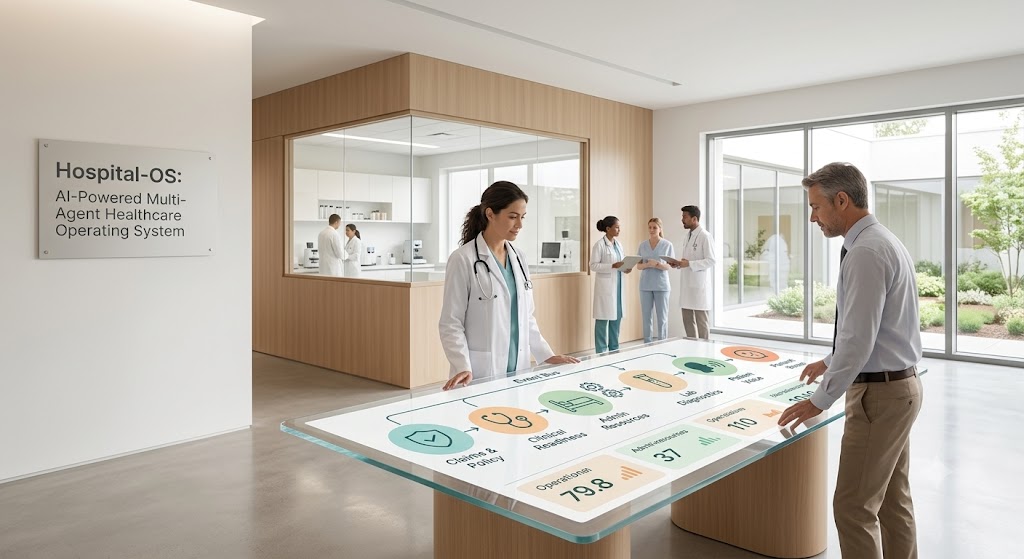
🏥 Hospital-OS
AI-Powered Multi-Agent Healthcare Operating System
Hospital-OS is a proposed multi-agent healthcare operating system designed to connect doctors, hospital administrators, laboratory technicians, patients, and insurance workflows through intelligent AI agents, real-time events, healthcare interoperability standards, and voice-based communication.
**🧠 Multi-Agent AI** • **🏥 Healthcare Automation** • **📋 Claims Intelligence** • **🩺 Clinical Workflows** • **🎙️ Voice AI** • **🔗 FHIR**
🌟 Inspiration
Modern hospitals operate through multiple interconnected departments, but many workflows remain fragmented.
Insurance claims, surgical preparation, laboratory results, hospital resources, patient communication, and administrative operations can involve different systems and teams. This fragmentation can lead to delays, repeated manual work, and difficulty maintaining a unified view of a patient's operational journey.
Our idea is to build Hospital-OS as an intelligent coordination layer across these workflows.
Instead of creating a single healthcare chatbot, we propose a multi-agent ecosystem where specialized AI agents handle specific hospital responsibilities and communicate with each other through a centralized event-driven architecture.
🎯 Core Vision
┌──────────────────────────────┐
│ HOSPITAL-OS │
│ AI-Powered Coordination │
└──────────────┬───────────────┘
│
┌─────────────┬───────┼───────┬─────────────┐
▼ ▼ ▼ ▼ ▼
👨⚕️ Doctor 🏢 Admin 🧪 Lab 👤 Patient 🛡️ Insurance
│ │ │ │ │
└─────────────┴───────┼───────┴─────────────┘
▼
🤖 Multi-Agent Layer
│
▼
🔄 Hospital Event Bus
│
┌───────────┴───────────┐
▼ ▼
FHIR / EHR AI / RAG
The goal is to transform disconnected hospital workflows into a coordinated intelligent system.
🚀 What We Plan to Build
Hospital-OS is planned as a 17-agent healthcare ecosystem across 5 major operational domains.
| Domain | Planned Capability |
|---|---|
| 🛡️ Insurance | Policy monitoring, claims validation & correction |
| 👨⚕️ Doctor | Surgery readiness, clinical clearance & AI assistance |
| 🏢 Administration | Resource optimization & bottleneck intelligence |
| 🧪 Laboratory | Diagnostic workflow & result processing |
| 👤 Patient | Care-plan visibility & AI voice communication |
🧠 Multi-Agent Architecture
The core of Hospital-OS will be a specialized multi-agent architecture.
Each agent will have a specific responsibility instead of relying on one general-purpose AI.
flowchart TB
USER["🏥 Hospital Users"]
USER --> DOC["👨⚕️ Doctor"]
USER --> ADM["🏢 Administrator"]
USER --> LAB["🧪 Lab Technician"]
USER --> PAT["👤 Patient"]
DOC --> EVENT["🔄 Hospital Event Bus"]
ADM --> EVENT
LAB --> EVENT
PAT --> EVENT
EVENT --> AGENTS["🤖 Multi-Agent Layer"]
AGENTS --> CLAIM["🛡️ Claims & Policy Agents"]
AGENTS --> DOCTOR["🩺 Doctor Agents"]
AGENTS --> ADMIN["📊 Admin Agents"]
AGENTS --> LABAGENT["🔬 Lab Agents"]
AGENTS --> PATIENT["💬 Patient Agents"]
CLAIM --> RAG["📚 RAG / Policy Knowledge"]
DOCTOR --> FHIR["🔗 HL7 FHIR"]
ADMIN --> DB["🗄️ Hospital Data"]
LABAGENT --> FHIR
PATIENT --> VOICE["🎙️ Voice AI"]
RAG --> LLM["🧠 LLM Reasoning"]
FHIR --> LLM
DB --> LLM
VOICE --> LLM
LLM --> AUDIT["🔐 RBAC + Audit"]
🔄 Proposed Claims Intelligence Pipeline
One of the major workflows we plan to build is an AI-powered insurance claim validation pipeline.
flowchart LR

    A["📄 Payer Policy PDFs"]
    B["🔍 Policy Change Detector"]
    C["📚 Pinecone RAG"]
    D["🔗 FHIR Procedure Data"]
    E["🤖 Claims Validator"]
    F{"Decision"}

    G["✅ Approval Router"]
    H["📦 X12 EDI 837P"]
    I["❌ Rejection Ticket"]
    J["🎙️ AI Voice Agent"]
    K["🔄 Alternative Code"]
    L["♻️ Re-validation"]

    A --> B
    B --> C
    B --> D

    C --> E
    D --> E

    E --> F

    F -->|APPROVED| G
    G --> H

    F -->|REJECTED| I
    I --> J
    J --> K
    K --> L
    L --> E
Planned Flow
- Ingest payer policy documents.
- Detect changes between old and new policies.
- Store policy knowledge in a vector database.
- Retrieve relevant policy rules for incoming claims.
- Combine claim information with patient procedure history.
- Use an LLM to reason over the retrieved information.
- Produce an approval/rejection decision with reasoning and citations.
- Route approved claims toward standardized EDI generation.
- For rejected claims, initiate a patient communication workflow.
- If an alternative code is applicable, revalidate the claim.
The proposed architecture follows the claims workflow described in the project design.
🏥 Five Operational Domains
1. 🛡️ Insurance Claims & Policy Validation
The proposed claims ecosystem will contain specialized agents for:
- Policy change detection
- FHIR policy synchronization
- Claims RAG validation
- Approval routing
- Rejected-claim voice outreach
The claims validator is planned to combine patient procedure history, policy retrieval, claim information, and LLM reasoning before producing a structured decision.
2. 👨⚕️ Doctor Cockpit
The Doctor Cockpit will be designed around three major workflow areas:
🩺 Surgery Readiness
A planned readiness scorecard will evaluate multiple prerequisites such as:
- ECG / laboratory completion
- Pre-operative imaging
- Blood-bank reservation
- Insurance authorization
- Operating theater availability
🧑⚕️ Clinical Clearance
The proposed agent will evaluate structured patient information and support the pre-operative clearance workflow.
🔬 Diagnostic Scan Dispatcher
Doctor scan requests will be converted into standardized FHIR ServiceRequest objects and routed toward the laboratory workflow.
💬 Doctor AI Assistant
A natural-language assistant will be proposed for queries related to:
- Patient history
- Schedules
- Clearances
- Hospital workflow information
🏢 3. Admin Command Center
The administration layer will focus on hospital-level operational intelligence.
Planned Agents
Operation Claims Pre-Approval Agent
Designed to identify surgical claims requiring pre-authorization workflows.
OT & Bed Resource Optimizer
Planned to analyze:
Hospital Beds
      +
Operating Theaters
      +
Current Utilization
      ↓
Resource Optimization
Bottleneck Intelligence Agent
Designed to trace a patient's operational journey and identify potential sources of delay such as:
- Imaging queues
- Insurance authorization
- Missing workflow updates
- Department-level bottlenecks
Admin AI Assistant
A planned natural-language assistant for hospital administrators.
🧪 4. Laboratory Workspace
The proposed laboratory workspace will connect diagnostic workflows with the rest of Hospital-OS.
Planned Workflow
Doctor
  │
  ▼
📋 Diagnostic Order
  │
  ▼
🔄 Event Bus
  │
  ▼
🧪 Lab Technician
  │
  ▼
📊 Lab Result
  │
  ▼
🔄 Event Bus
  │
  ▼
🩺 Surgery Readiness
The system is planned to support diagnostic work-order management and publication of completed laboratory results as hospital events.
👤 5. Patient Care Hub
The patient-facing layer is planned to provide:
📊 Care & Claims Dashboard
Patients would be able to view relevant:
- Health records
- Procedure history
- Claim status
- Care-plan information
🎙️ AI Voice Communication
For selected claim workflows, a planned voice agent would communicate with patients using:
Deepgram STT → LLM Reasoning → Deepgram TTS
The proposed workflow would allow a patient response to influence whether a claim correction workflow continues or is escalated.
🔄 Hospital Event Bus
A major architectural component will be a decoupled event-driven communication layer.
Instead of directly connecting every agent to every other agent:
Doctor Agent ──────┐
Lab Agent ─────────┤
Claims Agent ──────┼──► 🔄 Event Bus ───► Relevant Subscribers
Admin Agent ───────┤
Patient Agent ─────┘
For example:
LAB_RESULT_READY
       ↓
Event Bus
       ↓
Surgery Readiness Agent
       ↓
Recalculate Readiness
       ↓
Doctor Cockpit
This architecture is intended to make the system more modular and allow individual agents to evolve independently.
🔐 Security & Healthcare Interoperability
Healthcare systems require controlled access and traceability.
Hospital-OS is therefore planned around:
🔑 Role-Based Access Control
DOCTOR
 ├── Patient Records
 ├── Surgery Readiness
 └── Clinical Workflows

ADMIN
 ├── Hospital Operations
 ├── Claims
 └── Resource Intelligence

LAB TECH
 ├── Diagnostic Orders
 └── Lab Results

PATIENT
 ├── Own Claims
 └── Care Plan
📋 Audit Provenance
The architecture proposes maintaining audit records for sensitive AI operations.
🔗 Healthcare Standards
The planned system will use:
- HL7 FHIR R4
- FHIR AuditEvent
- X12 EDI 837P
for healthcare interoperability, auditability, and electronic claim representation.
🧰 Proposed Technology Stack
| Layer | Technology |
|---|---|
| 🧠 Agent Orchestration | LangGraph |
| 🤖 LLM | Groq GPT-OSS-120B |
| 📚 Vector Database | Pinecone |
| 🔢 Embeddings | Hugging Face all-MiniLM-L6-v2 |
| 🎙️ Speech-to-Text | Deepgram Nova-2 |
| 🔊 Text-to-Speech | Deepgram Aura |
| ⚡ Cache / Memory | Redis |
| 🗄️ Database | SQLite |
| 🔗 Healthcare Standard | HL7 FHIR R4 |
| 📋 Claims Standard | X12 EDI 837P |
| ⚙️ Backend | FastAPI + Uvicorn |
| 💻 Frontend | Next.js + React + TypeScript |
| 🎨 UI | Tailwind CSS |
| 🔎 Observability | LangSmith |
🗂️ Proposed Data Architecture
The system is planned around several logical data domains:
                    🏥 Hospital-OS Data Layer
                              │
          ┌───────────────────┼───────────────────┐
          ▼                   ▼                   ▼
     🛡️ Claims            🩺 Clinical         🏢 Operations
          │                   │                   │
      Claims DB           FHIR Data          Hospital Data
          │                   │                   │
          └───────────────────┼───────────────────┘
                              ▼
                       🔄 Event Bus
                              │
                              ▼
                         🤖 AI Agents
The planned database model includes claims, doctors, surgeries, scans, hospital capacity, diagnostic reports, audit events, and hospital events.
📡 Planned API Layer
The backend is planned around role-specific REST APIs.
| Area | Example Endpoints |
|---|---|
| 🛡️ Claims | /api/upload, /api/claims, /api/stats |
| 👨⚕️ Doctor | /api/surgeries, /api/scans/order, /api/doctor/chat |
| 🏢 Admin | /api/admin/hospital-capacity, /api/admin/chat |
| 🧪 Lab | /api/lab/submit, /api/scans/complete |
| 🔄 Events | /api/events, /api/events/publish |
| 🔐 Audit | /api/audit-trail |
| 📊 Intelligence | /api/bottleneck/trace |
These endpoints represent the planned interface between the Hospital-OS frontend, agents, and backend services.
⚡ Key Challenges We Expect
Building a healthcare multi-agent system introduces several architectural challenges.
1. Multi-Agent Coordination
17 specialized agents need clear responsibilities and reliable communication.
2. Healthcare Data Interoperability
AI workflows must operate alongside structured healthcare standards such as FHIR.
3. Policy-Aware RAG
Insurance policies can change, so the system needs mechanisms for identifying and retrieving the correct policy information.
4. Real-Time Voice AI
Patient communication requires low-latency speech recognition, reasoning, and speech synthesis.
5. Security & Auditability
Healthcare data requires strict role-based access and traceable AI actions.
6. Event-Driven Consistency
Changes in one department may affect multiple downstream workflows, making reliable event propagation important.
🏆 What We're Proud Of
The primary achievement at this stage is the system concept and architecture.
We have transformed the initial healthcare problem into a structured multi-agent design covering:
17 AI Agents
      ↓
5 Operational Domains
      ↓
1 Hospital Event Bus
      ↓
FHIR + RAG + Voice AI
      ↓
Unified Hospital-OS
The architecture connects claims intelligence, clinical readiness, hospital operations, laboratory workflows, and patient communication into one proposed ecosystem rather than treating them as independent AI applications.
📚 What We Learned
While framing the architecture, we learned that an AI healthcare platform requires much more than an LLM.
The system needs a combination of:
- 🤖 Agent orchestration
- 📚 Retrieval-Augmented Generation
- 🔗 Healthcare interoperability
- 🔄 Event-driven architecture
- 🎙️ Real-time voice AI
- 🔐 Role-based security
- 📋 Audit provenance
- ⚡ Caching and asynchronous workflows
Most importantly, we learned that specialized agents can be designed around real operational responsibilities, rather than creating one generic chatbot for the entire hospital.
🛣️ What's Next for Hospital-OS?
Hospital-OS is currently being framed as a proposed architecture and implementation roadmap.
Our next phase will be to turn the architecture into a working prototype.
Phase 1 — Foundation
- Set up FastAPI backend
- Create hospital data models
- Establish FHIR-based structures
- Build role-based frontend foundation
Phase 2 — Intelligence
- Implement policy RAG
- Develop claims validation workflow
- Introduce LangGraph agent orchestration
- Build doctor and admin AI assistants
Phase 3 — Hospital Coordination
- Implement Hospital Event Bus
- Connect laboratory workflows
- Build surgery-readiness intelligence
- Add resource and bottleneck analysis
Phase 4 — Patient Interaction
- Integrate Deepgram STT/TTS
- Develop patient voice workflows
- Connect claim correction and escalation flows
Phase 5 — Security & Evaluation
- Implement RBAC
- Add FHIR audit provenance
- Add observability with LangSmith
- Evaluate agent reliability and workflow performance
🌐 Final Vision
🏥 HOSPITAL-OS
│
┌───────────────────┼───────────────────┐
│ │ │
👨⚕️ Clinical 🏢 Operations 👤 Patient
│ │ │
└───────────────────┼───────────────────┘
│
🔄 EVENT BUS
│
🤖 MULTI-AGENT AI
│
┌─────────────────┼─────────────────┐
│ │ │
📚 RAG 🔗 FHIR 🎙️ Voice
│ │ │
└─────────────────┼─────────────────┘
│
🧠 LLM CORE
│
🔐 AUDIT + RBAC
Our vision is to build Hospital-OS as an intelligent coordination layer for modern hospitals — connecting clinical, administrative, laboratory, insurance, and patient workflows through specialized AI agents.
👥 Project Focus
Hospital-OS & FHIRFlow
A proposed Multi-Agent Healthcare Operating System & Claims Intelligence Platform
Core Themes:
Multi-Agent AI · Healthcare AI · RAG · FHIR · Claims Intelligence · Voice AI · Event-Driven Architecture · Clinical Workflow Automation


Log in or sign up for Devpost to join the conversation.