Inspiration
In 2016 alone, an estimated 145 million visits were made to one of the United States’ 5,000 emergency rooms (CDC). By federal law, emergency rooms are required to care for all patients who request assistance, regardless of their ability to pay. As a result, non-urgent care patients are occasionally routed to hospital ER’s, leading to the potential for heavy debt.
“More than $18 billion could be saved annually if those patients whose medical problems are considered ‘avoidable’ or ‘non-urgent’ were to take advantage of primary or preventive health care and not rely on ERs for their medical needs.” (Debt.org)
In order to address this issue, the Hospital Helpers team sought to develop an app capable of not only introducing alternative healthcare options but also open the door for increased hospital transparency. Within the state of North Carolina, access to healthcare and health insurance information is lacking, and so this app aims to compile and make available possible health facility options for patients.
On a personal level, several members of the team have had close family members and friends who had gone through the NC hospital system for various health complications. They recognize from first-hand experience the difficulties that arise not only from paying hospital bills but also from making the right decision in the moment to find a healthcare facility that best fits their needs. Thus, when confronted with statistics and observations on both the state and national levels, the team sought to make a change in this area.
What it does
This application seeks to connect users with data about nearby hospital procedures using geographical information. The app is divided into several important components.
Locations Searching
Upon opening up the app, users are introduced to the Locations screen. From this page, the user may access a preset archive of all NC hospitals to select. If needed, they may input the zip code for their area to find location-specific healthcare facilities. Once the region has been confirmed, users may be redirected to the Google Maps app, which will indicate their current location, the location of the healthcare facility, and their relative distance to the hospital.
Procedures Searching
Additionally, aside from searching by location, the user can also add on a search by procedural application. These procedures may be searched using the official medical codes that hospitals use for such procedures (to minimize ambiguity). Based upon this, information regarding healthcare facilities offering the selected procedures is returned.
Directions
Finally, the app has a further resources page dedicated to clarifying the app’s purpose. It also provides the user with many useful articles about hospital price transparency and healthcare affordability.
How we built it
Once the area of inspiration was identified, our team set out to refine the list of ideas we had. There were several key components we identified as being crucial to the effectiveness of our final product. These components were selected based on their ability to ensure the simplicity and sustainability of our app as a tool available to the general public. That is, one, the information had to be updateable and patchable and, two, the app had to be easy to use, especially in the case it was lending information to the making of a crucial decision.
With this goal in mind, we wanted to ensure the app had the following functionalities: Determining the geographical location of users, Updatable information on healthcare facilities, and User interaction that would allow for manual addition of facilities.
Following extensive communication (each team member pitched a series of ideas, we discussed the pros and cons of each concept, and weighed the risks), we landed on the development of an app that compiled key hospital data in an updateable database, which could be categorized geographically and visualized on a map.
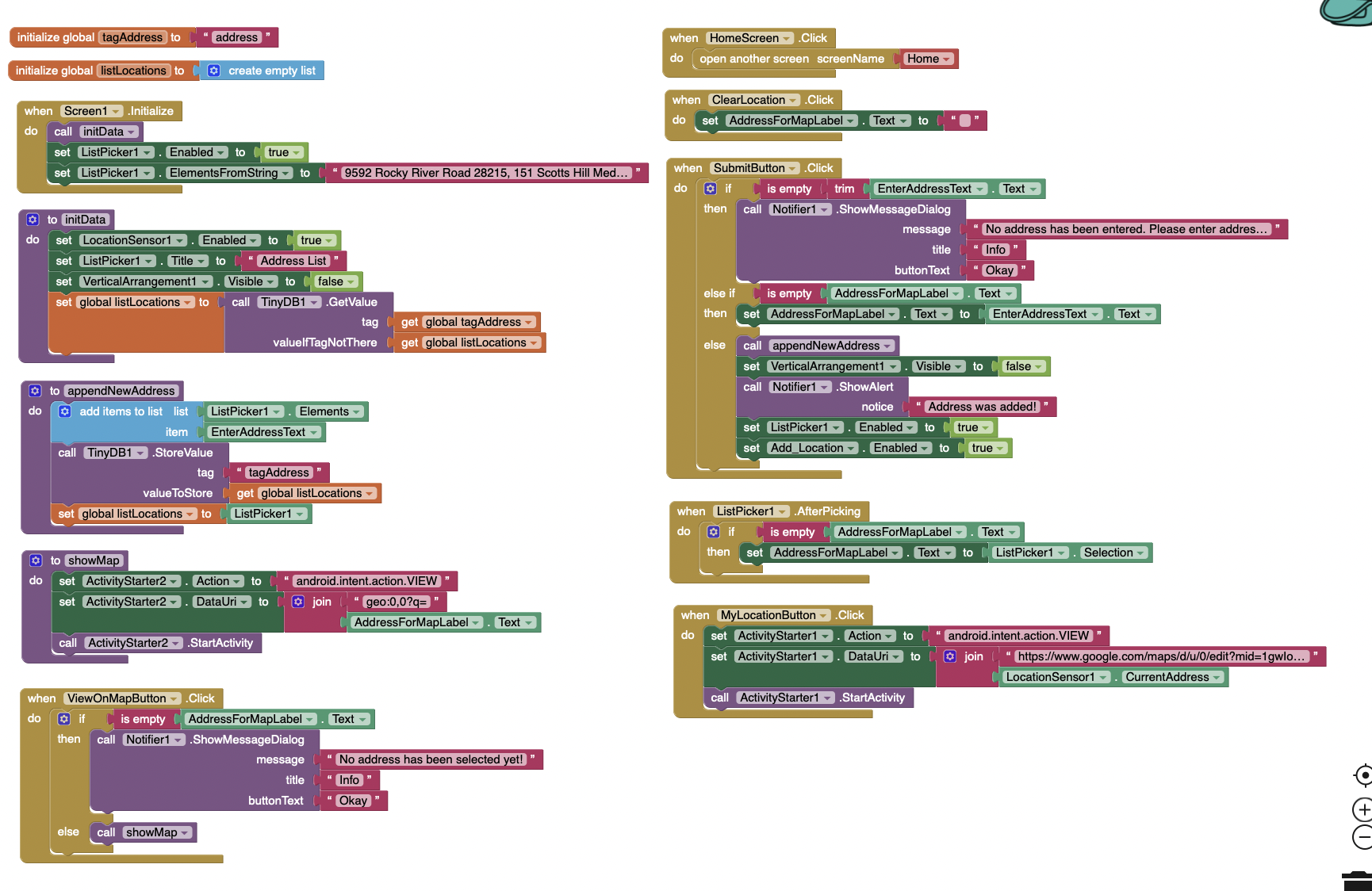
We opted to use MIT App Inventor to develop the interface. During the first few weeks of this project, our team members, several of whom had not used this platform before, sought out available training and tutorials online. This would allow for the relatively equal distribution of work and the identification of each others’ strengths and weaknesses for this project.
From there, our team divided into the core app development and writing team. Our app development team built upon what was learned during the training period and developed the foundational code, while the writing team created a well-rounded product concept and product brand.
Throughout the process, in order to ensure we were both maximizing our team’s potential and creating the best possible solution to the problem identified, we regularly communicated (typically over messages due to scheduling concerns) to provide feedback and reflection on our progress thus far.
Challenges we ran into
Despite our regular reflections and feedback sessions, our team was still faced with a number of challenges. One of our biggest challenges was gaining access to a complete database filled with the NC hospitals with their medical codes and prices. While one of our team members had previously worked with this database, extensive communication with the data owners was needed to ensure we had permission to use it in the app. After permission for data usage was obtained, the data itself required substantial cleanup in order to be imported into MIT App Inventor.
Additionally, scheduling turned out to be an unexpected issue in our workflow. Since many of our team members are also dedicated to other extracurricular activities and heavy schoolwork, it was difficult to get everyone to stick to a set time to meet. As a result, much of our work had to be done asynchronously, although we developed a strong rapport online, which helped remedy this situation slightly. We eventually rectified this issue by scheduling hour-long work sessions, especially as we approached the submission date. This allowed us to simultaneously ensure the focus of our fellow team members and collaborate in real time..
Accomplishments that we're proud of
In spite of each of the challenges we faced, our team has come together to develop a full-fledged application that fulfills each of the criteria we set for ourselves at the beginning of this project. While the process from idea to development to completion was met with numerous roadblocks, we still managed to step up to the plate and put our best foot forward.
In particular, we stepped beyond our initial expectations and were able to integrate both a database and a web-based map application into the app. The dataset was, in itself, difficult to wrestle into a useable format and was a beast in itself. Once the data had been processed (using Python code), it had to be processed a second time to be loaded onto the map. Through this project, we recognized how our capabilities and skills (including those gained) could be applied, of which we are incredibly proud. Thus, it follows that we are grateful for this opportunity to step out of our comfort zones and into an area of focus that is not generally touched by high school students.
What we learned
Over the past few months, our team has been fortunate enough to catch a small glimpse of key aspects of the initial app development process. While our team was relatively new to the area of app development,
Several of our team members did not have as much background knowledge in the area of app development and were initially hesitant to directly involve themselves in the project. Yet, as our team has progressed, we have each come to recognize that we play well off of each other’s strengths and, as a result, we have pushed each other to develop stronger analytical, critical thinking, and app development skills. Teamwork and creativity, too, further strengthened over the course of this project. Our research capabilities, particularly with a code-related problem-solving focus, also developed in part due to our approach to facing challenges.
What's next for Hospital Helpers
Hospital Helpers is excited to put forth this app as a product, as it has the potential to expedite and ease the anxiety of selecting a proper facility for healthcare. While the application does meet its original goal of providing public health transparency, particularly for NC hospitals, Hospital helpers still has a lot of potential. For example, we wanted to make insurance a key factor in our searches since it is highly impactful for each individual rather than hospital. This would give users the option to search for affordable procedures and hospitals alongside their or other insurance providers.
Regarding the data itself, we would like to integrate more clean data from primary or secondary data collection resources in order to gain the most up-to-date information about each hospitals and its procedures. We also wished to add a spreadsheet feature that would allow users to track their own procedures or pricing information. That way, they could document the prices they find, and even note any procedures that they found themselves without the app’s help.

Log in or sign up for Devpost to join the conversation.