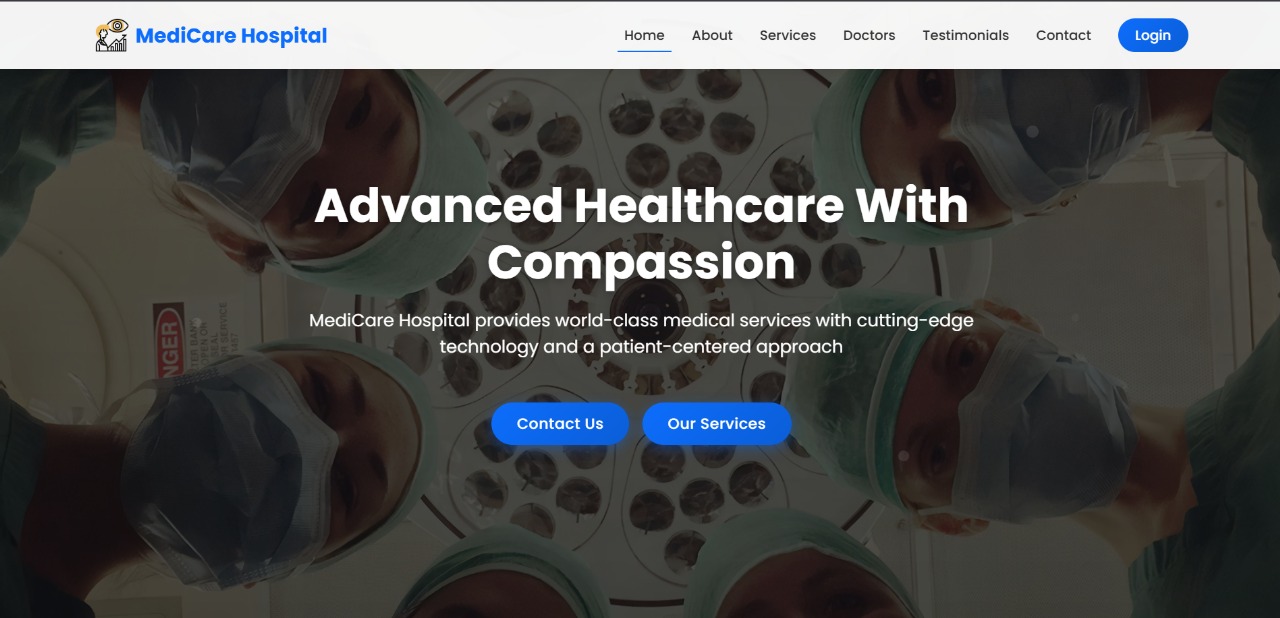


Challenges we ran into##The Hospital Copilot System was inspired by the urgent need for smarter, faster, and more efficient healthcare tools—especially in critical environments where time and accuracy are everything. During hospital visits and case studies, our team observed how overburdened medical professionals juggle multiple platforms, manual documentation, and delayed diagnostics, which can impact both care quality and staff burnout.
We asked ourselves: "What if we could give doctors an intelligent assistant that could generate reports, track patient data, and support critical decisions—all in real time?"
That question became the foundation for Hospital Copilot—a unified platform combining traditional hospital data systems with modern generative AI capabilities.
The Hospital Copilot System is a comprehensive hospital management platform that combines traditional clinical workflows with advanced AI-driven features to improve decision-making, reduce administrative workload, and accelerate diagnosis.
Key Functionalities: AI-Powered Diagnostic Reports Upload MRI scans, X-rays, or medical kit images, and the integrated LLM-based generative AI instantly produces detailed diagnostic reports with highlighted key findings.
Patient Record Management Search and manage patient profiles using ID or name, including demographics, medical history, current medications, and assigned doctors.
Vitals Monitoring & Visualization Track real-time vitals such as heart rate, blood pressure, SpO₂, and temperature, and view trends over time with dynamic charts.
Medical Notes System Doctors and nurses can record and timestamp clinical notes manually for better case tracking and collaboration.
Secure Role-Based Access Different access levels for admins, doctors, nurses, and receptionists ensure data privacy and system integrity.
Report & Document Uploads Upload and organize files like lab results, X-rays, prescriptions, and progress reports in PDF, JPG, or PNG formats.
Appointment & Treatment Scheduler Built-in calendar to manage treatment plans and doctor consultations, complete with alerts and reminders.
Emergency Alerts Trigger critical alerts from the dashboard, sending instant notifications via SMS and email using Twilio and Nodemailer.
PDF Report Generation Automatically generate downloadable or shareable medical summaries and discharge reports.
We built the Hospital Copilot System as a full-stack web application using the MERN stack (excluding React), combined with modern AI and automation technologies to enhance functionality, usability, and performance in clinical settings.
Building a real-time, AI-assisted hospital management system came with several technical, design, and domain-specific challenges. Here’s what we encountered and how we tackled them:
🔍 1. Integrating LLM for Medical Image Analysis Challenge: Generating accurate and reliable diagnostic reports from images (MRI, X-ray, etc.) using a large language model required fine-tuning prompts and handling diverse image types.
Solution: We optimized preprocessing pipelines for image input, used cloud-based inference endpoints, and structured prompts to extract concise key findings.
🔐 2. Securing Sensitive Medical Data Challenge: Ensuring HIPAA-like privacy and data protection while handling sensitive patient data and role-based access.
Solution: We used JWT for secure authentication, bcryptjs for password hashing, and helmet, CORS, and rate limiting for API hardening.
📉 3. Real-Time Performance Bottlenecks Challenge: AI report generation and large file uploads initially caused server lag and response delays.
Solution: Implemented asynchronous file handling, optimized image compression before upload, and parallelized AI calls using async queues.
🧑⚕ 4. Designing a Doctor-Friendly Interface Challenge: Balancing feature-rich functionality with a clean, intuitive interface usable by busy doctors and nurses.
Solution: Iteratively redesigned the dashboard with user feedback, using Bootstrap and iconography to improve navigation and accessibility.
🧪 5. Testing in Medical Contexts Challenge: Validating the AI-generated output and workflow logic in the context of real-world medical use cases.
Solution: Conducted mock scenarios, verified AI responses with publicly available case studies, and built fallback manual input modes for validation.
Despite tight deadlines and ambitious goals, our team successfully delivered a powerful and innovative healthcare solution. Here are the accomplishments we’re especially proud of:
🧠 1. LLM-Based Diagnostic Report Generator We built and integrated a generative AI system capable of analyzing MRI scans, X-rays, and medical kit images to automatically produce structured medical reports with highlighted key findings—a real leap forward for diagnostic efficiency.
🏥 2. End-to-End Hospital Management Platform We designed and developed a full-stack system for secure patient data management, including profile tracking, vitals visualization, appointments, medical notes, and file handling—all tailored to hospital workflows.
⚙ 3. Robust Backend Architecture Using Node.js, Express, and MongoDB, we engineered a secure, modular, and scalable backend with clean API endpoints and role-based access control that can be extended to larger deployments.
📈 4. Dynamic, Doctor-Friendly Interface We created a clean, responsive UI using HTML, CSS, JavaScript, and Bootstrap, focusing on usability for medical professionals under time-sensitive conditions.
📤 5. Emergency Alert System Integration We integrated Twilio and Nodemailer to enable real-time emergency alerts, allowing doctors or admins to notify critical care teams via SMS and email with one click.
🔐 6. Data Security Implementation We took extra care to protect sensitive data using JWT authentication, bcrypt password hashing, Helmet for HTTP security, and rate limiting to prevent abuse.
🚀 7. Deployable & Scalable Design The system is designed with deployment-readiness in mind and can be scaled to work in small clinics or large hospital chains, with modular components for future integrations like IoT or multilingual AI support.
Participating in this project challenged us to go beyond standard development and dive deep into the intersection of healthcare, AI, and system design. Here’s what we learned along the way:
🧠 1. How to Integrate Generative AI into Real-World Applications We explored the potential of LLM-based AI not just for chatbots, but for generating meaningful diagnostic reports from medical images. This taught us how to design prompts, process image data for inference, and validate outputs for high-stakes environments.
🛠 2. Building Scalable and Secure Healthcare Systems We learned how to architect and implement a secure, role-based backend that handles sensitive medical data responsibly using JWT, bcrypt, and access control patterns, ensuring both security and scalability.
🎨 3. Designing User Interfaces for Professionals Under Pressure Creating a UI that works for doctors and nurses in real hospital scenarios pushed us to prioritize clarity, speed, and simplicity in our frontend design. We learned how small UX decisions can dramatically affect usability.
🌐 4. Working with Real-Time Alerts and Communication APIs Integrating Twilio and Nodemailer helped us understand how to build real-time communication systems that can make a difference in emergencies—requiring precision and reliability.
📈 5. Collaborating Effectively Under Constraints Time, complexity, and ambitious goals made this a real test of team collaboration, task management, and problem-solving. We improved our ability to communicate clearly, divide responsibilities, and iterate quickly based on feedback.
This hackathon taught us how to combine cutting-edge AI with practical healthcare challenges—transforming ideas into a solution that could someday save lives.
The Hospital Copilot System is a strong foundation for the future of intelligent healthcare management. While we’ve built a fully functional prototype, we see tremendous potential to expand and improve the system across several dimensions:
🩺 1. Deeper AI Diagnostics Integration Extend the generative AI model to support multi-modal diagnostics, including CT scans, ECG data, and lab reports.
Incorporate AI-driven differential diagnosis to provide potential causes and treatment suggestions based on patient data.
🌍 2. Multilingual and Regional Language Support Enable voice and text interfaces in multiple languages to support diverse clinical environments and improve accessibility for rural and global healthcare settings.
📲 3. Mobile & Tablet Optimization Build a mobile-first version of the dashboard for use on tablet devices in clinics and during hospital rounds.
🔗 4. Integration with Wearable IoT Devices Incorporate real-time vitals tracking from smartwatches, ECG monitors, and other wearable health tech for continuous monitoring of patients.
👩⚕ 5. Collaborative Doctor Panels Allow multiple healthcare professionals to collaborate on a patient’s profile simultaneously, with live comments, annotations, and shared treatment planning.
🏥 6. EHR & Hospital System Integration Integrate with existing Electronic Health Record (EHR) systems like Epic, Cerner, or openEHR to ensure interoperability and data consistency.
✅ 7. HIPAA/GDPR Compliance & Auditing Implement audit logs, data retention policies, and encryption layers to meet international healthcare data protection regulations for full-scale deployment.
We envision Hospital Copilot as a scalable, AI-augmented solution that can be deployed across hospitals, clinics, and remote care facilities—empowering healthcare professionals and improving outcomes for patients globally.

Log in or sign up for Devpost to join the conversation.