-
-
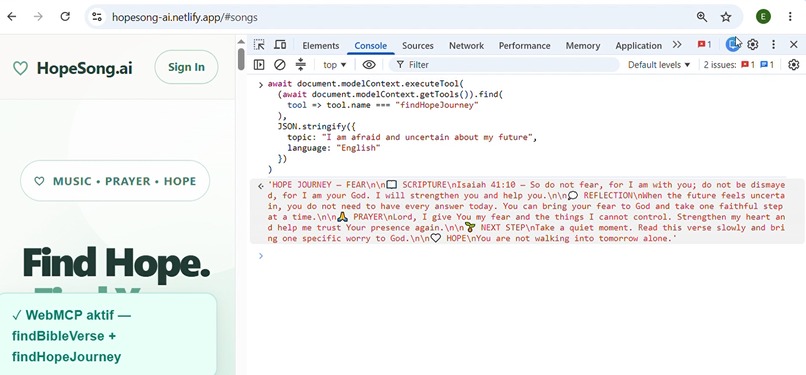
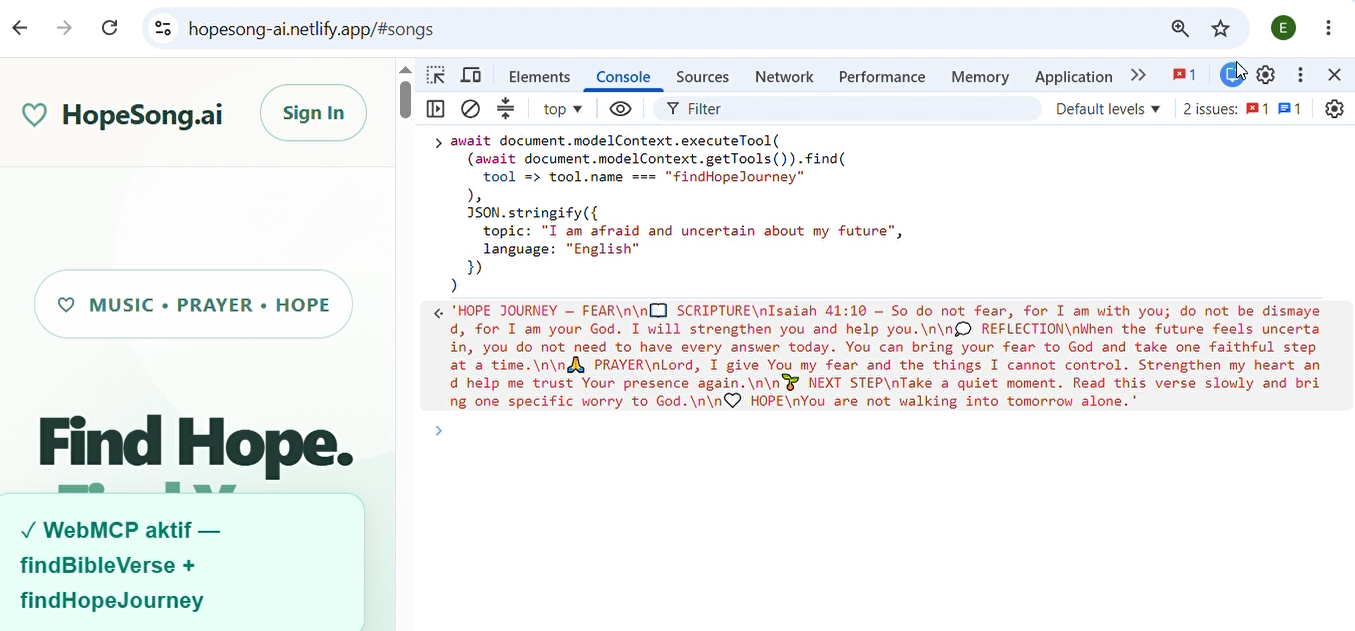
findHopeJourney — English Demo
-
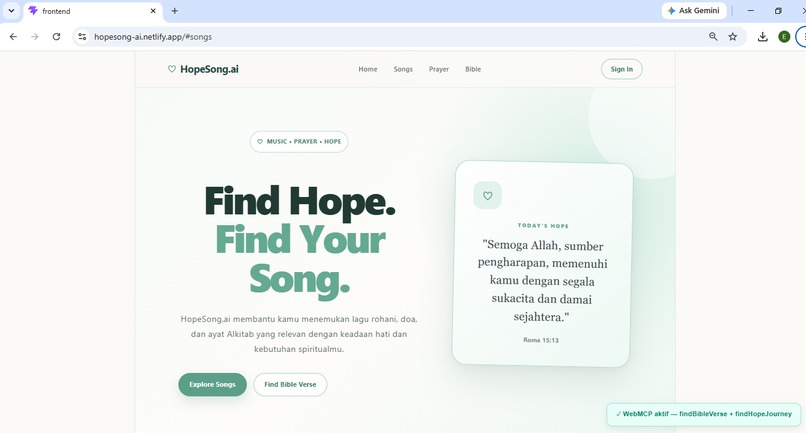
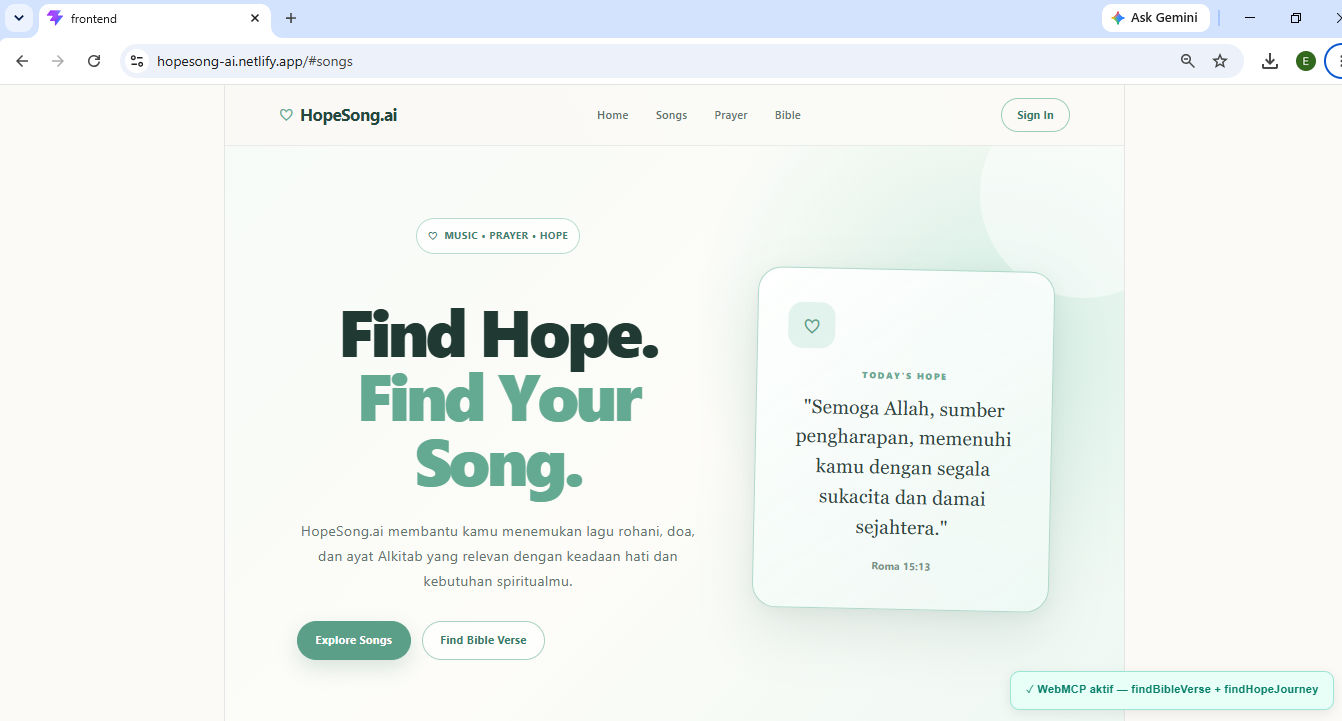
Homepage HopeSong.ai
-
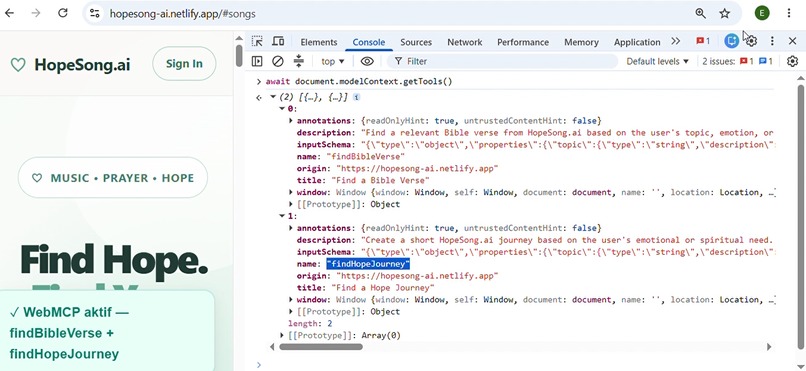
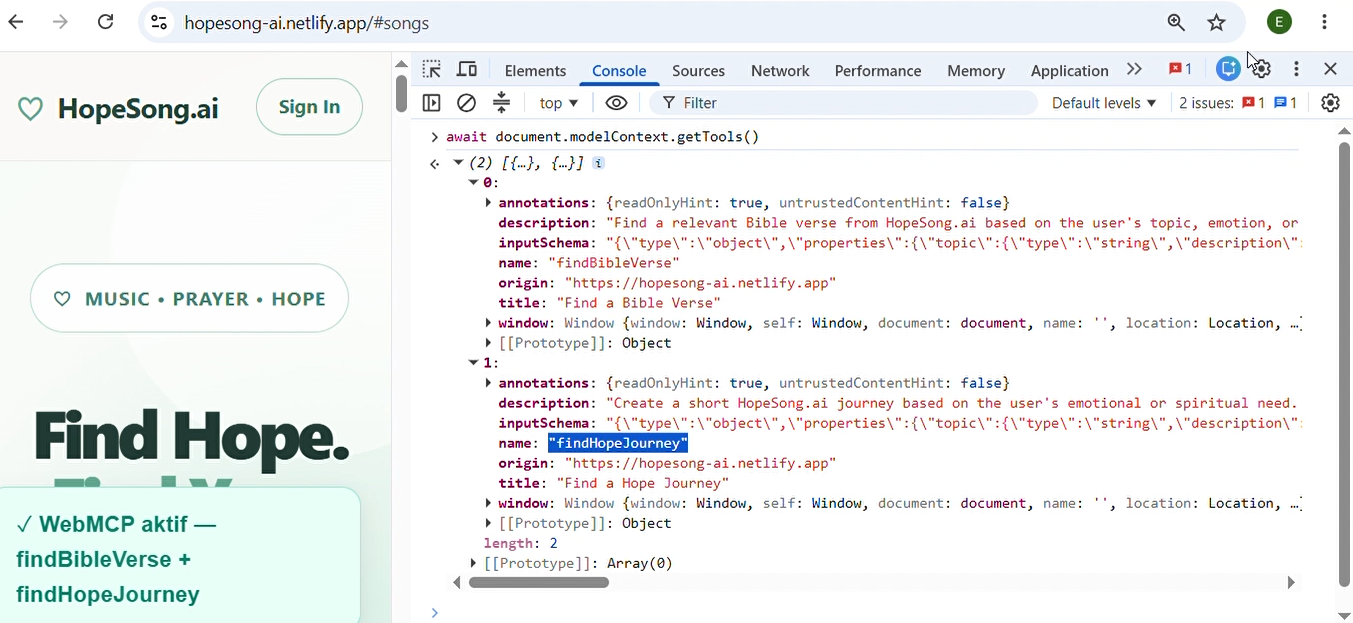
WebMCP Tool Discovery — 2 Tools Registered
-
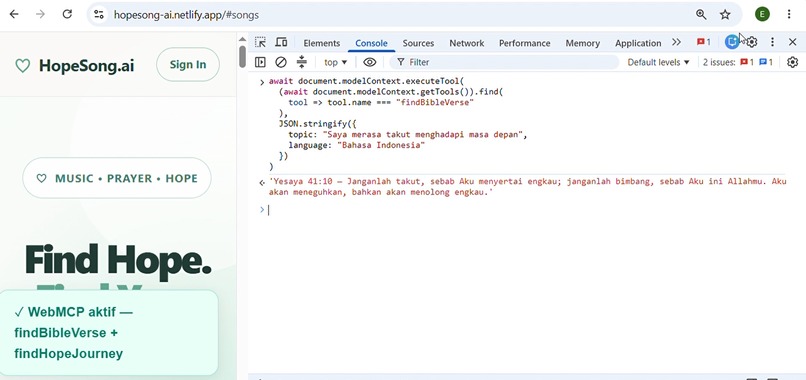
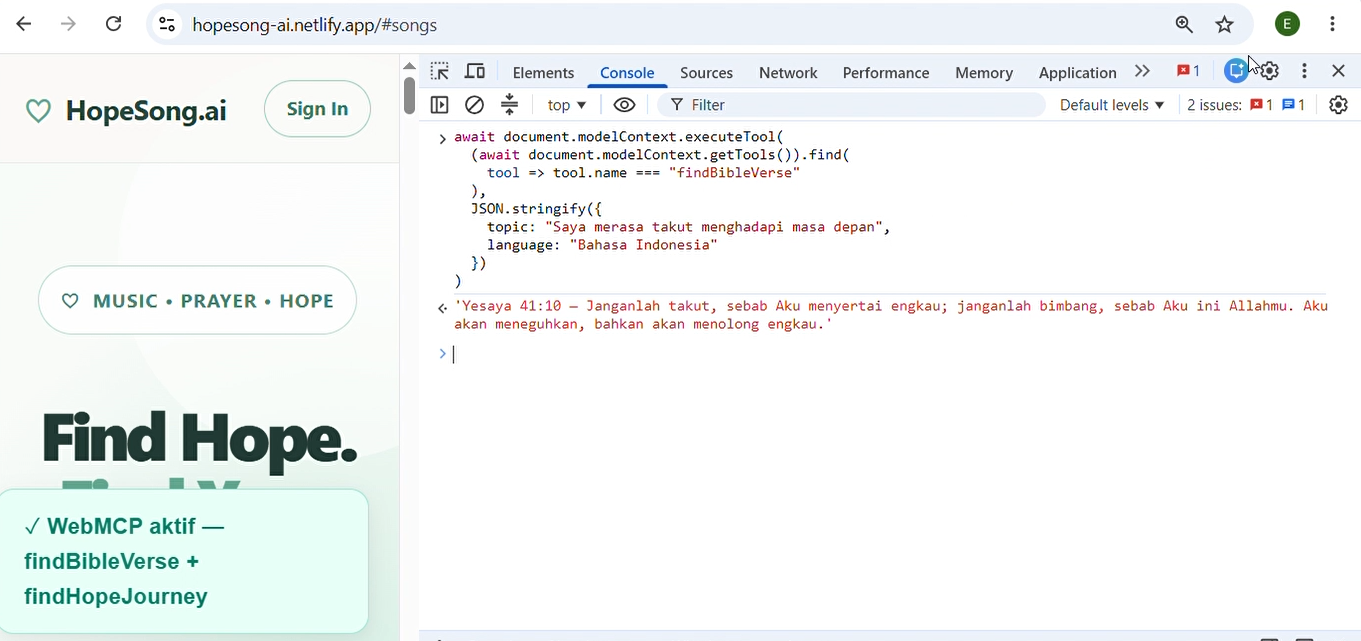
findBibleVerse — Bahasa Indonesia Demo
Inspiration
HopeSong.ai began with a simple question: what if AI could recognize a moment of fear, weariness, or uncertainty and help someone find a meaningful path toward hope?
When people feel overwhelmed, they may not know what to search for or where to begin. I wanted to create an experience that starts with the human need itself and connects that moment with Scripture, reflection, prayer, and a simple next step.
What it does
HopeSong.ai is a WebMCP-powered spiritual companion built around a journey from fear to peace and hope.
The website introduces users to songs, prayer, Scripture, and hope-centered experiences. Through WebMCP, HopeSong.ai also exposes structured capabilities that an AI agent can discover and use directly.
The current implementation provides two WebMCP tools:
findBibleVerse — finds a relevant Bible verse based on the user's topic, emotion, or spiritual need. It supports Bahasa Indonesia, English, Chinese, Korean, and Spanish.
findHopeJourney — creates a guided journey consisting of Scripture, Reflection, Prayer, a simple Next Step, and Hope. It currently supports English and Bahasa Indonesia.
For example, when someone expresses, "I am afraid and uncertain about my future," the agent can use findHopeJourney to return a structured experience designed around that need.
How I built it
HopeSong.ai is built with React and Vite and deployed as a live web application.
I integrated WebMCP using document.modelContext.registerTool(...), allowing the browser to expose HopeSong.ai's capabilities as structured tools instead of leaving them only as visual website interactions.
Both tools are read-only and use defined input schemas for topic and language. The implementation can be inspected in the public source code, and the live demo allows the WebMCP tools to be discovered and executed in a supported browser environment.
Human + AI collaboration
The human brings the need.
The AI interprets the context and discovers the appropriate WebMCP capability.
HopeSong.ai provides the structured experience behind it.
This creates a different interaction from simply browsing pages or searching through content. The user does not need to know which page, verse, or resource to look for first. Their need becomes the starting point for the interaction.
Challenges I ran into
One of the biggest challenges was moving from a traditional website experience to capabilities that an AI agent could discover and execute reliably.
I also worked through browser and origin requirements while testing the emerging WebMCP implementation, validated tool discovery with document.modelContext.getTools(), and tested tool execution directly on the production origin.
Another challenge was deciding how much functionality to expose. Rather than adding many shallow tools, I focused on two complementary capabilities that demonstrate a clear progression from finding relevant Scripture to creating a more complete Hope Journey.
Accomplishments that I'm proud of
I am proud that HopeSong.ai evolved from a content experience into a working WebMCP-enabled application.
The project now exposes two discoverable tools, supports multilingual Scripture discovery, and demonstrates a complete Hope Journey from an emotional need to Scripture, reflection, prayer, a practical next step, and hope.
Most importantly, WebMCP is not only a technical addition to the project. It changes how an AI agent can interact with HopeSong.ai's purpose.
What I learned
Building HopeSong.ai helped me understand the difference between designing only for human navigation and designing capabilities that can also be understood and used by AI agents.
I learned how structured tool definitions, clear input schemas, and focused outputs can turn an existing web experience into something agents can interact with more meaningfully.
What's next for HopeSong.ai
The current project is intentionally focused on proving the core WebMCP experience.
Future versions could expand the Hope Journey with more languages, additional hope-centered resources, deeper personalization, and connections between songs, Scripture, prayer, and the user's ongoing journey.
The long-term vision is simple:
Find Hope. Find Your Song.
Built With
- css
- github
- html
- javascript
- netlify
- react
- vite
- webmcp


Log in or sign up for Devpost to join the conversation.