-
-
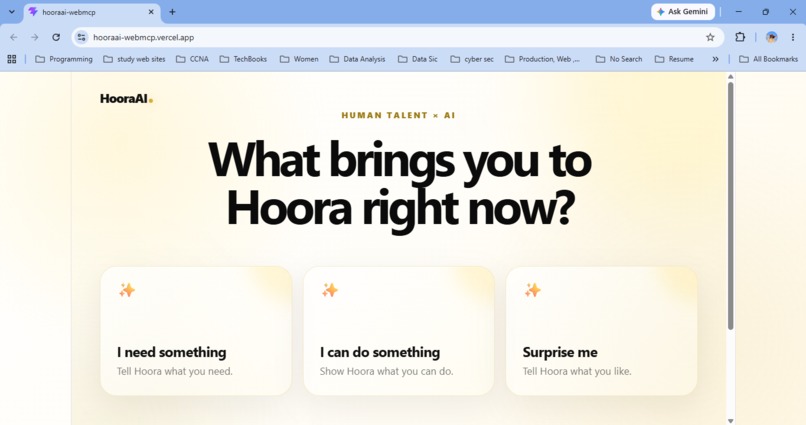
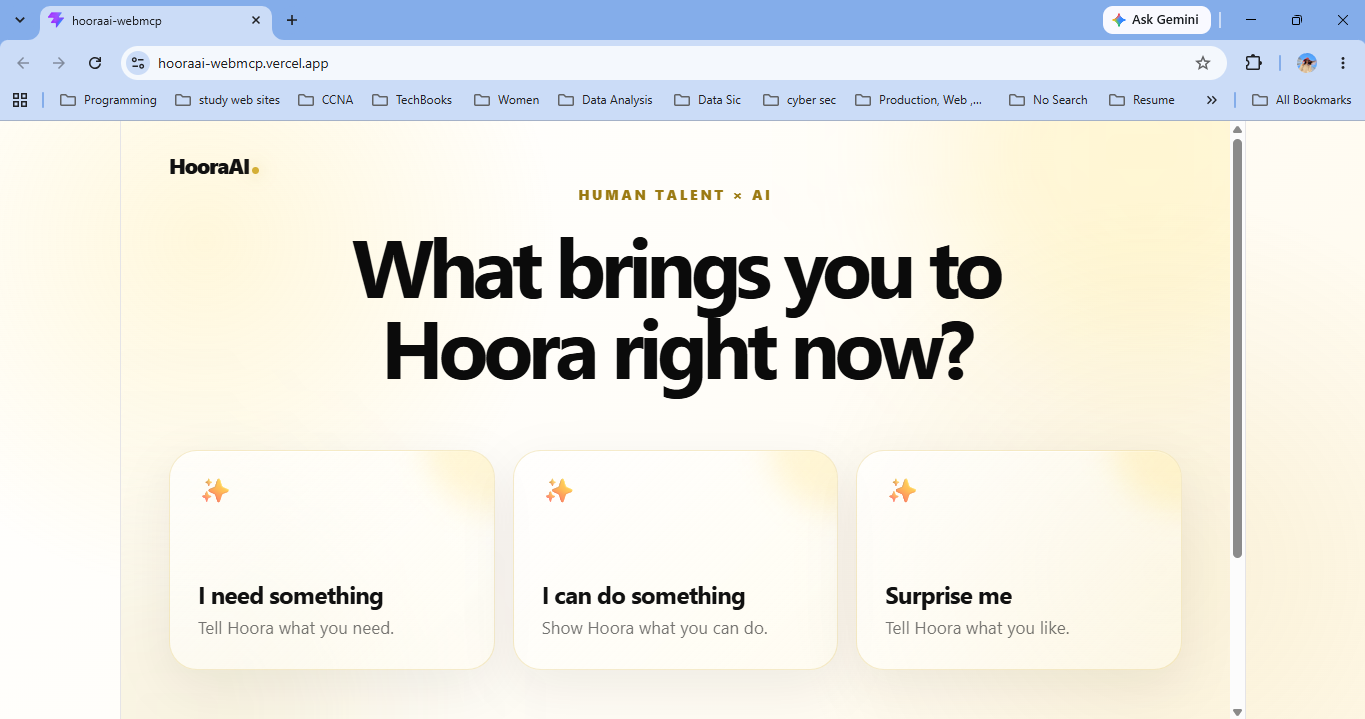
What brings you to Hoora right now?
Inspiration
AI agents are becoming increasingly capable, but most service marketplaces still make people fit themselves into rigid job titles, categories, search boxes, and forms.
HooraAI starts with a different belief: human talent is bigger than a job title.
Someone may know how to repair a refrigerator, creatively customize a bicycle, help reconnect someone with a first love, or have a valuable ability that does not fit any traditional professional category.
We wanted to explore what happens when humans simply express what they need, can do, or are curious about, while AI handles the work of understanding that intent and discovering relevant human talent.
Our core idea became simple:
The agent prepares. The human decides.
What it does
HooraAI is an AI-native marketplace for human talent.
Instead of asking users to choose a category, the prototype begins with natural human intent: “I need something,” “I can do something,” or “Surprise me.”
A customer can say something as practical as “I need to fix my fridge” or as unusual as “I need someone to help me find my first love.” A person offering talent can describe what they can actually do without first inventing a job title for themselves. Someone can even say “I love pink,” allowing Hoora to discover unexpected human talent related to that interest.
Hoora identifies the strongest relevant human connection as the user’s Nexus.
With WebMCP, an AI agent can understand the request, discover relevant talent, and prepare a structured Task. However, the Task remains a draft until the human explicitly approves it.
Nothing is automatically booked, assigned, charged, or started.
How we built it
We built the prototype with React, TypeScript, Vite, and WebMCP.
The site exposes structured WebMCP capabilities through document.modelContext.registerTool(...). The prototype currently includes three agent-facing tools: understand_need, discover_talent, and prepare_task.
understand_need structures natural human intent. discover_talent searches the same talent-matching logic used by the human-facing experience. prepare_task creates a structured draft Task around a selected Nexus and hands it back to the webpage for human approval.
A key architectural decision was to reuse the same application logic for both humans and agents rather than building a separate agent-only experience.
The current prototype uses seeded talent profiles and lightweight rule-based matching so we could focus on demonstrating the WebMCP interaction model, agent-to-webpage handoff, and human approval boundary.
Challenges we ran into
The most important challenge was deciding where agent autonomy should stop.
Allowing an agent to understand a request or discover possible talent is relatively low risk. Allowing it to independently create a real service relationship, book someone, assign work, or initiate payment is much more consequential.
We therefore designed prepare_task to prepare and surface a Task without authorizing the next action. The resulting Task remains in Draft status and visibly returns control to the human.
Another challenge was designing talent discovery without relying on traditional categories. HooraAI is intentionally trying to discover abilities that may not correspond neatly to existing job titles, so the interaction had to begin with natural language rather than a category tree.
Accomplishments that we're proud of
We are proud that WebMCP is not simply attached to the website as a technical demonstration. It meaningfully changes how an AI agent can interact with the marketplace.
The agent receives structured access to HooraAI's capabilities, can discover human talent, and can prepare a Task while the webpage remains the place where consequential human approval happens.
We are also proud of the shared architecture between the human interface and WebMCP tools. Both use the same talent-discovery logic instead of producing two disconnected experiences.
Finally, we introduced the concept of a Nexus: not merely a search result, but the strongest human connection Hoora identifies for a particular need, talent, interest, or moment.
What we learned
The biggest lesson was that agent-native does not have to mean agent-controlled.
WebMCP can make a website significantly more useful to AI agents without removing humans from meaningful decisions.
We learned that one of the most powerful roles for an agent may be to handle the difficult work of understanding intent, discovering possibilities, organizing information, and preparing actions—then return control to the person at the moment a meaningful decision must be made.
That principle became the foundation of our prototype:
Human expresses intent → Agent understands → Agent discovers talent → Agent prepares the Task → Human approves.
Built With
- css
- html
- javascript
- react
- typescript
- vite
- webmcp

Log in or sign up for Devpost to join the conversation.