-
-
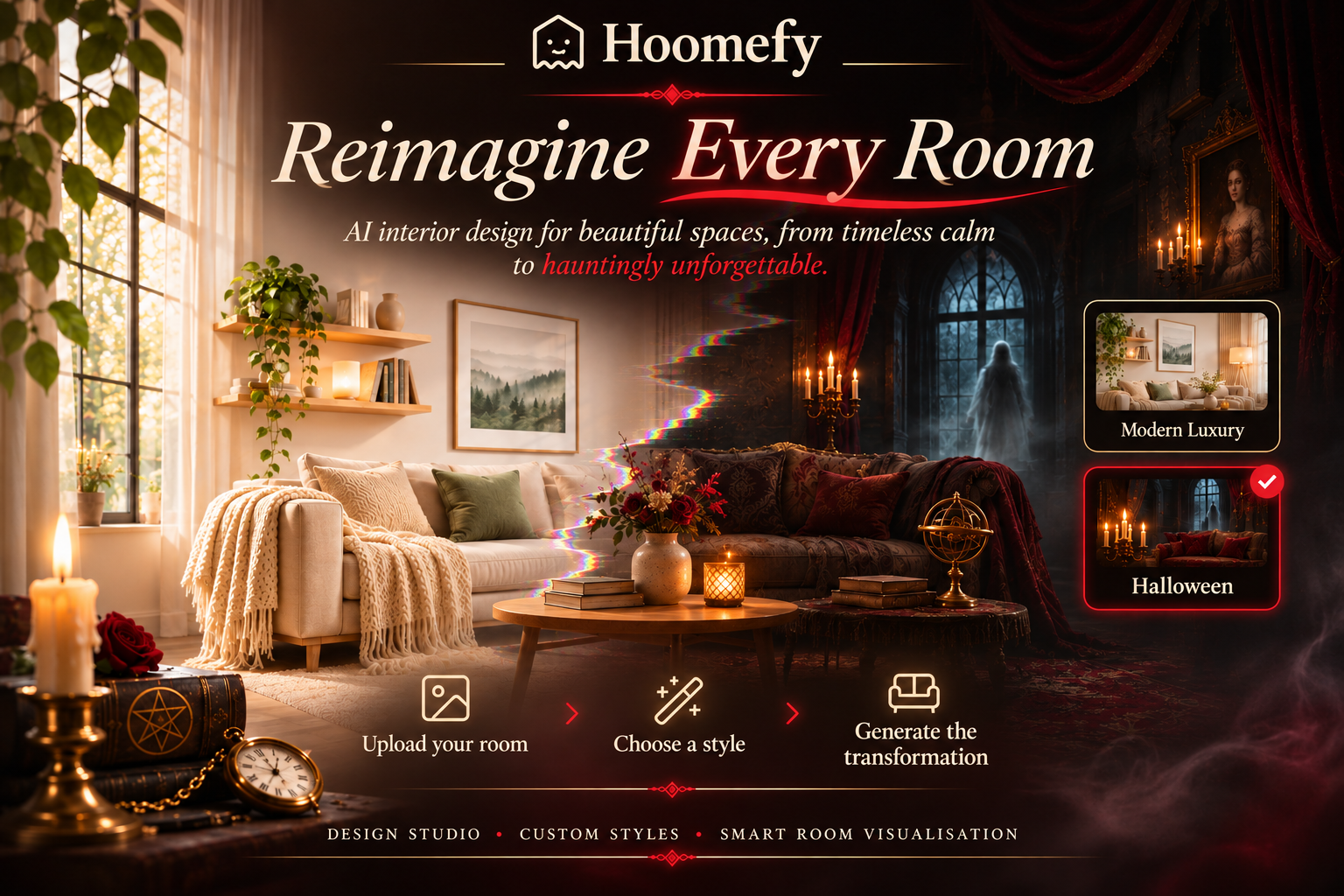
HoomefySteps
-
HoomefyPoster
-
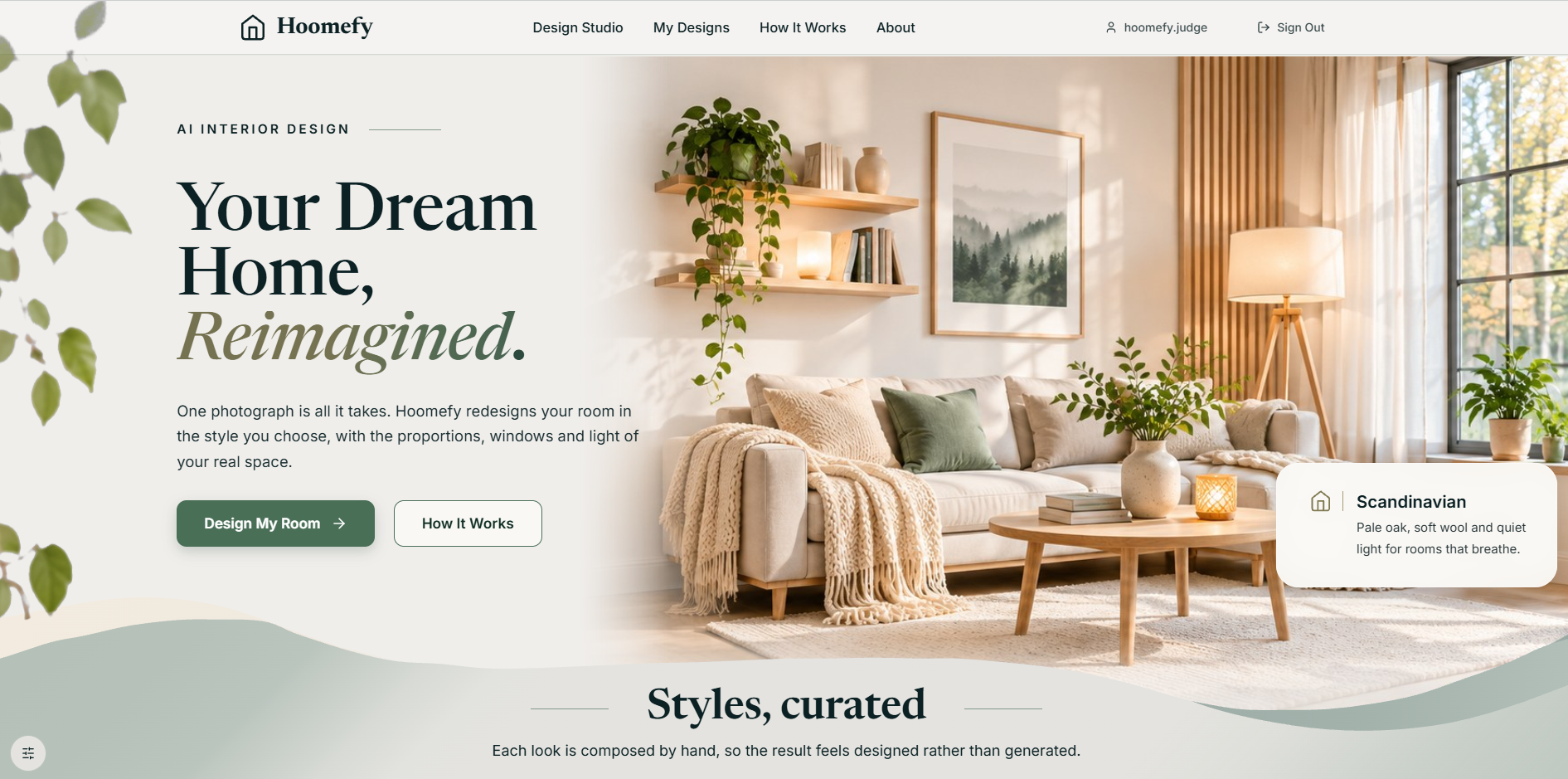
Hoomify Main Page
-
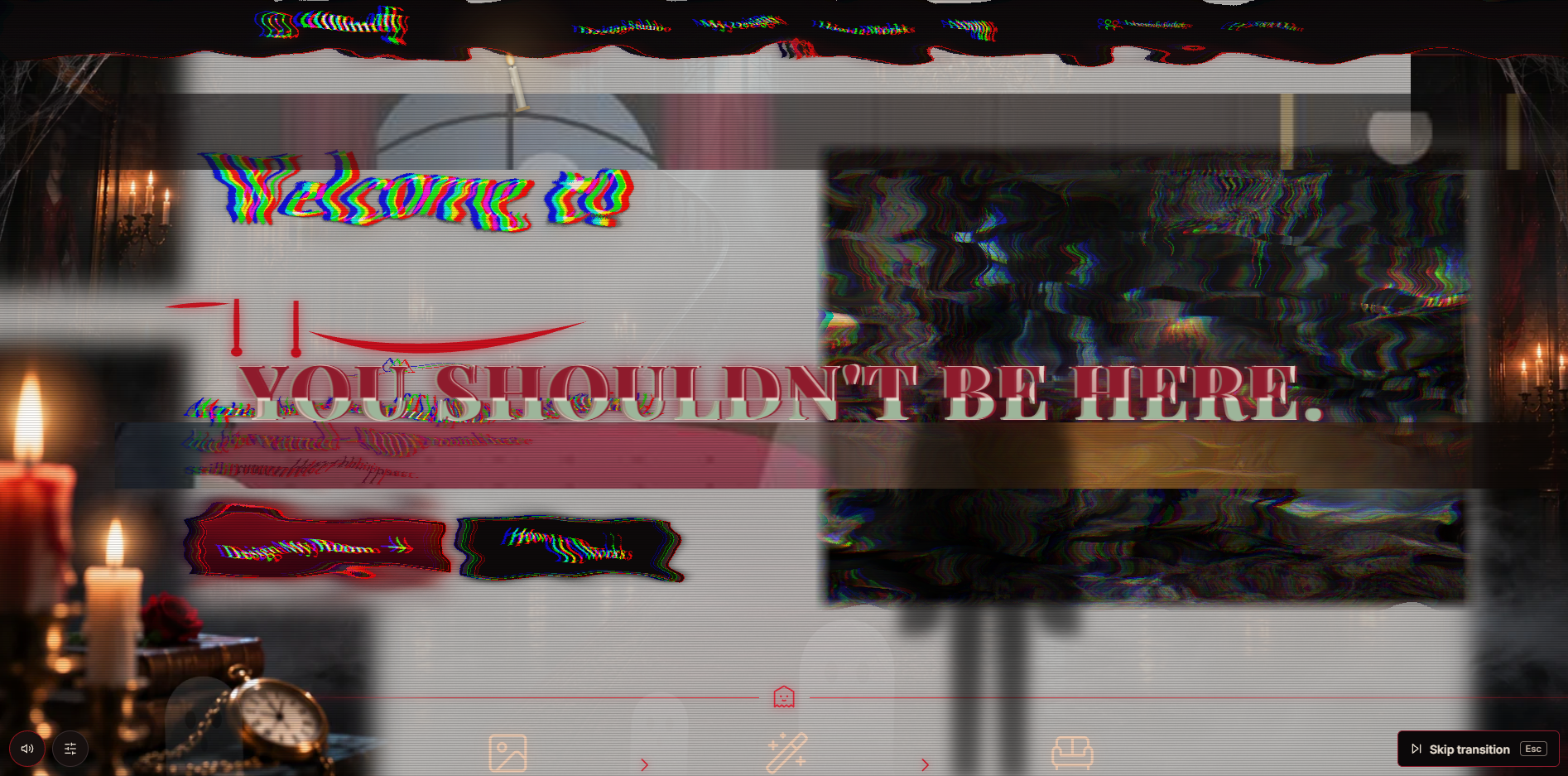
Hoomify Possession Page
-
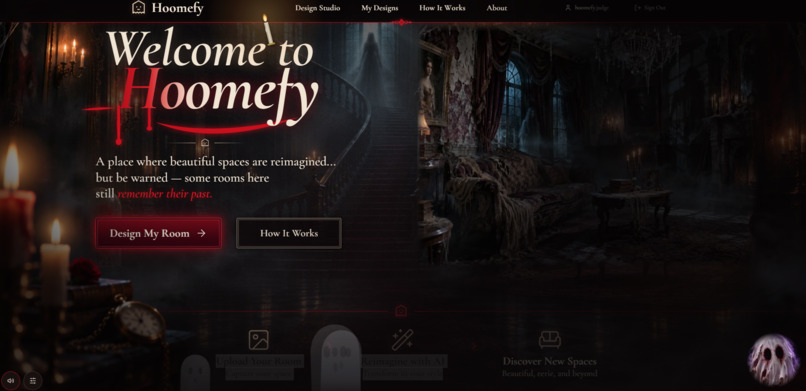
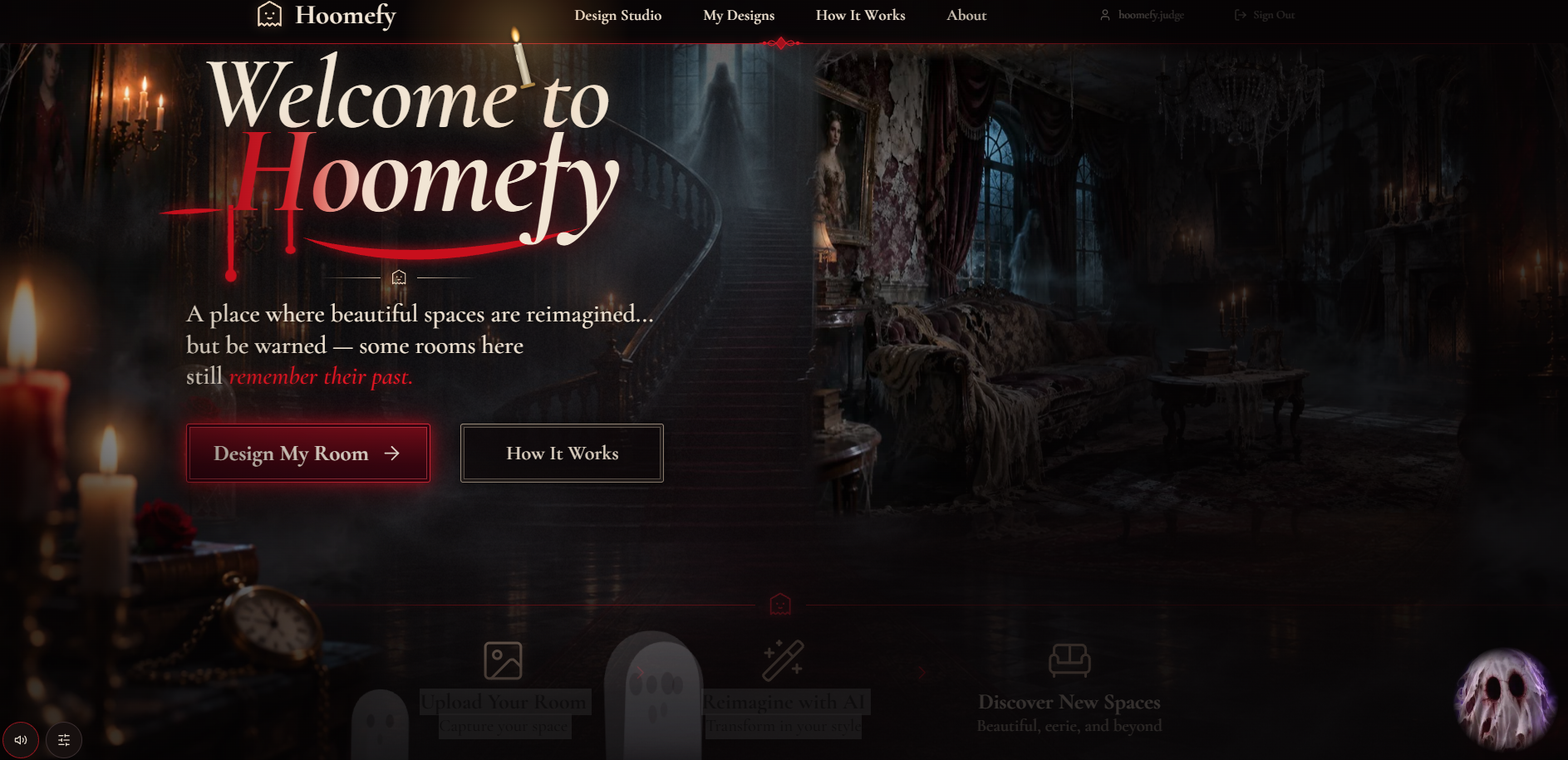
Hoomify Haunted Page
-
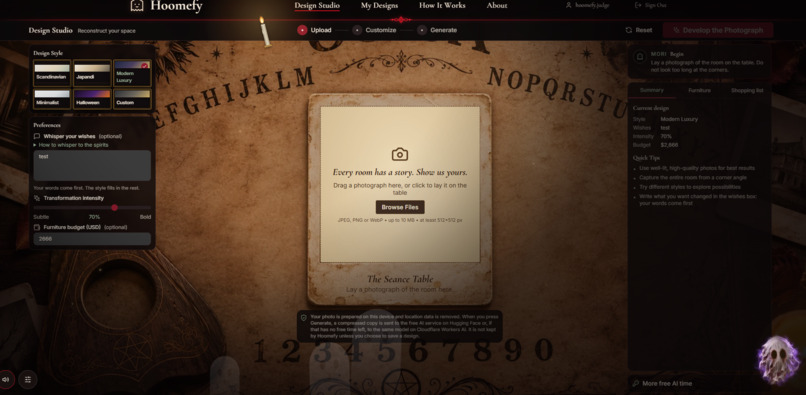
Hoomify Studio
-
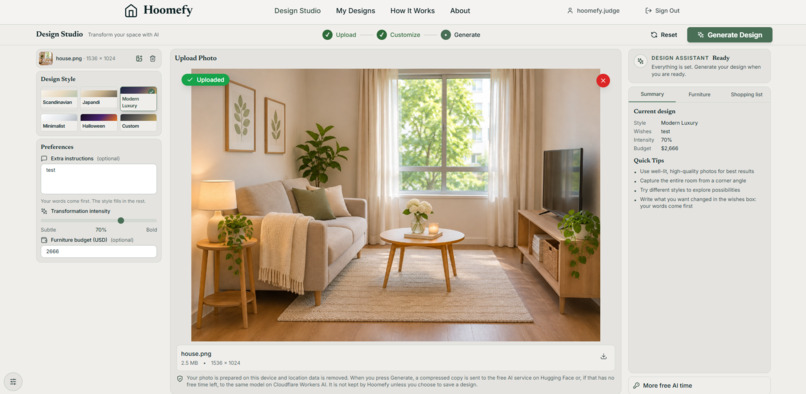
Hoomify cleanse
-
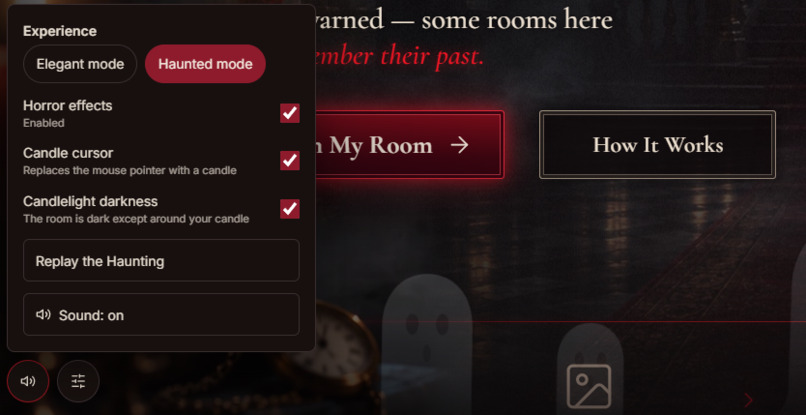
Change Mode
-
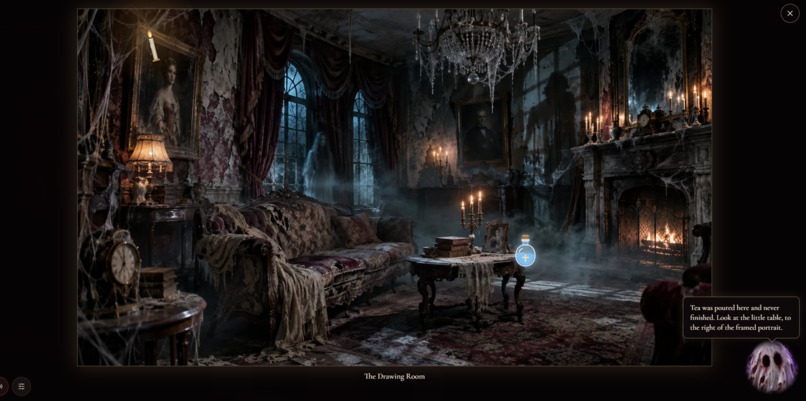
Hoomify Escape Game
-
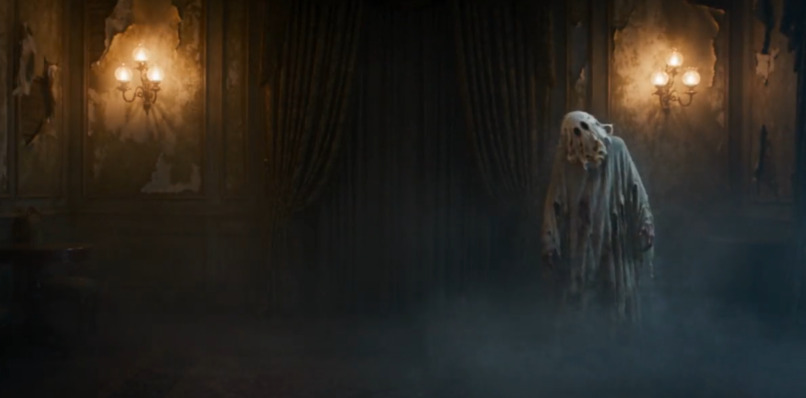
Jumpscare
-
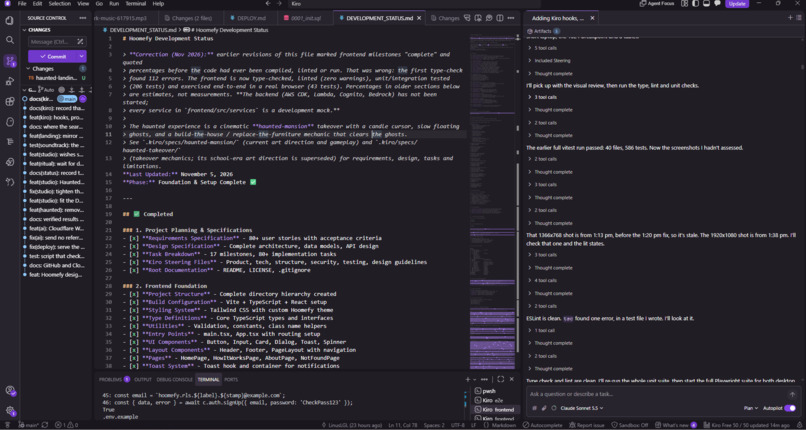
Vibe Coding With Kiro
Inspiration
Decorating a home should be an exciting and creative experience, especially during festive seasons such as Halloween and Christmas. However, transforming an ordinary living space into something extraordinary often comes with two challenges: visualising the final result and managing the cost of making it a reality.
According to the National Retail Federation's 2026 Halloween survey, 74% of consumers planned to celebrate Halloween, while 42% intended to decorate their homes or yards. Total Halloween spending was projected to reach $13.5 billion, averaging approximately $115 per person. During the Christmas shopping season, economic concerns also influence spending decisions, with many households starting their purchases earlier to spread out the financial burden.
These figures highlight how significant seasonal decoration has become. Yet spending money on decorations does not guarantee that they will complement an existing room. Furniture may not fit, colours may clash, and decorative pieces that looked appealing in a shop may feel completely different once placed at home.
What if people could see their dream room before spending a single dollar?
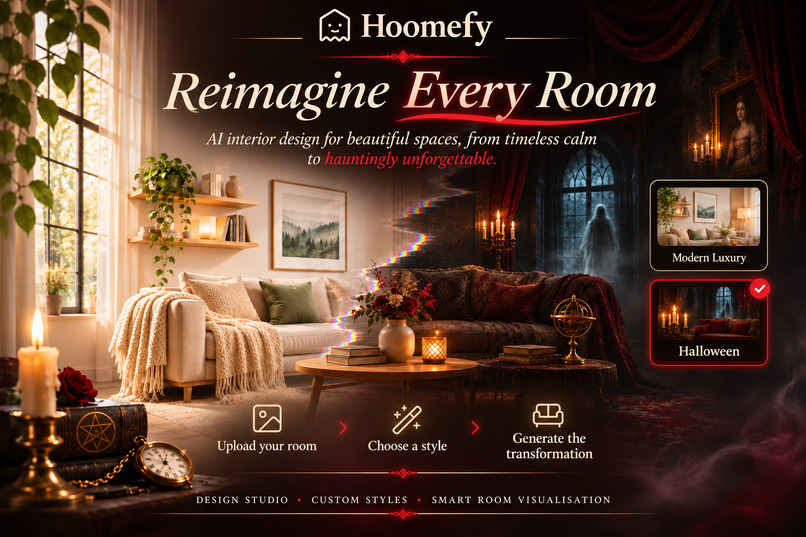
This question inspired the creation of Hoomefy, an AI-powered interior design experience that helps users visualise transformations of their actual living spaces, discover suitable furniture and decorations, and make more informed purchasing decisions.
Rather than expecting users to imagine how a design might look, Hoomefy brings that vision directly to their screens.
But when I discovered the Kiro Halloween Costume Contest, another idea emerged.
Most interior design applications focus on visualising beautiful spaces. They present elegant interfaces, attractive photographs, and straightforward design tools. While these experiences are practical, I wanted to explore something different.
What if an elegant interior design website was actually an escape room disguised as a design studio?
What if the website could suddenly transform into something completely unexpected? What if users were not simply choosing decorations, but exploring a mysterious mansion, solving supernatural puzzles, and performing an exorcism to create their dream room?
I wanted to build an application where the Halloween theme was not just a decorative overlay but an entirely different interactive experience.
That became the creative direction behind Hoomefy.
What it does
At its core, Hoomefy is an AI-powered interior design application designed to make decorating more accessible, creative, and budget-conscious.
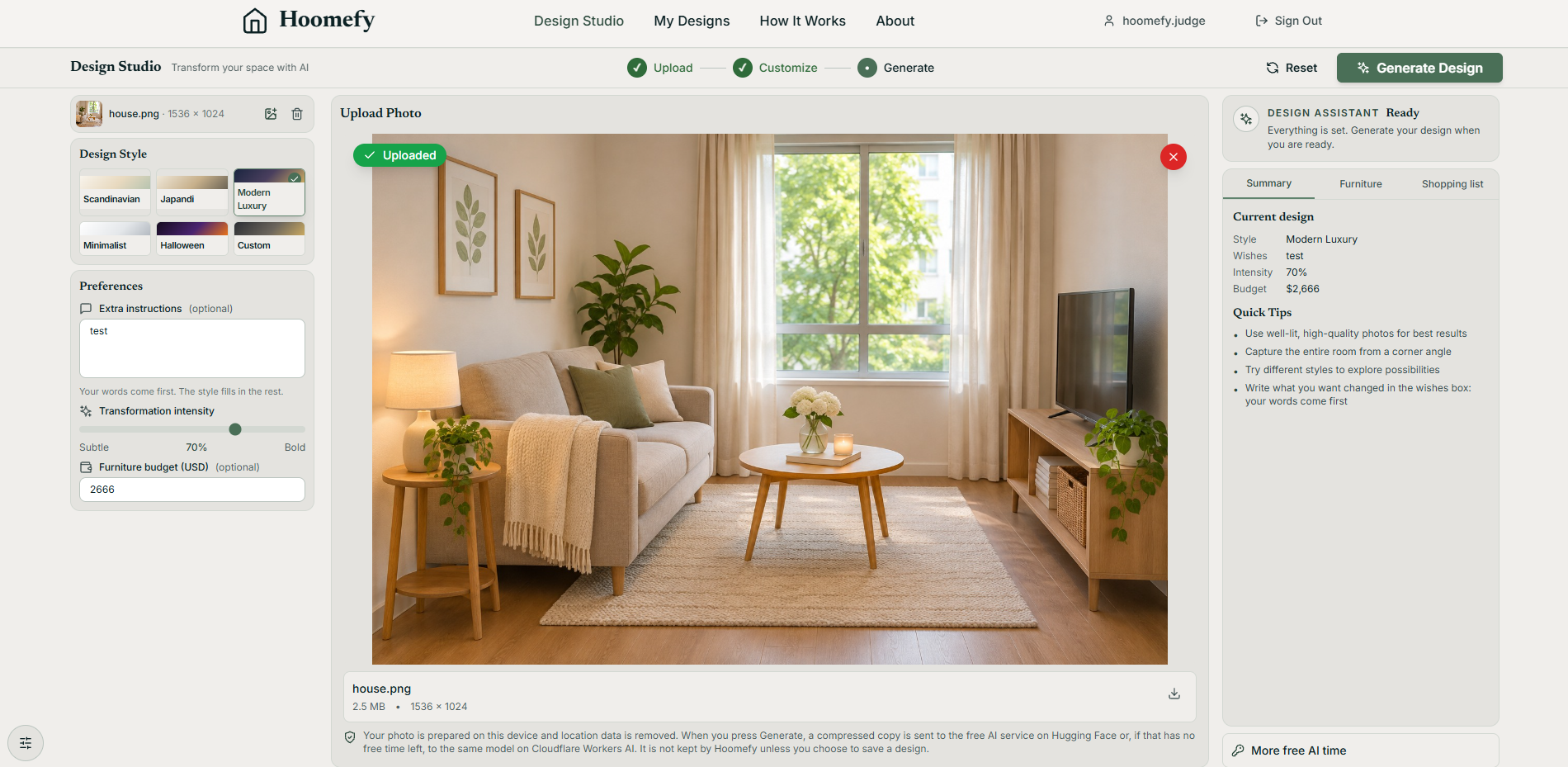
Users upload a photograph of their actual room and choose a design style or describe their preferred transformation using a custom prompt.
For example, a user might enter:
"A cosy Christmas living room with warm lighting, elegant decorations, and a Christmas tree beside the window."
The AI then generates a redesigned version of the uploaded room while aiming to preserve its original architectural structure, including the walls, windows, and general layout.
Instead of showing users a generic showroom, Hoomefy allows them to visualise how their own living spaces could look.
The application also includes a workflow for identifying furniture and decorative objects within the generated design, searching for similar products, and preparing a shopping list based on the user's budget.
Where an exact product price cannot be established, the system is designed to display a typical price marked as an estimate rather than presenting it as a confirmed retail price.
Users can experiment with different interior styles, regenerate designs, and explore alternatives before committing to a purchase.
However, Hoomefy is not an ordinary interior design application.
It has two identities: Elegant Mode and Haunted Mode.
The Elegant Experience
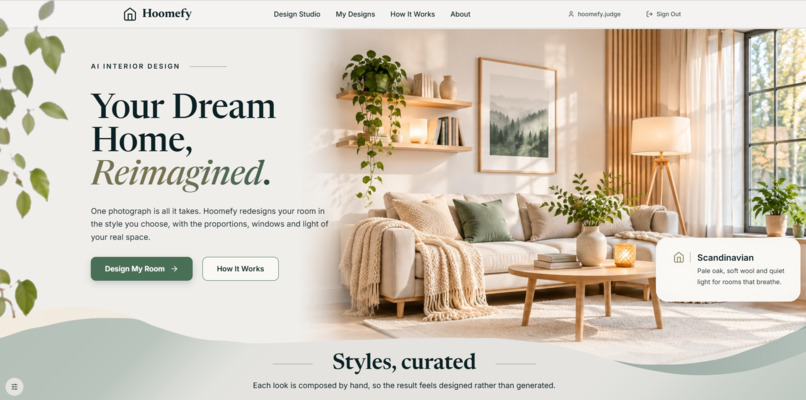
When visitors first arrive, they encounter a sophisticated Scandinavian-inspired interior design website.
The interface features soft neutral colours, elegant typography, curated interior design styles, and a calm, welcoming atmosphere.
Everything appears to be a conventional premium design studio.
Users can explore design inspirations, upload their room photographs, and create personalised interior transformations.
Yet hidden within the interface is a mysterious mirror.
At first, the mirror appears to be another decorative element.
But when visitors interact with it, or scroll to the hidden reveal, something unexpected happens.
The website becomes possessed.
The Haunted Transformation
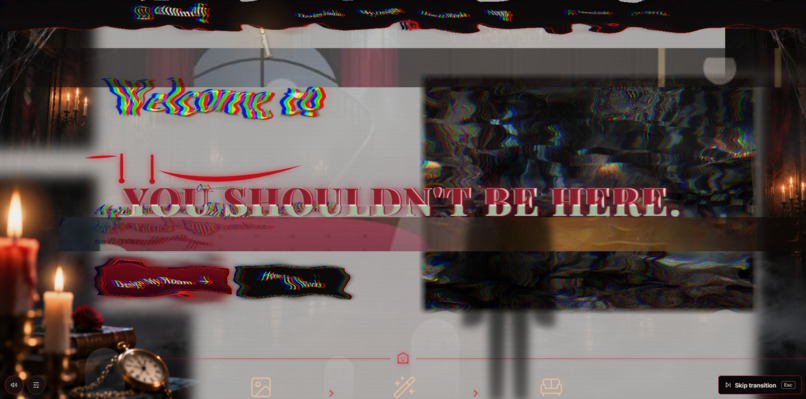
The peaceful interface suddenly begins to distort.
Images fragment, colours separate, text becomes unstable, and the entire page appears to tear apart.
Through a dramatic glitch transition, the bright Scandinavian design studio transforms into a dark, candlelit haunted mansion.
The elegant website disappears, revealing an entirely different world beneath its surface.
This transformation is more than a colour change or a Halloween background.
The entire user experience changes.
Visitors are transported into an interactive escape-room adventure featuring supernatural encounters, hidden clues, survival mechanics, and an exorcism ritual.
Trapped Inside the Haunted Mansion
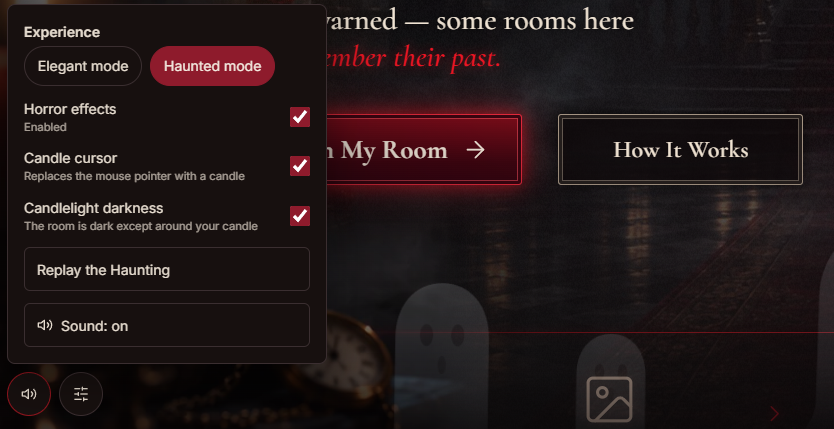
Upon entering Haunted Mode, visitors discover that their ordinary mouse cursor has been replaced by a flickering candle.
The surrounding mansion becomes almost completely dark, leaving only a small circle of illumination that follows their movements.
The candle gradually loses its brightness, reducing the visible area and increasing the sense of danger.
Users must click to replenish the candle's flame and keep their surroundings illuminated.
If the candle remains at its dimmest state for twelve seconds, a full-screen jumpscare is triggered.
This transforms ordinary website navigation into a survival challenge.
Visitors must remain alert while exploring the mansion.
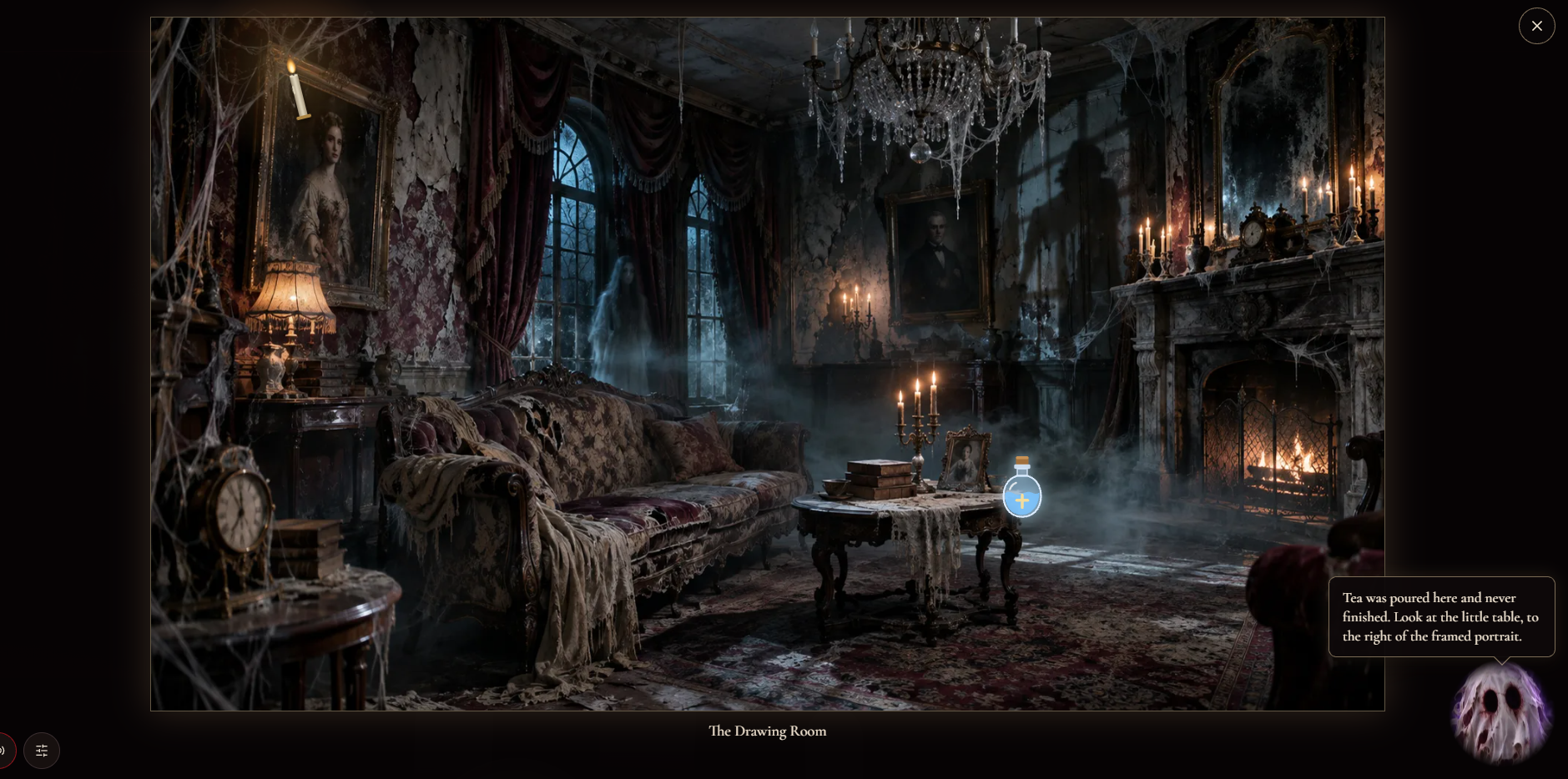
The haunted environment contains three mysterious rooms:
- The Drawing Room: An unsettling interior filled with eerie decorations and supernatural details.
- The Library: A shadowy collection of bookshelves, mysterious objects, and hidden secrets.
- The Grand Ballroom: A gothic ballroom with an ominous atmosphere and a sense that something supernatural is watching.
Each room contains an interactive painting and a hidden bottle of holy water, accompanied by a written clue.
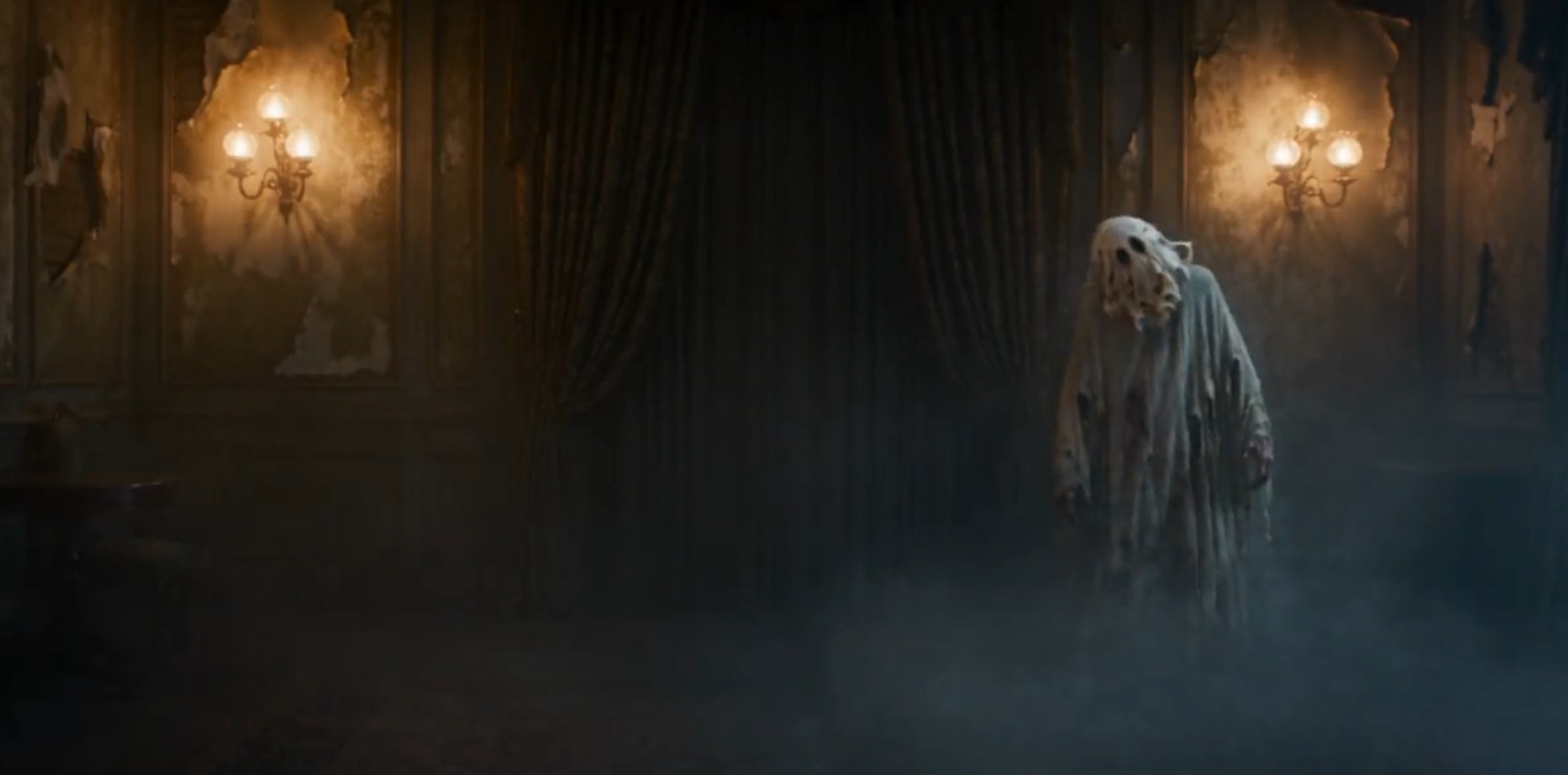
A mysterious ghost also appears within the interface, acting as both a guide and a supernatural presence.
To escape the mansion, visitors must discover a bottle of holy water and use it against the ghost.
This triggers a cinematic banishment sequence in which the supernatural presence is expelled.
Once the exorcism is completed, the haunting breaks and the website returns to its original Elegant Mode.
Collecting holy water also removes the candle-out jumpscare threat. Visitors who dare to interact with the mirror while in Haunted Mode can trigger a jumpscare on demand.
The haunted experience encourages visitors to interact with the interface, explore its hidden details, and uncover the secrets of the mansion.
The Design Studio Becomes an Exorcism Ritual
One of Hoomefy's most distinctive features is that the haunted experience extends directly into the AI interior design workflow.
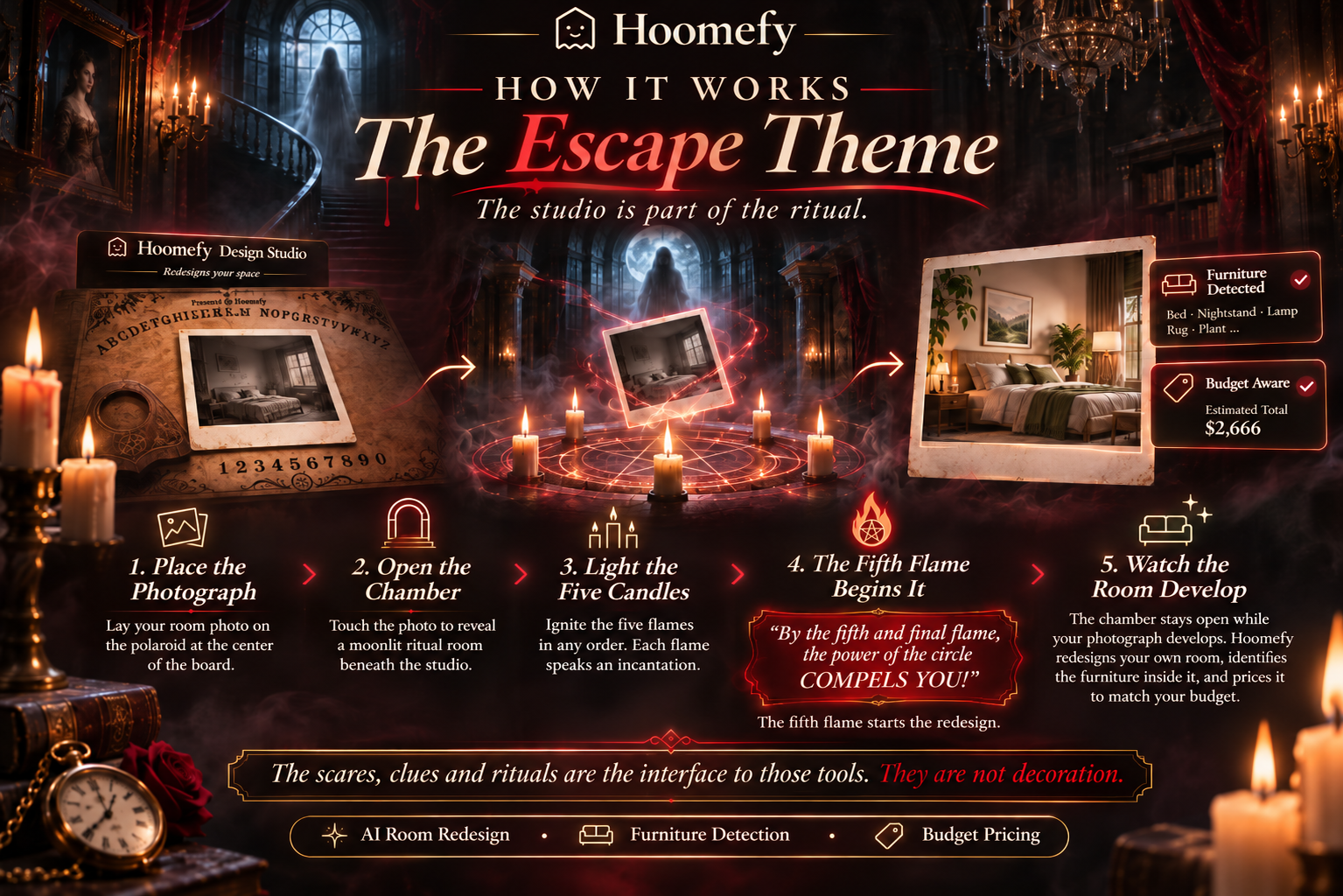
Instead of uploading a photograph and pressing a conventional "Generate" button, visitors participate in a supernatural ritual.
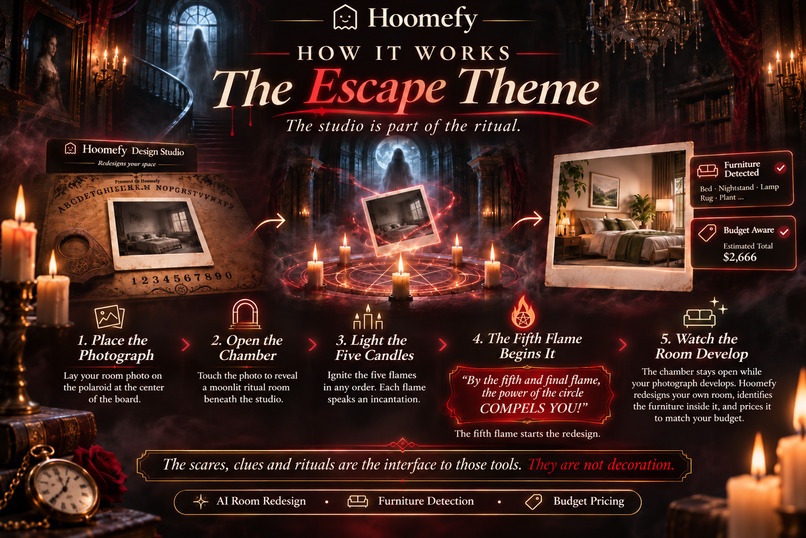
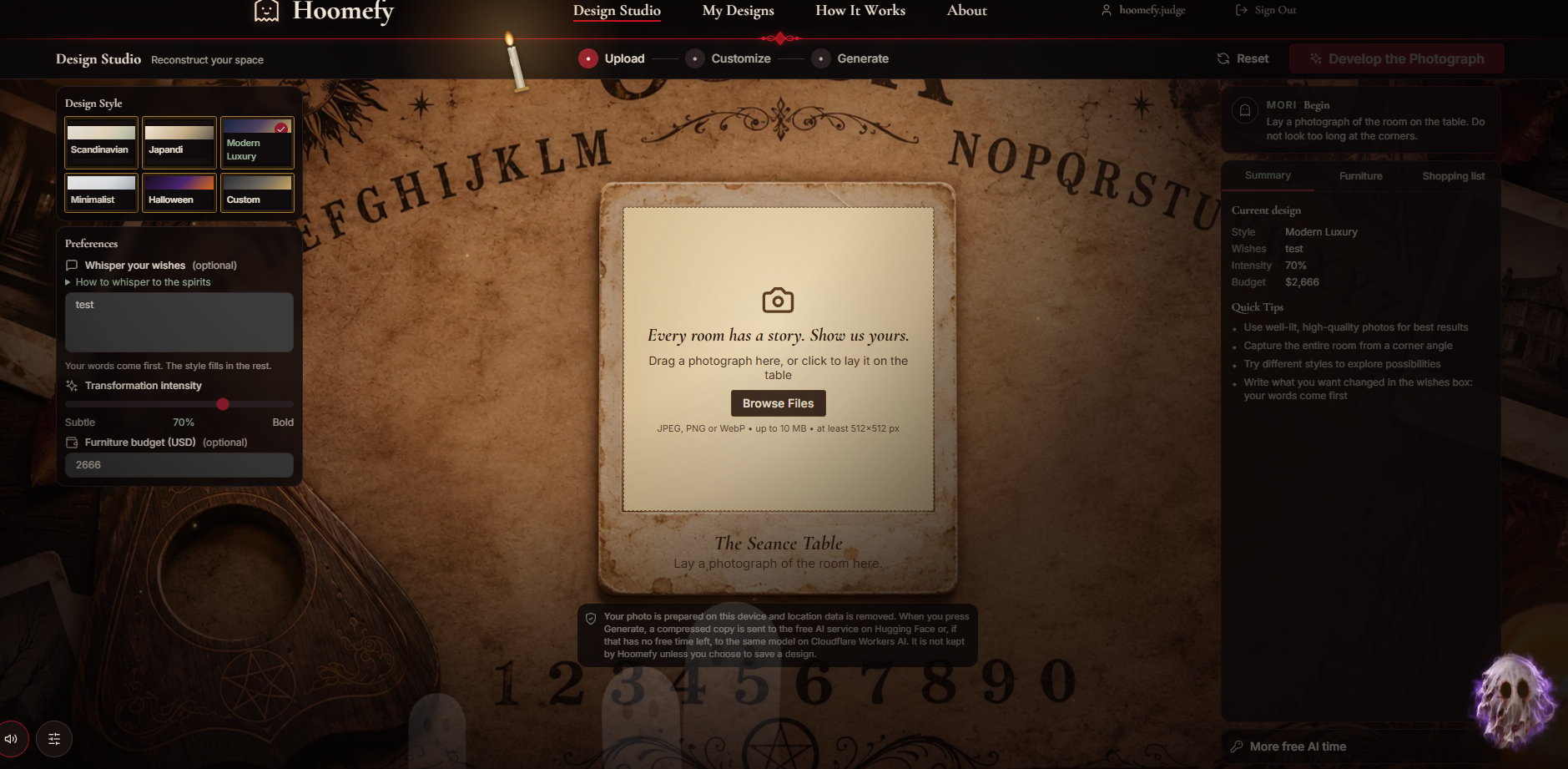
Their uploaded room photograph appears as a Polaroid resting on an animated Ouija board.
Interacting with the photograph opens a moonlit ritual chamber containing a mysterious spell circle surrounded by five candles.
Visitors must light all five candles, in any order, to complete the ritual.
Each candle triggers an eerie spoken incantation, gradually building anticipation until the final flame delivers the ultimate command:
"By the fifth and final flame, the power of the circle COMPELS YOU!"
The fifth flame initiates the AI room redesign process.
Rather than displaying a conventional loading spinner, the ritual chamber remains visible while the photograph develops.
The waiting period becomes part of the supernatural performance.
Behind this theatrical presentation, Hoomefy continues to perform its practical design operations: transforming the uploaded room, identifying furniture and decorations, and preparing budget-related shopping information.
The ritual is not merely a decorative animation. It is the interface through which the user interacts with the actual AI design workflow.
This is the central idea behind Hoomefy's Halloween experience.
The candle mechanic turns navigation into survival. The hidden holy water turns browsing into exploration. The ghost provides a character-driven objective, while the ritual transforms AI image generation into an interactive supernatural ceremony.
The scares, clues, and rituals are not simply decorations. They are part of how the application works.
How we built it
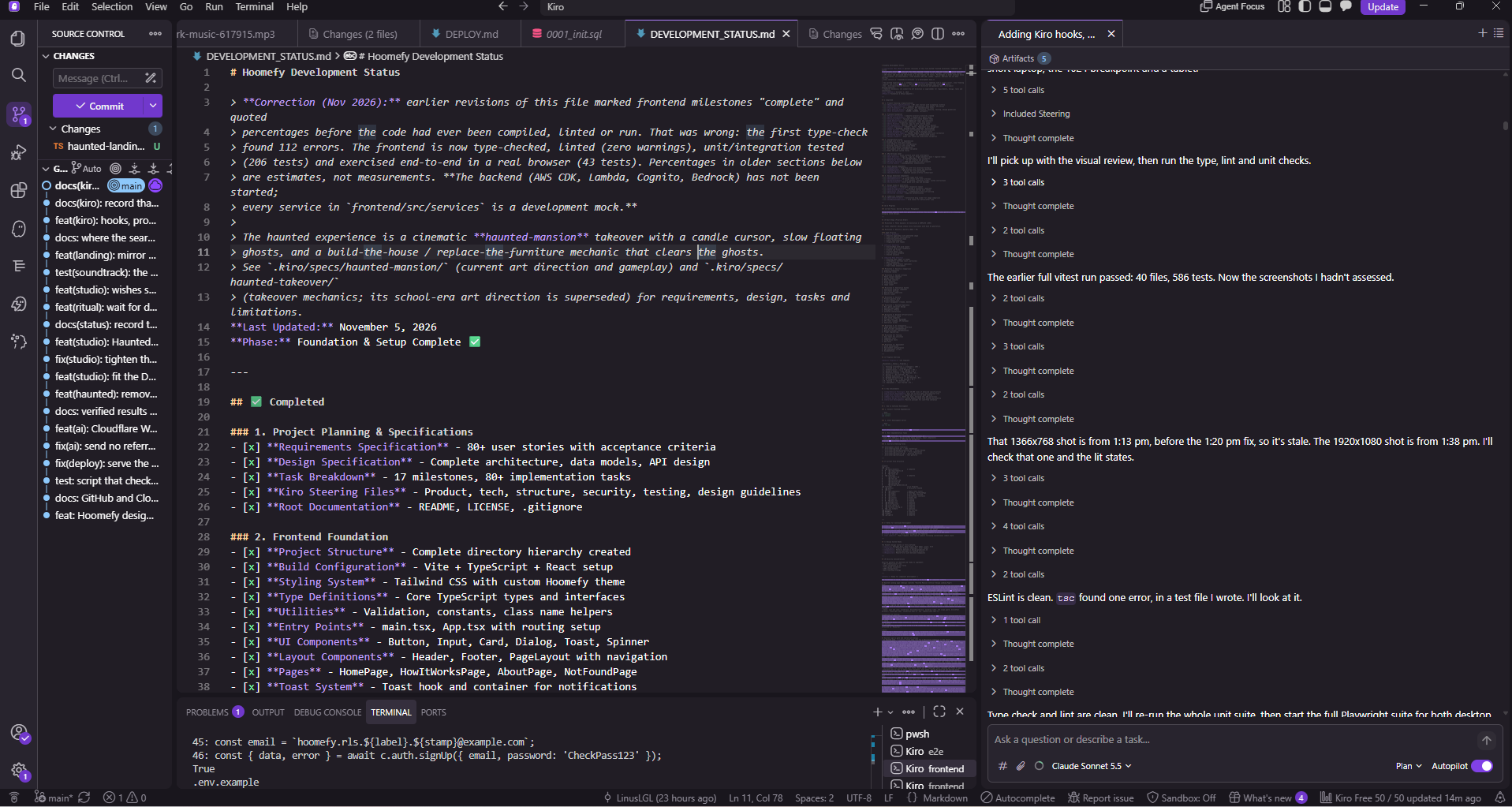
Hoomefy was developed using the Kiro IDE, combining AI-assisted development, structured specifications, automated testing, media generation, and interactive frontend design.
I chose the Kiro IDE because Hoomefy is a highly visual application that requires frequent adjustments to animations, layouts, interface interactions, and responsive behaviour.
Having the specifications, task lists, project files, and application code within one development environment made it easier to manage the project's increasingly complex requirements.
Although Kiro CLI and Kiro Web offer alternative development workflows, I focused on the IDE because it suited the interactive and iterative nature of Hoomefy.
The development process incorporated several Kiro capabilities, including Specs, Steering, Agent Hooks, Custom Agents, and agent-assisted code exploration.
Building with Kiro Specs
One of the greatest challenges of AI-assisted development is maintaining consistency as a project grows.
Hoomefy began as an interior design application, but its scope expanded to include a haunted mansion, supernatural interactions, an escape-room challenge, and a ritual-based design studio.
To prevent features from becoming disconnected or contradictory, I organised the development around Kiro's specification-driven approach.
Each major feature was documented within the .kiro/specs/ directory, with its own requirements, design considerations, and implementation task list.
Eight specifications were created:
- Core application functionality.
- AI-powered design studio.
- Haunted website takeover.
- Haunted mansion and escape-room interactions.
- Scandinavian-inspired Elegant Mode.
- Five-candle exorcism ritual.
- Furniture and decoration detection.
- Kiro development features and integrations.
These specifications helped translate imaginative ideas into precise technical requirements.
For example, the candle mechanic was not simply described as a light that gradually becomes darker.
Its behaviour was defined in measurable terms, including a 15% reduction in illumination every 1.2 seconds, the ability to restore brightness through user interaction, and the conditions required to activate a jumpscare.
The specifications also recorded changes to the design studio, such as removing unnecessary room-type and colour-palette fields.
Each task list tracked implementation decisions, outstanding work, and testing requirements, reducing the likelihood that important details would be forgotten as the project evolved.
Maintaining Development Standards with Kiro Steering
Hoomefy uses six always-on steering files covering product behaviour, technology, project structure, security, testing, and visual design.
These steering files establish consistent expectations across AI-assisted development tasks.
The product guidelines specify that Hoomefy must remain a functional interior design application in both Elegant Mode and Haunted Mode.
The design guidelines define accessibility requirements, including a minimum 4.5:1 text contrast ratio, appropriate touch-target sizes, and consideration for users who prefer reduced motion.
The security guidelines emphasise authenticated access, rate limiting, input validation, and preventing sensitive information from appearing in application logs.
Testing guidelines encourage placing tests alongside relevant code and evaluating observable behaviour rather than relying exclusively on implementation details.
One architectural change required additional attention. The steering files were initially written around an AWS-based technology stack involving Lambda, Cognito, and DynamoDB, while the application later evolved to use Cloudflare Workers and Supabase.
This meant that the underlying engineering and security principles remained useful, but platform-specific references needed to be interpreted according to the actual implementation.
Automating Quality Checks with Kiro Agent Hooks
To reduce repetitive development tasks, I configured three agent hooks.
The first is a Credential Guard, designed to scan file modifications for potential API keys and access tokens before they are written.
This was motivated by a real development incident in which a secret key was accidentally pasted into a chat.
The second is a Quality Gate, configured to run TypeScript checking and linting when an agent finishes a turn.
The third is a Worker Security Checklist, which reminds the development agent to verify authentication, rate limiting, input validation, and safe logging practices when working with Cloudflare Worker routes.
The security checklist hook was observed firing during development. It initially matched a test file unnecessarily, which led to a refinement of its matching rules.
The credential scanner is supported by seven unit tests, and the quality-gate script was successfully tested manually.
These hooks demonstrate how routine development checks can be incorporated into an AI-assisted workflow, while also highlighting the importance of verifying that configured automation behaves as intended.
Creating Specialised Kiro Agents
Hoomefy also includes two custom agents in the .kiro/agents/ directory.
The first is a Code Reviewer, designed to examine source code against the project's steering guidelines and report potential issues with severity levels, file references, and line numbers.
Its permissions are intentionally restricted to read-only operations, preventing it from modifying source files or executing shell commands.
The second is an Asset Director, designed to support creative media production using OpenArt.
This agent is configured to read the project, prepare visual prompts based on Hoomefy's creative direction, and request review before generating media.
Its permissions also restrict direct source-code modifications.
In addition, I used Kiro's built-in context-gatherer sub-agent to explore the existing design studio implementation before making major changes.
For example, it helped map the relevant code before repositioning the wishes box and removing the earlier furniture selection component.
This made it easier to understand the relationships between existing files and reduce unnecessary changes.
AI Models, Media Generation, and MCP
Hoomefy brings together several technologies to support both its practical interior design capabilities and its immersive Halloween experience.
The application uses Cloudflare Workers for its server-side architecture, Cloudflare Workers AI for AI-powered image transformations, and Supabase for account management and storage.
Its design workflow also incorporates image processing, furniture identification, and preparation of product information for budget comparison.
Serper was selected to support retail product and price searches, although the live shopping integration was not yet complete.
For the haunted experience, OpenArt was used as a source of generated visual and audio assets, including supernatural room imagery, animated sequences, and the five ritual voice lines.
OpenArt's hosted MCP endpoint, https://mcp.openart.ai/mcp, was identified for the media-generation workflow.
A local Kiro power named hoomefy-media-studio was also created to bundle the relevant media-generation instructions, visual guidelines, and MCP configuration.
Together, these technologies combine AI-driven room redesign with interactive storytelling, atmospheric media, and practical budget-planning functionality.
Testing with fast-check
To improve reliability, I introduced property-based testing using the JavaScript library fast-check.
Unlike conventional tests that evaluate a small number of predefined examples, property-based testing generates many different inputs and verifies that fundamental rules remain true.
The tests covered prompt generation, furniture detection and data cleaning, shopping results, candle illumination, image dimensions, and parsing of vision-model responses.
Examples of the tested properties included ensuring that cleaned prices remain finite and within acceptable ranges, and that candle illumination never falls below zero.
This approach helped identify unexpected input-handling issues that traditional tests had missed.
During development, the unit test suite expanded from 282 tests to 738 tests, while the browser test suite increased from 87 to 169 tests.
These tests helped establish a stronger foundation for maintaining the application as new features were introduced.
Challenges We Ran Into
Building Hoomefy required balancing creativity, technical reliability, and practical functionality. Our biggest challenge was ensuring that the Halloween experience was not just decoration, but an integral part of a functional AI interior design application.
Key Challenges
- Balancing Creativity and Functionality: Integrating haunted mansion exploration, ghost encounters, escape-room puzzles, and exorcism rituals with actual AI room redesign features while keeping the experience intuitive and engaging.
- Managing Evolving Requirements: Hoomefy grew from a simple interior design concept into an immersive application with two distinct visual identities. Keeping specifications and implementation aligned became challenging, especially when transitioning from AWS to Cloudflare Workers and Supabase.
- Handling Unexpected Inputs: Property-based testing uncovered edge cases involving infinite price values, invalid image resizing calculations, and incorrect test assumptions, requiring targeted fixes and regression testing.
- Refining Development Automation: Automated agent hooks occasionally triggered unnecessary checks, requiring more precise conditions to distinguish application code from test files.
- Ensuring Responsive Experiences: Cinematic animations, jumpscares, and interactive rituals needed to work smoothly across different screen sizes without compromising usability.
Connecting AI Designs to Real-World Shopping
Another significant challenge was connecting AI-generated room designs to practical shopping decisions. Beyond creating beautiful interiors, Hoomefy aims to identify furniture, recommend similar products, and estimate costs based on the user's budget. Coordinating AI image generation, object identification, product searches, and pricing proved technically complex.
Lessons Learned
While substantial progress was made, live shopping-price integration, final integration testing, and media licensing verification remain areas for improvement. These challenges reinforced the importance of specification-driven development, continuous testing, and ensuring that creative innovation remains grounded in practical user needs.
Accomplishments that we're proud of
One of the accomplishments I am most proud of is turning a practical interior design concept into an application with two completely different interactive identities.
Hoomefy is designed to function as a calm, elegant interior design studio while concealing a supernatural world that visitors can discover through exploration.
Creating Two Experiences Within One Application
Elegant Mode and Haunted Mode are not separate websites.
They are two different experiences built around the same underlying application.
The transformation from a Scandinavian-inspired design studio into a candlelit haunted mansion demonstrates how interface design, animation, and storytelling can dramatically change the way people experience a digital product.
What initially appears to be a conventional interior design website becomes an interactive escape-room adventure.
Making the Halloween Theme Part of the User Journey
Rather than relying on decorative Halloween elements, Hoomefy integrates supernatural mechanics into its interactions.
The candle cursor introduces a survival mechanic.
The hidden holy water encourages exploration.
The ghost provides an objective and a character within the experience.
The five-candle ritual transforms AI design generation into a cinematic ceremony.
ven the photograph's development period becomes part of the ritual.
These features make the Halloween experience an interactive layer of the product rather than a temporary visual skin.
Combining Entertainment with a Practical Purpose
Another accomplishment is preserving Hoomefy's original purpose while introducing its unconventional Halloween experience.
The application still focuses on helping people visualise room transformations, experiment with styles, identify decorative items, and make more informed budget decisions.
This demonstrates that creative storytelling and practical software functionality do not have to be mutually exclusive.
Establishing a Structured Kiro Development Workflow
The project grew to include eight feature specifications, six always-on steering files, three agent hooks, and two custom agent configurations.
This structure helped turn increasingly ambitious ideas into documented requirements and implementation tasks.
The specifications also preserved important decisions and made outstanding work easier to identify.
Building a Substantial Automated Test Suite
I am also proud of the testing foundation developed throughout the project.
The unit test suite expanded from 282 to 738 tests, while the browser suite grew from 87 to 169 tests.
The addition of property-based testing was particularly valuable because it identified three unexpected input-handling issues that traditional example-based tests had missed.
These results reinforced the importance of combining creative experimentation with engineering discipline.
Bringing Multiple Technologies Together
Hoomefy integrates several different technical disciplines, including frontend development, AI image transformation, server-side processing, user authentication, data storage, product detection, automated testing, and creative media production.
The experience also combines generated imagery, video sequences, atmospheric audio, and spoken ritual incantations.
Bringing these elements together into a coherent concept was a major achievement.
Most importantly, the project demonstrates how an ordinary application can be transformed into something memorable without abandoning the problem it was originally designed to solve.
What We Learned
Building Hoomefy taught me that successful AI-assisted development requires more than generating code quickly. It requires structured planning, reliable testing, and creativity that serves a meaningful purpose.
Key Lessons Learned
- AI-Assisted Development Needs Structure: Kiro Specs helped me transform creative ideas into clear requirements and manageable tasks, keeping Elegant Mode and Haunted Mode aligned as the project evolved.
- Steering Ensures Consistency: Kiro Steering helped me establish guidelines for security, accessibility, testing, and application behaviour. I also learned that these guidelines must evolve alongside architectural changes.
- Automation Requires Verification: Agent hooks improved development consistency, but false-positive triggers showed me why automated checks must be carefully configured and tested.
- Testing Should Challenge Assumptions: Property-based testing uncovered unexpected issues involving invalid prices and non-finite image dimensions. I also learned that test assumptions must be validated, not just application code.
- User Experience Goes Beyond Visual Design: Cinematic animations and interactive elements are most effective when they remain intuitive, responsive, and connected to meaningful user actions.
My Biggest Takeaway
The most valuable lesson I learned was that creativity and functionality should reinforce each other. I designed Hoomefy's haunted mansion, escape-room challenges, and exorcism ritual to become part of the AI interior design journey rather than simply adding Halloween decorations.
The best interactive experiences don't just look different. They make familiar actions feel different.
What's next for Hoomefy
Hoomefy establishes the foundation for an AI-powered interior design application that combines practical decoration planning with creative and immersive interaction.
The next stage of development will focus on strengthening its core design capabilities while expanding the possibilities of its interactive experience.
Improving AI Furniture Identification
Further improvements will focus on identifying furniture and decorative objects more accurately within generated room images.
Better object detection and product matching would help produce shopping lists that reflect the generated designs more closely.
The longer-term goal is to reduce the gap between visual inspiration and practical purchasing decisions.
Expanding Interior Design Possibilities
Although Hoomefy includes a Halloween experience, its underlying design concept is not limited to one season.
Future development could introduce additional interior styles, more personalised design recommendations, and seasonal themes.
For example, users could explore Christmas-inspired living rooms, elegant festive dining spaces, or other personalised home transformations.
The same underlying AI design workflow could support different visual identities and user experiences.
Making Interior Design More Imaginative and Accessible
Ultimately, I want Hoomefy to make interior decoration easier to visualise, more affordable to plan, and more enjoyable to explore.
The project began with a practical question:
"What if people could see their dream room before spending a single dollar?"
The Halloween Costume Contest introduced another:
"What if the application itself could become part of the adventure?"
Hoomefy brings these two ideas together.
It is an interior design application that helps users imagine new possibilities for their homes, but it is also an interactive experience that challenges expectations of what a design website can be.
Hoomefy is not simply a website wearing a Halloween costume. The costume transforms how users experience the application itself.
And that is what I wanted to create: something useful enough to solve a real problem, but imaginative enough to make people remember the experience long after they leave the website.
One room. Two worlds. Endless possibilities.
Welcome to Hoomefy. Your dream home awaits… if you can escape the mansion first.
Built With
- axios
- cloudflare-workers
- cloudflare-workers-ai
- css
- fast-check
- flux
- gradio
- gsap
- hugging-face
- kiro
- llma
- mcp
- openart
- playwright
- postgresql
- react
- react-router
- supabase
- tailwindcss
- tanstack-query
- typescript
- vite
- vitest
- zustand
