


In today's digital world, the internet is deafeningly loud. Anyone can use AI to generate more text, but that only adds to the noise. The real challenge isn't creating more content; it's creating content with impact.
Founders, creators, and marketers don't need another simple text generator. They need a strategic partner. They need a tool that understands the deep psychology of persuasion.
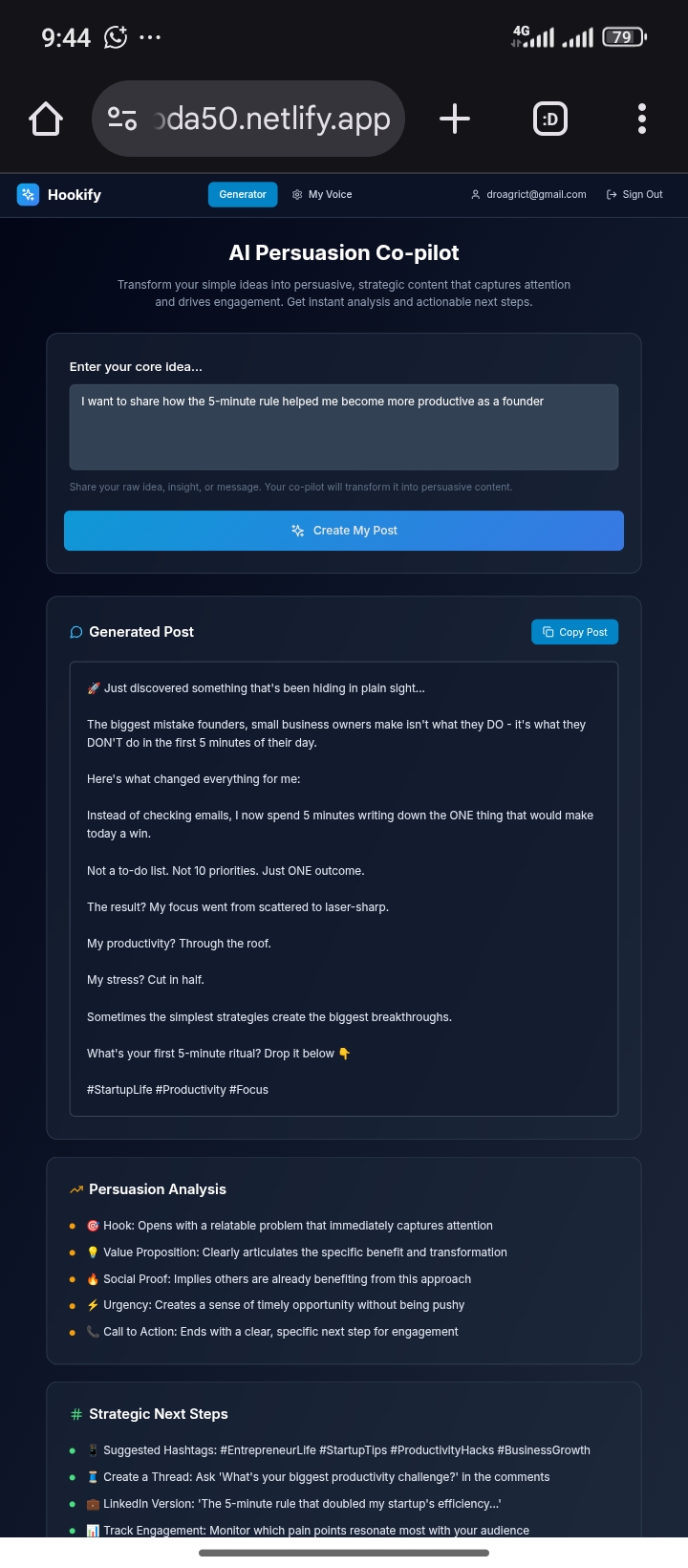
Our inspiration was to solve this problem by building the world's first AI Persuasion Co-pilot. We envisioned a tool that wouldn't just write for you, but would act as your personal marketing strategist, embedding proven persuasion techniques into every word and giving you the "why" behind its work. We didn't want to build a tool; we wanted to build an unfair advantage.
How We Built It
Hookify is a testament to the new frontier of AI development. It wasn't built line by line; it was architected and executed from a single, comprehensive one-shot prompt.
Our prompt acted as a complete architectural blueprint. It specified the entire full-stack application:
The Vision: It defined the revolutionary concept of an "AI Persuasion Co-pilot."
The Frontend: It commanded the AI to build a sleek, modern UI using Next.js, TypeScript, and Tailwind CSS.
The Backend: It instructed the integration of Supabase for user authentication and to store personalized "My Voice" data, turning a generic tool into a personal one.
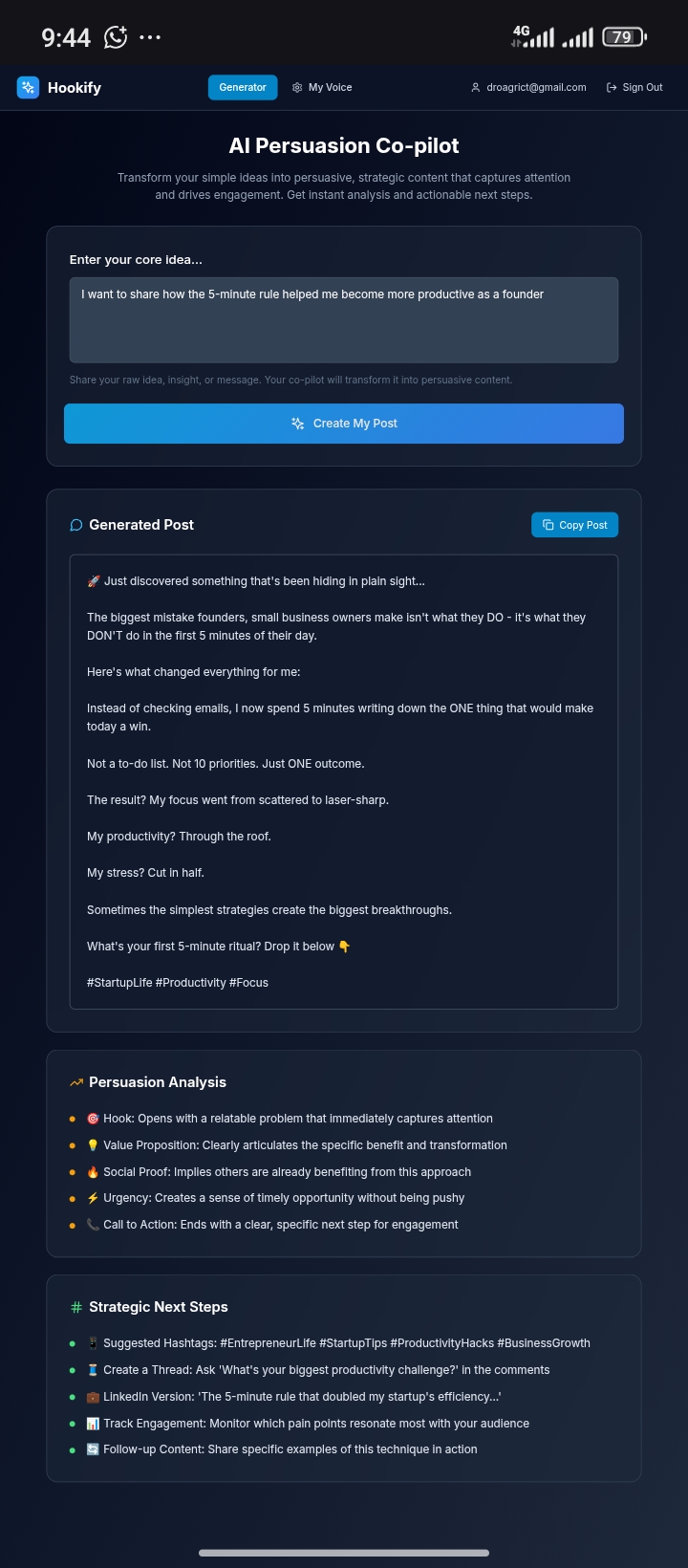
The Core Logic: Most critically, the prompt defined a structured API contract. We didn't ask for a block of text. We demanded a multi-part JSON object containing the generatedPost, the persuasionAnalysis, and the strategicNextSteps. This structured data is the key to Hookify's intelligent and useful interface.
This project was built entirely within the Bolt.new environment, leveraging the powerful code-generation and reasoning capabilities of Anthropic's Claude AI to bring this complex vision to life from a single command.
Challenges We Faced
The primary challenge was one of architectural density. How do you embed the entire vision, business logic, technical stack, database schema, and UI/UX design for a full-stack application into a single prompt without ambiguity? Every word in our prompt had to be precise, acting as both a command and a constraint.
Another significant challenge was ensuring output reliability. For an application like Hookify to work, the AI must return a perfectly structured JSON object every single time. We had to meticulously engineer the prompt to define this output schema so rigorously that the AI's response would be consistently flawless, preventing any frontend errors and ensuring a seamless user experience.
What We Learned
This project was a profound lesson in the future of software development. We learned that the power of Large Language Models has moved beyond simple conversation and into autonomous system creation. A well-crafted, architectural-level prompt can serve as the foundational act of creation for complex, production-ready applications.
Furthermore, we confirmed that the true value of AI in content creation isn't just generation, but analysis and strategy. By forcing the AI to not only create a post but also to justify its persuasive elements, we unlocked a new layer of value that transforms the user from a passive recipient into an educated, more effective marketer. Hookify proves that the future of AI tools lies in their ability to be our co-pilots, not just our engines.
Built With
- anthropic
- bolt.new
- claude
- css
- next.js
- one-shot
- prompt
- supabase
- tailwind
- typescript

Log in or sign up for Devpost to join the conversation.