-
-
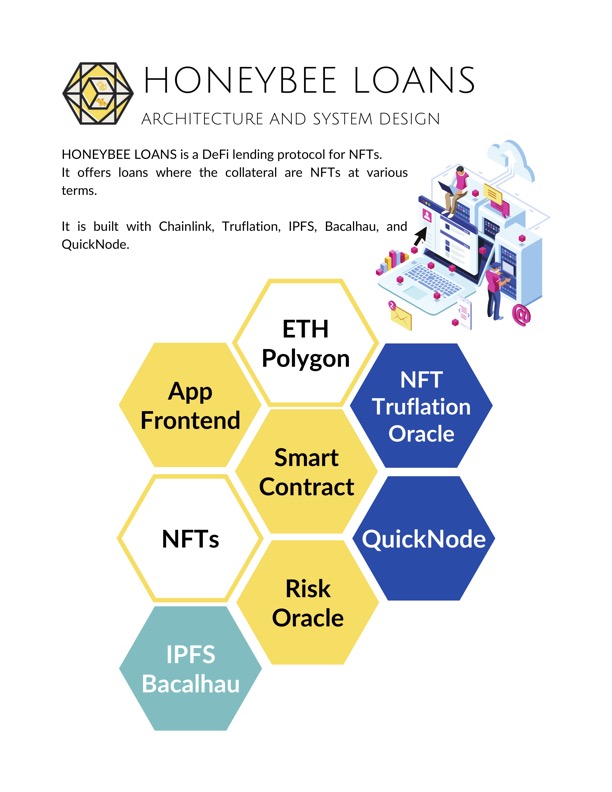
Architecture and System Design
-
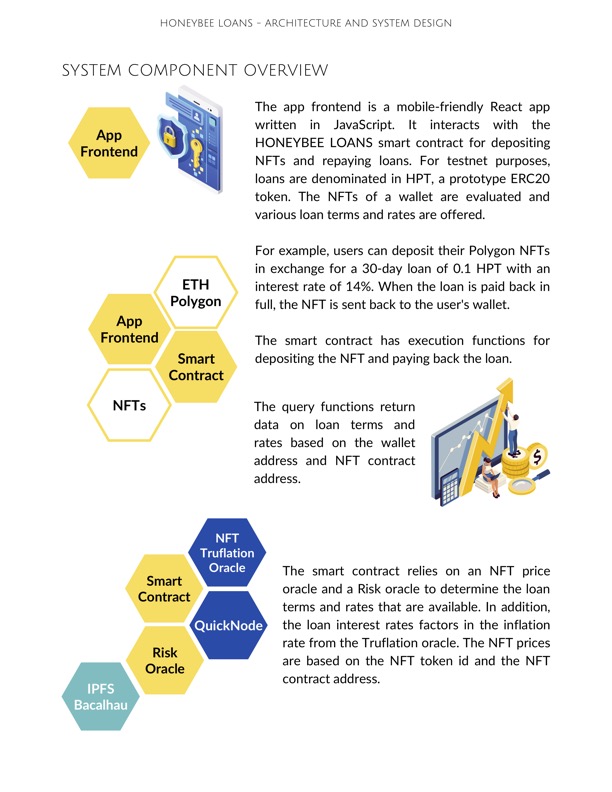
System Component Overview
-
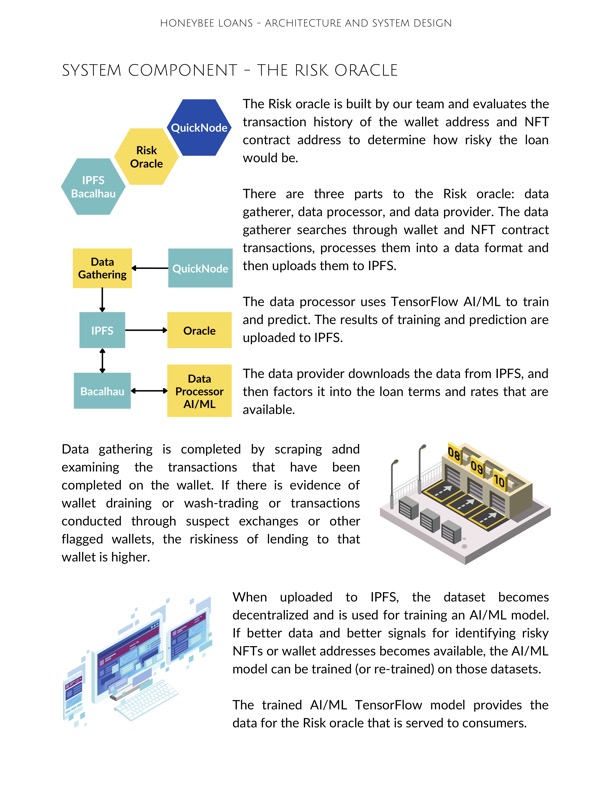
System Component - Risk Oracle
-
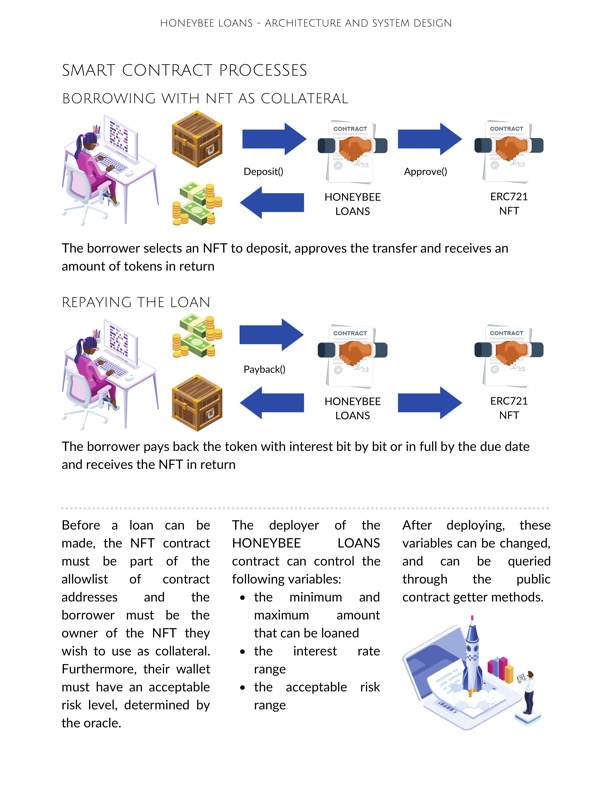
Smart Contract Processes
The Problem Our Project Addresses
Over the last few years, NFTs have become highly valued assets that are easy to buy, sell and trade. They make a great investment and should play an active role in a diversified portfolio. However, it is difficult to unlock the value of your portfolio without selling your NFTs.
With our Chainlink 2022 submission we wanted to solve this problem by making NFTs more liquid in a simple, transparent, and easy to use way!
HONEYBEE LOANS addresses this problem by evaluating NFT collections to determine their value as collateral for loans, unlocking value for customers. Another problem that arises on the part of the lender, the loan provider, is how to evaluate and determine the risk of the borrower.
How We've Addressed the Problem / How We Built it
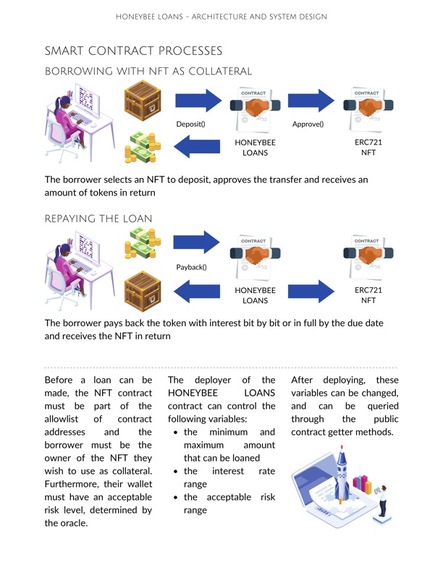
HONEYBEE LOANS provides ERC20 token loans using NFTs as collateral. We use NFT market index data to determine the bounds of the loan amounts and the interest rates that can be offered. If the NFT market cools down, smaller amounts with higher interest rates are offered. If the market heats up and NFTs are growing in value, larger amounts with lower interest rates are offered to customers.
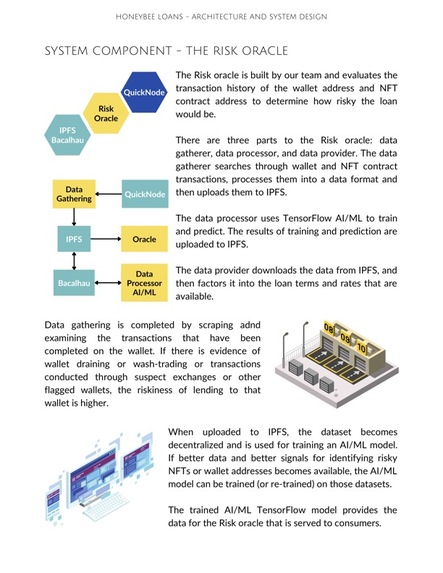
After that, we use a risk oracle data feed developed by our team to determine the specific rates and whether the loan can be offered at all. For example, wallets with questionable transactions on them or unknown NFT collections are rated as “high risk” (with risk scores above 100). The risk oracle is a machine learning model that uses transactions data from wallets and NFT contracts to determine how much of a risk the wallet borrower is.
By offering loans at reasonable rates and amounts, we improve liquidity for NFTs.
Technologies We Used to Solve the Problem
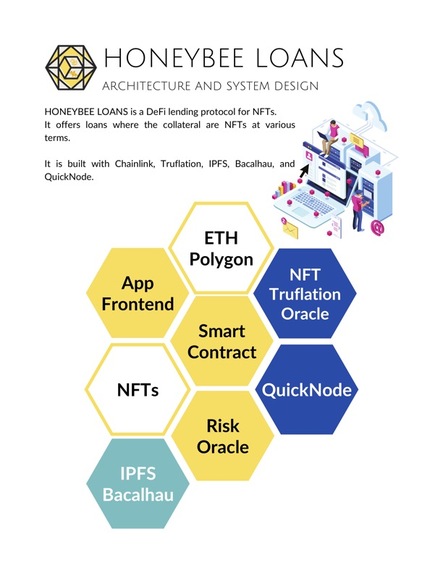
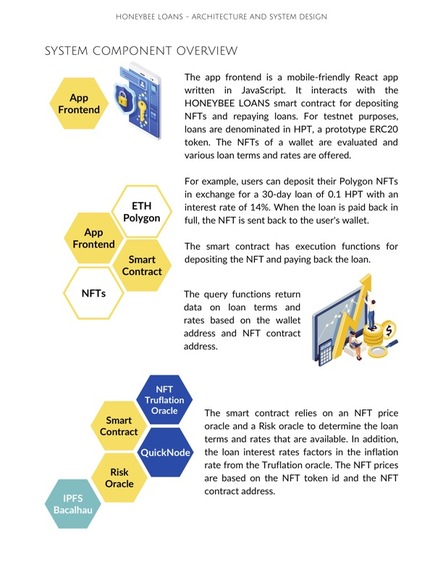
The smart contract was developed and deployed to the Polygon Network using Hardhat and Solidity. The frontend was developed using React.
We used Truflation NFT Index Chainlink data feed to determine the loan interest rates and amounts. We also used a Chainlink data feed for retrieving data from external JSON API sources to retrieve the risk score oracle data.
QuickNode was used for creating training data for the risk oracle. We used the QuickNode API methods for getting information about NFT collection transactions, finding out what additional tokens and NFTs are owned by a wallet address. It was also used for web3 api interaction on Polygon.
IPFS was used for storing training data and trained memory weights for our risk oracle machine learning model. Bacalhau was used to run the machine learning training for the risk oracle. The machine learning model was developed using TensorFlow.
Inspiration
Our inspiration for HONEYBEE LOANS is very simple - we love NFTs as both an instance of blockchain innovation and a new way to think about decentralized values and practices.
Our UX design flow and visual identity for HONEYBEE LOANS was influenced by the idea of a seamless interaction and transparency. We wanted to make HONEYBEE into a small, but powerful, streamlined and hard-working Chainlink app - just like a bee!
We developed HONEYBEE LOANS as a Chainlink based app that can address some of the existing NFT liquidity needs. Our slogan for the app sums up our vision really well - It’s Your Honey. What this means is that we designed HONEYBEE app to offer you quick, secure, and intuitive access to your NFT Portfolio, and, based on the portfolio’s assessment, you can then access loans by using your NFTs as collateral.
Challenges we ran into
Design Challenge: one of our challenges during the development of HONEYBEE LOANS was to ensure we were able to go through multiple iterations of UX design. This allowed us to eliminate redundant pages and keep only the essential components that a user would rely on for occasional or frequent use: your NFT Portfolio, Loans, Loan applications, and Loan repayment. Making decisions on key functionality was vital to the HONEYBEE LOANS app.
Development challenges: testing the Chainlink feed and how the data is parsed from a request had to be done through multiple testnet deploys. Thankfully Polygon is easy and fast to work with and the faucets were helped along with the Hardhat deploy script.
Accomplishments that we're proud of
Some of the accomplishments we are proud of:
- As a team, we are proud of being able to successfully use a Chainlink data feed and Truflation data feed. Using these technologies has been both exciting and fun.
- By approaching our dev timeline strategically we were able to create a great looking mobile User Interface as a frontend to the Smart Contract. Yay!
- We are proud to participate in an inclusive hackathon that actively promotes women in tech. There was great support in discord with helpful advice and suggestions.
- Finally, using QuickNode to accurately gather transactions data for an AI/ML training dataset is both a challenge and a success. We are happy with the results!
What we learned
Some of the lessons we learned during this hackathon are that:
- Chainlink has a lot to offer in terms of data feeds. This can be great for building even more complex and rewarding apps on multiple blockchains.
- We also learned that IPFS can be used for more than just NFTs and decentralized web hosting. It’s possible to use it in a data pipeline. Very exciting!
- By going through multiple rounds of UX design, we learned how crucial ideation is for apps that need to provide a very streamlined experience.
What's next for HONEYBEE LOANS
HONEYBEE LOANS app is a starting point addressing and simplifying the existing need for unlocking the value of your NFTs. Working on HONEYBEE LOANS got us thinking about what the next steps of this project could look like.
Our next set of goals includes:
- Improving machine learning model and training data
- Updating smart contract data structure to support multiple loans in different ERC20 tokens
- Allowing more NFT collections to be supported as collateral for loans
- Integrate Chainlink Keeper to update loan configuration on a schedule
Built With
- bacalhau
- chainlink
- ipfs
- machine-learning
- polygon
- quicknode
- react
- solidity
- truflation


Log in or sign up for Devpost to join the conversation.