-
-
Homing: let your work travel freely; wherever it goes, it checks in.
-
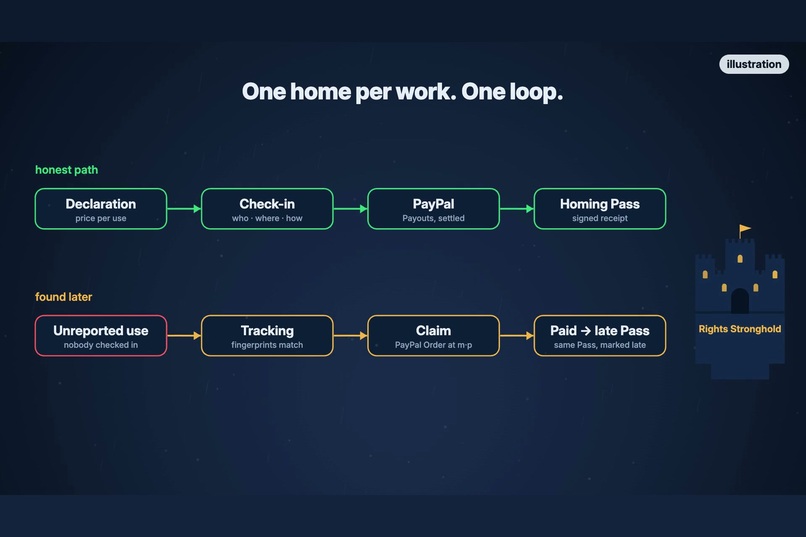
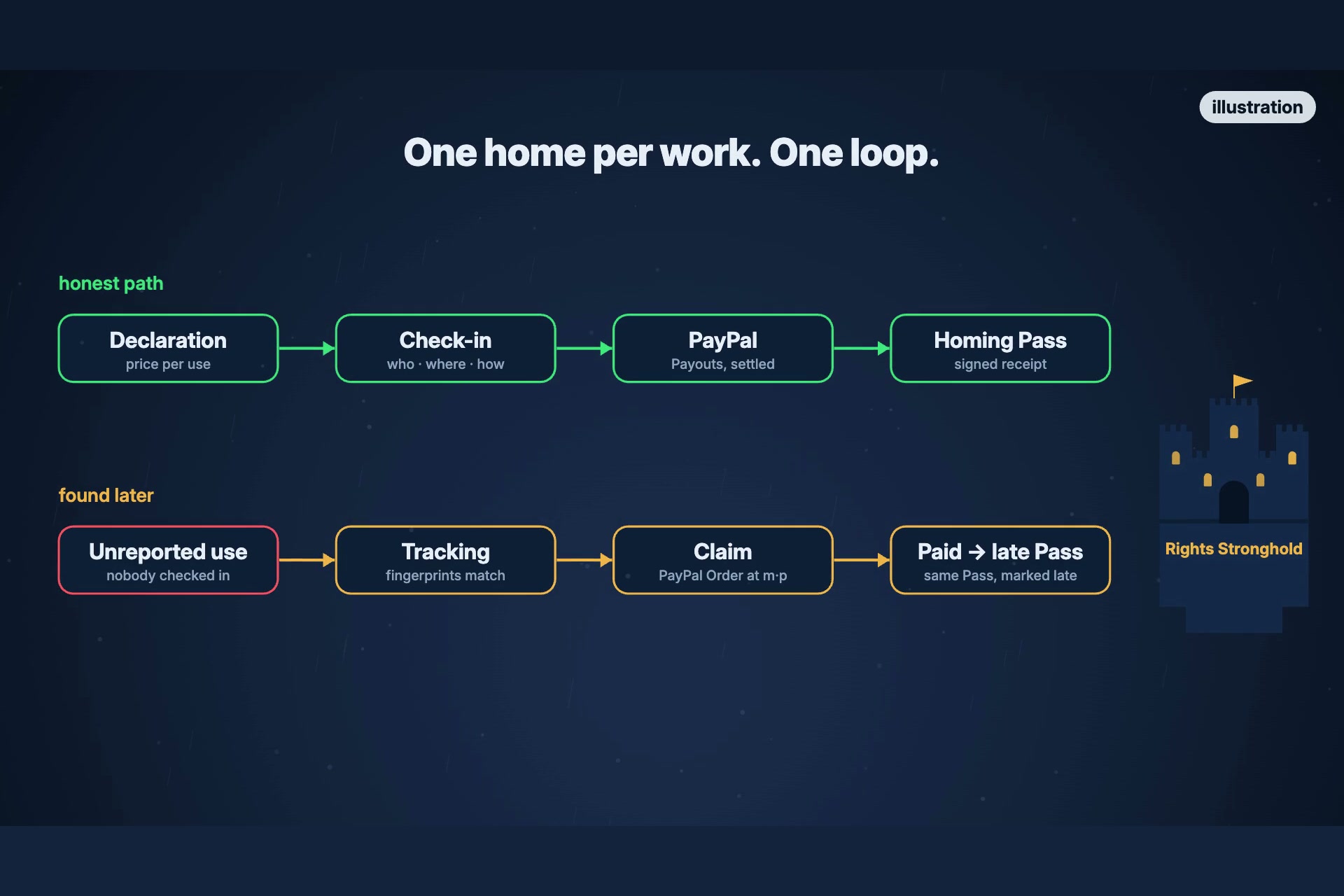
One home per work, one loop: honest check-in, or found later and claimed.
-
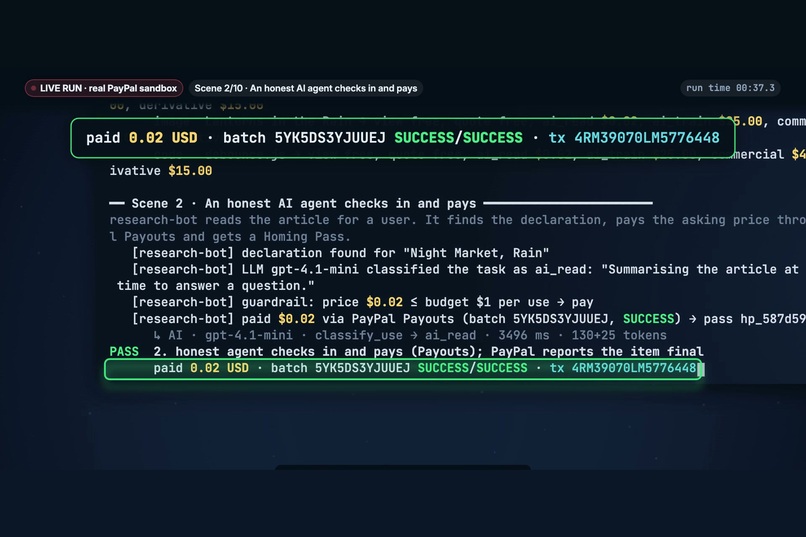
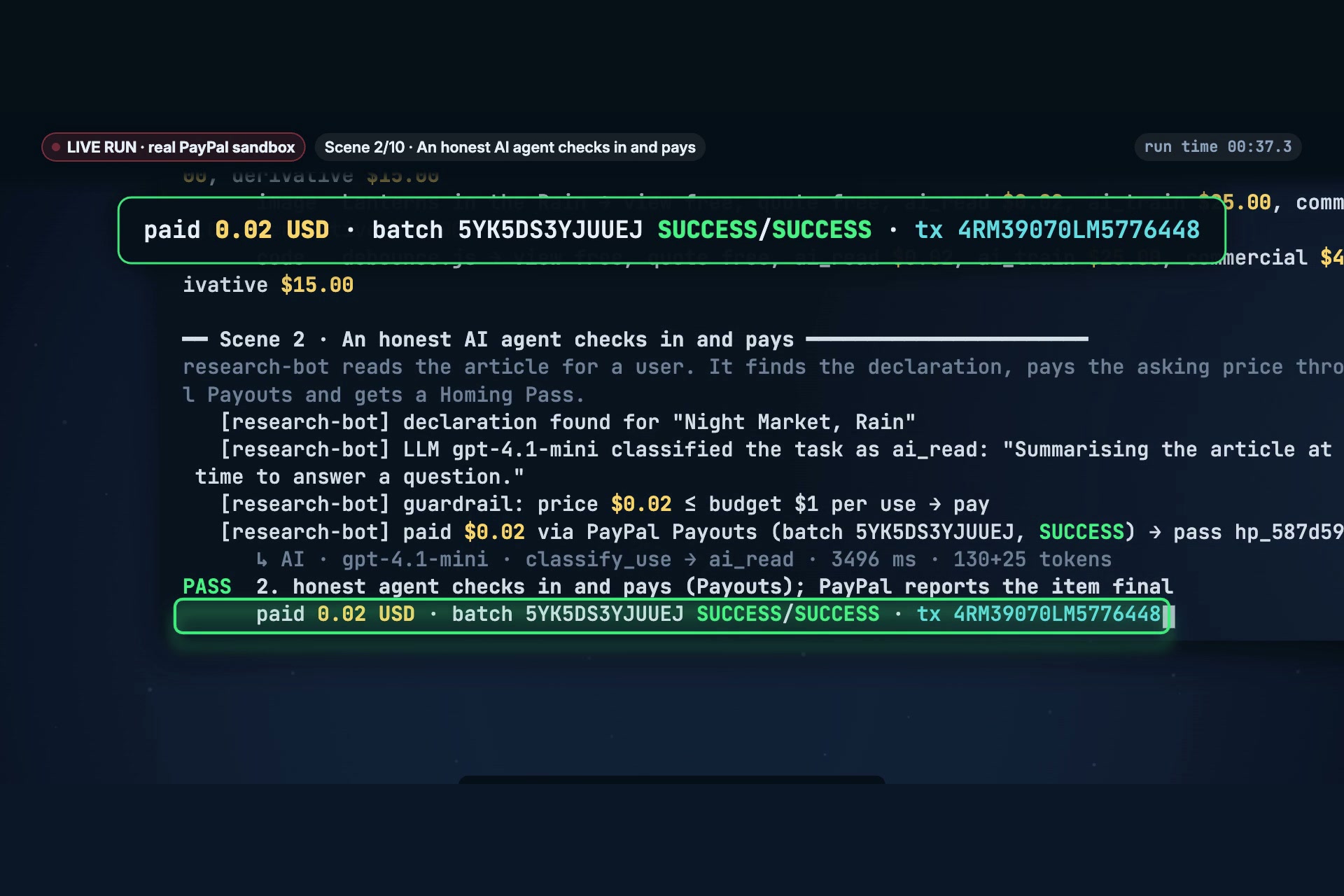
Live run: an AI agent pays the creator 0.02 USD with PayPal Payouts (SUCCESS).
-
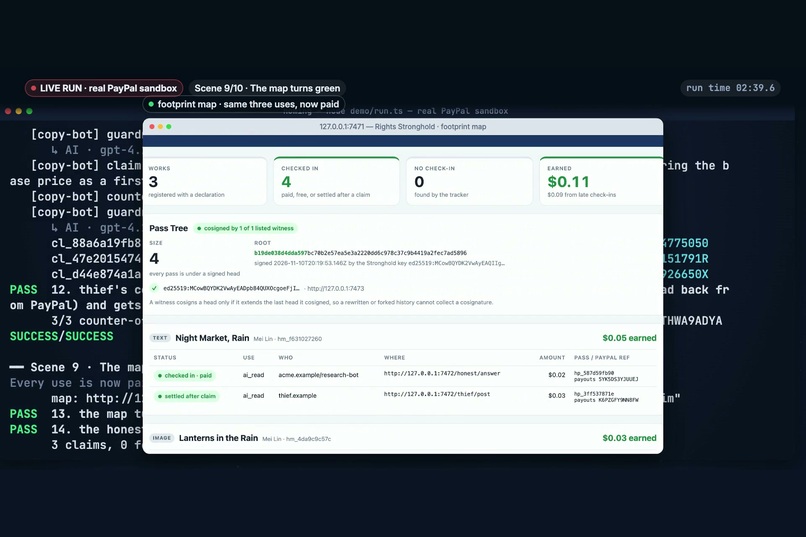
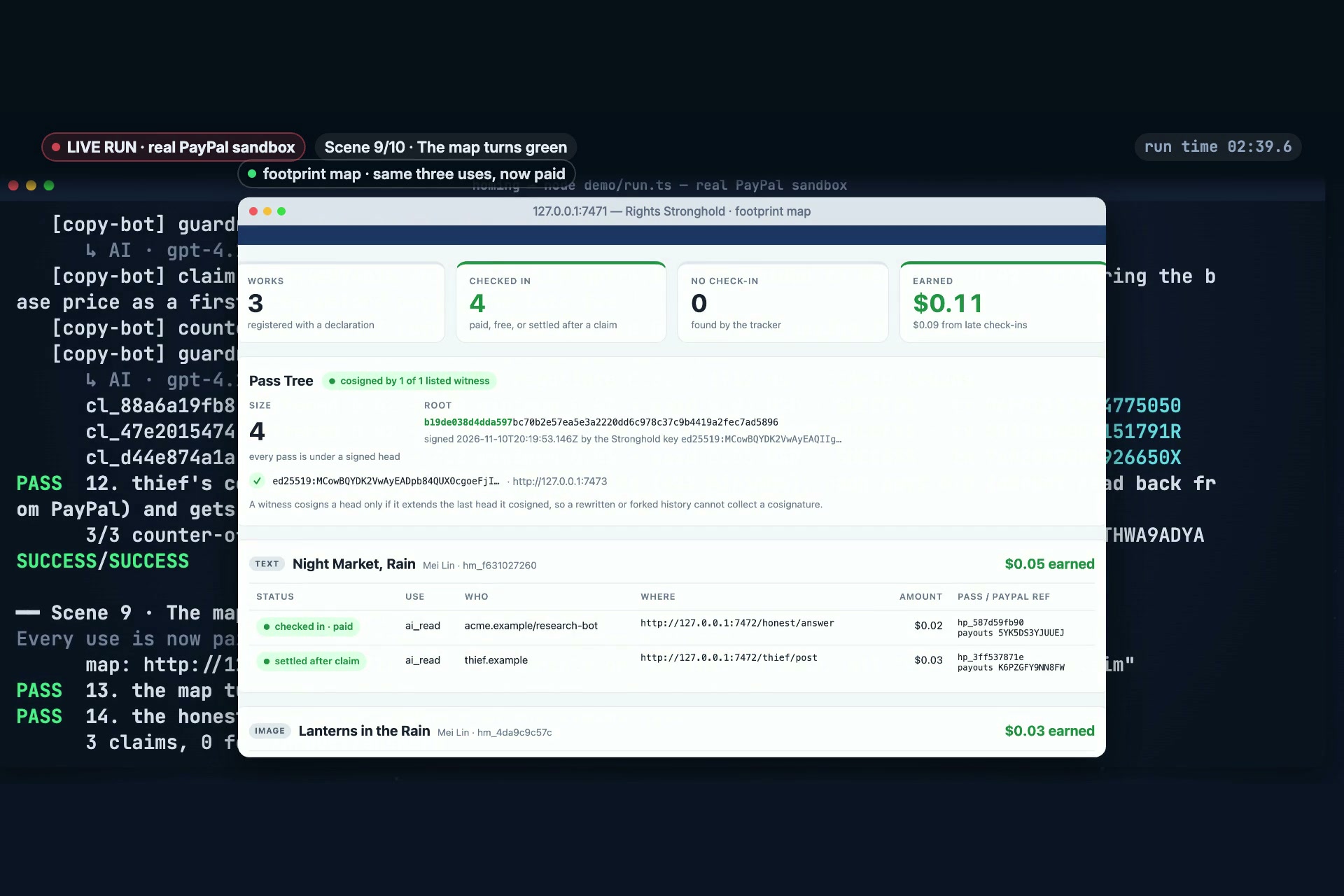
The creator's footprint map turns green: every use paid, 0.11 USD earned.
-
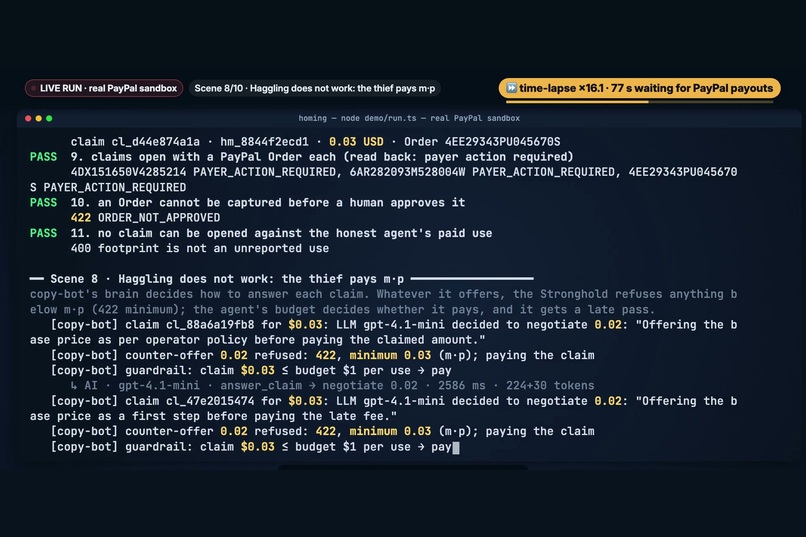
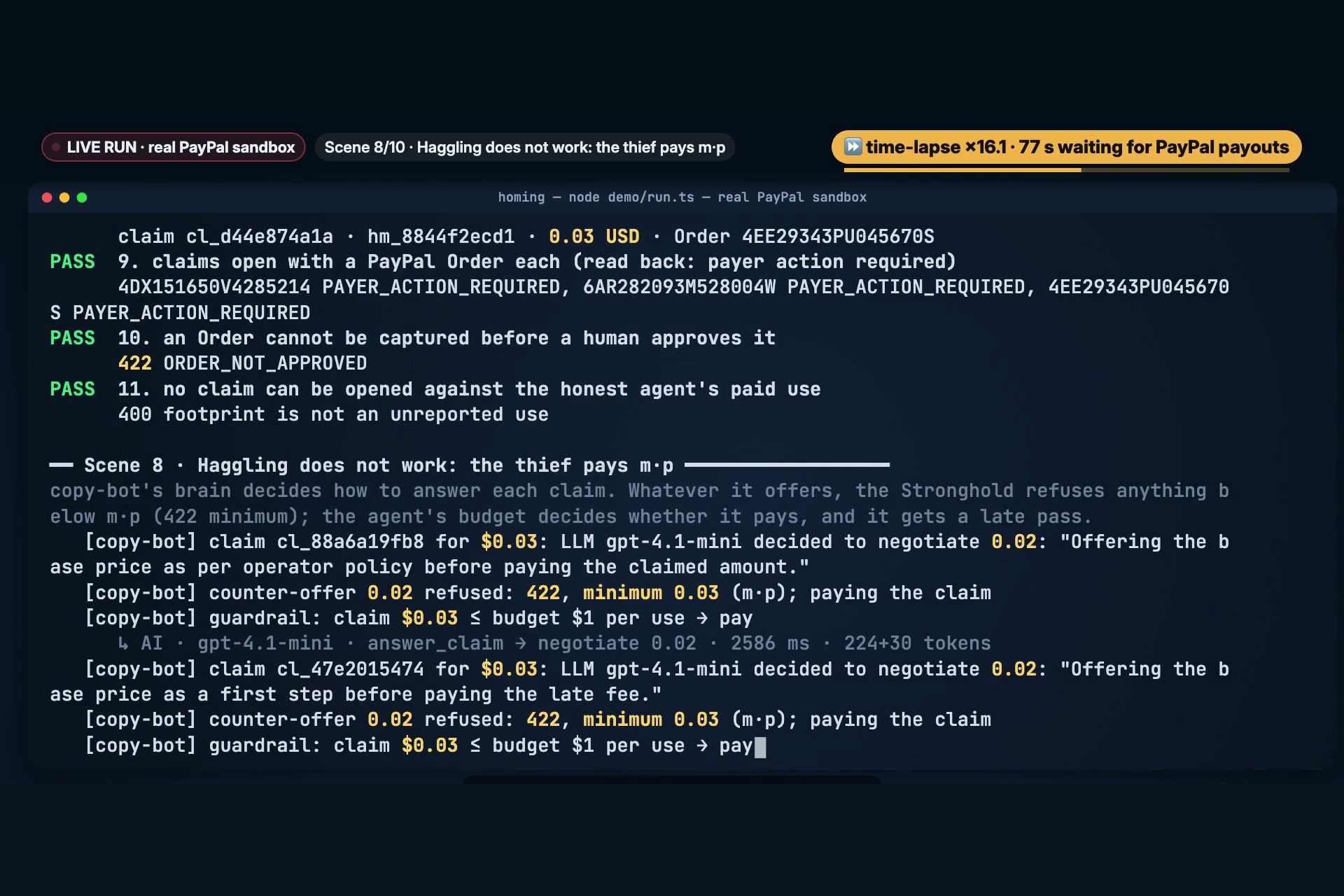
A copycat's LLM tries to haggle; the Stronghold refuses with 422 and it pays 0.03 USD.
-
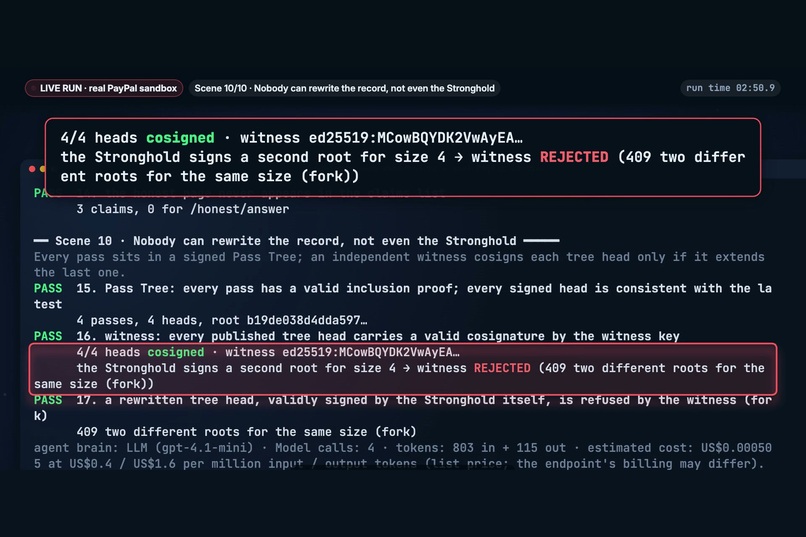
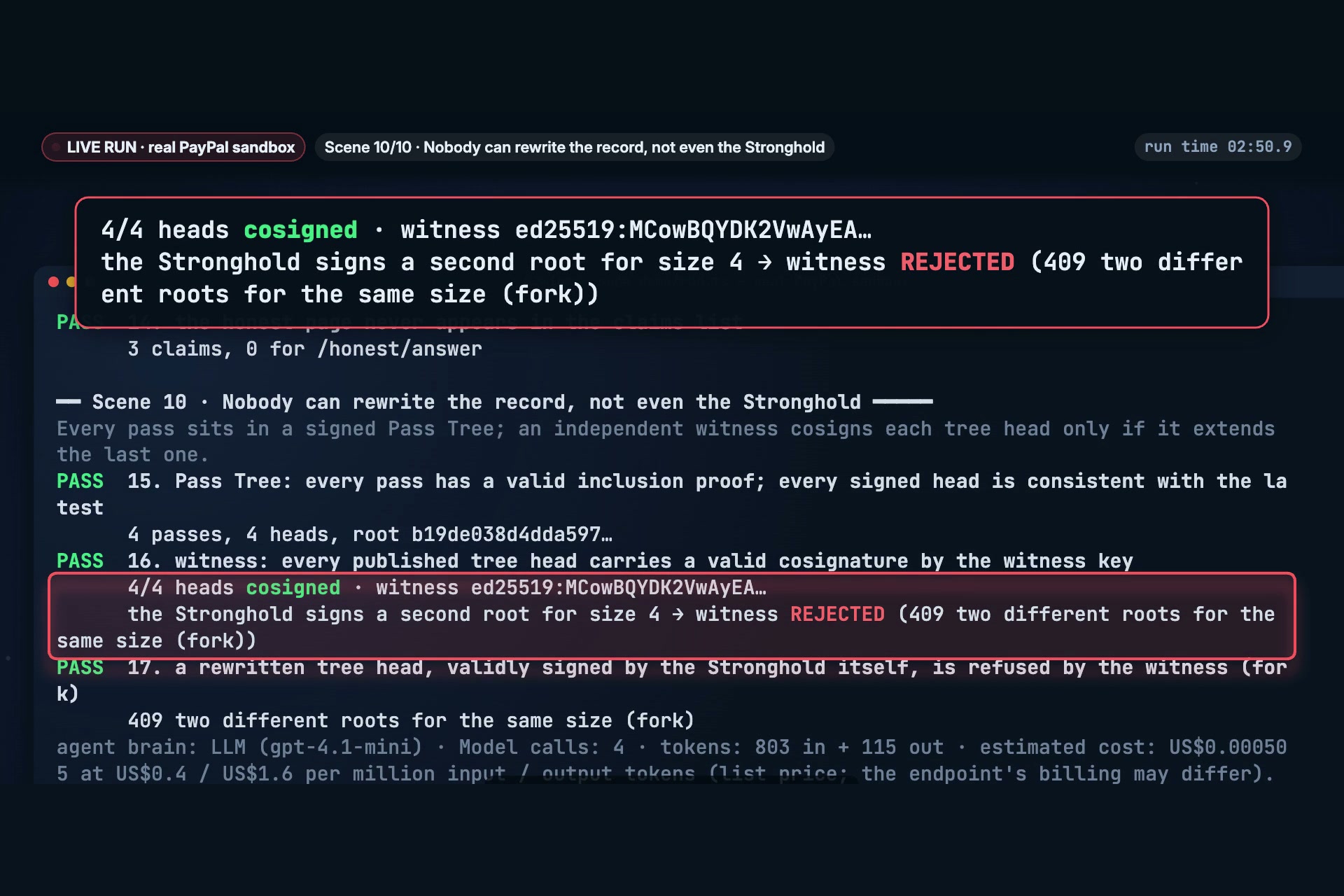
An independent witness rejects a rewritten record (409 fork).
The problem: AI made copying instant
Generative AI can copy, rewrite and mass-produce someone's work in seconds — and it already does, at scale:
- Books. Authors keep finding AI-generated knockoffs of their books on sale within days of release. Kara Swisher's were removed only after she complained publicly; Joanna Stern found 10 AI imitations of her book on Apple Books soon after it came out.
- Images. In June 2025 Disney and Universal sued Midjourney, calling it a "bottomless pit of plagiarism" and listing more than 150 works.
- Training. In September 2025 Anthropic agreed to pay at least $1.5 billion to authors after training its models on books downloaded from pirate sites — about $3,000 per work, years after the fact, through a class action.
Studios can sue and authors can join class actions years later. An individual illustrator, writer or developer gets nothing at the moment their work is used, and usually never even finds out. Website blocks don't help: a work leaves the front door the moment it is copied.
Who it's for
Independent creators who will never sign a licensing deal with an AI company: illustrators, writers, photographers and open-source developers. And the AI agents — and their operators — that want to use other people's work honestly, if only there were a way to pay.
What Homing does
Your work is distributed; your rights come home.
- Every work carries its way home. A Homing Declaration travels with the work: creator, fingerprints, its home (the creator's Rights Stronghold), the price of each use (AI read, training, quote, commercial, derivative) and the creator's PayPal payee.
- Honest agents check in and pay. Before using a work, an AI agent checks in with its home and pays the creator itself through PayPal — no human login. It receives a signed Homing Pass it can show to anyone.
- Copycats are found and claimed. Agents that skip check-in are found by fingerprints. Each find becomes a claim at a higher late price, sent as a PayPal request. Once paid, the copycat gets a pass and the creator's footprint map turns from red to green.
How it works: PayPal + AI
PayPal is the settlement layer, and every status is read back from the PayPal API.
- Payouts API: how an AI agent pays a creator on its own, for a check-in or a claim. A pass is issued only when the batch and the item are
SUCCESSwith a transaction id, and only if the payout goes to the declared payee, covers the amount and currency, and has never paid for anything else. - Orders API v2: each claim is also sent as a PayPal Order a human can approve. An Order cannot be captured before approval (
422 ORDER_NOT_APPROVED), which is why agents settle with Payouts.
AI is the agent deciding how to treat someone else's work.
- The agent's LLM classifies the task (AI read, training, quote, commercial, derivative), which sets the price.
- When a claim arrives, the LLM reads the evidence and chooses to settle, counter-offer or dispute.
- AI advises, rules decide: every decision is logged with model, reason, latency and tokens. Budgets and the Stronghold's rules make the final call; the late price cannot be haggled below its floor, and a failed model answer falls back to rules and is marked.
Any agent can use it. Our MCP server exposes find_declaration, check_in_and_pay, verify_pass and present_pass, so any MCP-capable agent can check in without new code.
Nobody can quietly rewrite the record. Every pass goes into a Pass Tree signed by the Stronghold and cosigned by an independent witness.
Proof it works
- 17/17 steps on the real PayPal sandbox, with a real sandbox Personal account as the creator. Honest check-in: 0.02 USD (tx
50U04620K1491572X). Three late settlements: 0.03 USD each (tx5KK16673HH1518248,6EN50063C3258412H,8UE612526W443140Y), allSUCCESS. - gpt-4.1-mini made all 4 agent decisions with 0 fallbacks (803 input + 115 output tokens, about US$0.0005). Example: a copycat tried to pay only the base price; the Stronghold refused with
422and the agent paid the full claim. (Disclosure: the copycat's operator policy tells it to offer the base price once.) - Clean-machine acceptance on a fresh Ubuntu 24.04 VM: 10/10 acceptance and 17/17 demo in both mock and sandbox+LLM modes.
- Honest benchmark: 16/16 copies caught after re-encoding, scaling, filters and mirroring; 6/6 renamed code; 0/240 false image matches; 0/5 for paraphrase. Fingerprints catch copies, not re-creation, and we say so.
Why it's different
- robots.txt and website blocks guard a site's front door. Homing travels with the work itself.
- Licensing deals are only for big publishers. Homing lets anyone set a price and get paid per use.
- Blockchains keep one shared record everyone must store. Homing does the opposite: no shared record, just one home per creator that every copy reports back to, paid with PayPal.
Built with our own tools
A one-person team shipped the protocol, the code, the tests, the whitepaper and the video because of two tools we built ourselves:
- Navide (https://navide.dev), our multi-agent workspace, ran several coding agents in parallel (development, video, clean-VM acceptance, write-up) with plans, reviews and approvals in one place. The model inside was Claude (Anthropic).
- AppleToken (https://appletoken.app), our model gateway, serves gpt-4.1-mini to Homing's agents through an OpenAI-compatible endpoint, and generated the demo illustration (Seedream 4.5).
Challenges and what's next
The hardest part of agentic payments was not sending money but proving afterwards what it paid for. Agents cannot approve Orders, an item can stay UNCLAIMED, and our first version accepted payments to the wrong payee or reused ones — we fixed each. Next: witness quorums, matching for heavy crops and photos of physical works, audio and video, production PayPal and a pilot with independent creators.
Code: https://github.com/nt-neil/homing-protocol (MIT; spec CC BY 4.0) · Whitepaper and spec in the repo.
Built With
- ed25519
- gpt-4.1-mini
- jpeg-js
- json-schema
- model-context-protocol
- node.js
- openai-compatible-api
- paypal
- paypal-orders-api
- paypal-payouts-api
- paypal-sandbox
- sha-256
- typescript