-
-
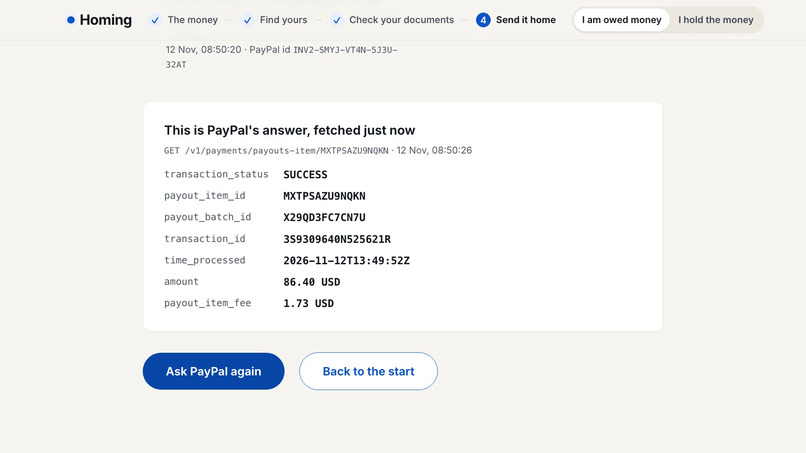
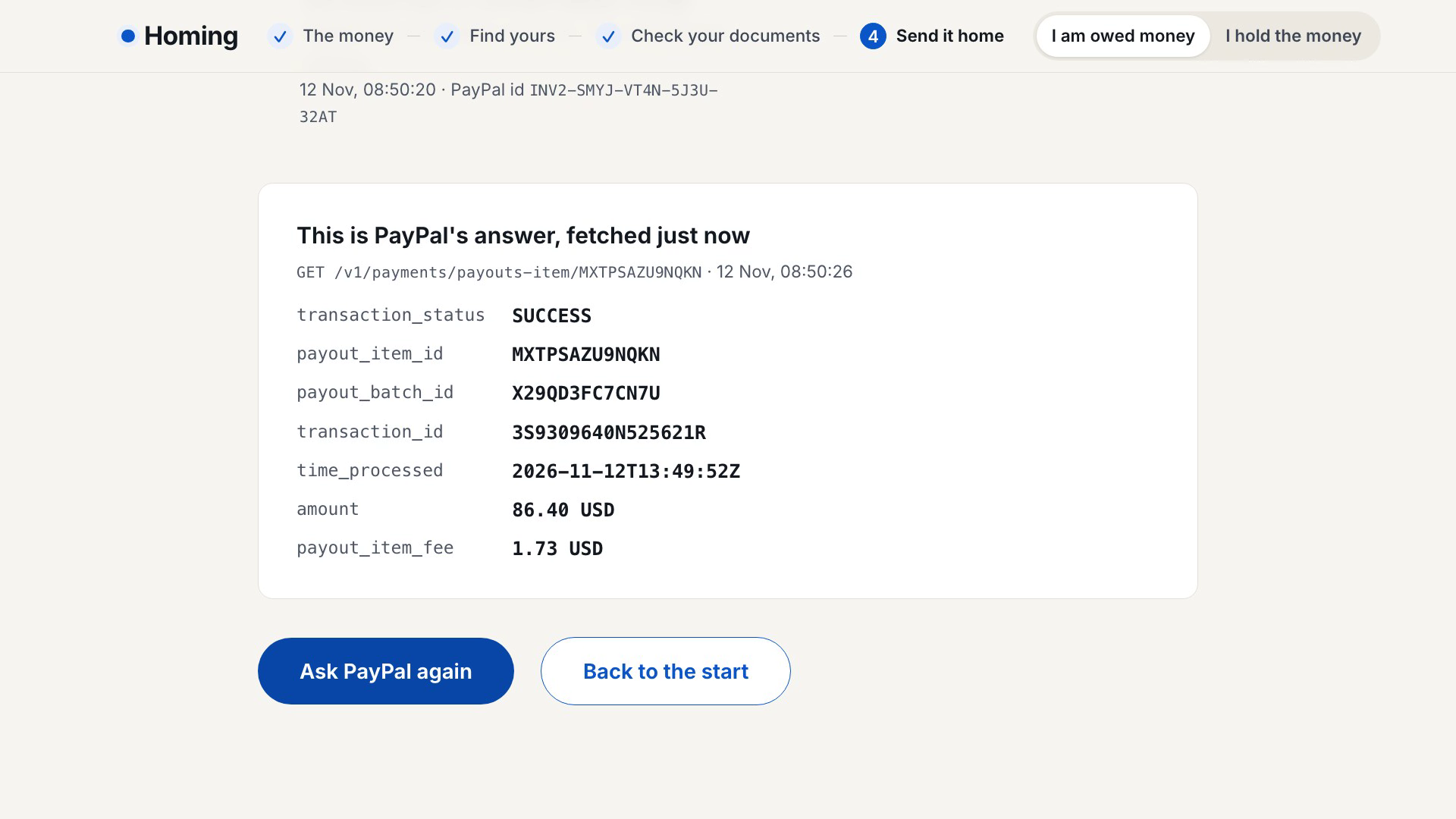
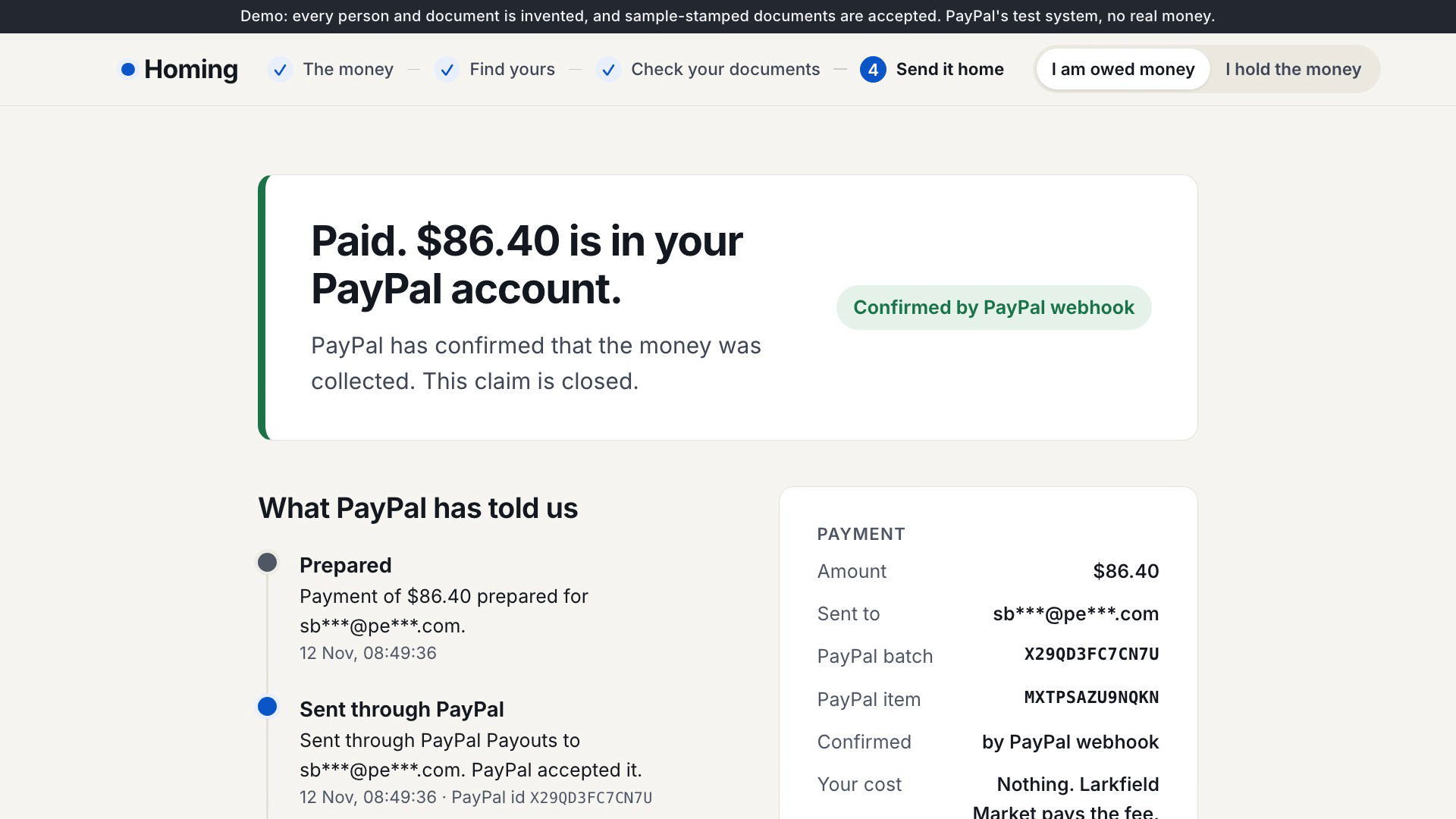
Paid: the page says so only after PayPal reports the money was collected
-
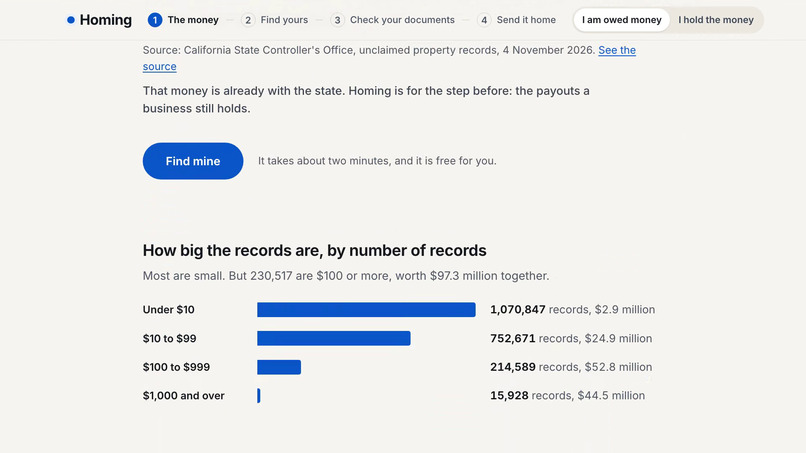
PayPal's own record of the payout, fetched live
-
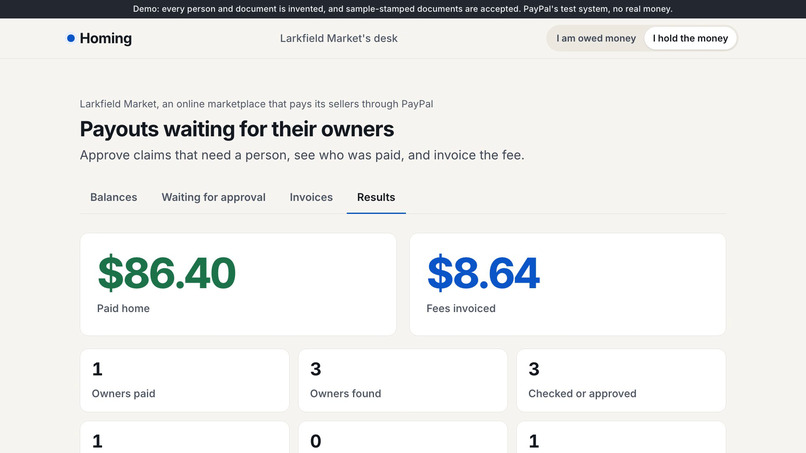
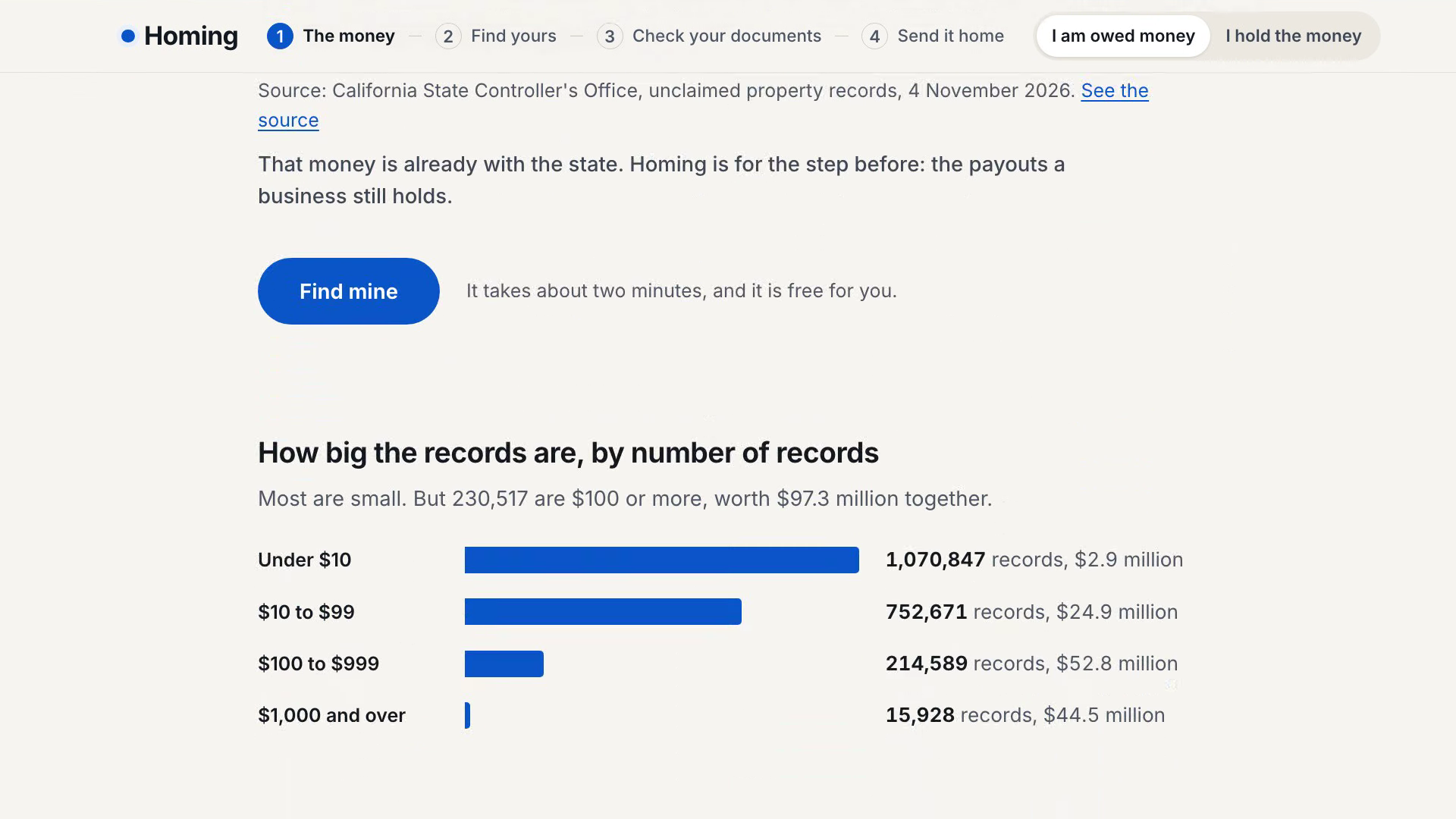
The number: what PayPal alone has reported to California as unclaimed
-
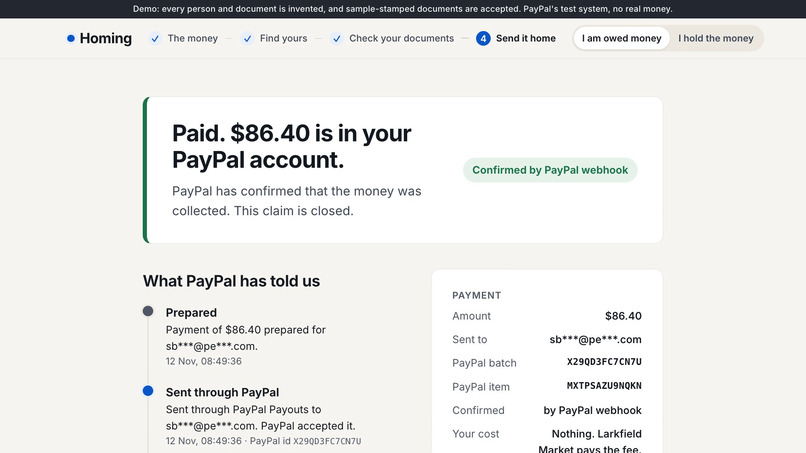
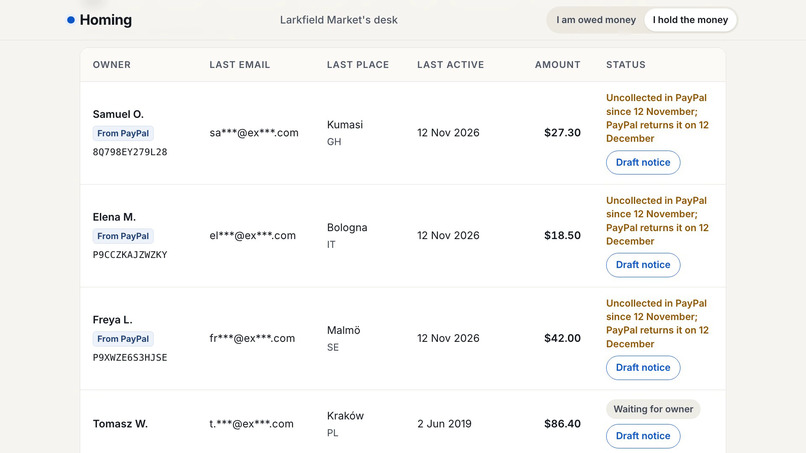
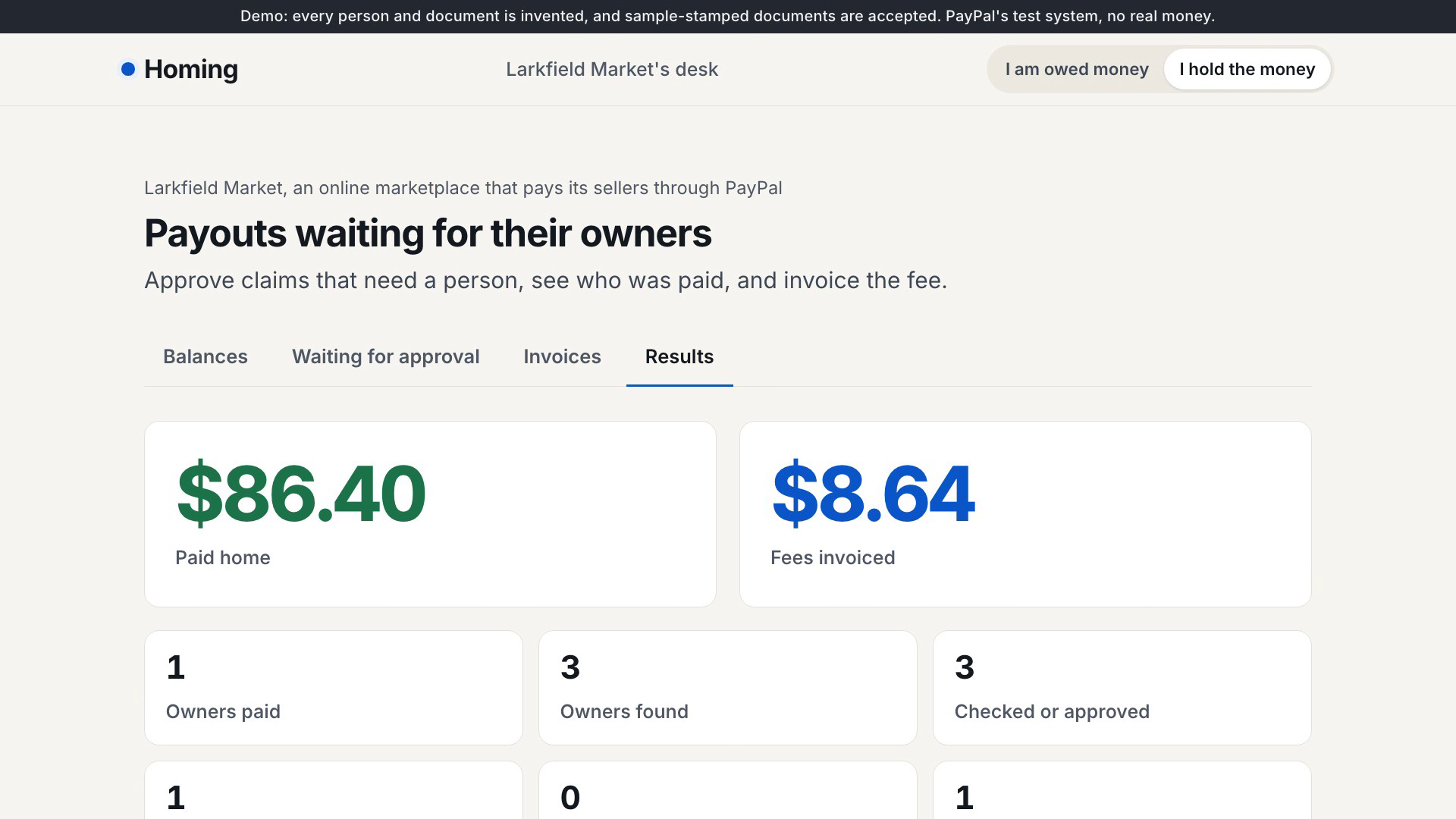
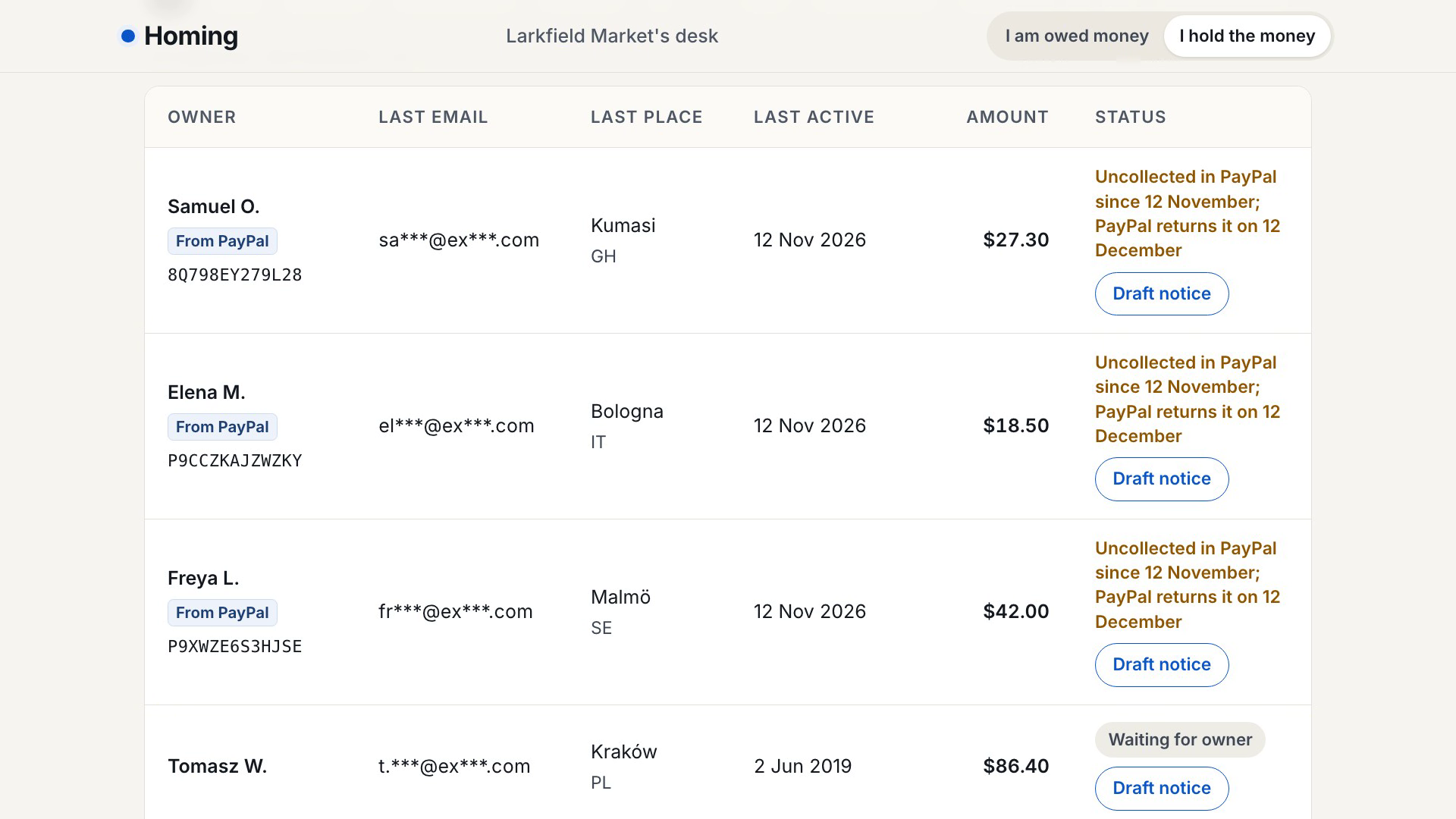
The business's desk: uncollected payouts imported from PayPal
-
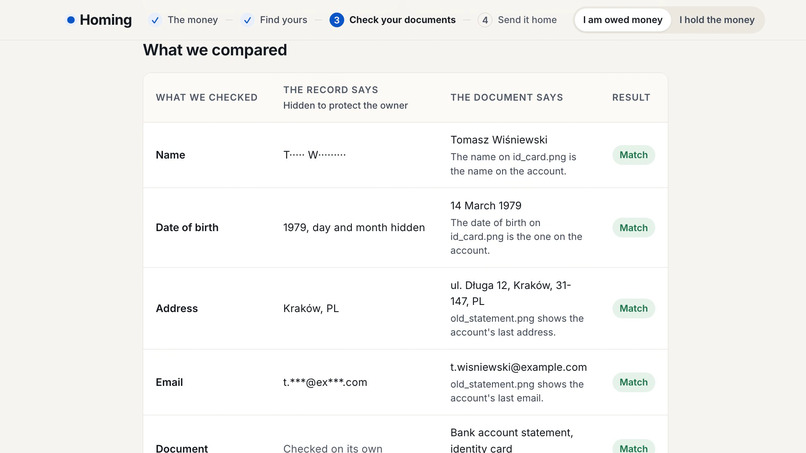
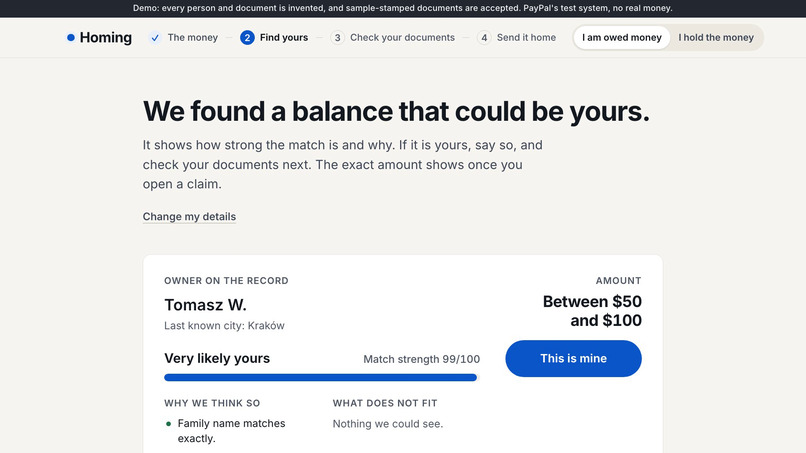
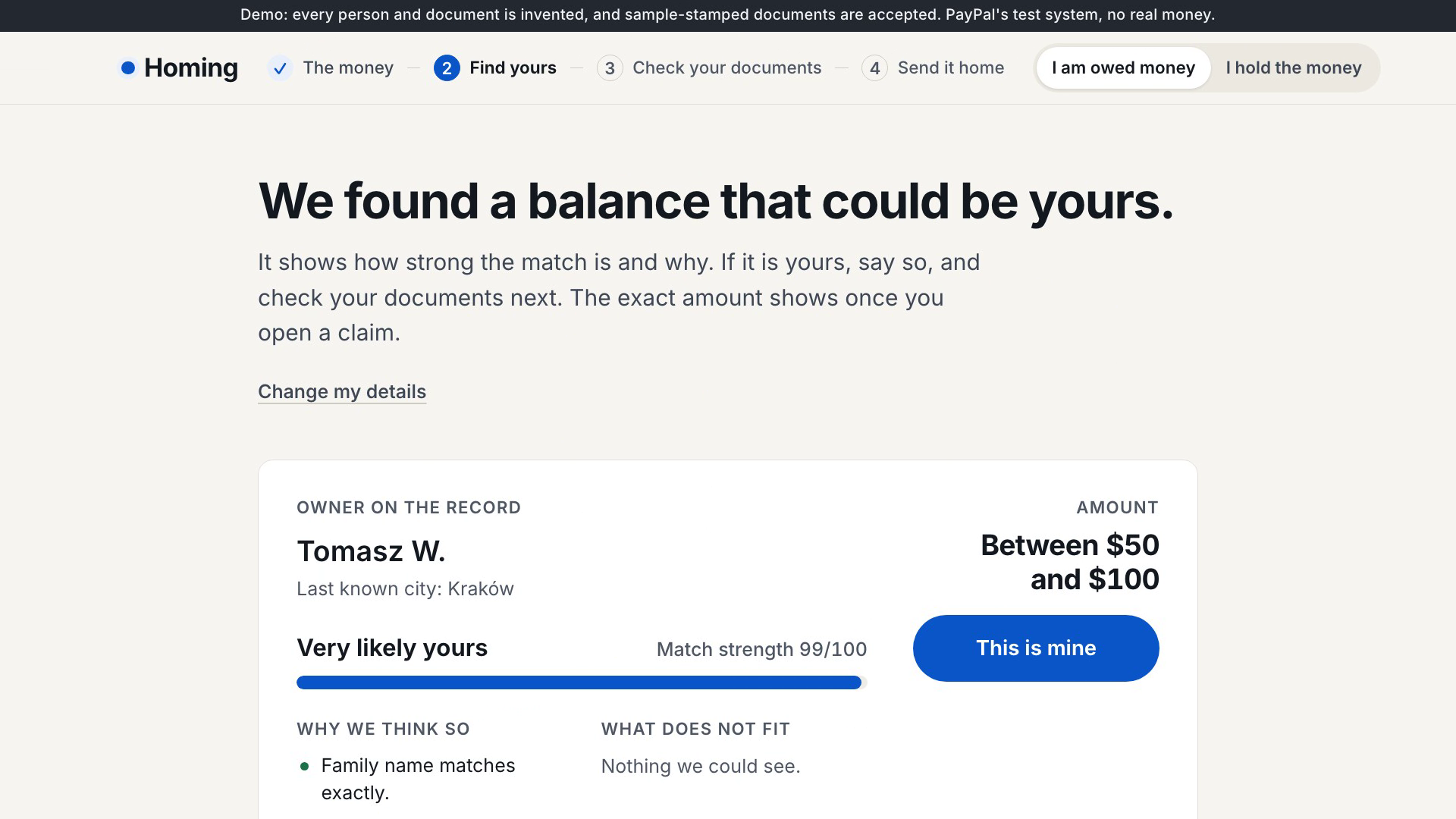
The owner finds the payout, with the reasons it matches
-
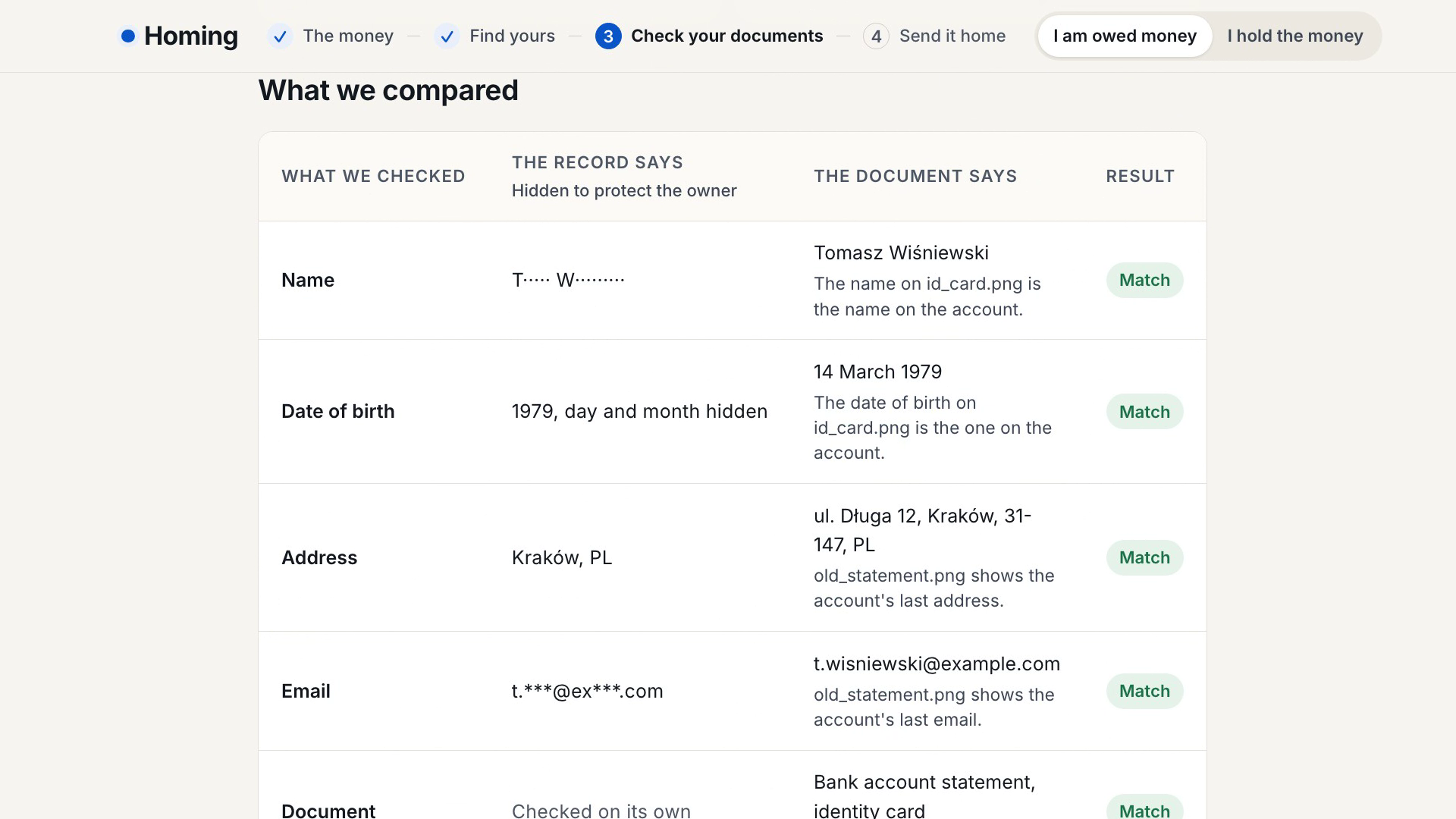
What the model read, and what plain code compared
-
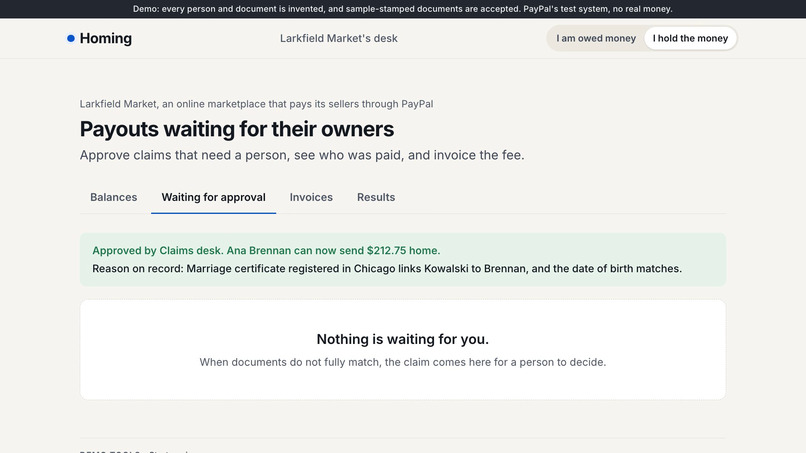
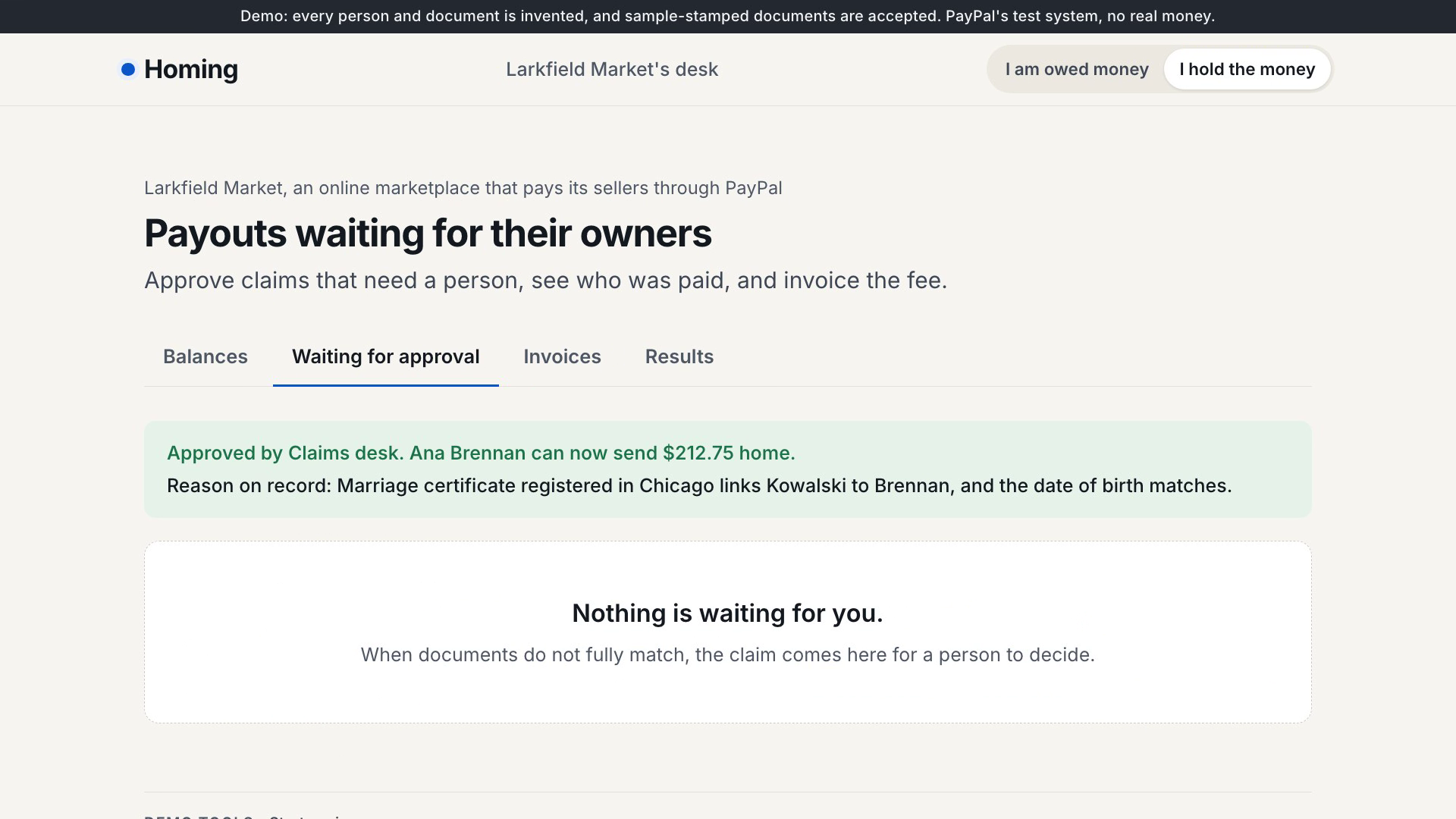
A doubtful claim: a person must write down why they approve
-
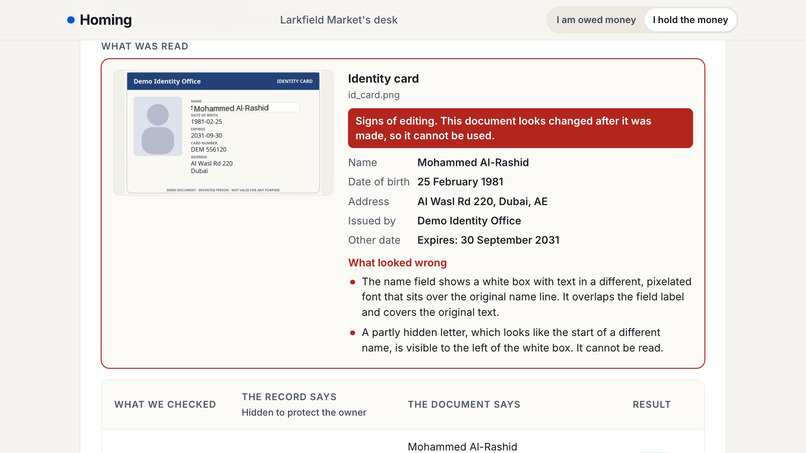
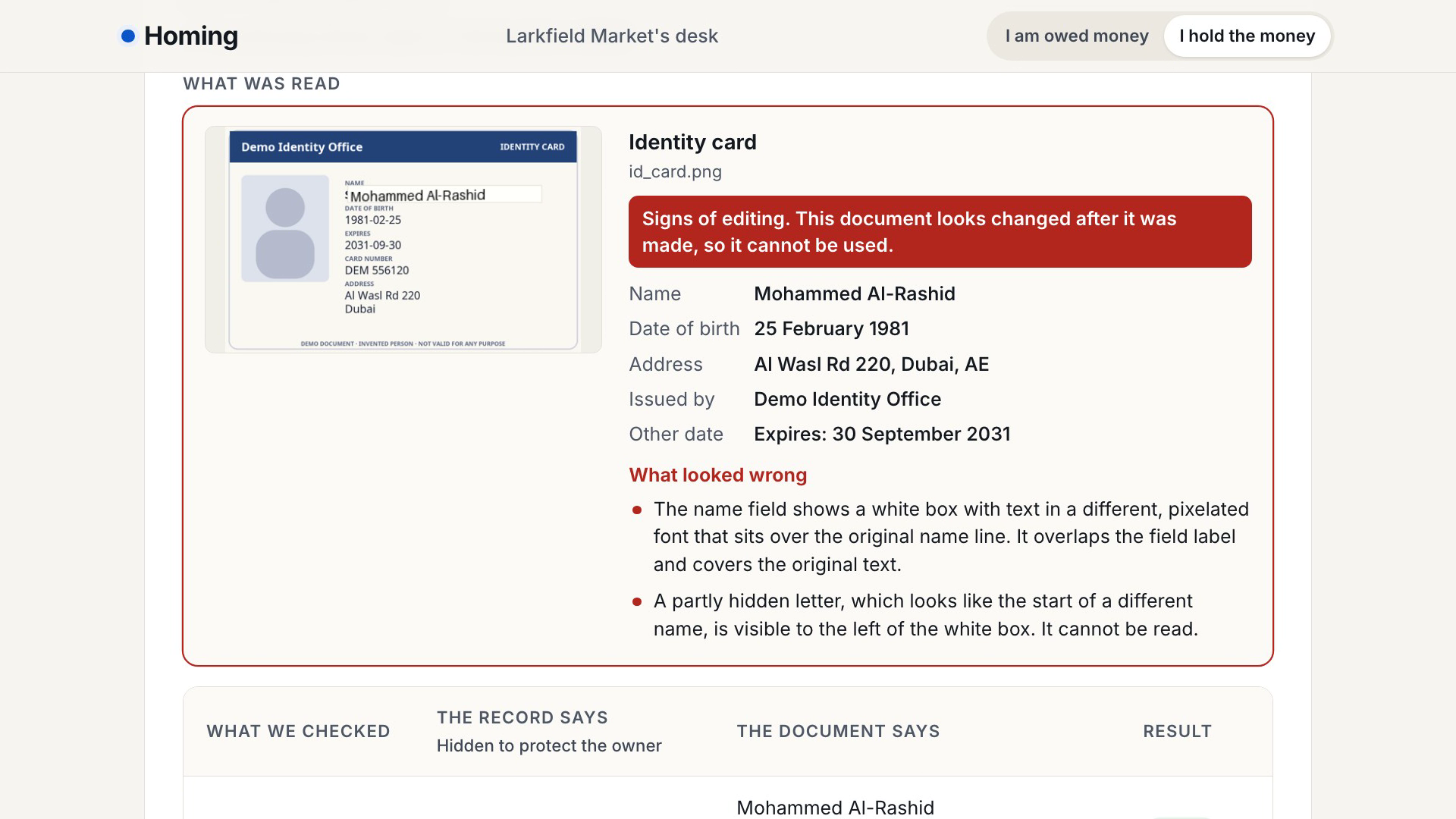
An edited identity card, flagged by the model and stopped by code
-
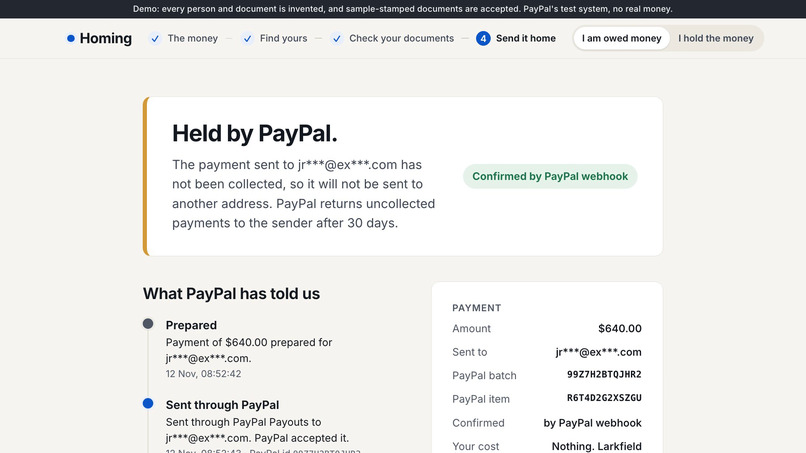
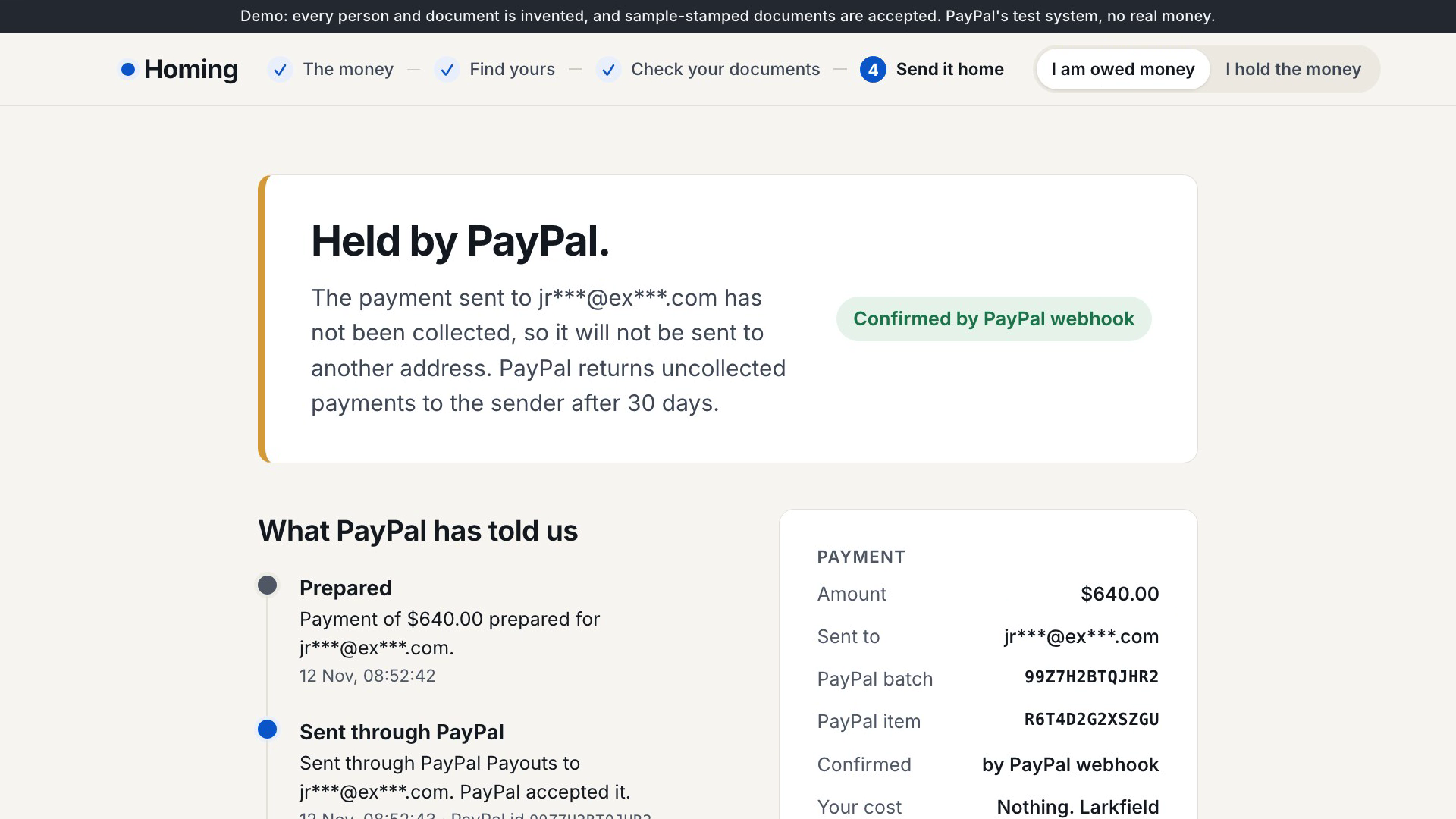
Held by PayPal: an uncollected payout is never sent twice
-
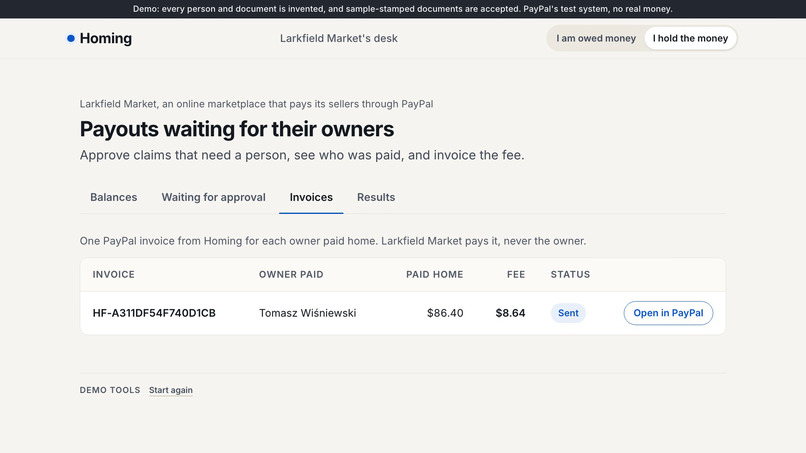
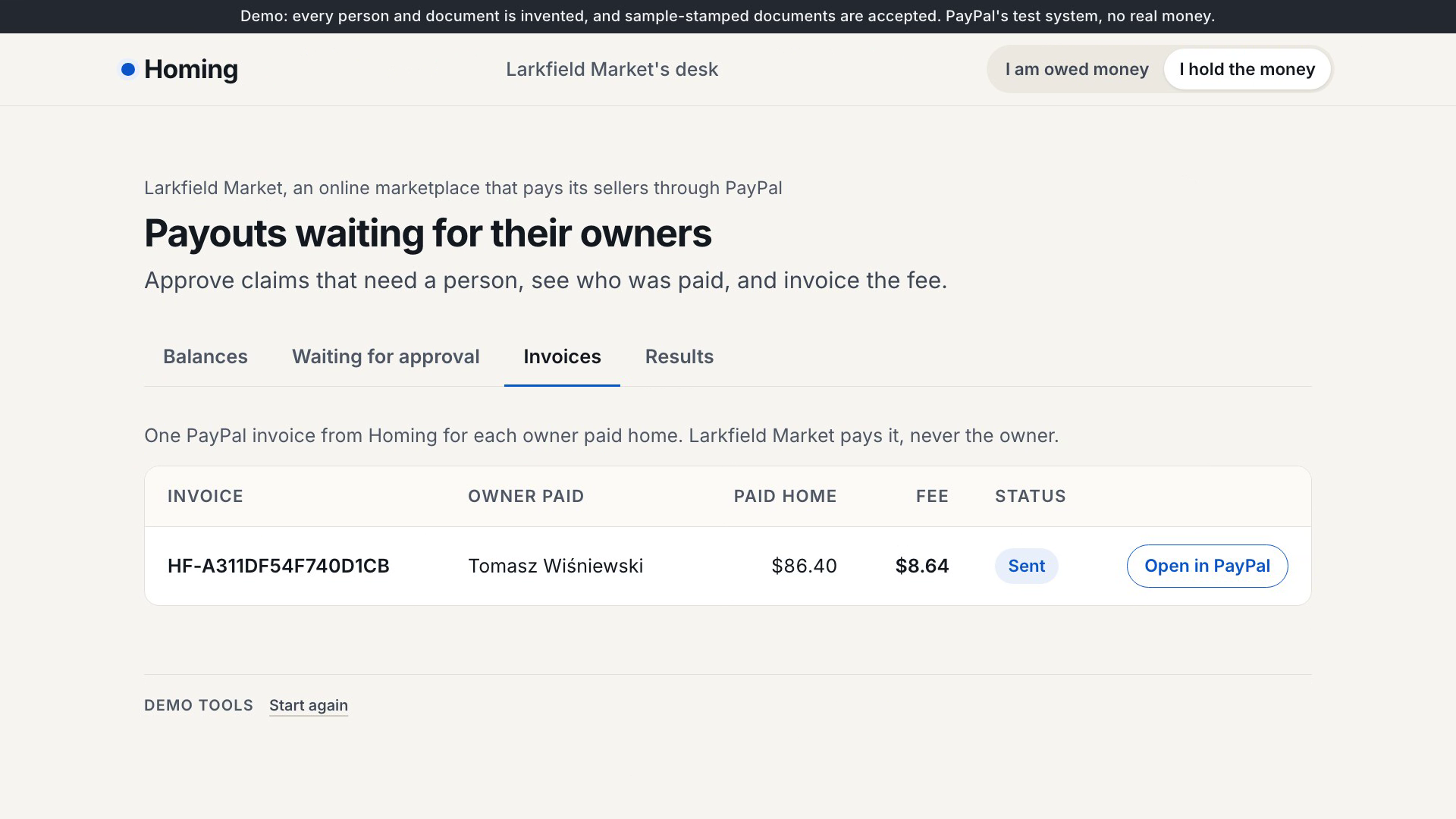
One PayPal invoice to the business for each payout that gets home
-
Results from the recorded sandbox run
Inspiration
A marketplace pays a seller through PayPal Payouts, but the seller's email is dead. The payout sits unclaimed in PayPal for 30 days, goes back to the marketplace, and stays on its books until the law hands it to the state. Homing is for businesses that pay people through PayPal Payouts and still hold payouts nobody collected. In the video, asked to pay a claim that had been turned down, its AI desk agent calls the pay tool and code refuses it: only code, or a person who must write down why, can approve a payment, and a claim can never be paid twice.
In one state, across every payment channel, California's unclaimed property file of 4 November 2026 holds 44,698,123 records worth $3,044,769,901 in payments businesses owed people: wages, commissions, refunds, vendor checks and royalties. PayPal alone reported 2,054,035 records worth $125,083,033, 93% of them filed as miscellaneous intangible property. Homing touches none of that money and works on the step before, while a business still holds a payout it sent through PayPal and nobody collected.
We also wanted an agent that can move money without being trusted with it. An AI that can both read an identity card and pay is one forged document away from paying an impostor. So Homing's desk agent chooses its own steps, including live PayPal lookups and the tool that pays, but every tool runs through code that can refuse it, and the money itself moves through a payout state machine that cannot pay twice.
What it does
Homing is for a business that pays people through PayPal and still holds payouts nobody collected. The demo uses an invented marketplace, Larkfield Market, and invented sellers.
- Imports the problem from PayPal. For each payout batch the business has on file, it asks PayPal for the batch and lists every item PayPal reports as unclaimed or returned. In the demo, three real uncollected sandbox payouts sit beside a sample ledger of older balances such as Tomasz's. PayPal still holds those three for 30 days, so Homing holds them too and drafts the notices. Once PayPal returns a payout to the business, it becomes a balance like Tomasz's, which the demo pays end to end.
- Drafts the notice. A model drafts the notice to each owner in the language they most likely read, with an English copy. Homing never sends it; the business does, to whatever contact it still has on file (a postal address, a phone number, the seller account's inbox). The claim page accepts any old name, email or place, so an owner whose payout email died can still show the money is theirs.
- Finds the payout. The owner types their name, old names and the places they have lived. Homing shows each match with the reasons it fits and the reasons it might not. Two people with the same name come back as doubtful, never as a sure match.
- Checks the claim. The owner photographs an identity document and something that ties them to the account. A model reads the documents and the screen shows exactly what it read. Plain code compares every field with the account record and decides: approved, sent to a person, or turned down. The model can stop a claim (it flags an identity card with a pasted-in name) but it can never approve or pay one. A turned-down claimant sees one sentence; only the business's desk sees why.
- Sends doubtful claims to a person. A married-name change with a new address goes to the business's desk. The reviewer sees every check and must write down why they approve.
- Runs a desk agent. On the business's side, an agent works the open queue with narrow tools: it asks PayPal about each uncollected payout, holds what PayPal still holds, drafts the notices, hands two owners with one name to a person, and pays a claim a person has approved, then waits for PayPal's confirmation. Every tool call is shown and logged. In the recorded run it paid Ana $212.75 through PayPal Payouts; asked to pay the claim that had been turned down, it called the pay tool and code refused it. Why an agent: code lists the open cases (PayPal-held payouts, balances that share a name, turned-down and approved claims) and gives the model a short instruction for each. The model picks each tool call, reads PayPal's live answers and the ledger, and writes the reason a person will read. When it calls the pay tool on a claim the rules forbid, code refuses it. The point is not that a model out-thinks a rule. It is that an agent can hold real PayPal money tools and still cannot pay the wrong person.
- Pays it home. An approved claim is paid with PayPal Payouts to the owner's current PayPal address. The page says "Paid" only after PayPal reports that the money was collected, and shows PayPal's own record of the payment.
- Why it matters to PayPal. Every claim Homing settles is a PayPal Payout (the sandbox charged a $1.73 payout fee on Tomasz's $86.40), and the owner collects into a PayPal account, which PayPal invites them to open if they have none.
- Never pays twice. If a payout goes to an address nobody collects from, PayPal holds it, and Homing will not send that money again until PayPal returns it (after 30 days). Then the claim goes back to the business to send to an address the owner confirms.
- Bills the business, not the owner. For each payout that reaches its owner, Homing sends the business one PayPal invoice for its fee. The business owes this money to its owner or, after the dormancy period, to the state, and it is expected to try to reach owners first and keep a record. Homing drafts each notice, logs every step, and ends with the owner paid, which also gives a seller a reason to come back. The fee in the demo (10%, at most $25) is our assumption, not a market rate.
- Helps after the handover. For money already with the state, it prepares a claim packet for the owner to review, sign and send.
How we built it
- PayPal Payouts (sandbox): single-item batches with a batch id derived from the claim, so a retry after a crash can never pay twice. PayPal's duplicate-batch refusal is used to adopt the existing batch.
- PayPal webhooks: payout item and batch events are verified with PayPal's signature check and applied in any order. In two live sandbox runs behind a public tunnel, 5 payouts (3 collected, 2 uncollected) were each confirmed by a signature-verified PayPal webhook delivery. Earlier runs, and the desk agent's $212.75 payout to Ana shown in the video, were confirmed by asking PayPal, which is the fallback.
- PayPal Invoicing: one fee invoice is created per paid claim under a fixed invoice number, from Homing's own PayPal account to the business (in one live case the webhook and our own status check confirmed the payout within two seconds of each other and the send was recorded twice; the invoice was created once).
- AI: Claude reads the photographed documents (names, dates, addresses, signs of editing), writes the plain-language result in the owner's language, drafts the notices, and drives the desk agent: a tool loop where the model picks the next tool (live PayPal lookups, ledger search, hold, send to a person, pay) and code executes or refuses it. Approval is decided by plain code or by a person with a written reason; the pay tool is refused unless that approval exists and the owner left a PayPal address. The agent's PayPal tools call PayPal's REST API directly: as far as we could find, PayPal's Agent Toolkit and MCP server have no Payouts tools, and the pay tool has to sit behind Homing's own approval check. The toolkit's Invoicing tools would be a natural next step.
- Python and FastAPI on the server, React and TypeScript in the browser, SQLite for the claim and settlement records, and 145 automated tests (plus 5 live sandbox tests), including the no-double-pay rule and out-of-order webhooks.
Challenges we ran into
- PayPal's sandbox never accepted a cancel of an unclaimed payout: 6 requests came while the batch was still processing (BATCH_NOT_COMPLETED) and 6 got HTTP 500, so we could not confirm that a cancel works there. We made the safe behaviour the rule: the claim stays "Held by PayPal" and nothing is paid twice.
- A document reader that also decides is easy to fool, so reading and deciding are kept apart. We had to design each check so that code, not the model, makes the call, and so a rejected claimant learns nothing about what to forge.
- Unhappy paths took more work than the happy one: duplicate batches, webhooks arriving before the API answers, two owners with one name.
Accomplishments that we're proud of
- Real runs in PayPal's sandbox on 12 November 2026, counted by
scripts/live_tally.pyfrom our local settlement database (the output is committed asdata/live_tally.txt): 32 payouts sent across repeated runs of the same sample cases (the demo resets between runs); 20 collected and reported SUCCESS; 12 sent to addresses with no PayPal account, all held, and no claim paid twice; 20 fee invoices created and sent; 30 webhook deliveries verified with PayPal's signature check, and a live test confirms that check rejects a forged delivery. - In a live run the desk agent asked PayPal about each uncollected payout, held them, handed two same-name owners to a person, paid Ana $212.75 through PayPal Payouts, and was refused by code when asked to pay a turned-down claim.
- The edited identity card is caught by the model on a live reading and stopped by code, and the claimant is told nothing about why.
- The headline number is reproducible from California's public files with one script.
What we learned
Most of the work in moving money safely is deciding what must never happen: paying twice, paying the wrong person, saying "paid" before it is true. PayPal's Payouts lifecycle (unclaimed, returned, cancelled) already describes this problem; Homing is built on top of it.
What's next for Homing
- In production the payout step runs under the business's own PayPal account, self-hosted or with delegated access, so Homing never holds its keys. Homing's own account only sends the fee invoice.
- PayPal reported 2,054,035 records worth $125,083,033 to California in this one file. The same flow could run on PayPal's own dormant balances before they are reported.
- Reading a business's payout history through Transaction Search, so no batch list is needed.
- Identity checks from a verification provider beside the document comparison.
- The same flow for other holders with the same duty: marketplaces, gig platforms, charities' donation processors.
Try it
Live demo: https://homing-955819688070.us-central1.run.app. Paying is live to PayPal sandbox test accounts, with a daily test-money cap. The hosted copy has no model connected, so it shows saved readings of the sample documents (data/samples in the repo) and a saved desk-agent run recorded with the real model and live PayPal lookups (its pay step is a rehearsal that sends nothing; the video shows the live payment to Ana).
No login is needed for the hosted demo. To see the money arrive, open "See PayPal's record" on any paid claim, which fetches PayPal's own answer live, or pay a free personal sandbox account of your own.
Try it in two minutes
- Open the live demo, choose "I am owed money", and search for
Tomasz Wiśniewskiwith the old email[email protected]. - Upload the two files in data/samples/clean from the repo.
- Send it home to
[email protected]for a real sandbox payout, or to any@example.comaddress to see "Held by PayPal". - Switch to "I hold the money", open Desk agent and press "Show the saved run".
Built With
- claude
- duckdb
- fastapi
- google-cloud-run
- paypal
- playwright
- python
- react
- sqlite
- typescript
