-
-
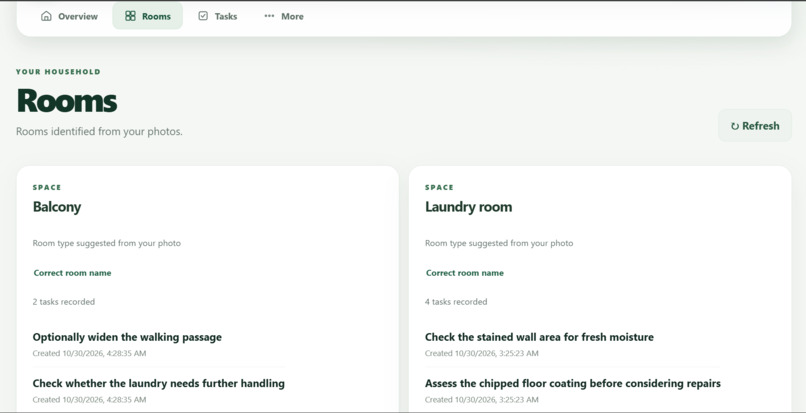
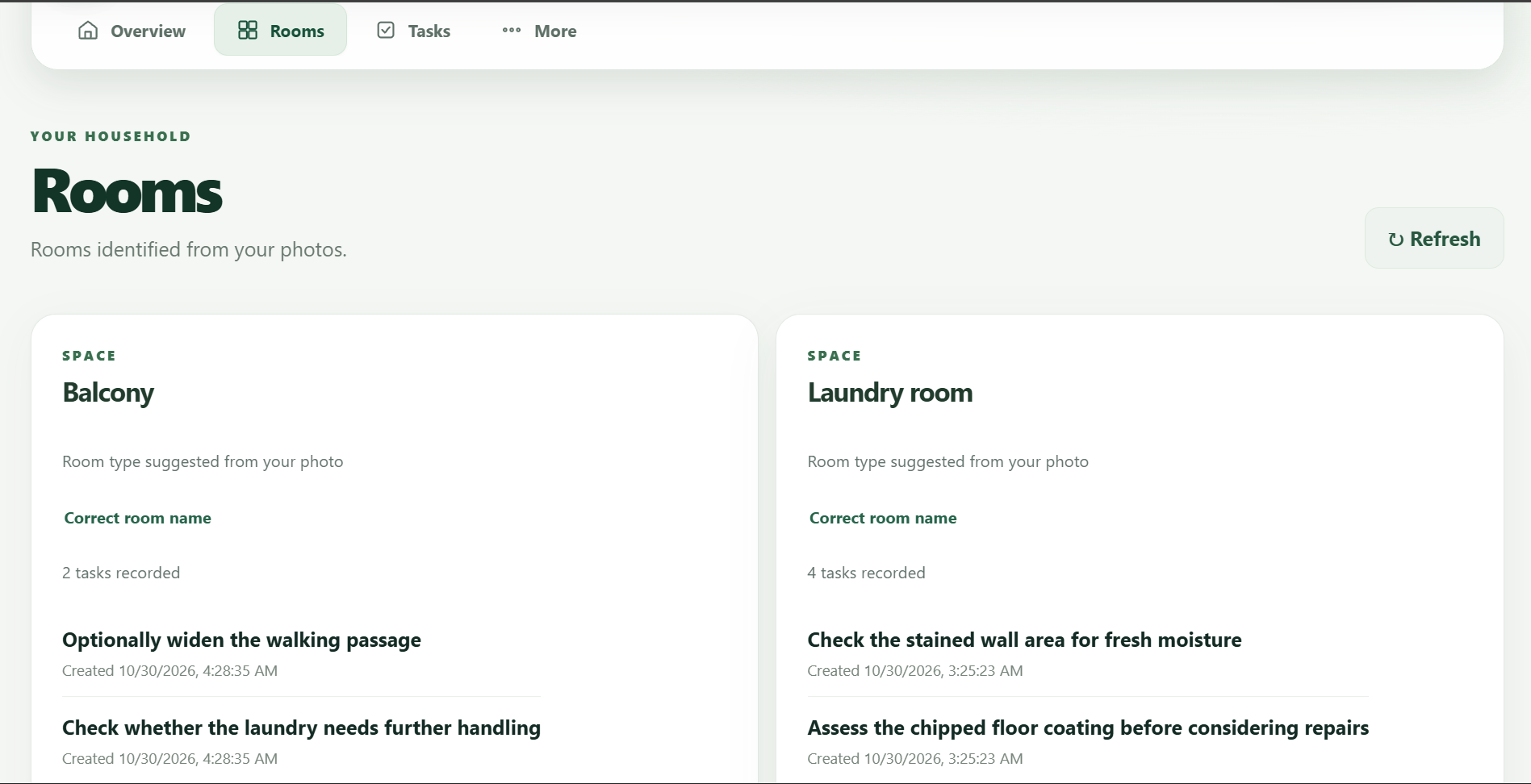
Automatically recognized household spaces with persistent room identities, associated tasks, and observation history.
-
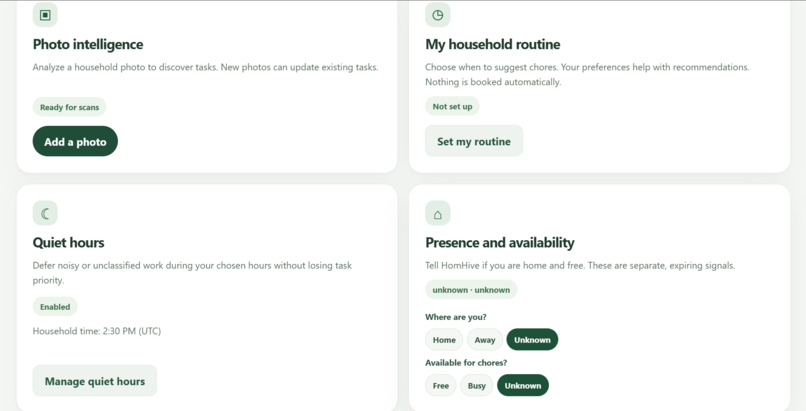
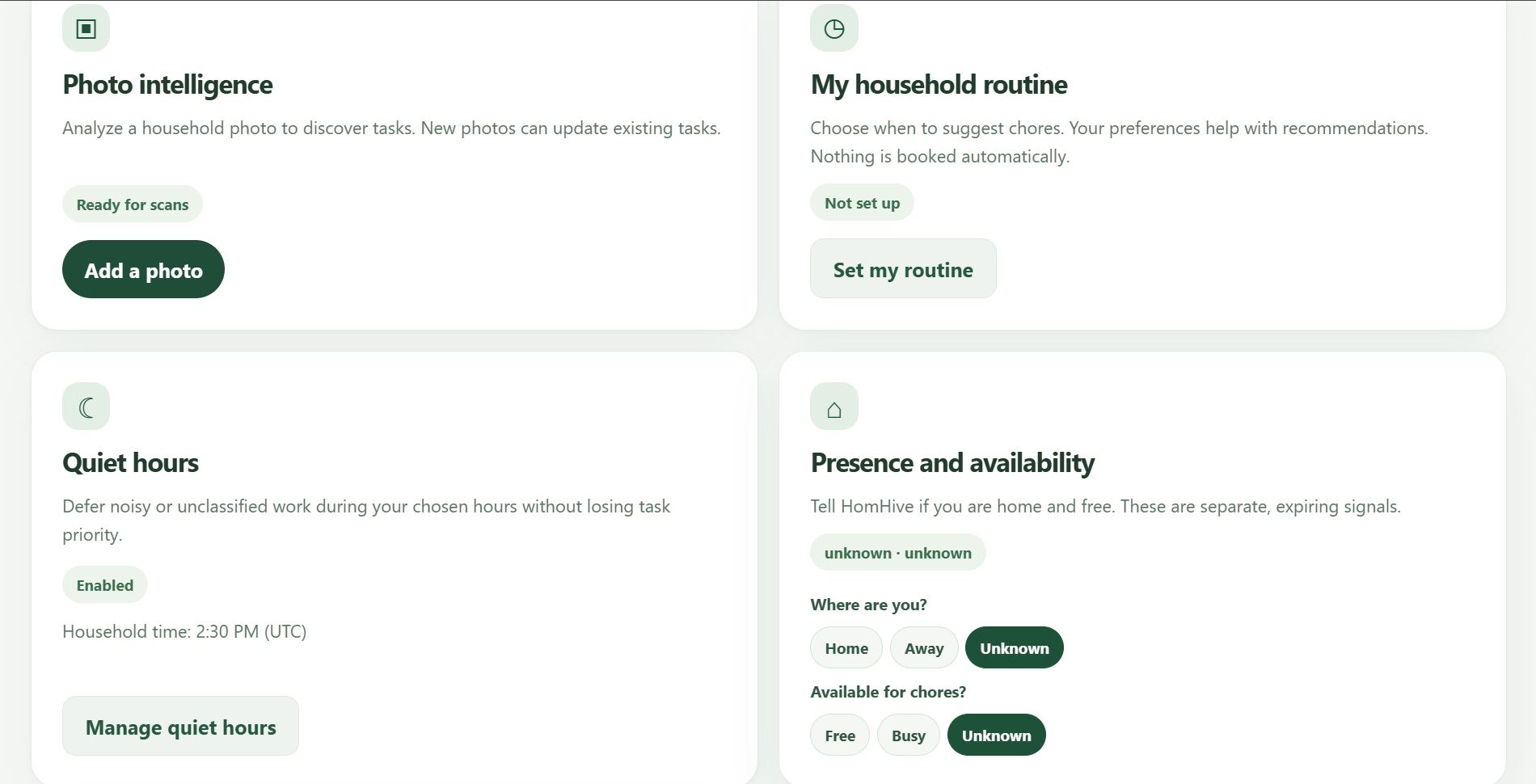
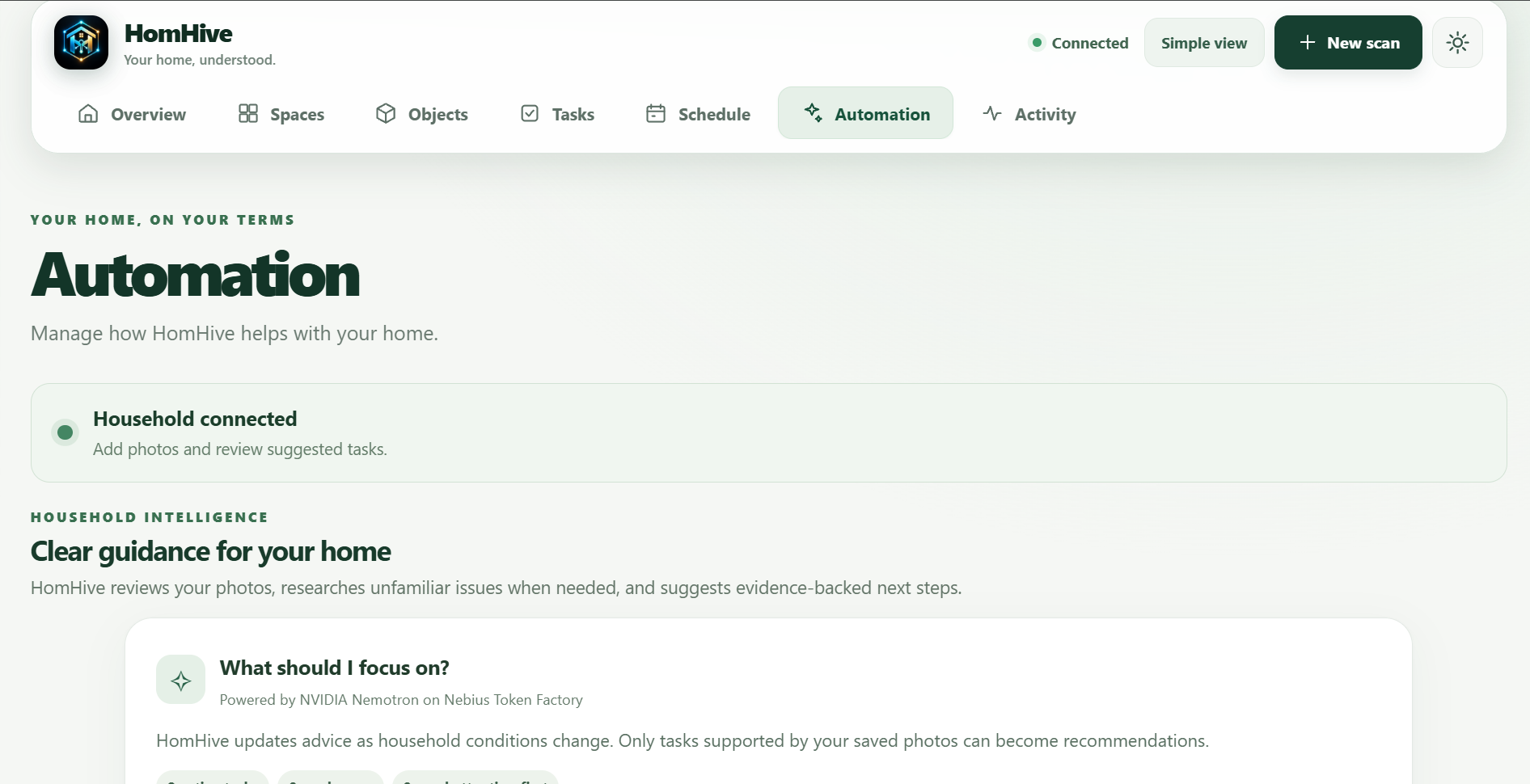
Personalized automation with photo intelligence, household routines, quiet hours, and availability awareness.
-
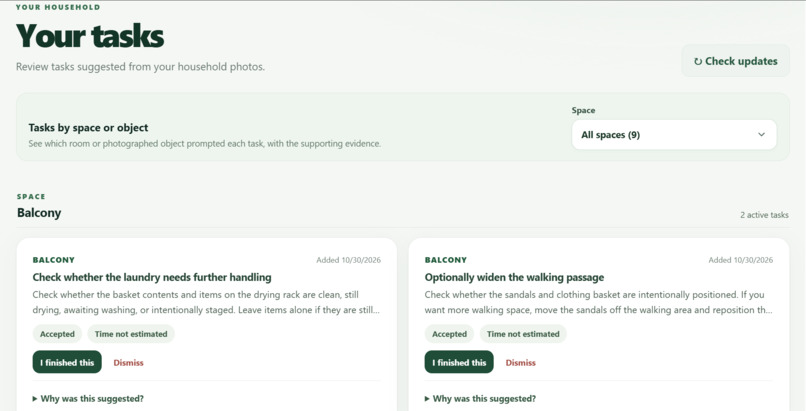
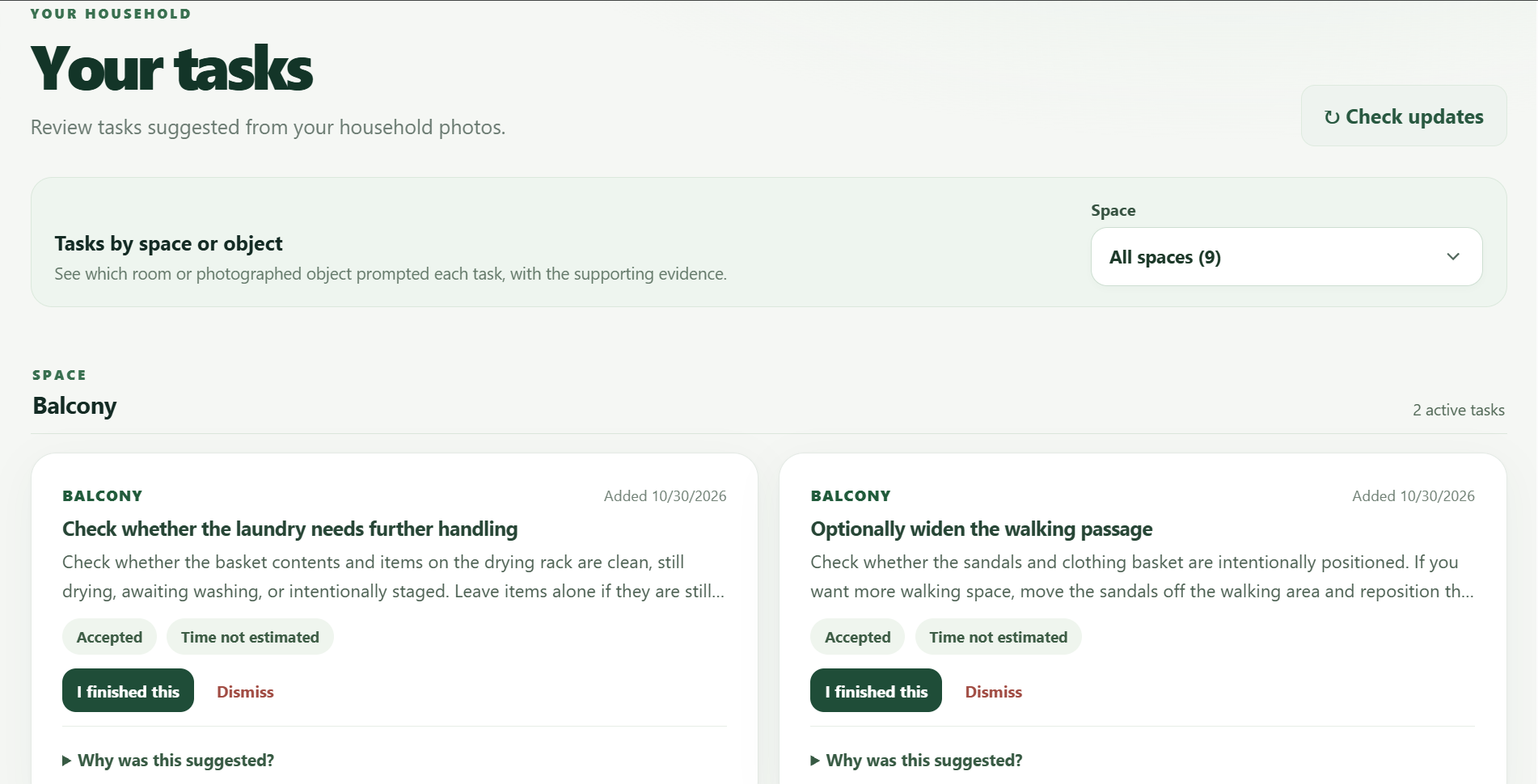
AI-discovered household tasks organized by space, with actionable suggestions and supporting visual evidence.
-
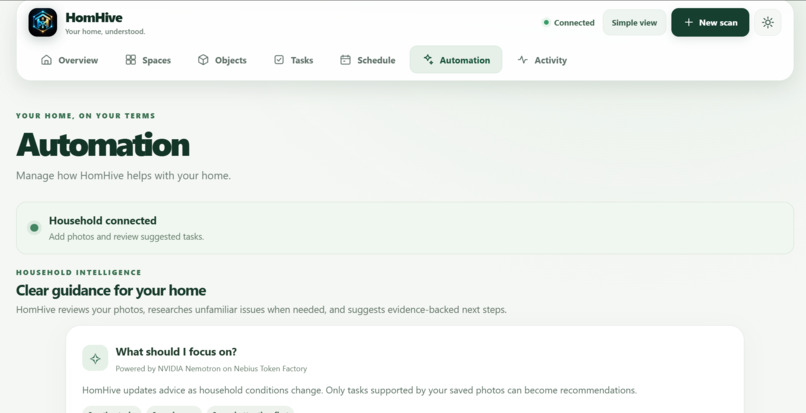
NVIDIA Nemotron powers context-aware household recommendations, prioritization, and intelligent planning.
-
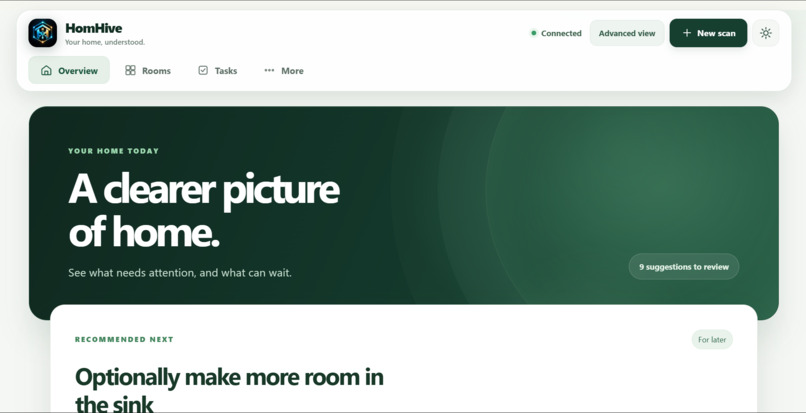
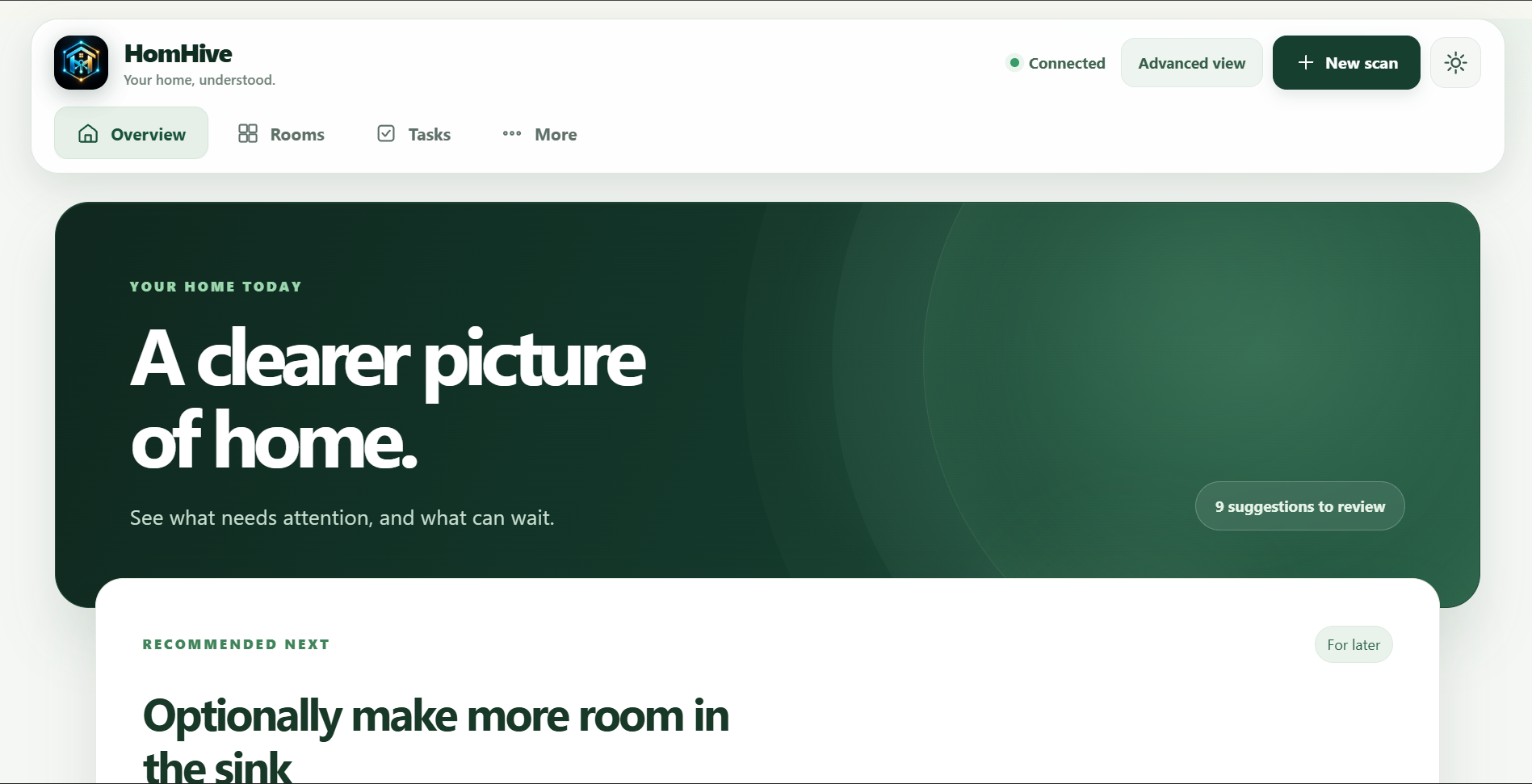
HomHive provides a clear overview of household conditions, priorities, and AI-generated recommendations.
-
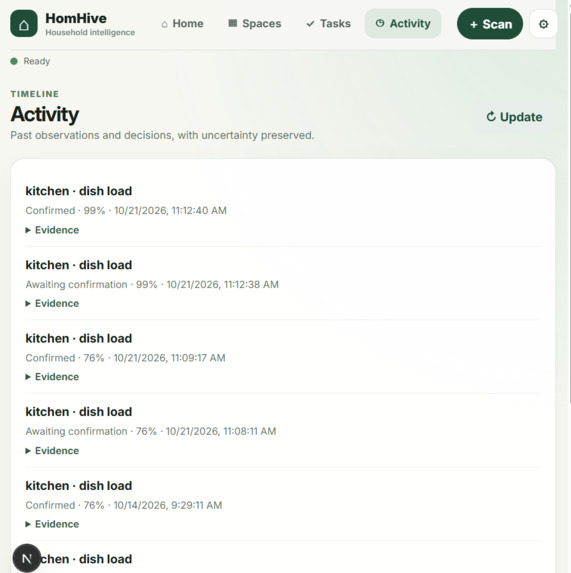
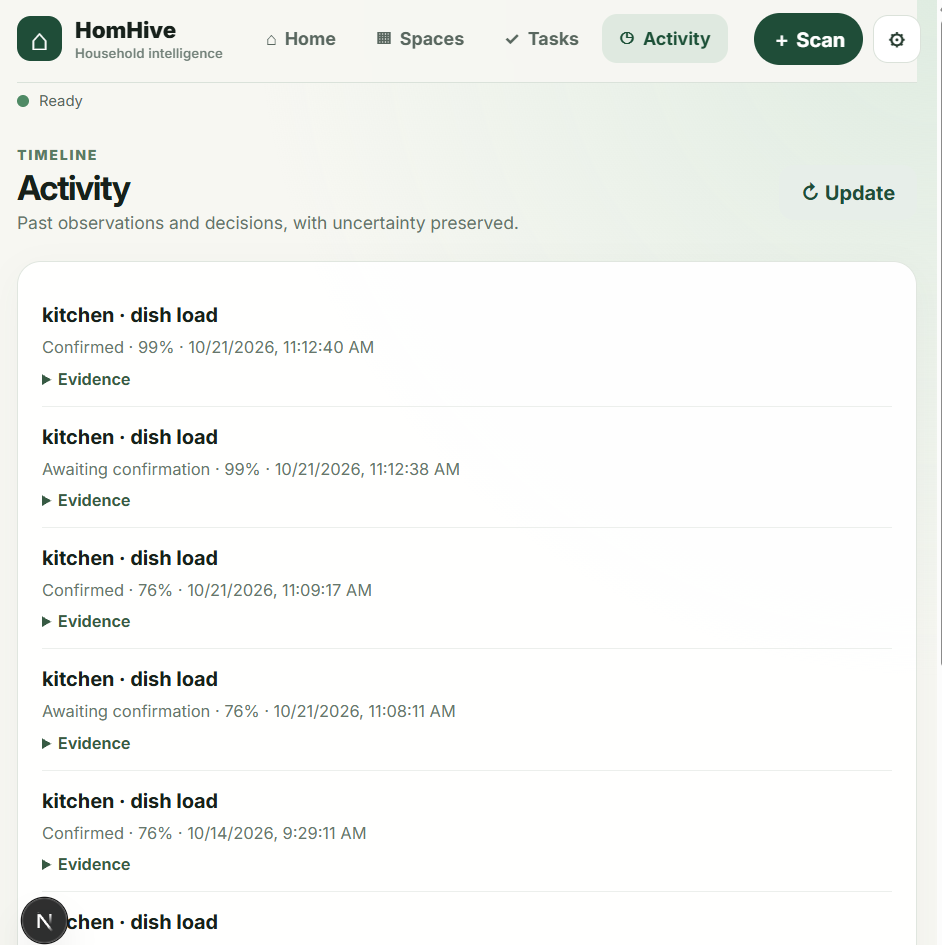
A chronological activity history tracks household observations, task updates, and automated decisions.
-
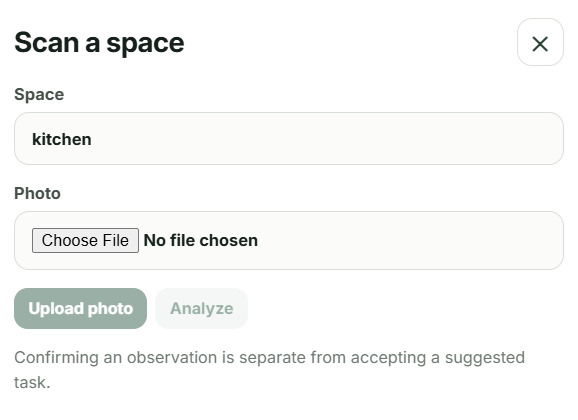
HomHive analyzes household photographs to recognize environmental conditions and discover potential tasks.
-
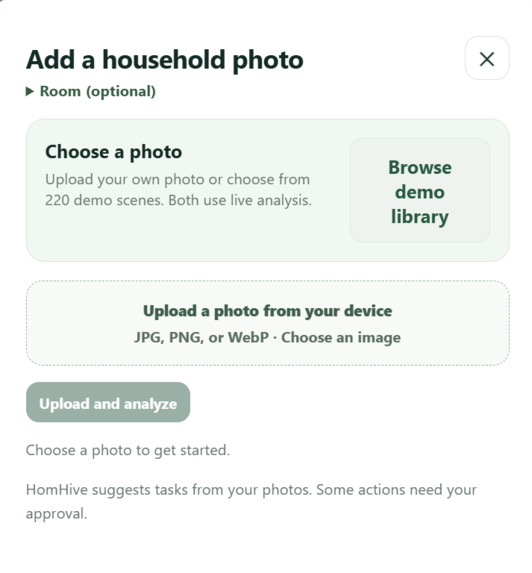
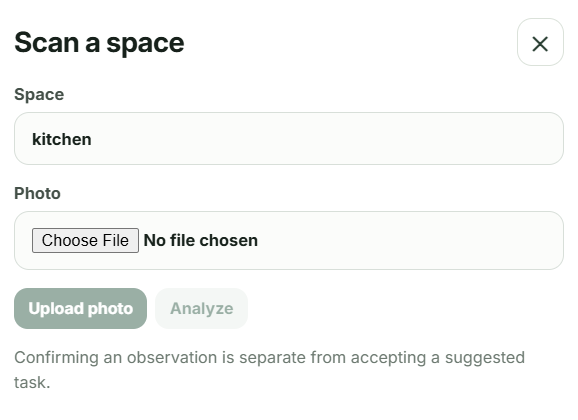
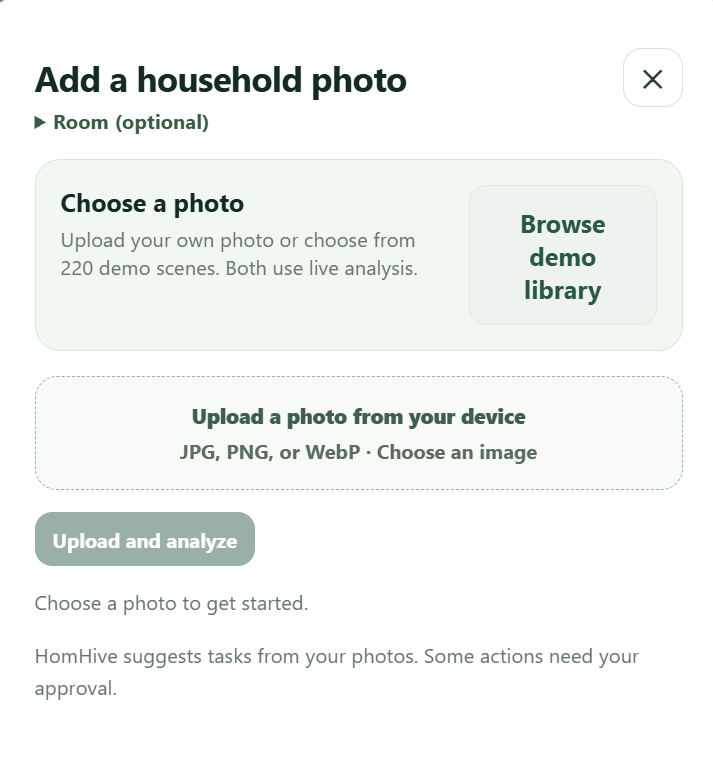
Upload household photographs or choose demo images to initiate autonomous visual analysis and task discovery.
-
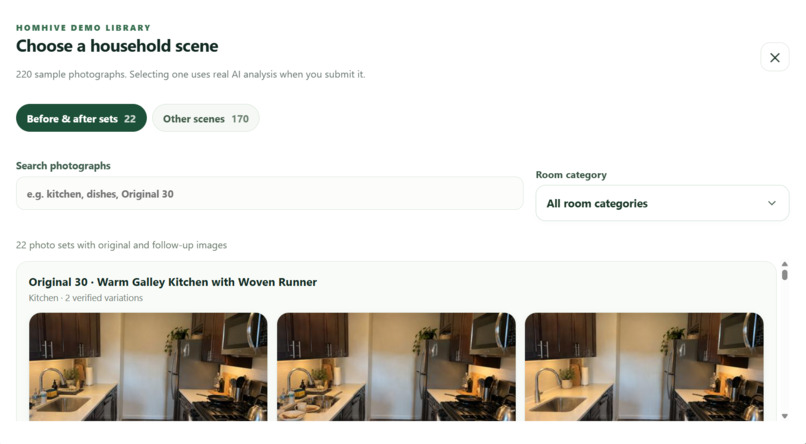
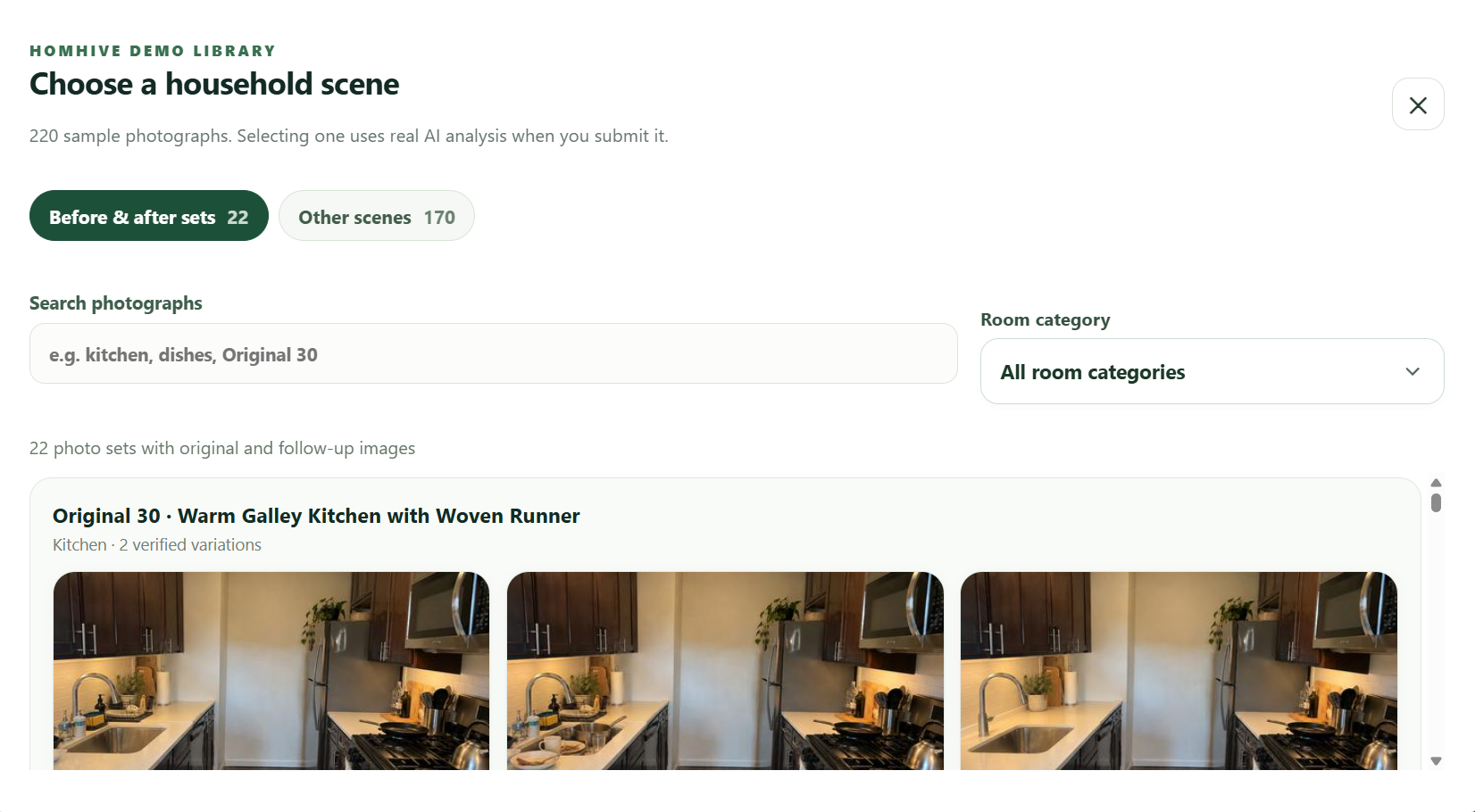
A controlled image library enables testing of scene recognition, task discovery, and progress across photographs.
HomHive: The Intelligence Layer for the Autonomous Home
Your home, understood.
Inspiration
Smart homes have become good at responding to commands, but they still depend on people to recognize what needs to be done.
A smart speaker can turn on a light. A robot vacuum can clean a scheduled area. But who notices the dishes accumulating in the sink, the laundry waiting to be handled, a plant that may need attention, or a household task that was only partially completed?
Most household productivity apps have the same limitation: someone must first identify the problem and manually create the task.
I built HomHive to explore a different approach.
What if a home could understand its changing environment, discover useful work automatically, and help decide what should happen next?
HomHive is an AI-powered household intelligence and coordination system that I designed to become the reasoning layer for autonomous homes.
My goal was not simply to build another chatbot or household checklist. I wanted to connect visual observations, persistent memory, research, task discovery, and planning into one intelligent system.
What It Does
HomHive transforms household photographs into actionable, evidence-backed intelligence.
1. Understands Household Scenes
Users upload photographs of spaces such as kitchens, laundry rooms, living rooms, and balconies.
HomHive analyzes visible objects, room characteristics, and environmental conditions using multimodal AI.
I implemented independent verification in the perception pipeline so that uncertain visual claims do not automatically become household facts.
2. Discovers Tasks Automatically
Instead of manually creating chores, users can review tasks discovered from photographs.
For example, HomHive might identify items occupying a kitchen sink, clothing that needs further handling, or a possible moisture issue near a wall.
It connects suggestions to the observations that justify them, while distinguishing optional improvements from more important concerns.
Users can approve, defer, dismiss, or report progress on suggested work.
3. Remembers Rooms, Objects, and Progress
I designed HomHive to maintain persistent household state using PostgreSQL.
I modeled observations, physical spaces, object identities, and tasks separately to preserve history, prevent duplicate tasks, and recognize changes across multiple scans.
When a newer photograph of the same space is uploaded, HomHive can compare observations and update visible task progress.
During my demonstration, a kitchen task progressed toward completion after a follow-up photograph, while the system continued identifying the remaining work.
A visual change is treated as evidence, not unquestionable proof that a physical action occurred.
4. Researches Unfamiliar Situations with Tavily
A photograph cannot answer every household question.
I integrated the Tavily Search API so HomHive can automatically research unfamiliar objects or conditions when additional knowledge is needed.
For example, when analyzing a scene containing plants, HomHive can examine visible plant characteristics and retrieve references about possible identities and care requirements.
The results are presented with source links and appropriate uncertainty.
This is a real runtime integration, not a hardcoded demonstration. During testing, I verified a completed plant-related scan that successfully saved nine external research sources across three plant-care topics.
5. Uses NVIDIA Nemotron for Household Planning
I integrated NVIDIA Nemotron through Nebius Token Factory to support context-aware household reasoning and recommendations.
HomHive's coordination layer considers active tasks, priorities, progress, presence, availability, quiet hours, and estimated duration.
Nemotron contributes to reasoning and research planning, while deterministic constraints protect against unsupported scheduling decisions.
When critical information is unavailable, HomHive communicates the missing prerequisite instead of assuming that somebody is home or inventing a task duration.
I designed this approach to make household automation useful while maintaining human oversight.
How I Built It
I developed HomHive as a full-stack AI application with a structured backend, persistent database, autonomous processing, and a responsive web interface.
Frontend: I used Next.js, React, and TypeScript to build the household dashboard, photo uploads, spaces, objects, tasks, activity tracking, and automation controls.
Backend: I used Python, FastAPI, and Pydantic for API development, autonomous scan processing, model orchestration, and task-management logic.
Persistence: I implemented PostgreSQL with SQLAlchemy and Alembic to preserve household entities, observations, persistent object identities, task states, and historical changes.
AI perception: I integrated multimodal inference through Nebius Token Factory, supported by independent OpenAI and Anthropic visual reviews.
Planning: I integrated NVIDIA Nemotron 3 Super through Nebius Token Factory for household reasoning and recommendations.
Research: I implemented Tavily integration to retrieve external information automatically when visual evidence or planning identifies a knowledge gap.
Background processing: I developed an autonomous worker to handle scan analysis, research, and subsequent coordination.
I structured the system around an evidence-first pipeline:
Photograph → Visual analysis → Evidence verification → Persistent household state → Task discovery → Conditional research → Nemotron-assisted planning → User action
Challenges I Faced
Visual Accuracy and Uncertainty
Household scenes are highly variable. The same room can look different from another camera angle, and a photograph may not reveal the exact condition of an object.
I developed additional scene checks, confidence-aware observations, and identity-matching logic to reduce unsupported conclusions.
One important challenge was distinguishing room classification from physical room identity. Recognizing a laundry room is not the same as proving that two photographs show the same physical laundry room.
Tracking Progress Without Inventing Completion
A removed object might have been relocated, temporarily hidden, or moved outside the camera frame.
I separated observations from tasks and implemented progress reconciliation so HomHive could describe visual changes without automatically treating every disappearance as confirmed completion.
Building Useful Tasks Instead of Generic Chores
Early recommendations sometimes focused too narrowly on visible clutter.
I refined the planning prompts to consider broader household workflows rather than generating simple cleanup suggestions.
For example, clothing in a laundry room might need washing, folding, or putting away. However, its cleanliness cannot reliably be determined from a photograph alone.
This required designing conditional recommendations that distinguish visible evidence from information requiring confirmation.
Integrating Multiple AI Services Reliably
Visual inference, verification, Nemotron reasoning, and Tavily research have different response formats, latency, cost, and failure modes.
I implemented structured processing, explicit constraints, independent validation, and background orchestration to improve reliability.
Another important challenge was ensuring external research remained visible in the application even when it did not create a new household task.
Building a Usable Product
I repeatedly refined the interface through testing of photo scanning, task navigation, progress tracking, automation controls, and feedback.
My objective was to present useful decisions clearly without overwhelming users with unnecessary technical details.
What I Learned
Building HomHive taught me several important lessons.
AI perception needs verification. A plausible model description is not automatically reliable evidence.
Persistent memory changes what agents can do. Understanding one photograph is useful, but connecting observations over time enables continuity and progress tracking.
Research should be triggered by knowledge gaps. External search is most valuable when answering a question grounded in observed evidence.
Reasoning and execution require different safeguards. An AI model may suggest an action, but actual scheduling or execution must respect household constraints.
Autonomy is more than generating recommendations. It requires persistent identity, state management, historical context, uncertainty handling, and human oversight.
I also gained extensive hands-on experience integrating NVIDIA Nemotron, Nebius Token Factory, multimodal models, Tavily, autonomous workers, and evidence-grounded AI reasoning into a functional application.
This project strengthened my understanding of both AI engineering and the system architecture required to build reliable autonomous agents.
What's Next
The current HomHive prototype operates through submitted photographs and a working household intelligence pipeline.
My long term vision is to make HomHive continuously aware of its environment.
Connected cameras and sensors could maintain updated household observations without requiring manual scans. Smart appliances and future humanoid robots could then receive coordinated tasks, subject to safety controls and user approval.
I envision HomHive becoming the intelligence layer that connects what a home observes, what it understands, what needs attention, and what should happen next.
My goal is not to replace every appliance with another smart device.
It is to give the entire home a shared layer of intelligence.
HomHive. Your home, understood.
Built With
- ai-agents
- alembic
- anthropic-claude
- docker
- fastapi
- minicpm-v
- multimodalai
- nebius-token-factory
- next.js
- nvidia-nemotron
- openai
- postgresql
- pydantic
- python
- railway
- react
- sqlalchemy
- tavily
- typescript
- vercel

Log in or sign up for Devpost to join the conversation.