-
-
-
-
-

App Icon
-

Inspiration
We run a regenerative cattle ranch in Uruguay. Between the buildings, equipment, solar system, and an actual household on top, something always needs attention — and my wife Jane manages most of it. Watching her work, I noticed her process almost always began with a photograph: a sagging gate hinge, a stain spreading across a ceiling, a pump making a noise pumps shouldn't make. The photo was a promise to deal with it later.
But later is where the system broke down. The photos piled up in a camera roll with no dates, no costs, no way to tell the urgent from the eventual — hundreds of small obligations with no shape. She wasn't disorganized; she had invented a genuinely good system, and it was overwhelming her because no software respected it.
That's the insight HomeTend is built on: don't teach people a new habit — finish the one they already have.
What it does
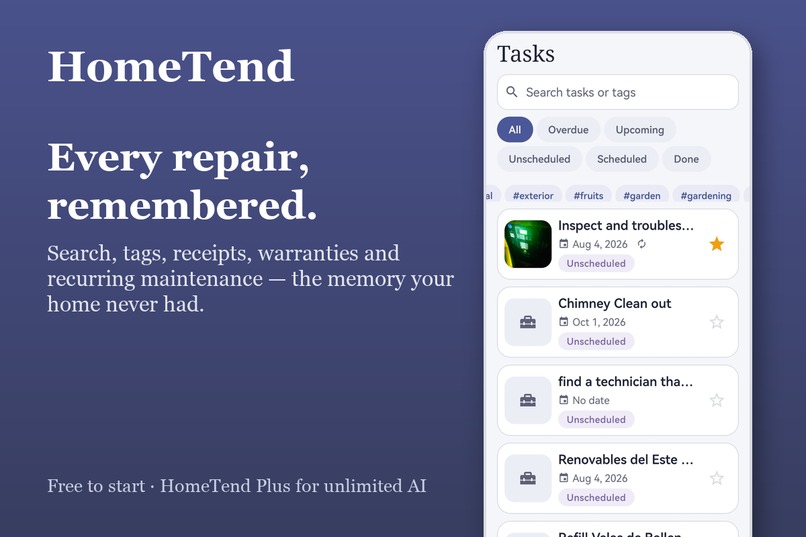
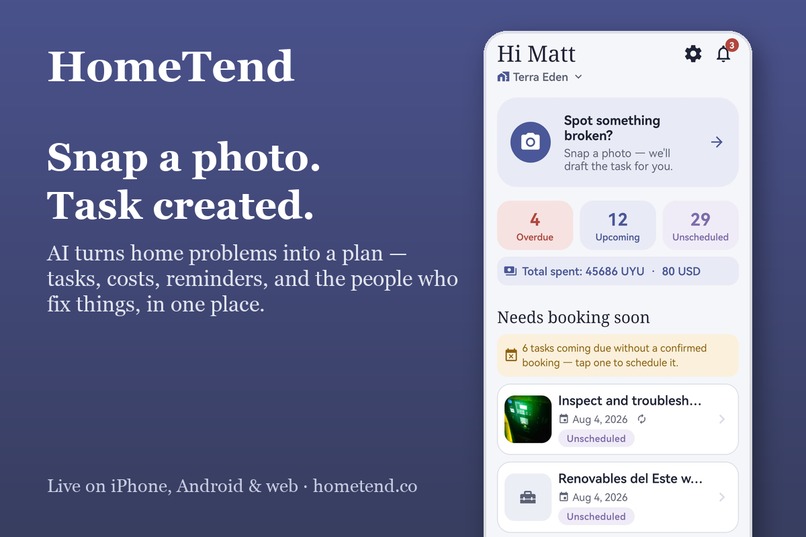
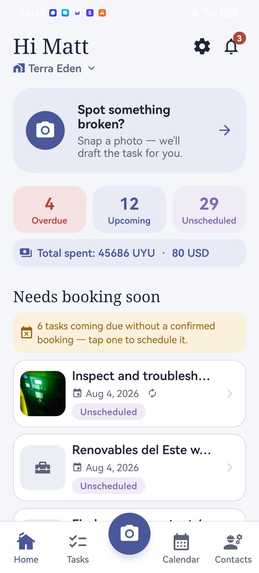
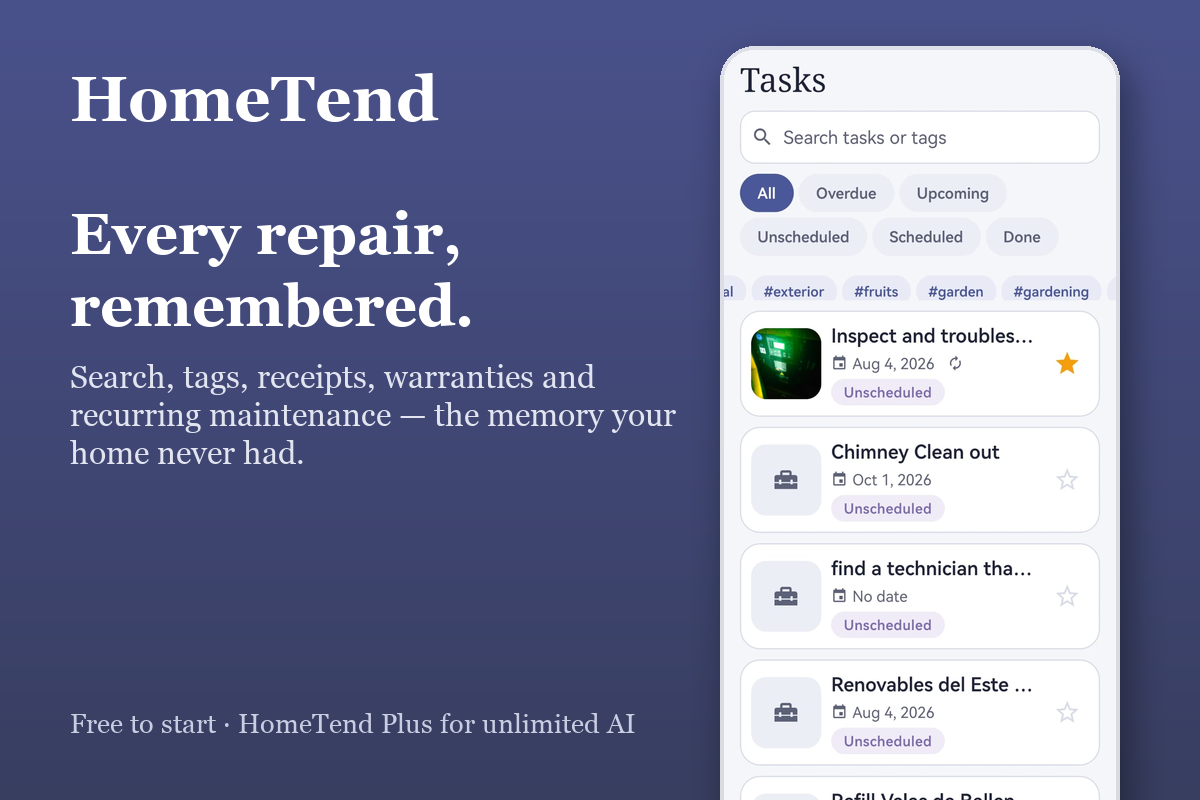
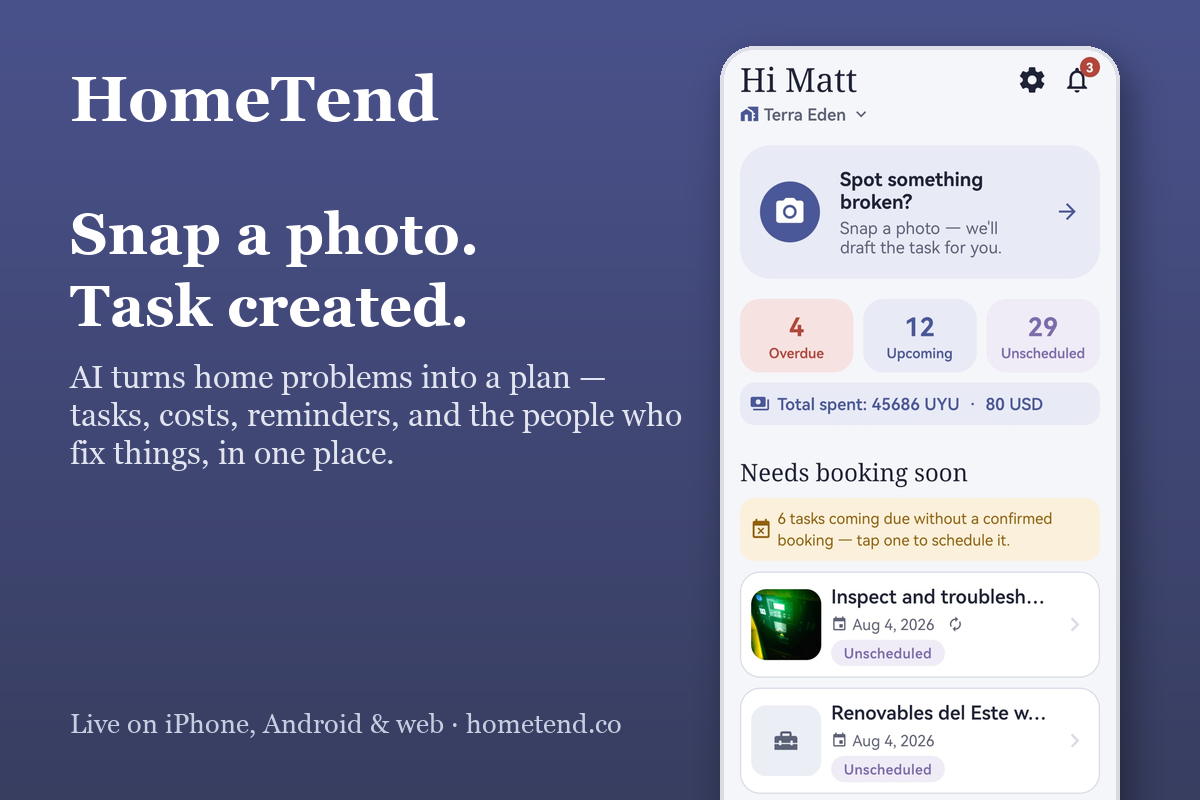
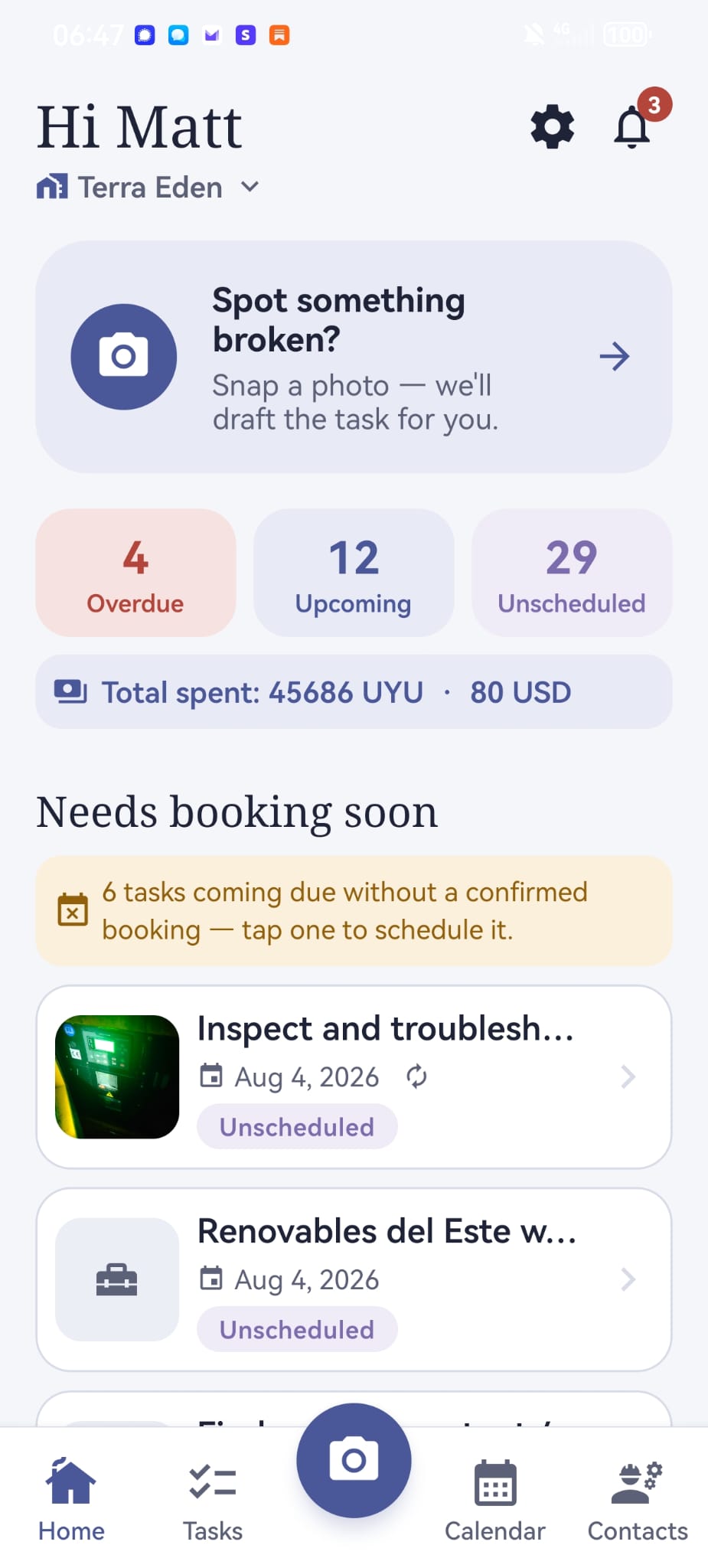
In HomeTend, the photograph is the task. Point the camera at anything wrong with your home and AI names the problem, writes the description, tags it, and asks when. Photograph a receipt and it extracts the cost, vendor, and warranty date. Recurring chores reschedule themselves after completion; the app nudges you when something is coming due without a booking. A contact book keeps your tradespeople next to the jobs they fixed, households share one property view, and everything syncs across iPhone, Android, and the web dashboard — where you can also just drag and drop photos or receipts onto any task.
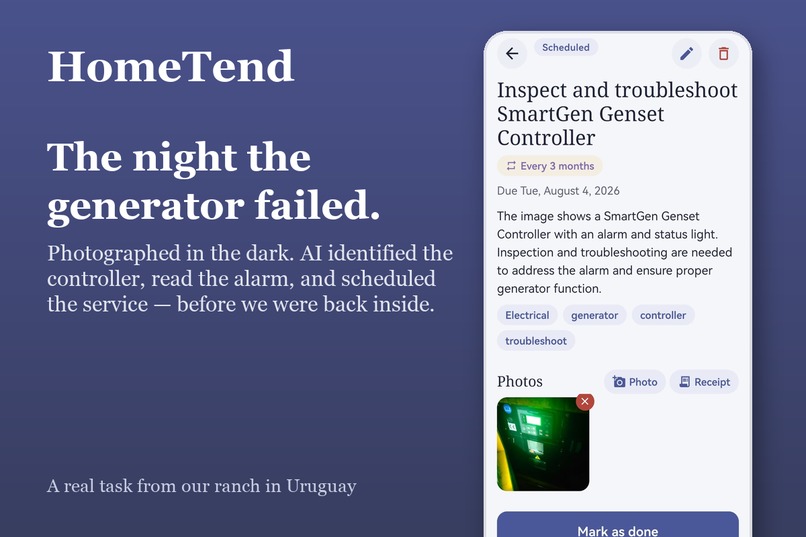
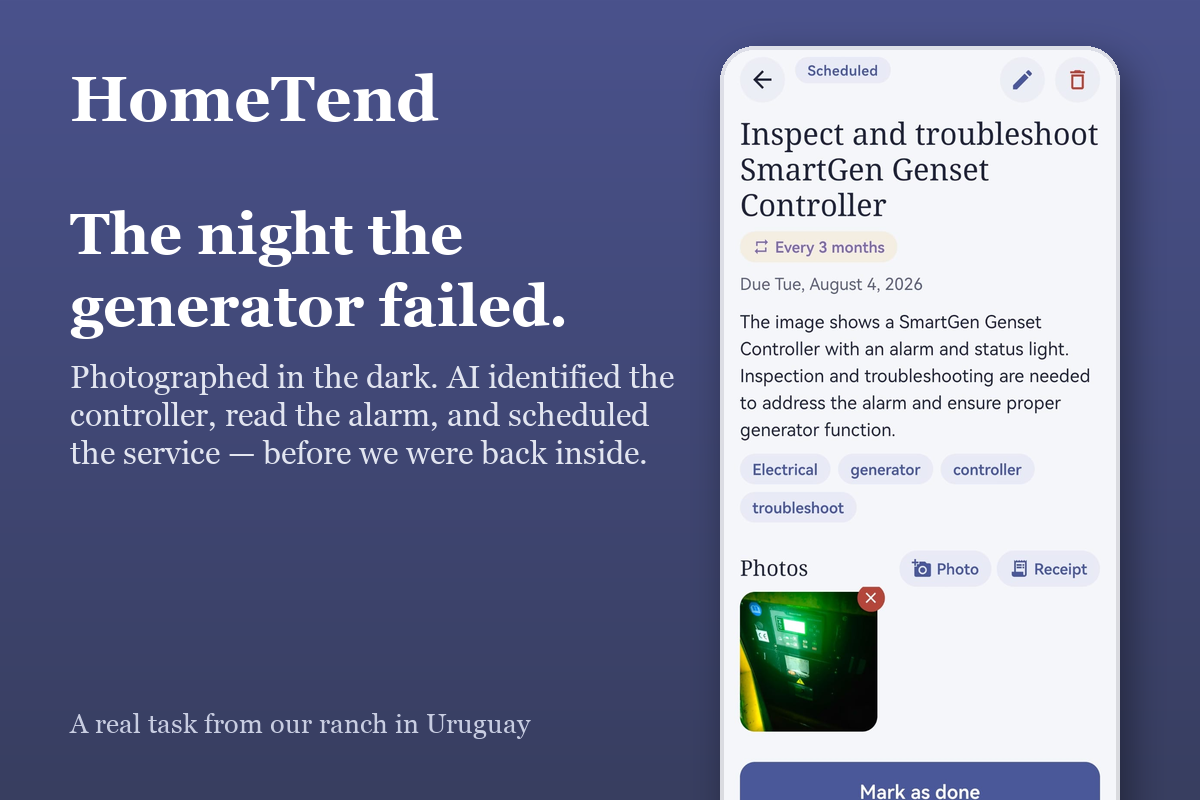
One night our power went out after cloudy days drained the solar batteries. The backup generator sounded wrong and a warning light was flashing. In the dark, I photographed it. HomeTend identified the generator, recognized the service warning, and turned my worry into a scheduled maintenance task before I was back inside. It didn't fix the generator — it caught the falling thing so nobody had to carry it in their head.
How we built it
One TypeScript monorepo: a React Native/Expo codebase producing both mobile apps, a tRPC + Drizzle backend on MySQL, and a React web dashboard, all deployed on Railway. OpenAI vision powers photo→task drafting and receipt extraction. RevenueCat runs per-property subscriptions, AppsFlyer handles ad attribution (SKAdNetwork on iOS — no tracking prompt), and passwordless auth works by email magic link on the web and 6-digit codes in the app. Built essentially solo, with AI pair-programmers doing the heavy lifting.
Challenges we ran into
The hard parts weren't the AI — they were the unglamorous edges of shipping:
- App Review, twice. A guideline 3.1.2 rejection for a missing EULA link taught us that store metadata is part of the product.
- A manifest merge war. The attribution SDK and our secure-storage library both claimed Android's backup rules; the build died until a custom config plugin brokered the peace.
- A login that worked while looking broken. Our magic-link flow set the session perfectly, then dropped users on a marketing page whose nav said "Sign in." Every login succeeded; every user believed it failed.
- The login wall itself. Attribution data showed 34 installs producing just 5 sign-ups — a conversion rate of $\frac{5}{34} \approx 15\%$. Cold users wouldn't hand over an email before seeing the magic.
Accomplishments that we're proud of
- Live on three platforms — iOS, Android, and web — with daily active users and subscriptions wired end to end.
- Try-before-signup onboarding: new users now open straight into the camera, watch AI draft their task, and are asked for an account only at the moment of saving — the draft follows them through sign-up as their first task.
- A real measurement pipeline: every funnel step is instrumented, so decisions like the onboarding rebuild come from data, not vibes. If the new flow converts at even $35\%$, the effective cost per signup falls by more than half: $\text{CPS} = \frac{\text{CPI}}{p_{\text{signup}}}$, and $\frac{0.15}{0.35} \approx 0.43$ of what we pay today.
- Migrating the entire backend off its original no-code hosting onto our own infrastructure without breaking a single live user.
What we learned
Shipping is a funnel, and every stage lies to you in a different way. Store "downloads" overcount, opens undercount, and the only honest numbers come from instrumenting your own product. We also learned that the best feature specs come from watching a real person work — Jane never asked for an app; she showed us one, one photograph at a time.
What's next for HomeTend: AI Home Maintenance
Measuring the new onboarding against its 15% baseline, opening paid acquisition on ChatGPT Ads when app campaigns become available, and deeper receipt intelligence — warranty-expiry alerts that tell you a repair is covered before you pay for it twice. And more listening to Jane.## Inspiration
Built With
- appsflyer
- drizzle
- expo.io
- gpt-4o
- mysql
- node.js
- openai
- railway
- react
- react-native
- resend
- revenuecat
- tailwindcss
- trpc
- typescript

Log in or sign up for Devpost to join the conversation.