Inspiration
61% of hourly workers skipped meals in the past year to cover expenses. 77% have less than $500 in emergency savings, and 63% would rather be paid weekly or on demand. Those figures come from Branch's seventh annual report on hourly workers, December 2025, with more than 2,300 respondents.
The people on the other side of that are small business owners. The owner of a small catering company builds the schedule by hand on a Sunday night, redoes it when someone calls in sick, and runs payroll every two weeks because anything more often is too much work. Nobody is being unfair. The tools just make paying late the easy option.
What it does
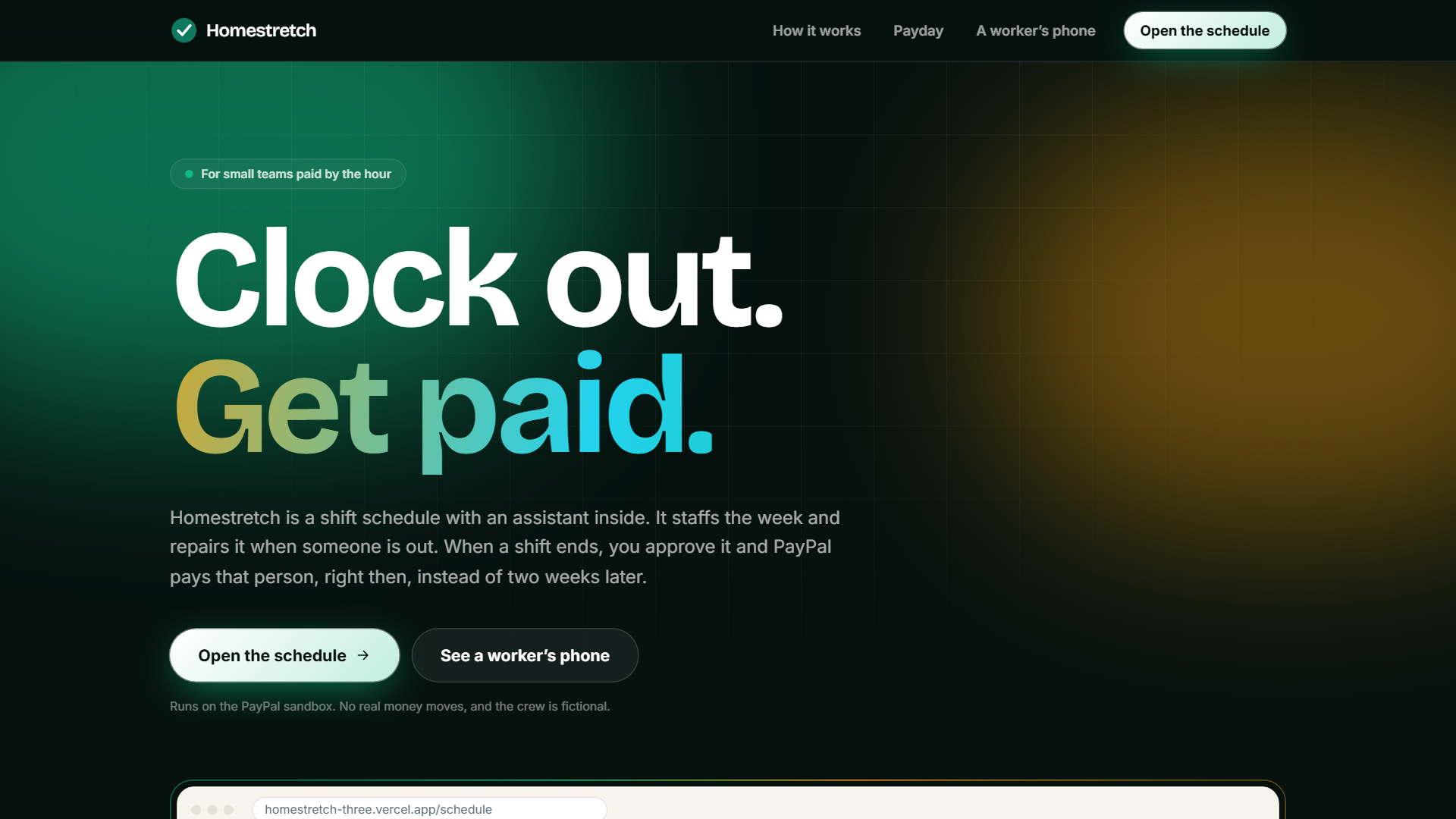
Homestretch puts the schedule, an assistant and the payment on one screen. The demo runs for Juniper & Rye Catering, a fictional business with a crew of eight, entirely on the PayPal sandbox.
The assistant drives the schedule.
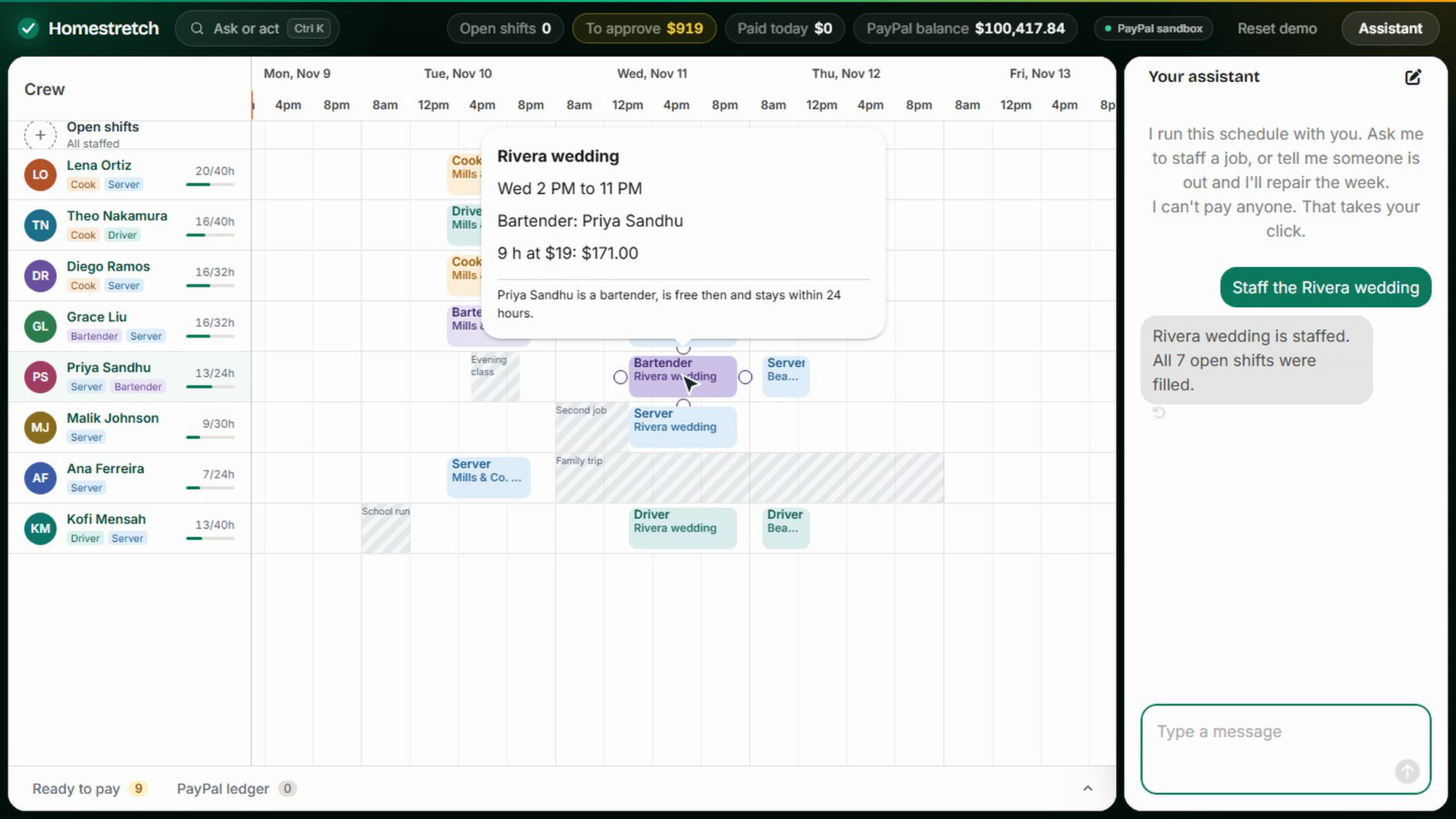
- "Staff the Rivera wedding." Seven open shifts land on people, one at a time, within everyone's skills, availability, rest and weekly hours. Hover a shift to read why that person got it.
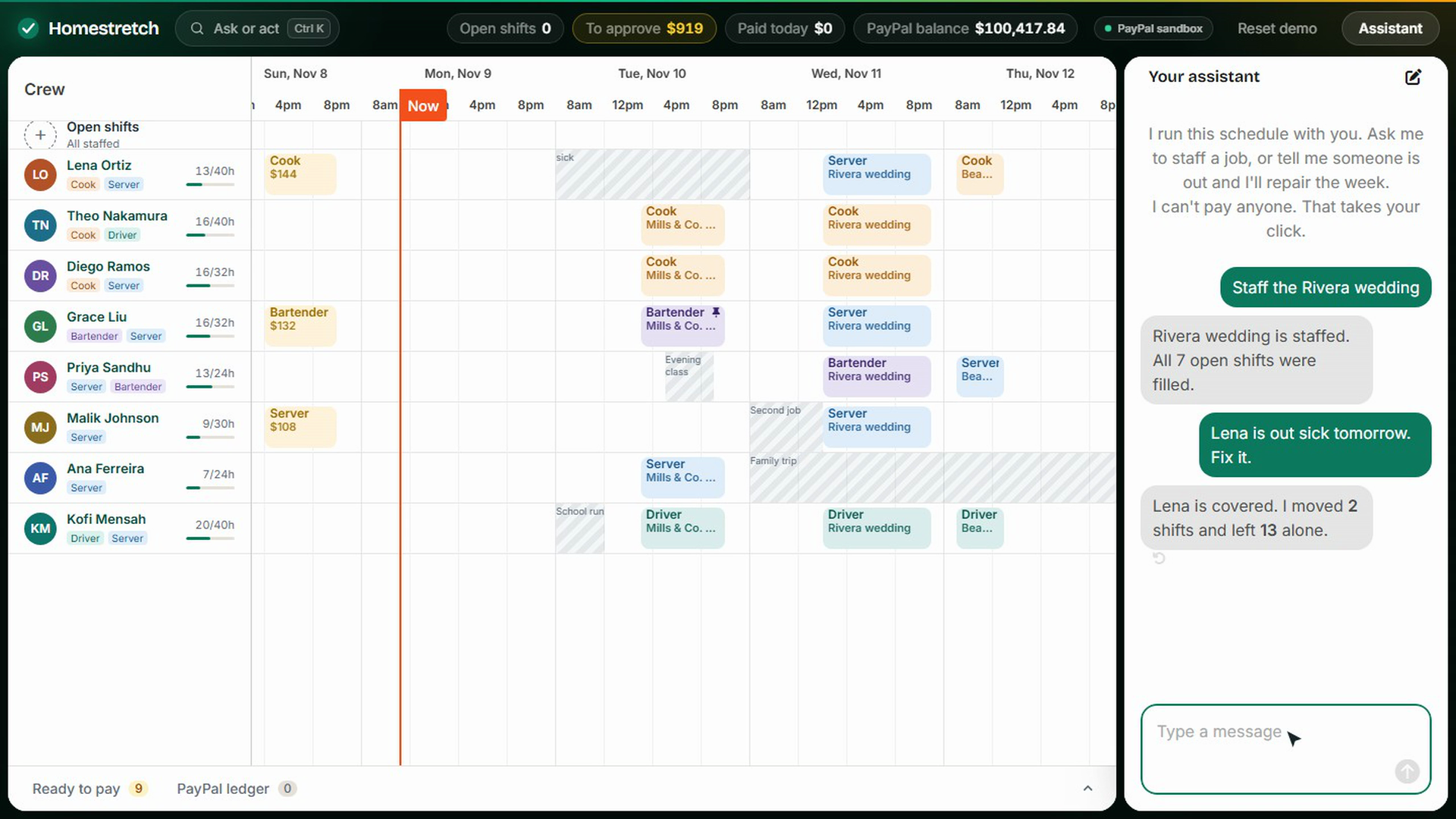
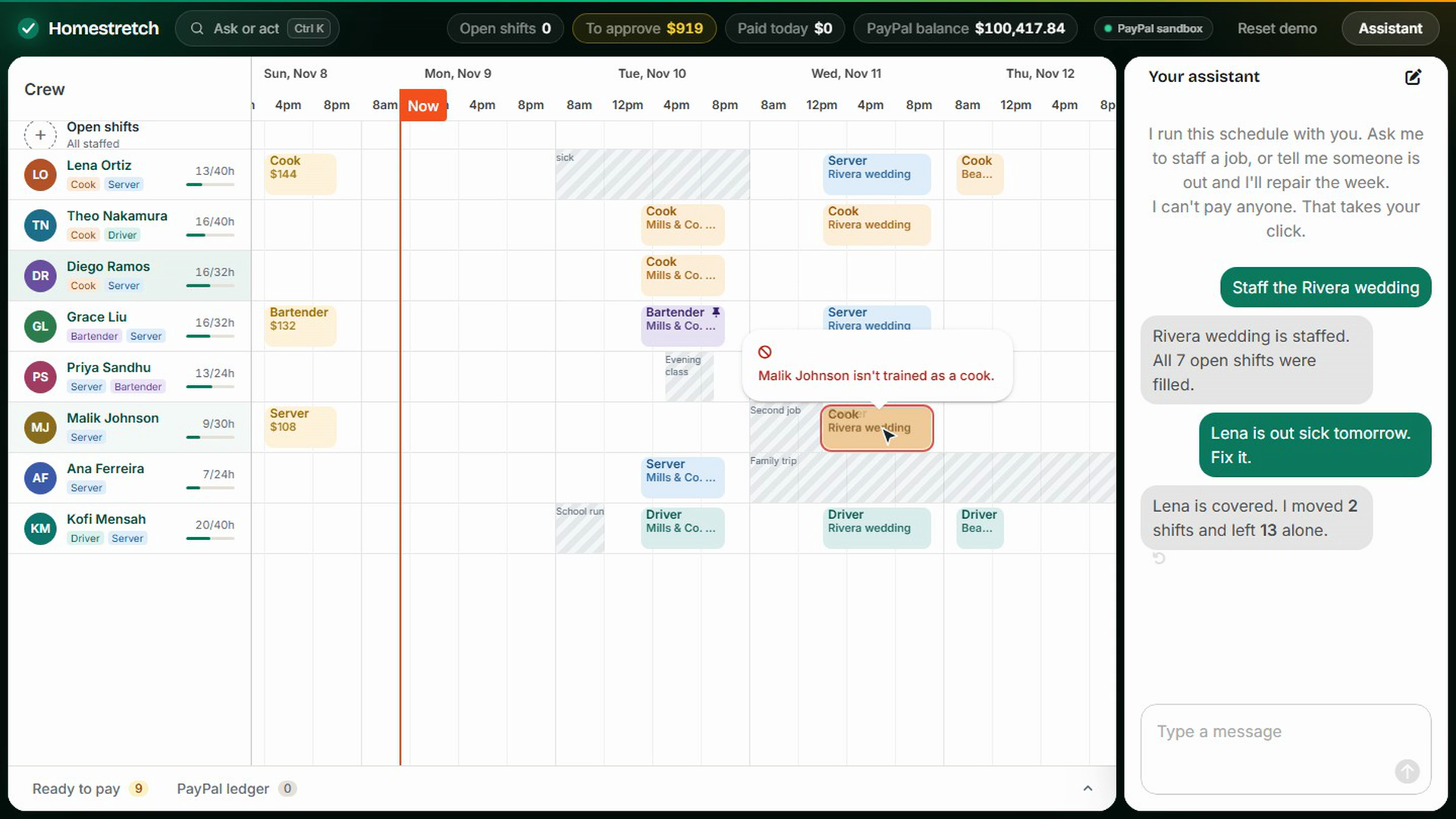
- "Lena is out sick tomorrow. Fix it." It blocks her time and repairs the week with the fewest moves it can find: two shifts move, and the rest stay put. It says who moved and why, leaves pinned shifts for the owner to decide, and one click in the chat undoes all of it.
- "We just booked a dinner on Friday. One cook, two servers." It adds the job, and staffs it when asked.
The rules hold for everyone. Drag a shift onto someone who can't take it and the bar turns red with the reason, using the same rules the assistant has to follow.
A person approves. PayPal pays.
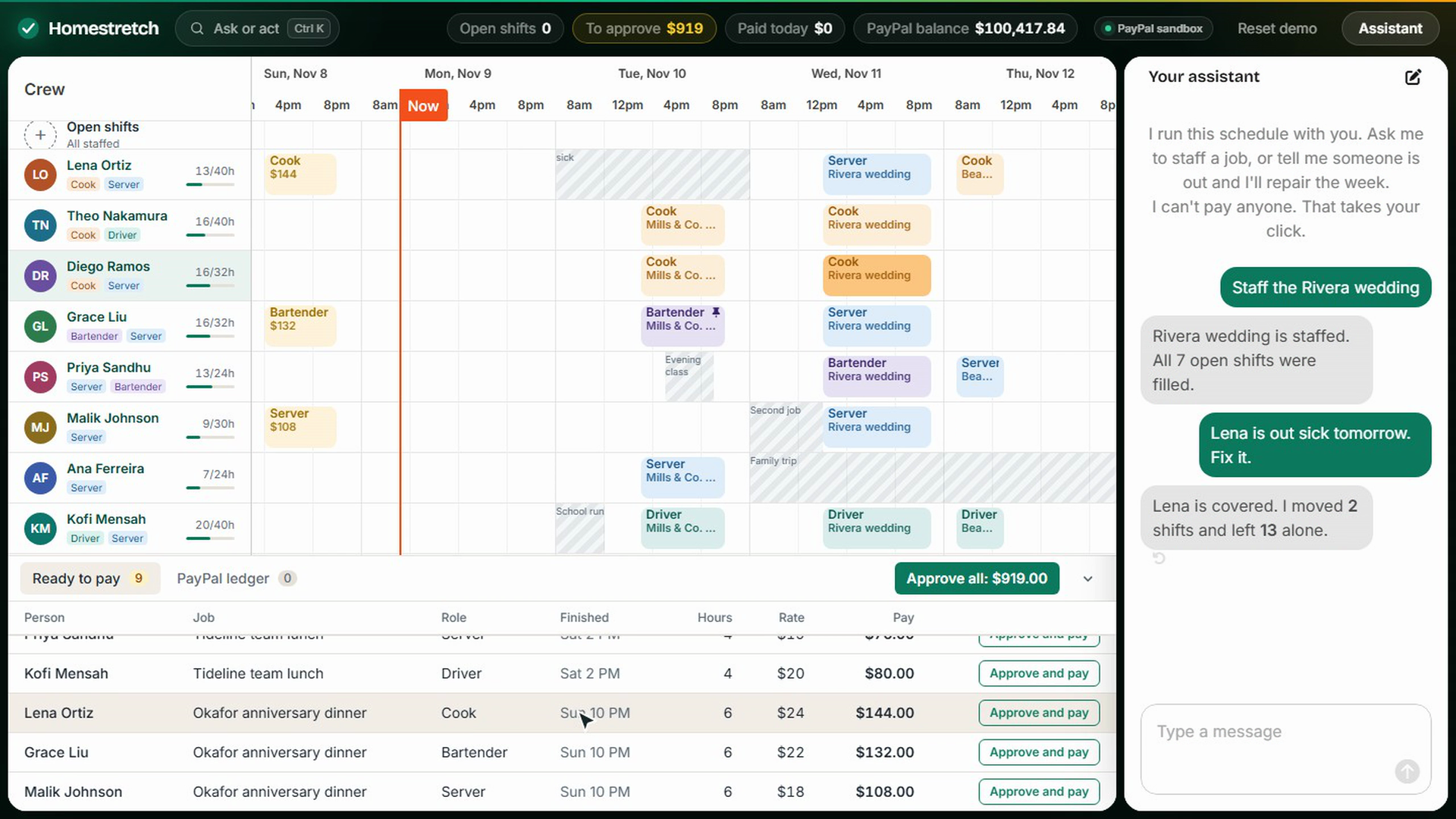
- When a shift ends, it goes amber and lands in Ready to pay, with hours, rate and amount.
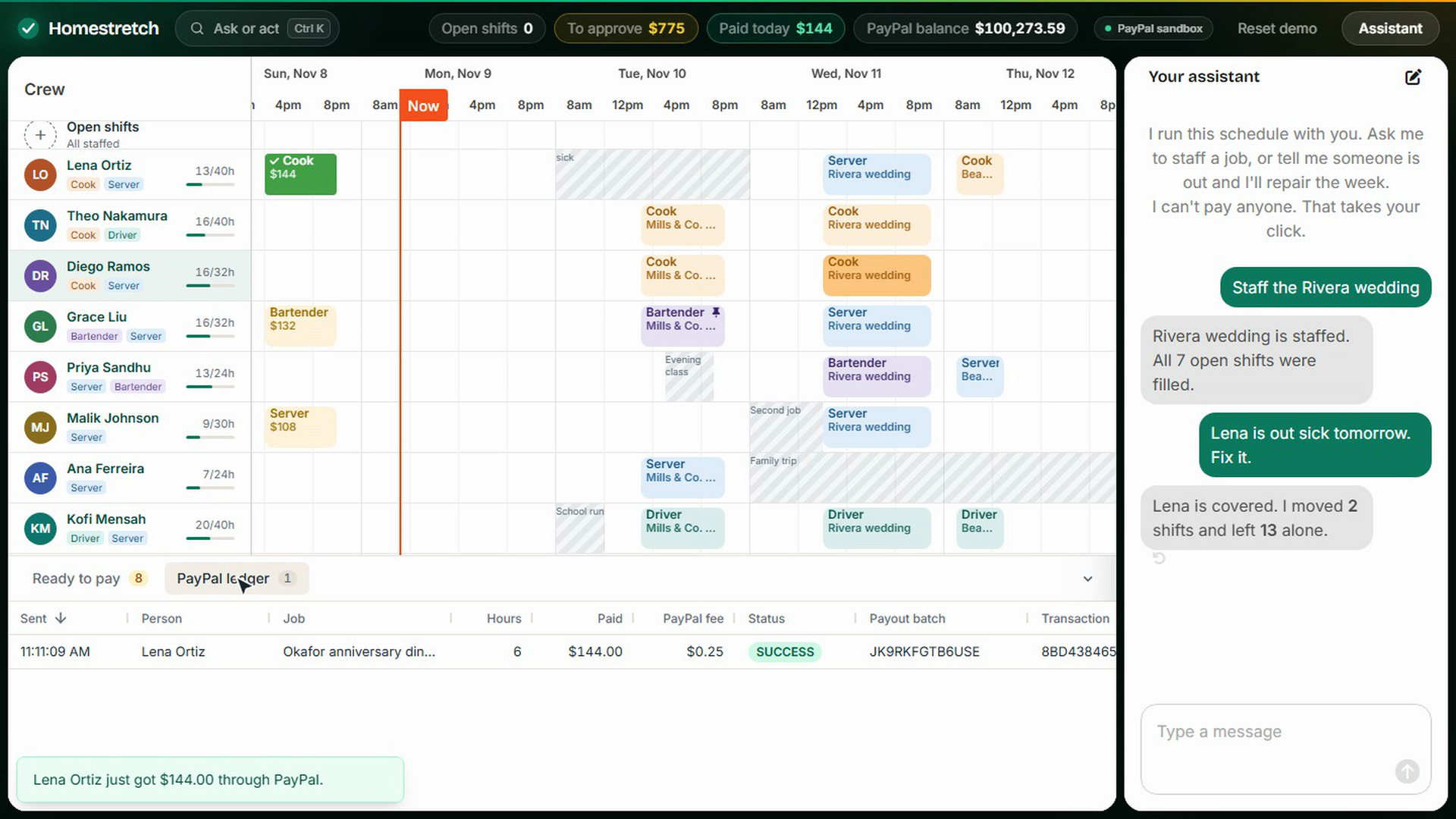
- One click on Approve and pay sends a real sandbox payout through PayPal Payouts.
- The ledger shows PayPal's own answer as it comes back: status, fee, batch and transaction IDs.
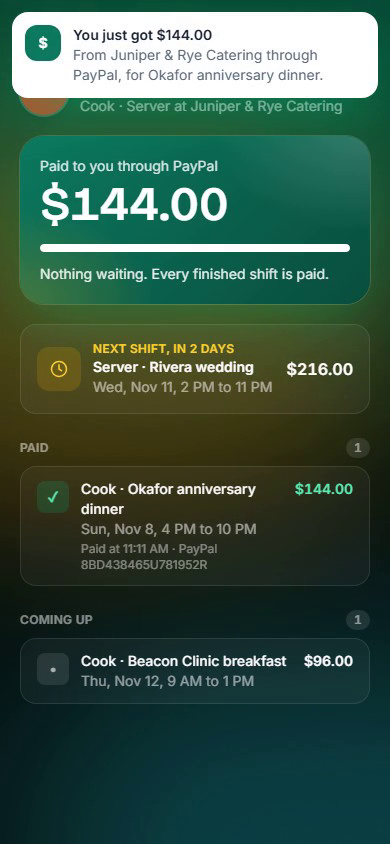
- The worker's phone view announces the money within seconds.
The assistant knows what's waiting and whether the PayPal balance covers it. It can't pay anyone: that takes a person's click.
Fast to drive. Ctrl K opens a command palette: the assistant's prompts, the shifts ready to pay, the PayPal ledger, each worker's phone.
Every day is a new shift day. Come back tomorrow and a fresh week starts around the new day: the shifts that just ended wait for approval, and the earlier PayPal payments are still in the ledger.
How we built it
PayPal
| What | API |
|---|---|
| Paying approved shifts | Payouts: one batch per approval, with a key that stops a retry paying twice |
| Status, fee and transaction ID | Payouts: batch details, polled until PayPal settles each payment |
| Can the business cover this? | Balances |
The server sets every amount from its own rates, caps the hours and picks the recipient, so a tampered request can't name a price or a payee.
AI
- OpenAI GPT-5.4 mini, called through a server proxy that holds the key, only serves the site's own pages, limits calls per visitor and per day, and caps each answer.
- The agent lives in Bryntum's AI panel, with eight tools of our own:
checkSchedule,addJob,fillOpenShifts,reportAbsence,whoCanTake,moveShift,pinShiftandlistReadyToPay. They act directly on the Scheduler's stores, so the owner watches each change happen. - The model decides what to do and explains it. A tested solver works out who can take which shift, so the model can't get a rule wrong.
- The panel also brings general tools such as "update any shift" and "delete shifts". The server offers the model only an allow-list and drops any call outside it. No tool can pay.
- Our own worked examples teach the model these tools, and what to say when it's asked to pay someone.
Bryntum Scheduler 8
- The crew and an open row as resources, shifts as a custom event model, blocked time as resource time ranges, and night hours hidden so that a week fits on screen.
- Drag validation that shows the rule's own message, a custom event menu and tooltip, and a current-time line.
- The AI feature with
OpenAIPlugin, custom tools, training data, undo and redo, in a panel docked beside the schedule.
AG Grid Community holds the ledger of payments, updating as PayPal answers.
The rest: Next.js 16, React 19, TypeScript, Tailwind CSS, Vercel. Vitest and GitHub Actions for tests and CI.
Built from scratch during the hackathon, starting on 6 November 2026.
Built with AI. The code was written with Claude Code, using Bryntum's MCP server for version-correct documentation. Changes were checked in a real browser with Playwright. The demo video's voice is generated with OpenAI text-to-speech.
Challenges we ran into
- An agent that can't be trusted with arithmetic, on a screen that has to feel like it's driving. We split the two: the model picks the tool and explains the result, a solver works out the moves, and the board plays them one at a time so the owner can follow.
- Tools that went around the rules. The panel's built-in "update any shift" would let a model put a server on the bar. Removing those tools in the browser crashed the panel, so the server filters what the model is offered and what it may call. That's a stronger guarantee anyway.
- Undo must not unpay anyone. A payment is a fact, not an edit. Payments live in the ledger, outside what undo can reach, and a shift reads its payment from there.
- A balance that lags. PayPal's balance figure refreshes every so often, so the screen takes payments sent since that time off it.
- A public demo that moves money, even sandbox money. That called for a daily budget on payouts, limits on model calls, and clear messages in the chat when one runs out.
Accomplishments that we're proud of
- A sick call handled in seconds: two shifts moved, everything else untouched, and each move explained.
- From a click on Approve to a worker's phone in under 30 seconds, through real PayPal sandbox payouts.
- The rules live in one place, so dragging by hand and the agent get the same answer, in the same words.
- The assistant does the scheduling, and a person keeps the decision about money.
What we learned
- The best use of a model here is deciding and explaining, not computing. Handing it a solver made it more useful, and made a wrong answer about a rule impossible.
- Paying people sooner is mostly a workflow problem. Once approving a shift is a single click at the moment it ends, the two-week wait has no reason to exist.
What's next for Homestretch
- A time clock, so that pay follows the hours really worked.
- A database and sign-in, for real businesses and real workers.
- PayPal webhooks instead of polling.
- Going live, with Venmo as a way to get paid.
- Learning preferences, such as who likes which shifts, and who asked not to close twice in a row.
Built With
- ag-grid
- bryntum
- bryntum-scheduler
- claude-code
- gpt-5.4-mini
- next.js
- openai
- paypal
- paypal-balances-api
- paypal-payouts
- playwright
- react
- tailwindcss
- typescript
- vercel
- vitest

