
HomeScore
Inspiration
Buying a home is one of the biggest financial decisions a person makes, yet most real estate platforms encourage buyers to filter by price and bedrooms first. This often leads people to fall in love with a house before evaluating whether the neighborhood truly fits their long-term lifestyle and financial goals.
We were inspired by the gap between what buyers think they need and what actually determines long-term satisfaction and investment return. Research consistently shows that neighborhood factors such as safety, schools, commute time, and economic growth often influence long-term outcomes more than cosmetic house features.
We wanted to build something different, a platform that prioritizes community fit first, and helps buyers evaluate not only the present price of a home, but its future cost and value trajectory.
What it Does
HomeScore flips the traditional real estate search process.
Instead of starting with houses, users rank what matters most to them:
- Safety
- Property security
- Schools
- Neighborhood wealth
- Commute
- Education level
- Diversity
- Family-friendliness
These preferences form a weighted vector:
$$ P = (w_1, w_2, \dots, w_n) $$
Each neighborhood is represented by its feature vector:
$$ N_i = (x_1, x_2, \dots, x_n) $$
We compute a compatibility score using:
$$ Score_i = P \cdot N_i $$
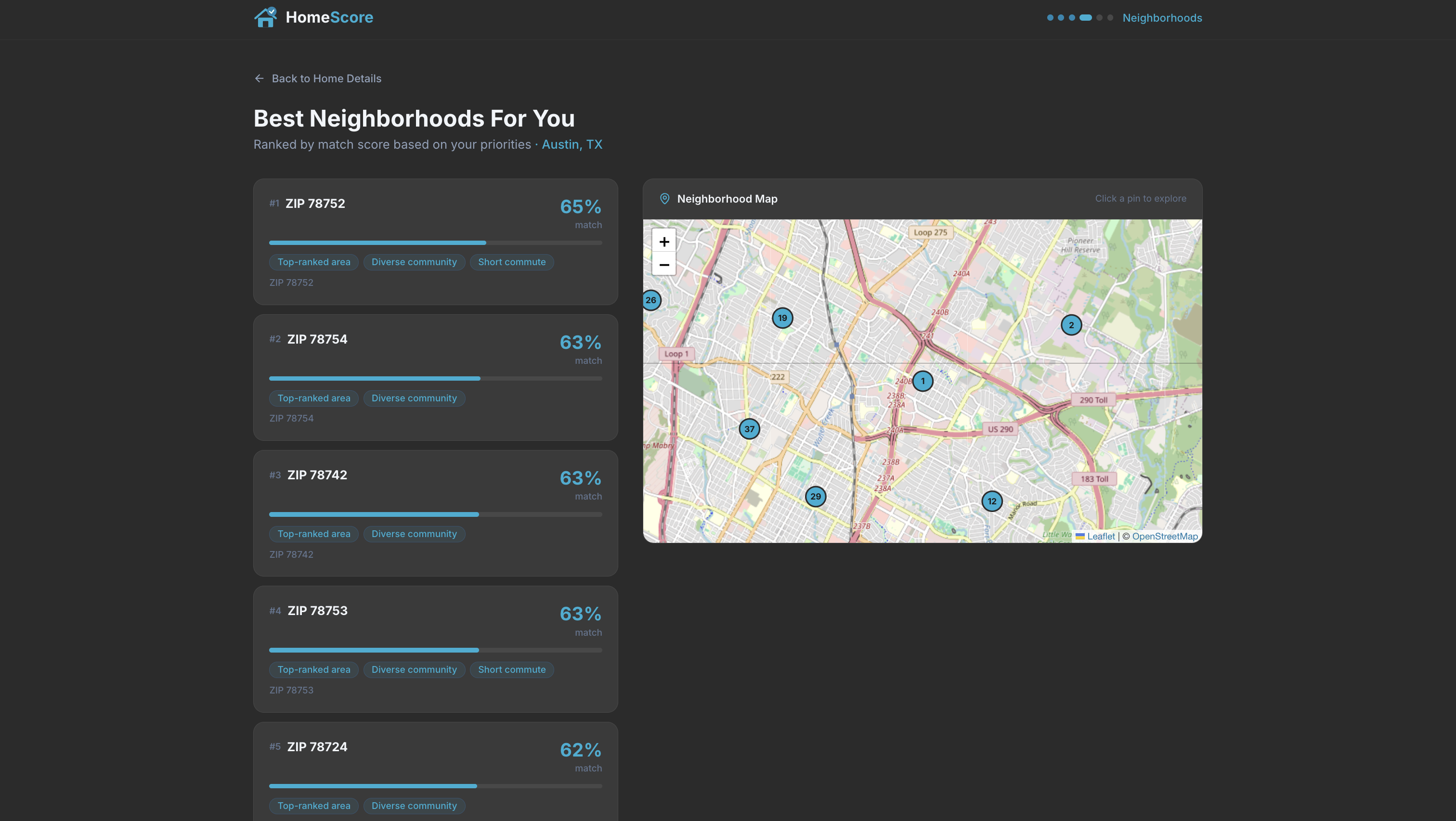
Neighborhoods are ranked before any house listings are shown.
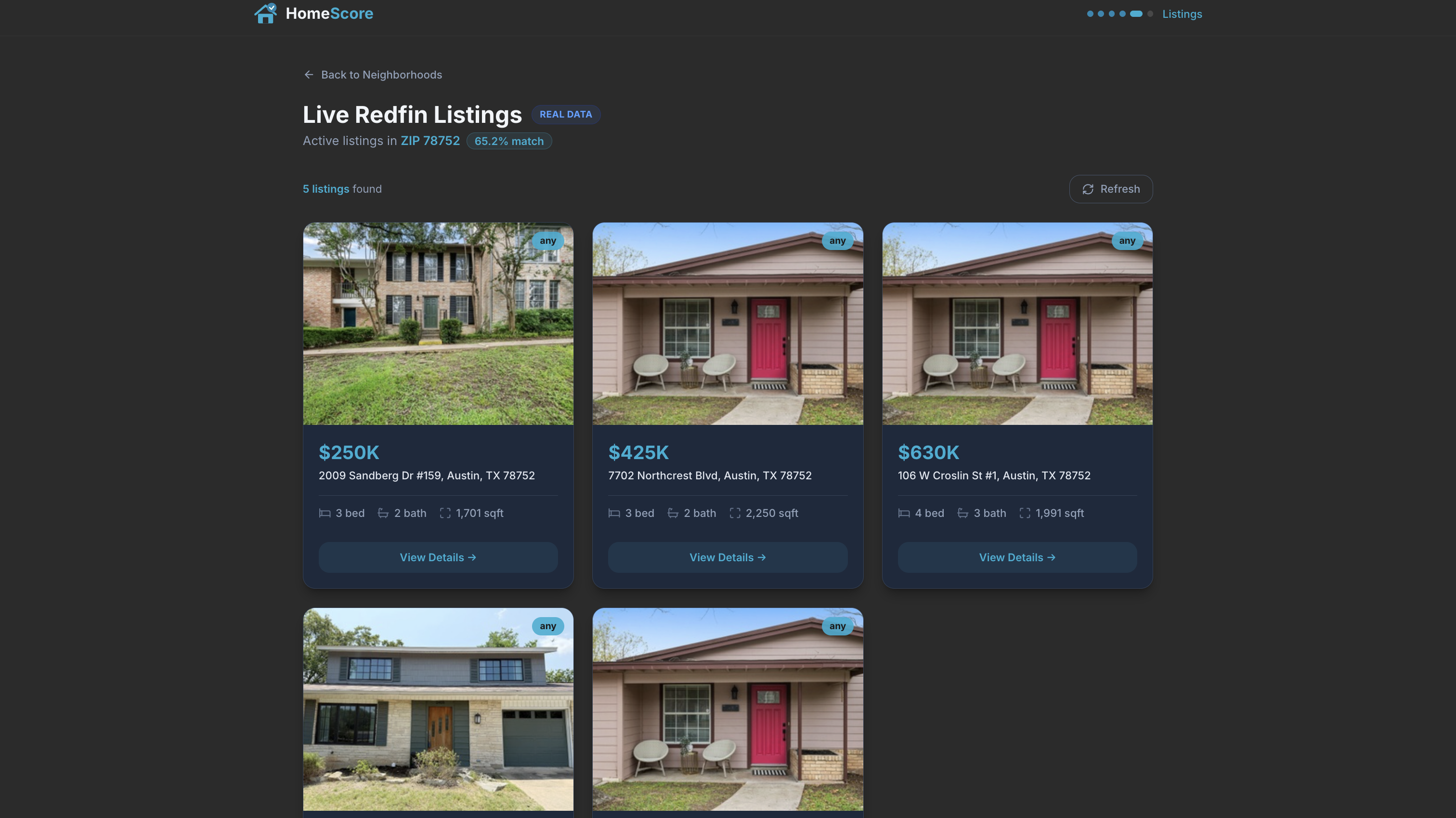
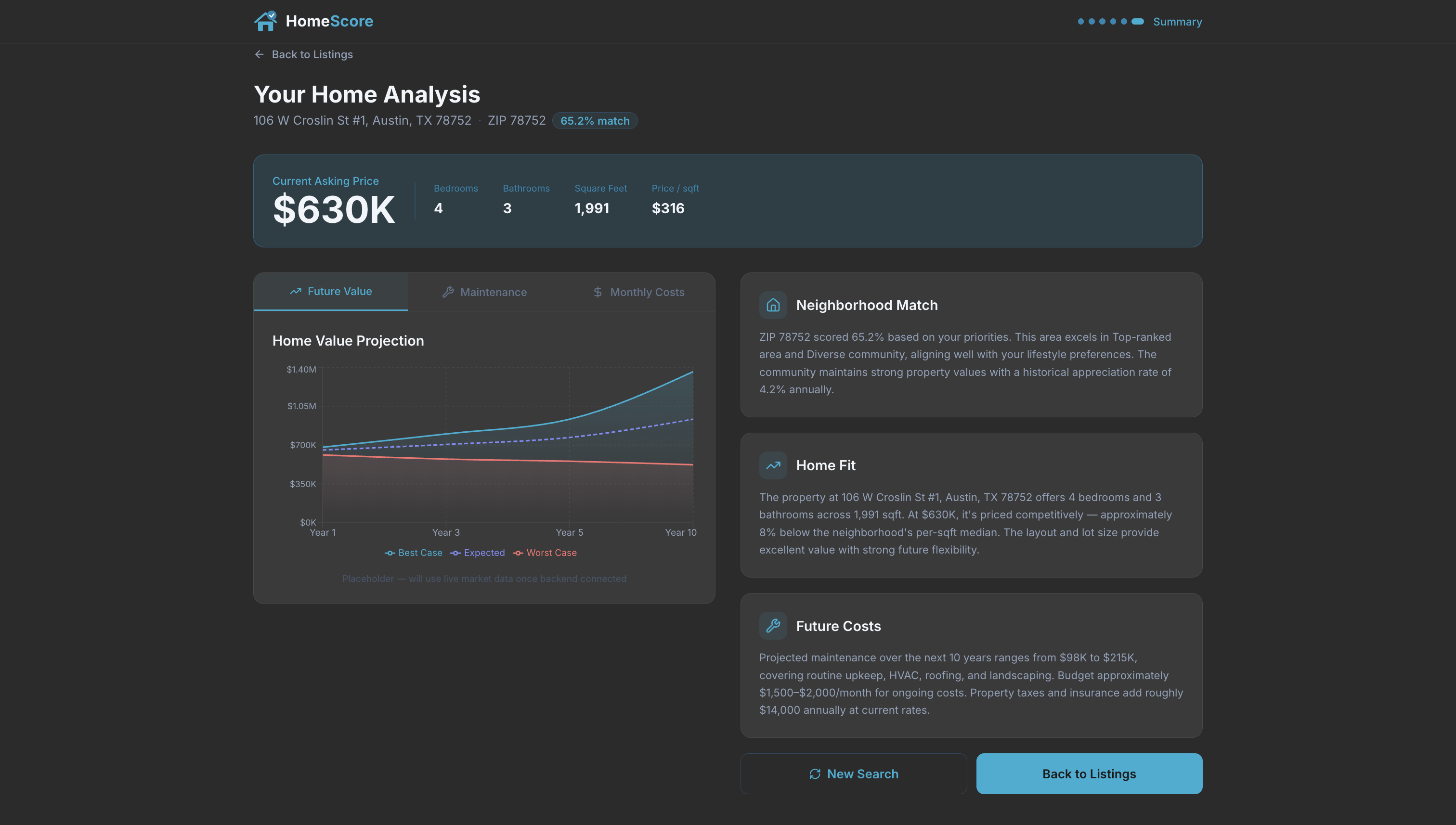
After a neighborhood is selected, users see houses that match their physical requirements. Finally, we project:
- Future home value
- Maintenance costs
- Best-case and worst-case scenarios
across multiple time horizons (6 months, 1 year, 3 years).
An LLM generates a transparent explanation of why each recommendation was made.
How We Built It
HomeScore follows a four-stage pipeline:
Preference Intake (Frontend)
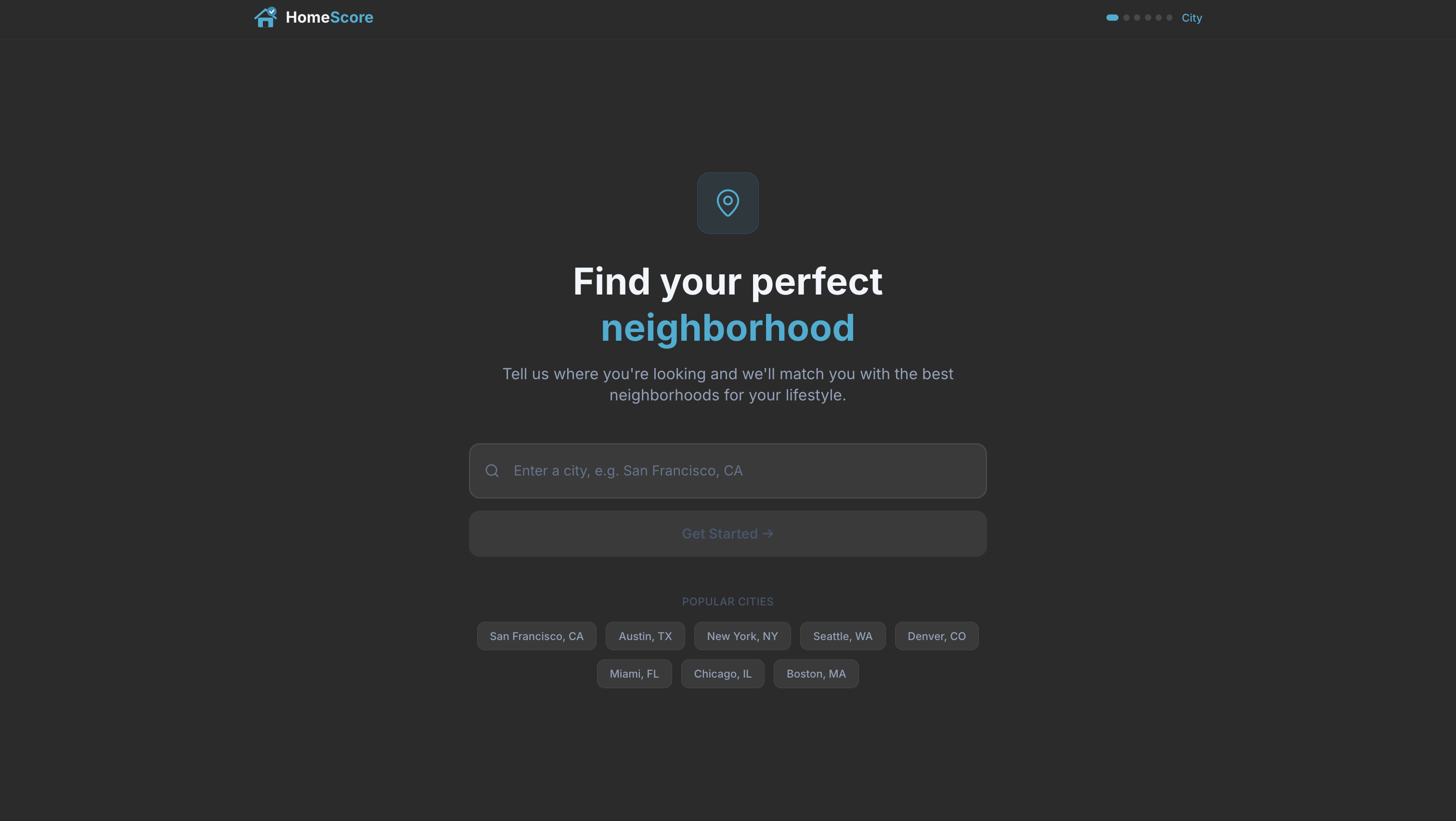
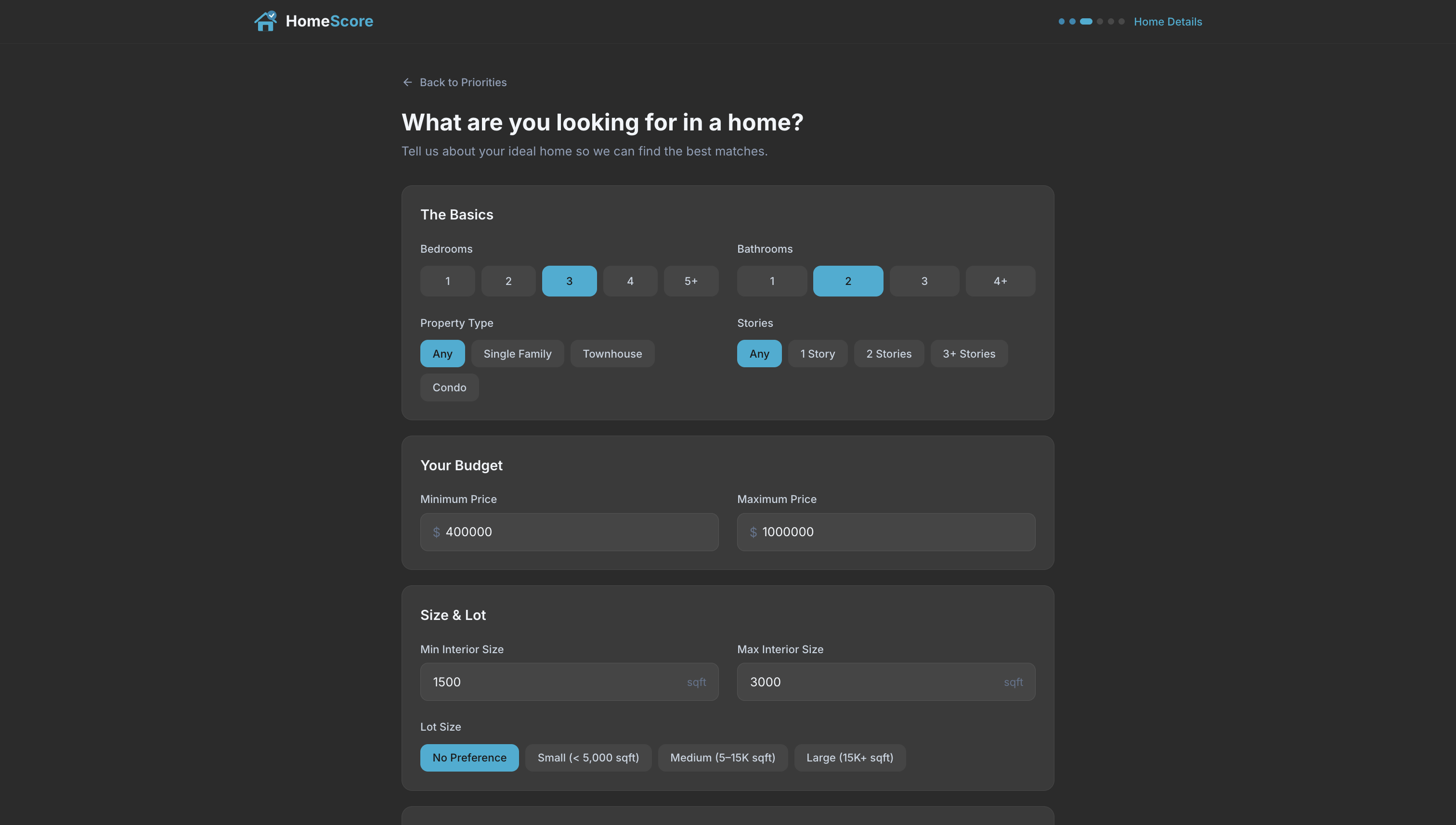
A React-based interface captures both lifestyle and house requirements.
Neighborhood Classification
We trained a classification model using multi-source data:
- Crime statistics
- School ratings
- Income levels
- Commute times
- Education demographics
The model ranks neighborhoods uniquely for each user.
Rule-Based House Filtering
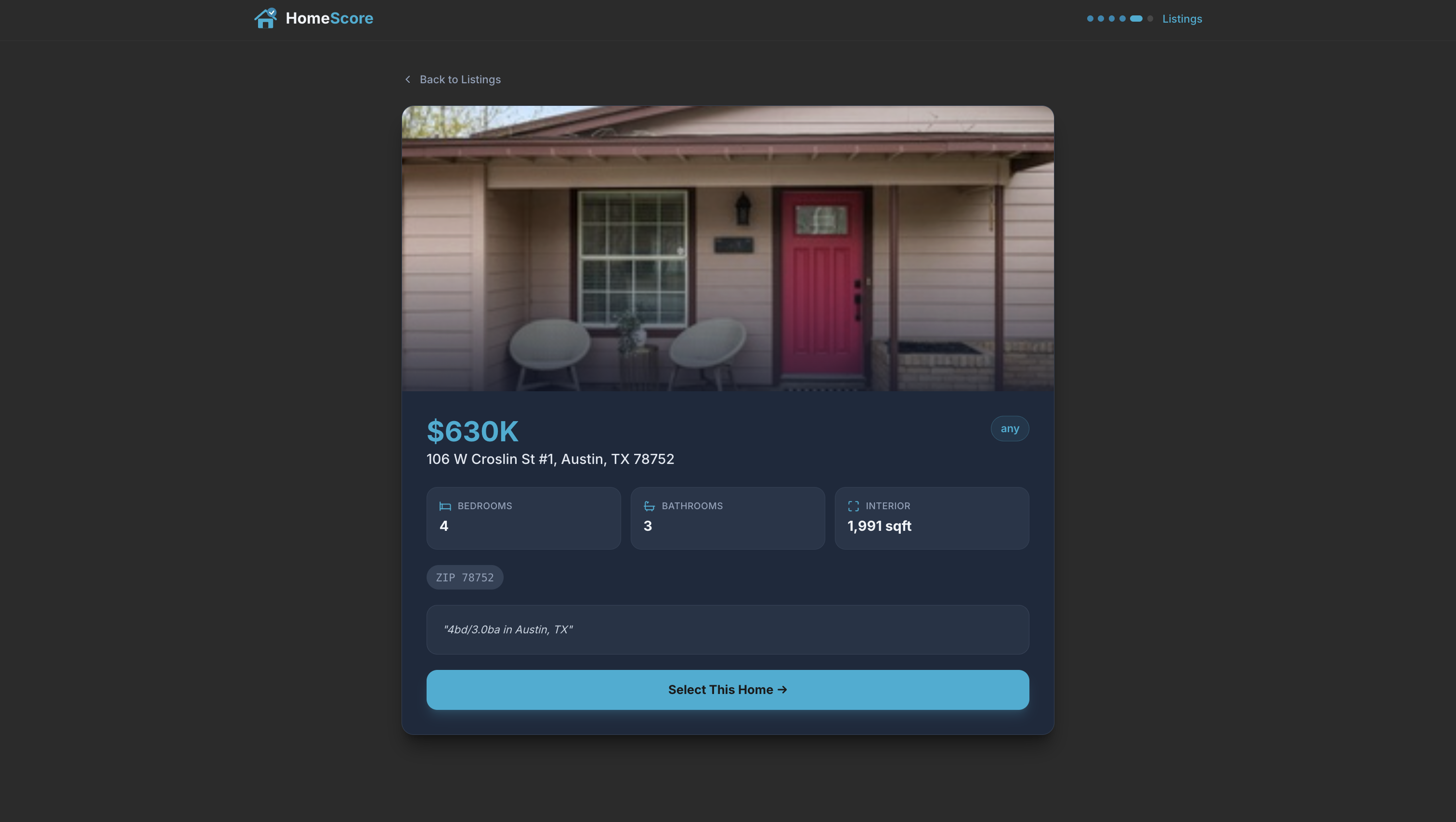
Once a neighborhood is selected, hardcoded filters match listings based on beds, baths, square footage, and other physical features.
Regression + LLM Layer
We trained a regression model on historical housing transactions augmented with macroeconomic features such as:
- Interest rates
- Employment growth
- Housing inventory
The projected value function can be simplified as:
$$ \hat{V}_{t+k} = f(V_t, r, g, i, m) $$
where
- ( V_t ) = current value
- ( r ) = interest rate trends
- ( g ) = regional growth
- ( i ) = inventory levels
- ( m ) = maintenance lifecycle
If the trained model is unavailable, an LLM fallback generates projections using structured economic inputs.
Challenges We Faced
- Collecting clean neighborhood data from multiple sources
- Normalizing different datasets into a unified feature schema
- Avoiding overfitting with limited historical data
- Designing explainable AI outputs instead of black-box scores
- Managing time constraints during the hackathon
- Balancing frontend polish with backend model development
One major challenge was ensuring that the LLM was used only for narrative explanation, while predictive intelligence remained within trained models.
Accomplishments We’re Proud Of
- Successfully inverted the traditional house-first search flow
- Built personalized neighborhood classification
- Integrated macroeconomic signals into value projections
- Designed an explainable scoring pipeline
- Delivered a demo-ready React frontend
Most importantly, we created a system where every recommendation is personalized, not static or generic.
What We Learned
- Feature engineering often matters more than model complexity
- Explainability builds trust in AI-driven financial decisions
- Economic forecasting requires uncertainty bounds, not single-point predictions
- LLMs are powerful for summarization but should not replace structured predictive models
- System design and UX matter just as much as algorithm selection
What’s Next for HomeScore
- Expand to more cities across the United States
- Integrate live listing APIs nationwide
- Improve regression accuracy with deeper macroeconomic signals
- Add rental ROI forecasting
- Build scenario simulation (e.g., interest rate change of (+1\%))
- Develop long-term tracking dashboards for users
Our long-term goal is to transform HomeScore from a search tool into a decision engine for one of life’s most important investments.
Built With
- beautiful-soup
- fastapi
- github
- google-gemini-api
- greatschools-api
- javascript
- leaflet.js
- linear-model
- llm
- python
- react
- redfin-api
- typescript
- us-census-bureau-api
- vite
- xgboost-regresssion


Log in or sign up for Devpost to join the conversation.