-
-

HomeResolve Mobile Experience - Responsive design with an intuitive appliance dashboard, accessible navigation , evidence-first assistance.
-
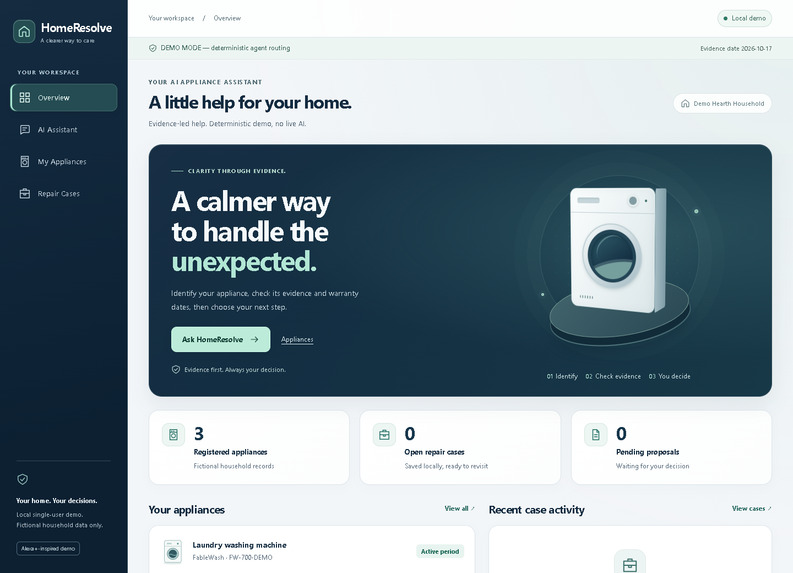
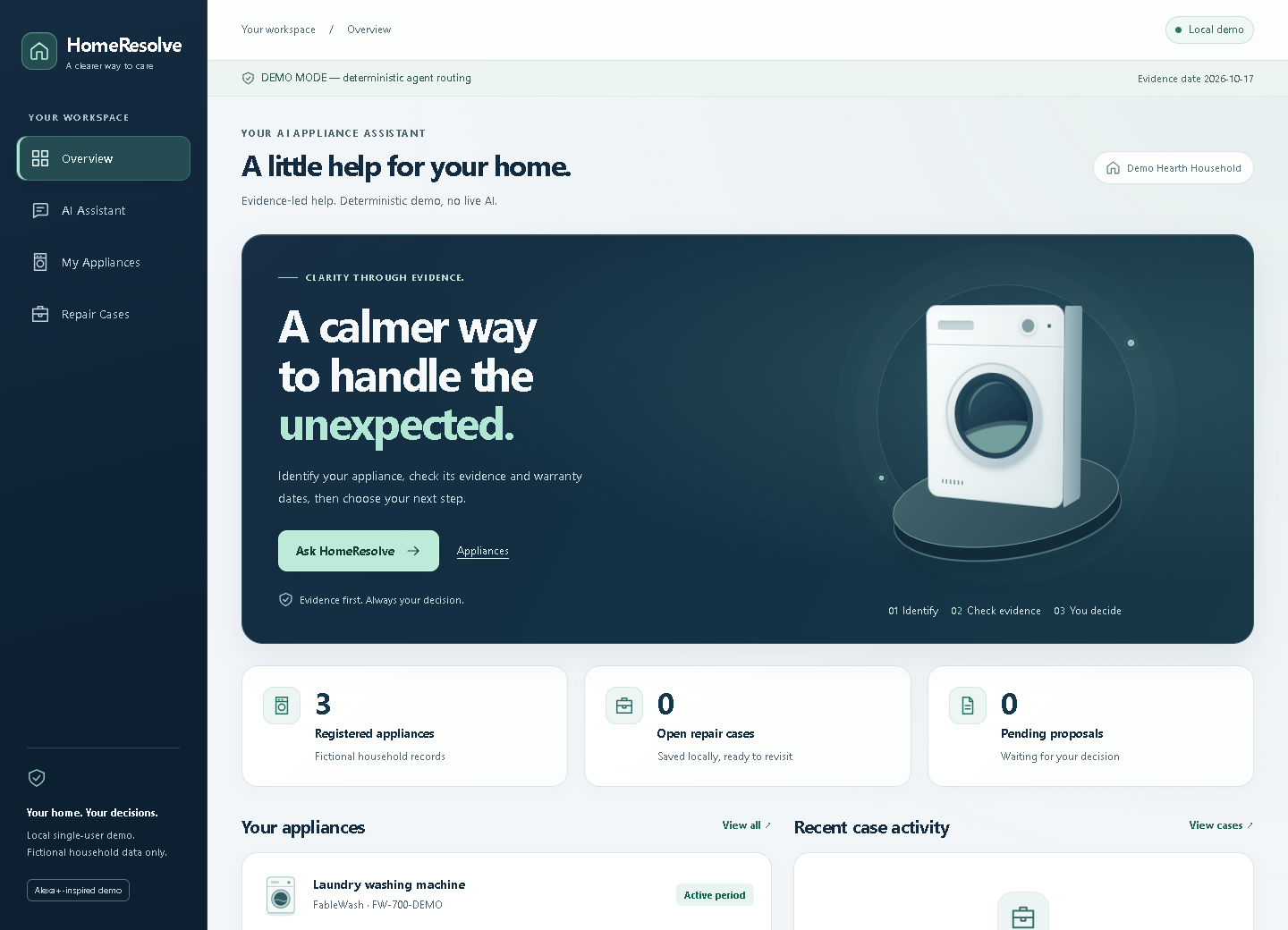
HomeResolve Premium Dashboard — A modern AI-powered interface featuring 3D appliance visuals, warranty insights, and repair case management.

Inspiration
Imagine your washing machine suddenly starts leaking. You know something is wrong, but what should you do next?
Finding the purchase receipt, checking warranty information, understanding repair options, and keeping track of previous decisions can be frustrating and time-consuming.
Today, AI assistants can answer questions, but a truly useful household assistant should do more than generate suggestions. It should retrieve reliable information, explain uncertainty, and help people make informed decisions without taking control away from them.
That inspired HomeResolve — an evidence-driven AI appliance assistant built around one simple principle: Evidence first. Human decision second. Action only with approval.
Inspired by the possibilities of Alexa+ and agentic AI, HomeResolve explores how intelligent assistants can simplify everyday household problems through real tools, transparent reasoning, and meaningful human oversight.
What it does
HomeResolve helps homeowners investigate appliance problems, understand warranty evidence, and manage their next steps through an AI-powered workflow.
A user can ask a natural-language question such as:
"My washing machine is leaking. Is it still under warranty?"
Instead of guessing, HomeResolve's AI agent discovers and calls real Model Context Protocol (MCP) tools to:
Identify the appliance using available household records.
Retrieve purchase evidence, including receipt information and purchase dates.
Evaluate warranty dates and explain the evidence supporting the result.
The application presents completed tool activity, supporting information, and an evidence-based explanation.
HomeResolve can then prepare a repair proposal for the homeowner to review. No repair case is created until the homeowner explicitly approves it.
Once approved, the decision is stored in a local SQLite database along with its audit history. This information remains available even after restarting the application.
HomeResolve also handles uncertainty responsibly. If an appliance has no receipt or reliable warranty documentation, the system reports the warranty status as unknown instead of inventing documents or promising coverage.
The current prototype demonstrates active, expired, and unknown warranty situations using fictional household records.
What makes HomeResolve different?
HomeResolve combines genuine AI-generated tool calls, structured evidence, explicit human approval, and persistent decision history within one accessible interface.
It is an Alexa+-inspired local web simulation with real agentic functionality—not a production Alexa+ integration or a real technician-booking service.
How we built it
HomeResolve combines local AI inference, a standards-based MCP server, a protected application backend, and a responsive premium frontend.
AI Agent — Ollama and Qwen3
The AI agent uses Ollama with a locally installed Qwen3 4B model to understand user requests, select appropriate tools, and generate evidence-grounded response plans.
The system runs locally without requiring a paid AI inference API.
Real Model Context Protocol Integration
We implemented a real MCP server using the official Python SDK and Streamable HTTP.
The agent discovers and invokes three read-only tools:
find_appliance — Identifies matching appliances.
get_purchase_evidence — Retrieves available purchase information.
evaluate_warranty — Evaluates warranty dates using the available evidence.
The backend independently validates model-generated plans against actual tool results to reduce unsupported claims.
Backend and Data Persistence
Python, FastAPI, Pydantic, and SQLite power the application's business logic, structured validation, repair proposals, approval operations, and persistent case history.
Approval and rejection remain trusted application operations rather than actions controlled directly by the language model.
Local-session security protections and duplicate-approval safeguards help keep the workflow predictable and controlled.
Frontend and User Experience
The interface is built using React, TypeScript, Vite, and CSS.
We developed a premium navy-and-teal dashboard featuring:
Original lightweight CSS-based 3D appliance artwork.
Responsive desktop and mobile layouts.
Clear appliance and warranty information.
Visible AI tool activity and supporting evidence.
Explicit human approval controls.
Saved repair cases and audit history.
Accessible navigation and reduced-motion support.
Testing and Verification
We used pytest, Vitest, and Playwright to test the system across backend, frontend, MCP communication, persistence, and real browser interactions.
The final local release passed 309 Python tests and 28 frontend tests.
Earlier genuine-model evaluation also passed 17 out of 17 defined Ollama scenarios, including situations involving missing evidence, ambiguity, failures, and recovery.
These results demonstrate successful verification of defined scenarios rather than universal AI accuracy.
Challenges we ran into
- Making Local AI Inference Reliable
Running a language model locally introduced cold-start delays and variable response times.
Initially, loading the model could consume the time intended for response generation.
We improved reliability by separating bounded model-loading and generation phases while preserving transparent error reporting.
- Preventing Unsupported AI Claims
A language model can sometimes generate convincing explanations even when supporting evidence is incomplete.
We addressed this challenge by restricting the agent to read-only MCP tools and validating its response plans against actual retrieved evidence.
Missing warranty documentation remains unknown rather than being treated as proof of coverage.
- Keeping Humans in Control
We wanted AI assistance without giving the model unrestricted authority over important decisions.
Our solution separates information gathering from action.
The AI can help prepare a proposal, but only an explicit homeowner confirmation can create a local repair case.
- Real MCP Integration and End-to-End Testing
Integrating MCP tool discovery, structured responses, FastAPI, browser security protections, and SQLite persistence required careful coordination.
We tested real client/server communication, approval and rejection behavior, API restarts, duplicate decisions, and failure recovery instead of relying only on simulated responses.
- Balancing Design with Functionality
We also wanted HomeResolve to feel like a polished product rather than a basic technical demonstration.
We refined the dashboard, responsive layouts, typography, accessibility, and original 3D artwork while preserving the verified AI workflow.
Accomplishments that we're proud of
Our biggest accomplishment is building a working, evidence-driven AI prototype rather than a static demo or a chatbot that only generates text.
We are particularly proud of:
Implementing genuine Ollama-generated MCP tool calls.
Building a real MCP client/server integration with three read-only tools.
Grounding warranty explanations in retrieved evidence.
Reporting uncertainty instead of fabricating missing information.
Requiring explicit human approval before creating repair cases.
Preserving repair history and audit events across application restarts.
Designing a premium, responsive interface with original 3D visuals.
Publishing a reproducible, MIT-licensed open-source GitHub repository with installation and testing instructions.
Verifying the application through automated backend, frontend, integration, and browser tests.
Open-Source GitHub Repository:
https://github.com/prince889035-sys/HomeResolve
What we learned
Building HomeResolve taught us that a reliable AI agent is much more than a powerful language model.
Its real value comes from connecting intelligence to trustworthy tools, enforcing clear boundaries, managing failures, and presenting information in a way users can understand.
We learned how MCP provides structured access to application capabilities, how backend validation helps reduce unsupported model claims, and why explicit human approval is essential when an AI system influences real-world decisions.
We also gained practical experience with:
Local LLM inference and tool calling.
Model Context Protocol integration.
Full-stack AI application architecture.
Secure application boundaries.
Persistent database workflows.
Accessibility and responsive UI design.
Automated regression and browser testing.
Reproducible open-source software releases.
Most importantly, we learned that a successful AI product should not simply sound intelligent.
It should help people make better-informed decisions while remaining transparent about what it can and cannot do.
What's next for HomeResolve
Our long-term vision is to evolve HomeResolve from a local prototype into a more capable household assistance platform.
Future possibilities include:
Secure Household Accounts: Permission-based access to appliance records and household information.
Receipt and Document Ingestion: Uploading and analyzing purchase documents to simplify evidence collection.
Broader Appliance Support: Supporting additional appliance categories and evidence sources.
Hybrid AI Inference: Allowing suitable local models and cloud AI APIs to be used depending on the environment.
Authorized Repair Provider Integrations: Exploring real service scheduling with appropriate user consent and external integrations.
Proactive Maintenance Assistance: Using appliance history to help homeowners understand maintenance needs.
Potential Deeper Alexa+ Integration: Exploring future platform integrations subject to available capabilities, security requirements, and authorization.
These are future development goals, not features claimed to exist in the current prototype.
We plan to validate the experience with real users and evaluate how effectively HomeResolve reduces the effort involved in household appliance decisions.
HomeResolve represents our vision for responsible agentic AI: intelligence that gathers evidence, communicates uncertainty, respects human decisions, and turns everyday problems into clearer next steps.
Built With
- fastapi
- mcp
- ollama
- playwright
- pydantic
- pytest
- python
- qwen3
- react
- sqlite
- typescript
- vite
- vitest

Log in or sign up for Devpost to join the conversation.