-
-
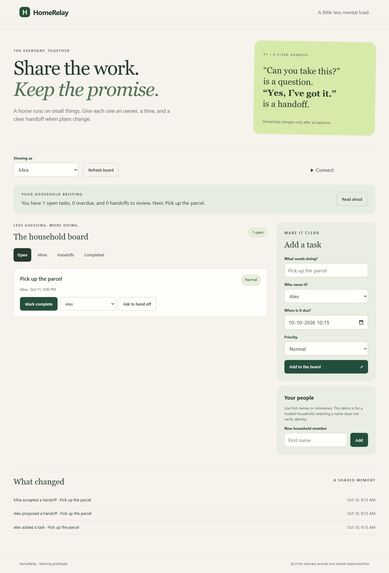
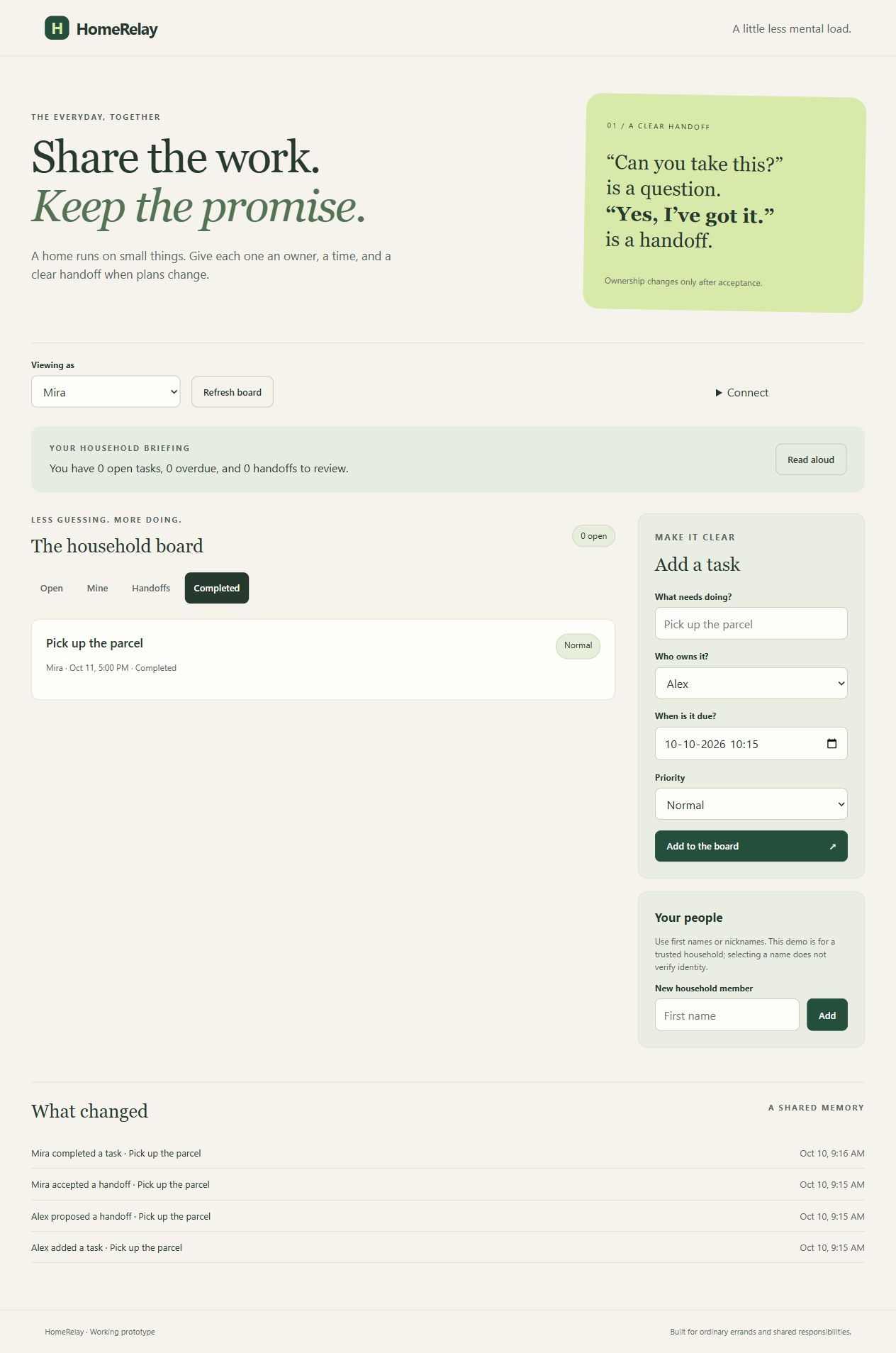
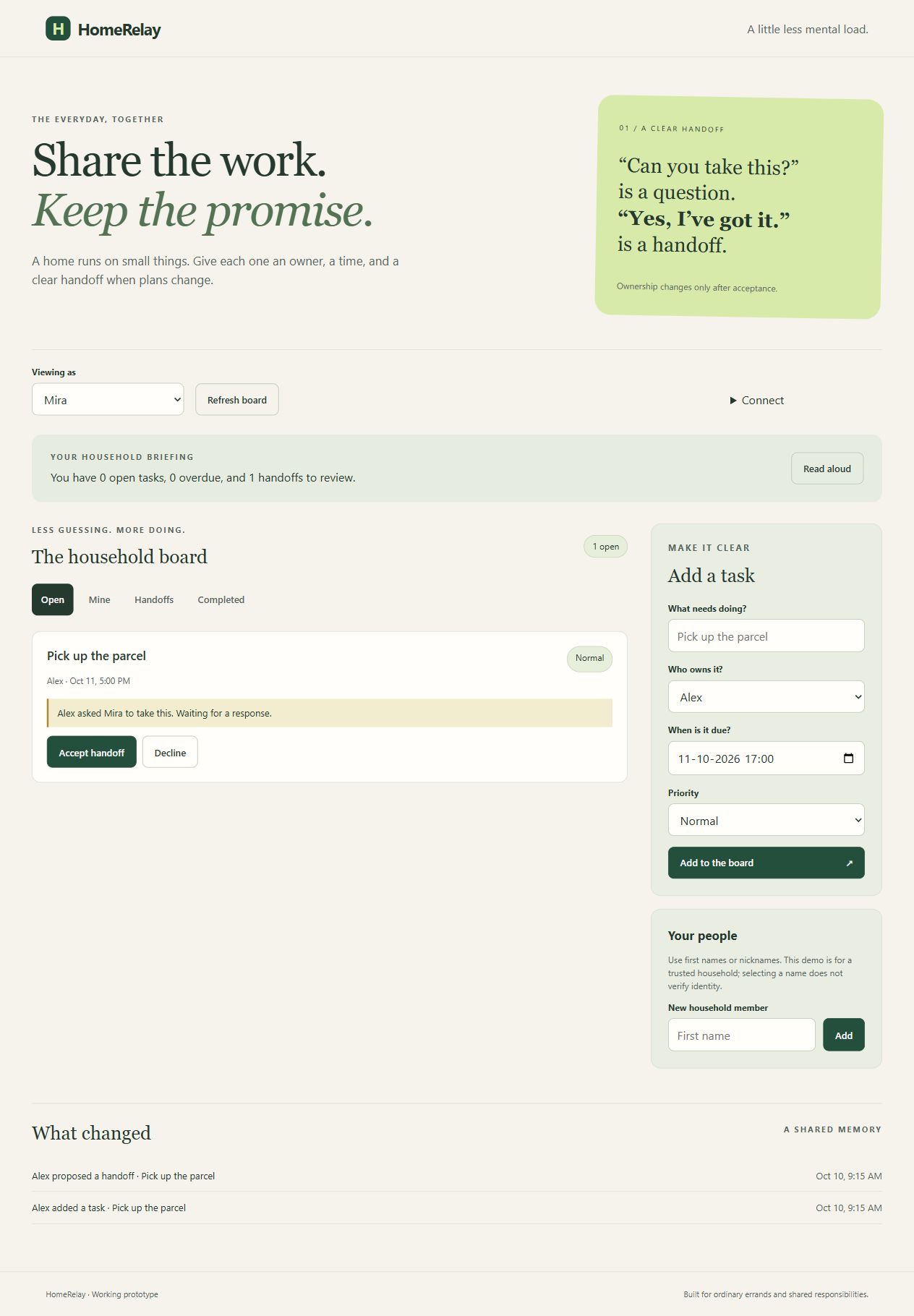
Actual HomeRelay browser workflow. A proposed handoff keeps responsibility clear until the recipient accepts.
-
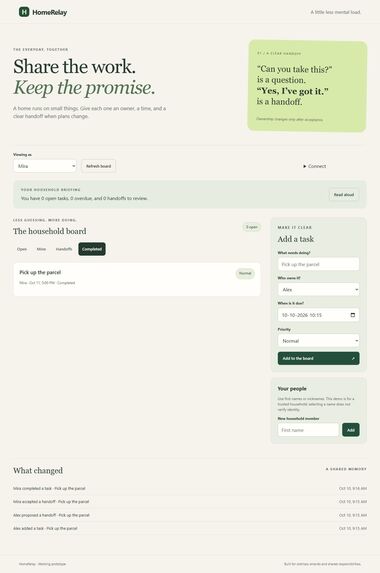
Actual HomeRelay browser workflow. The board records task progress with persistent state and an audit history.
-
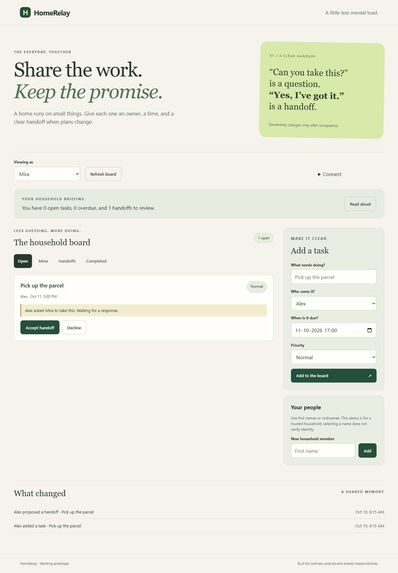
Actual HomeRelay browser workflow. Fictional household data; responsibility and event history are visible.
Inspiration
An errand can fall through the gap between “can you take this?” and an actual agreement. HomeRelay makes the request and the recipient’s acceptance separate steps so responsibility stays clear.
What it does
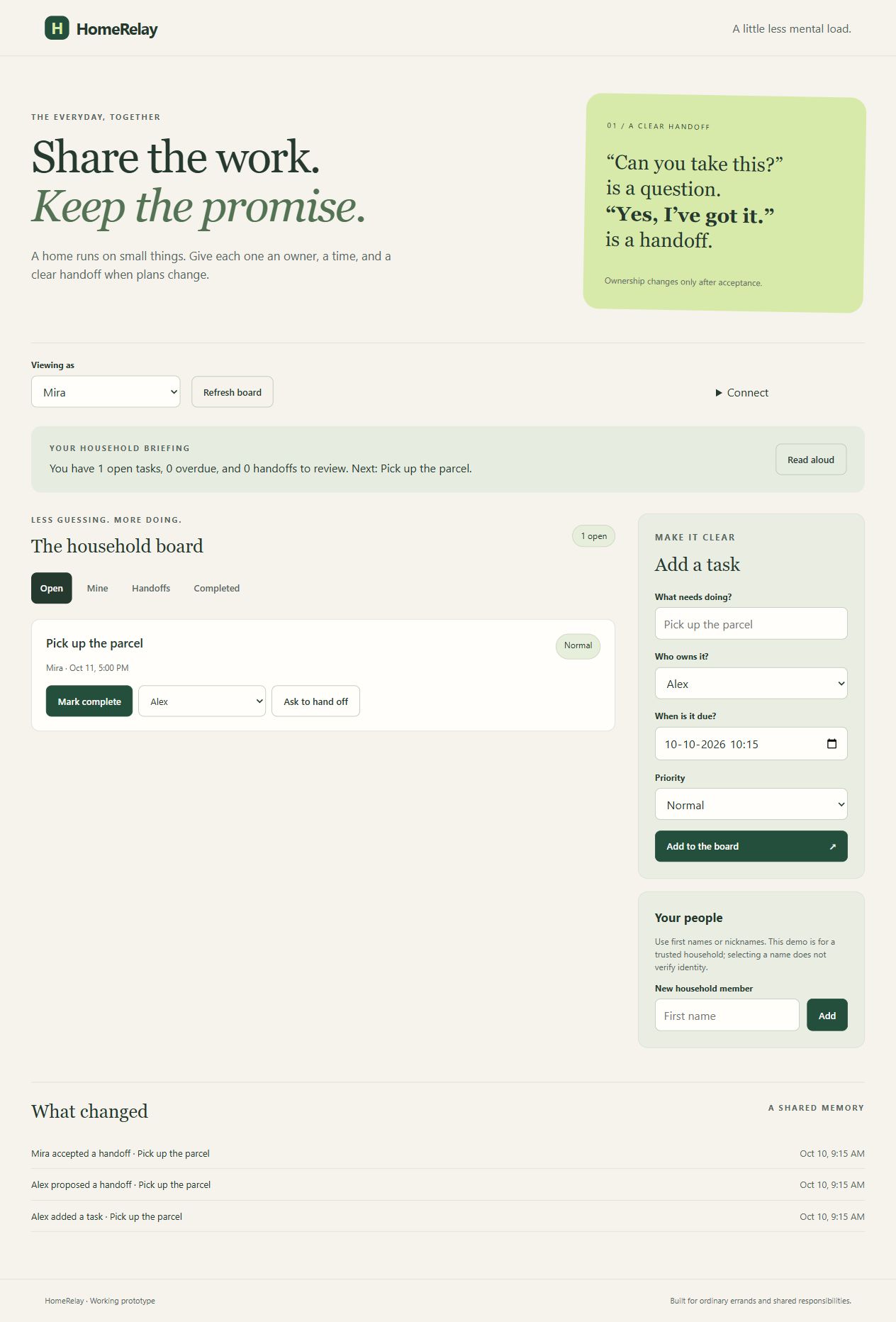
A household member creates a task with an owner, due time and priority. The owner can propose a handoff; the recipient accepts or declines. Ownership stays with the original person until acceptance. The board shows open, personal, pending and completed tasks, an ordered history, and a factual briefing that the browser can read aloud.
How we built it
HTML, CSS and vanilla JavaScript power the responsive interface. FastAPI validates REST requests. SQLite persists members, tasks, event history and retry request fingerprints. Task versions reject stale edits; immediate transactions prevent conflicting writes from both succeeding. The MCP Python SDK exposes six real Streamable HTTP tools using the same store operations. A separate-server integration test uses an actual MCP HTTP client with protocol 2025-11-25.
Challenges we ran into
A proposed handoff must never be mistaken for acceptance. We kept those transitions separate, tested unauthorized actor selections and stale versions, and preserved the original owner while a request is pending. Structured MCP responses also needed concrete return annotations for consistent client consumption.
Accomplishments and lessons
Nine automated tests pass, covering store behavior, REST, HTTP MCP, persistence, retries and concurrent edits. GitHub CI, Ruff and JavaScript syntax checks pass. A real browser journey creates, proposes, accepts, reloads and completes a task. At 390px the interface had no horizontal overflow and inputs had labels. These are prototype engineering checks; no user adoption or field-study results are claimed.
What’s next
Evaluate with real households, add individual authentication and household isolation, test accessibility with users, and verify an operational deployment. Today this is a trusted-household prototype: choosing a nickname does not authenticate a person. The source includes setup instructions; there is no public hosted app or built-in Alexa connection.
AI assistance and originality disclosure
This application was newly developed on October 10, 2026 during the event. Extensive Codex AI assistance was used for implementation, tests, documentation and demo preparation. Public dependencies were used under their licenses; no existing application repository was copied. The demo shows actual app states with fictional household data and English captions. No teammate-specific code contributions or sponsor integrations are claimed.
Source and setup: https://github.com/haresh-sai06/homerelay

Log in or sign up for Devpost to join the conversation.