-
-
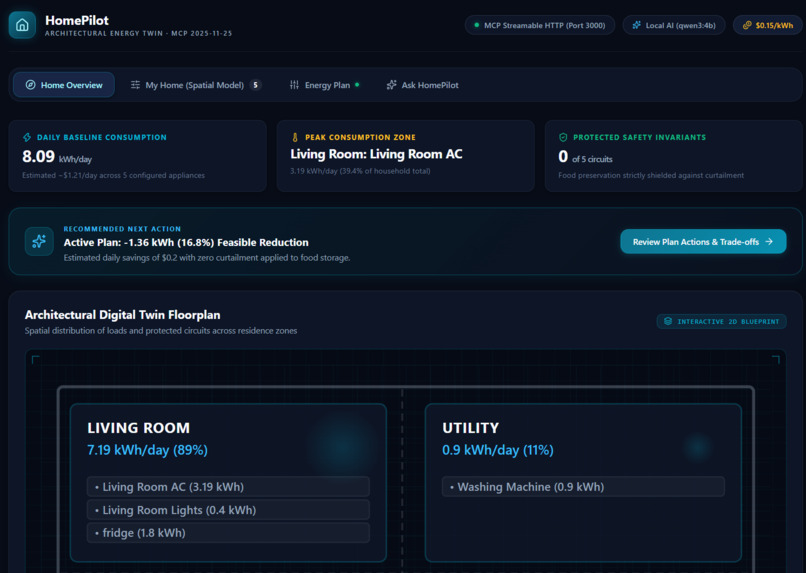
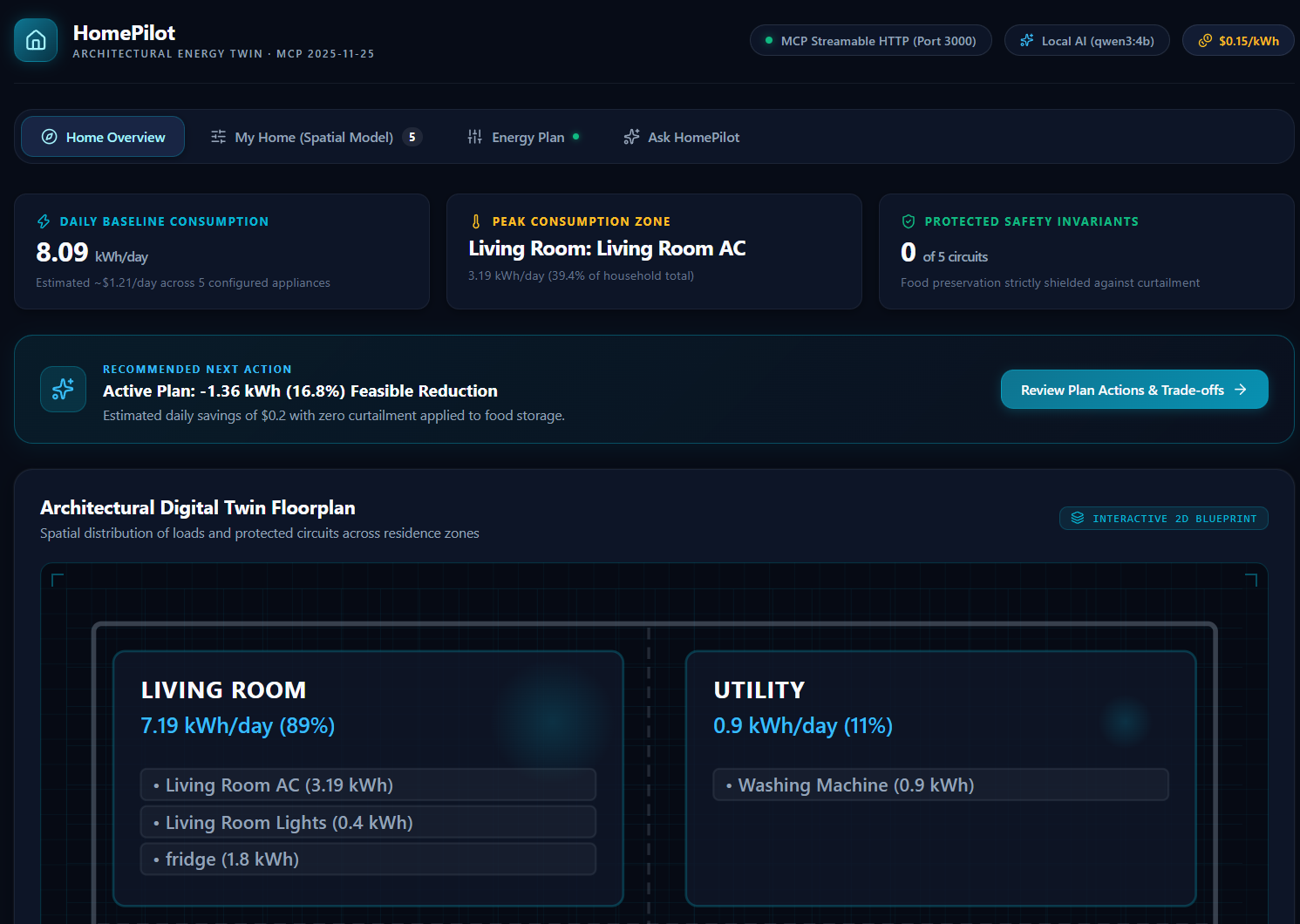
Home Overview dashboard
-
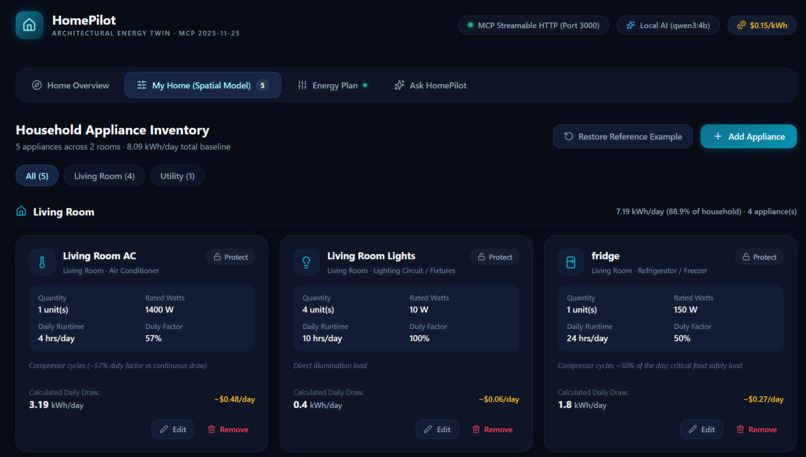
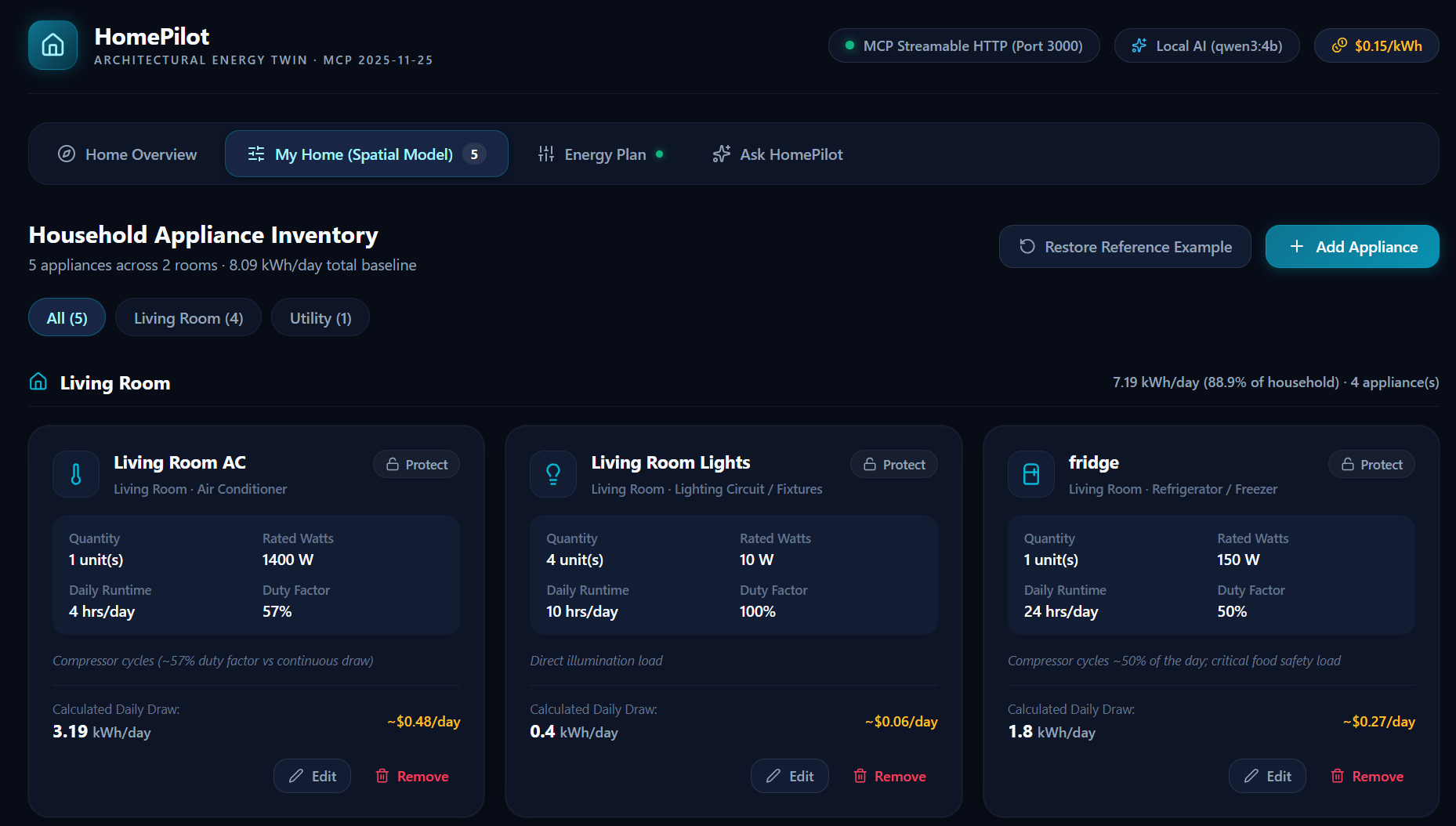
Household Appliance Inventory
Inspiration
Households need better ways to reduce electricity consumption without compromising essential needs. Simply switching off appliances can disrupt daily routines or put food preservation at risk. We wanted to build an assistant that turns energy-saving goals into clear, explainable, and safety-aware plans.
What it does
HomePilot is a goal-driven household energy operations assistant. Users can configure their household appliances, view estimated energy usage, and ask for a specific reduction, such as cutting electricity consumption by 20% while keeping the refrigerator safe.
HomePilot calculates a proposed plan using a deterministic energy planner, identifies potential savings, and protects critical devices from being selected for curtailment. The interface presents the estimated before-and-after usage and explains the recommended actions.
How we built it
The application combines a React and Vite frontend, an Express API gateway, a Model Context Protocol (MCP) server, a deterministic energy-planning engine, and local AI through Ollama using qwen3:4b. MCP exposes tools for energy usage, device status, energy summaries, and energy-reduction planning.
The AI helps interpret natural-language requests, while deterministic calculations and safety rules govern the resulting plan. If local AI is unavailable, HomePilot can fall back to deterministic intent handling.
Challenges we faced
We worked to keep the assistant's recommendations consistent across the user interface, API, and MCP tools. Another key challenge was ensuring that a requested energy reduction would not override critical-device protections. We added configurable household appliances, instance-aware planning, input validation, and regression tests for safety-sensitive scenarios.
What we learned
We learned how to combine local AI, MCP tool execution, deterministic calculations, and explicit safety constraints into one application. We also learned the importance of testing not only whether a plan reaches its target, but whether it respects the user's constraints.
What's next
Future improvements could include importing real household meter data, validating estimates against measured consumption, and adding user-configurable tariffs and more detailed planning constraints. The current application uses estimated or simulated household data and provides recommendations rather than physically controlling appliances.
Built With
- express.js
- javascript
- model-context-protocol-(mcp)
- node.js
- ollama
- qwen3
- react
- vite
