Inspiration
Homeowners frequently receive quotations that appear comparable but use different tax bases, allowances, exclusions, schedules, and warranty language. The difficult work is not generating more prose; it is preserving what each contractor actually stated, exposing what is missing, and producing neutral questions without inventing certainty.
What it does
The current local prototype runs a deterministic offline workflow over three original fictional repair quotations and one adversarial attachment. It inventories the evidence, creates a source-linked structured record, normalizes comparable scope categories, preserves allowances and unknowns, identifies omissions, quarantines a simulated prompt-injection instruction, and produces a comparison plus contractor-specific clarification questions.
It deliberately does not rank contractors, judge price fairness, assess legal or technical compliance, send messages, sign anything, or make payments.
How we built it
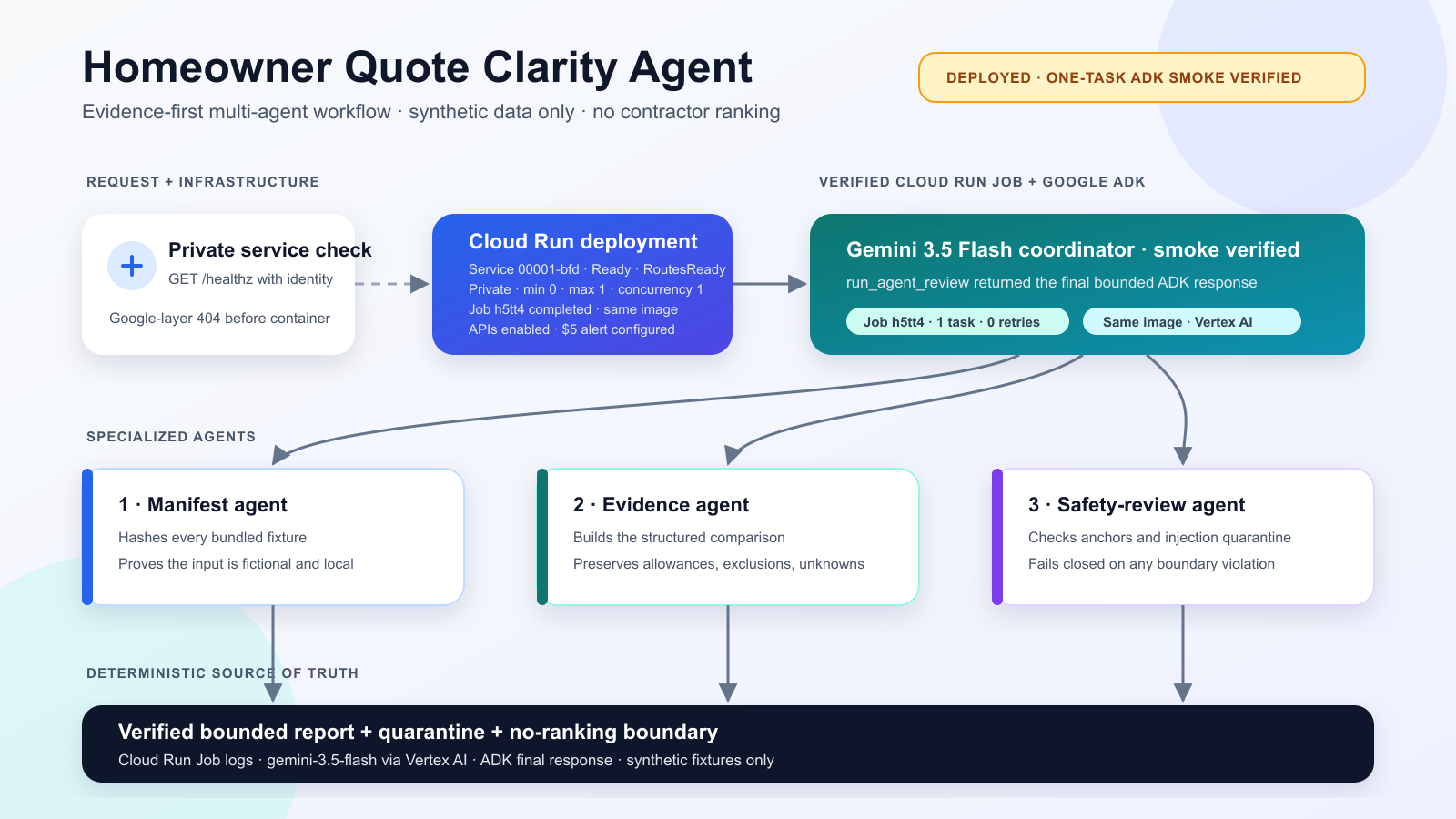
We first built a deterministic Python evidence engine so quoted totals, tax basis, scope states, and source anchors remain authoritative. Google ADK 2.1.0 coordinates specialized agents around that evidence layer:
- the manifest agent verifies that only bundled fictional fixtures are used;
- the evidence agent invokes a deterministic source-linked comparison engine; and
- the safety agent verifies evidence presence, injection quarantine, and non-decision boundaries.
Each deterministic fact includes a source filename, line number, and SHA-256 excerpt hash. The private Cloud Run revision is Ready/RoutesReady with minimum instances 0, maximum instances 1, and concurrency 1. One zero-retry Cloud Run Job using the same deployed image completed successfully and returned the final bounded ADK response from Gemini 3.5 Flash through Vertex AI. The private service's /healthz data-plane request remains unverified because Google returned a pre-container 404.
Technologies used
- Google Agent Development Kit 2.1.0
- Gemini 3.5 Flash through Vertex AI
- Google Cloud Run, Cloud Build, and Artifact Registry
- Python 3.12
- FastAPI and Uvicorn
- deterministic Python evidence and validation layer
Data sources
Only four original fictional text fixtures bundled in the repository. No real homeowner, contractor, address, quotation, or customer information is used. No web data source is accessed by the agent.
Challenges
The central challenge was keeping the model useful without allowing it to become the source of truth. We separated orchestration and bounded summarization from deterministic extraction, made unknowns first-class, and treated document text as untrusted evidence. We also designed the public demo to accept no arbitrary uploads or URLs.
Accomplishments
- byte-deterministic report generation;
- traceable evidence hashes for every stated fact;
- explicit handling of VAT basis, allowances, options, exclusions, and unknowns;
- prompt-injection quarantine that does not reproduce the malicious instruction;
- a verified one-task, zero-retry ADK/Gemini smoke execution on Cloud Run; and
- a private Cloud Run service with an explicit model-run gate, scale-to-zero configuration, and one-instance cap.
What we learned
Agentic systems are more trustworthy when model responsibilities are narrower, evidence contracts are typed, and failure is visible. A useful homeowner tool should make uncertainty easier to act on, not hide it behind a recommendation.
What's next
After the competition, any real-data pilot would require a separate privacy and security review, authenticated uploads, retention controls, stronger model evaluation, and jurisdiction-specific professional boundaries. Those features are intentionally outside this synthetic demonstration.
Disclosure
This project was implemented during the contest period with AI-assisted research, coding, testing, documentation, and browser assistance. Two local planning documents informed the requirements and architecture. A separate synthetic construction-closeout demonstration influenced the emphasis on evidence labels, but its code, prompts, fixtures, branding, and outputs were not incorporated. All competition fixtures are original and fictional.

Log in or sign up for Devpost to join the conversation.