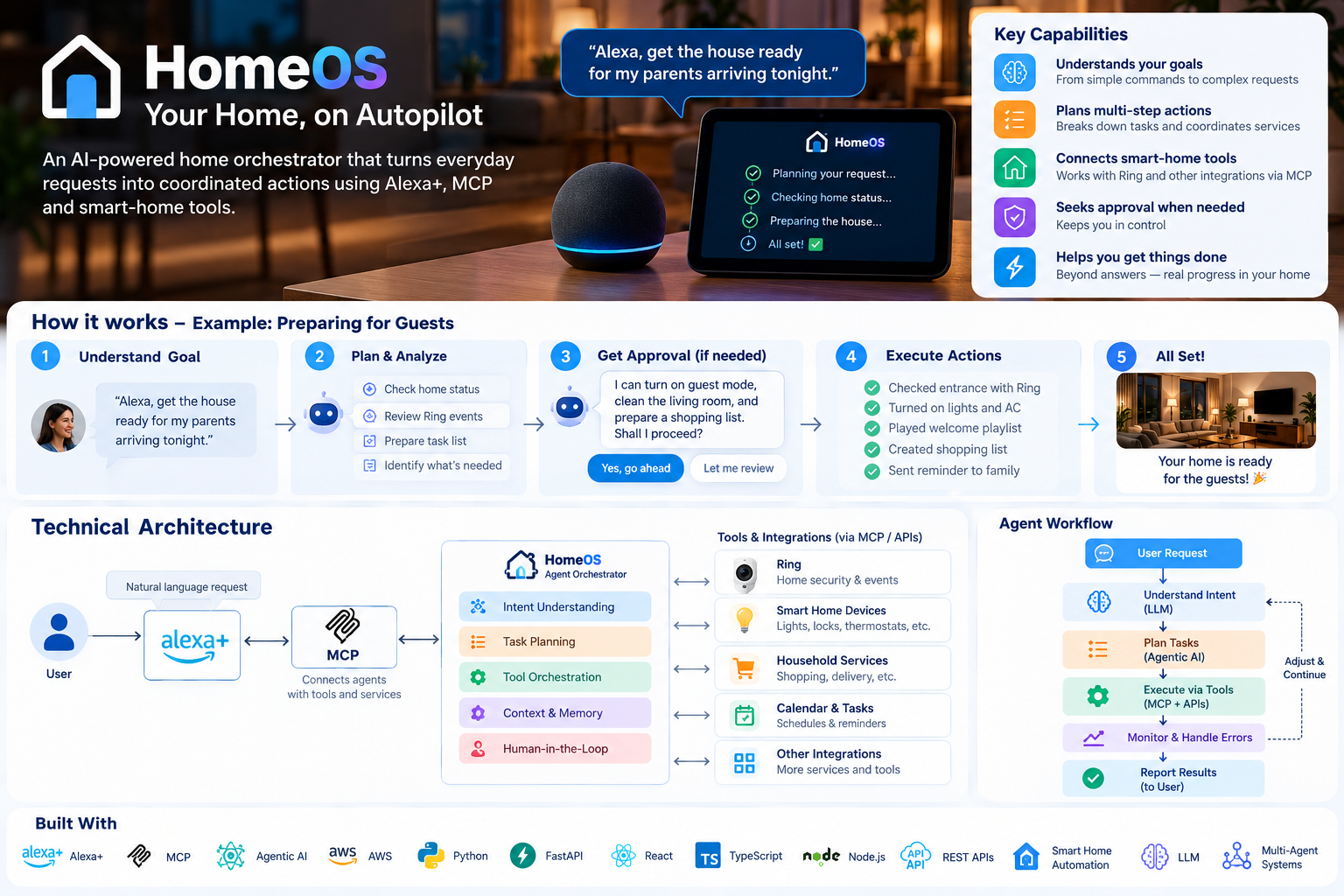
HomeOS — Your Home, on Autopilot
Inspiration
Smart homes can respond to individual commands, but coordinating multiple household tasks still requires human effort. We imagined a home that understands what people want to achieve, plans the steps, and coordinates actions intelligently. This inspired HomeOS—an AI-powered home orchestrator that turns everyday intentions into meaningful actions.
What it does
HomeOS transforms natural-language requests into coordinated, multi-step household workflows. Built for the Alexa+ track, it aims to use agentic AI and MCP to connect smart-home tools and services, gather relevant context, plan actions, and request human approval when needed. Instead of simply answering questions, HomeOS helps users get things done.
How we built it
HomeOS is designed around an agentic workflow that translates user intent into an actionable plan. The architecture centers on:
- Natural-language understanding to interpret household goals.
- Agentic planning to break requests into smaller, manageable tasks.
- MCP-based tool integration to connect supported services and capabilities.
- Human-in-the-loop approvals for actions that require user confirmation.
- A user-facing experience to present plans, progress, and outcomes.
The final implementation will demonstrate the integrations and capabilities that are successfully built and tested.
Challenges we ran into
Designing a reliable home orchestrator involves more than connecting an AI model to tools. Key challenges include translating ambiguous requests into useful plans, coordinating multiple steps, managing tool failures, protecting user privacy, and determining when an action should require approval. Another important challenge is ensuring that the demo showcases real functionality rather than just a conversational interface.
Accomplishments that we're proud of
We are proud of the vision behind HomeOS: moving beyond reactive voice assistants toward an intelligent system that can coordinate tasks around a user's goals. The project brings together agentic planning, tool orchestration, and human oversight in a practical smart-home use case, with a design that can grow as more integrations become available.
What we learned
Building HomeOS reinforces the importance of reliable tool integration, clear task boundaries, persistent context, and user trust in agentic systems. An effective AI assistant should not only understand what a user says—it should plan responsibly, communicate what it intends to do, handle failures gracefully, and keep the user in control.
What's next for HomeOS — Your Home, on Autopilot
Our next steps are to strengthen the Alexa+ and MCP integration, expand support for compatible smart-home services, improve contextual awareness, and make multi-step workflows more reliable. We also envision personalized routines, proactive recommendations, and coordinated household experiences—all with privacy, transparency, and user approval at the center.
HomeOS — From intent to action. A smarter home, working for you.
Built With
- agentic-ai
- ai-agents
- alexa+
- amazon-web-services
- api-integration
- cloud-computing
- context-awareness
- fastapi
- generative
- home-automation
- human-in-the-loop
- llm
- mcp
- multi-agent-systems
- node.js
- privacy
- python
- react
- rest-apis
- smart-home-automation
- tool-orchestration
- typescript
- voice-ai
- workflow-automation

Log in or sign up for Devpost to join the conversation.