Inspiration
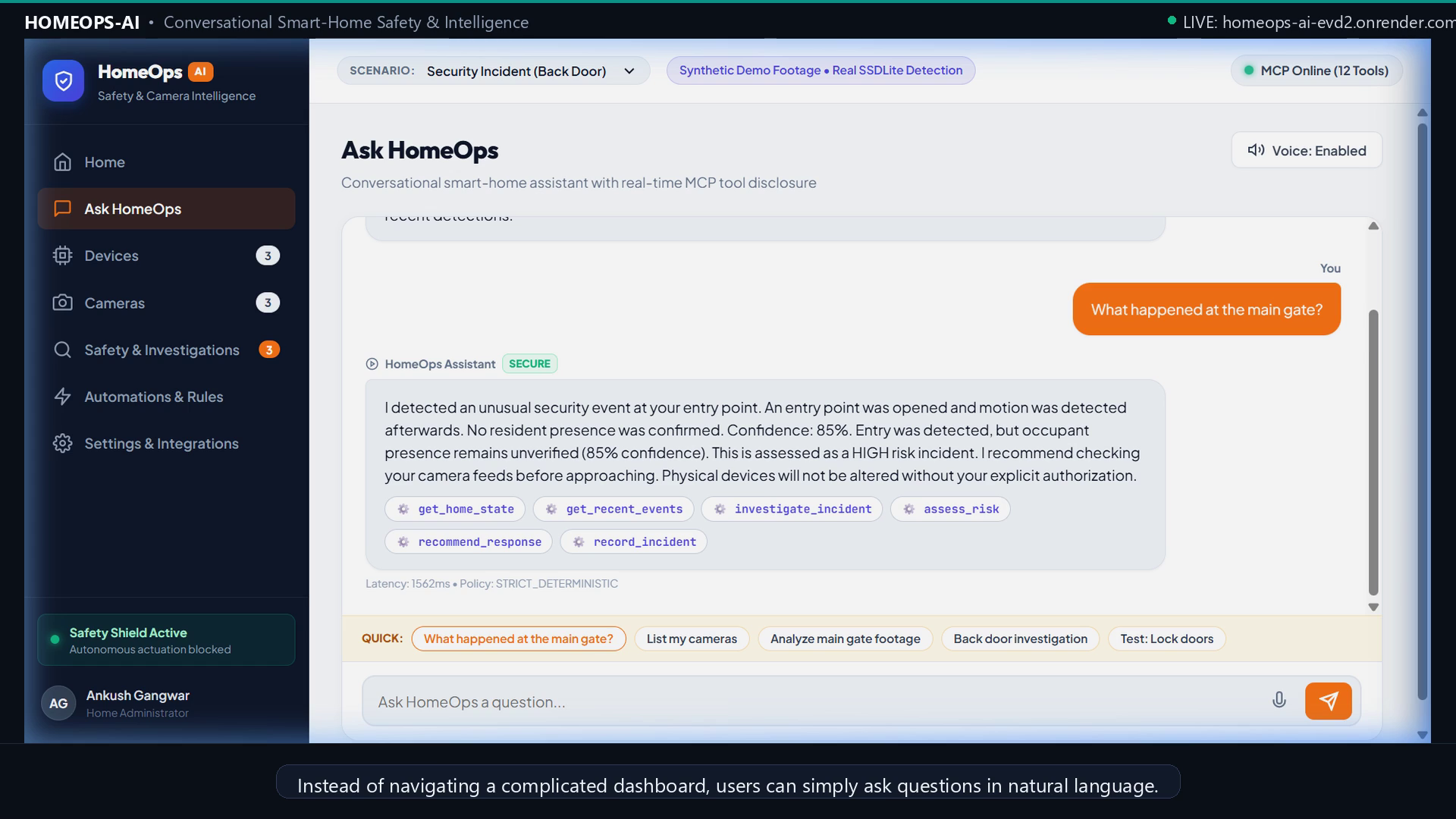
Smart homes generate data from doors, motion sensors, cameras, and other devices, but understanding what is happening during a suspicious event can still be complicated. We wanted to make home safety more conversational and accessible, so users could ask questions in natural language instead of navigating multiple dashboards. This inspired us to build HomeOps-AI, a safety-first assistant focused on understanding events, investigating risks, and helping people make informed decisions.
What it does
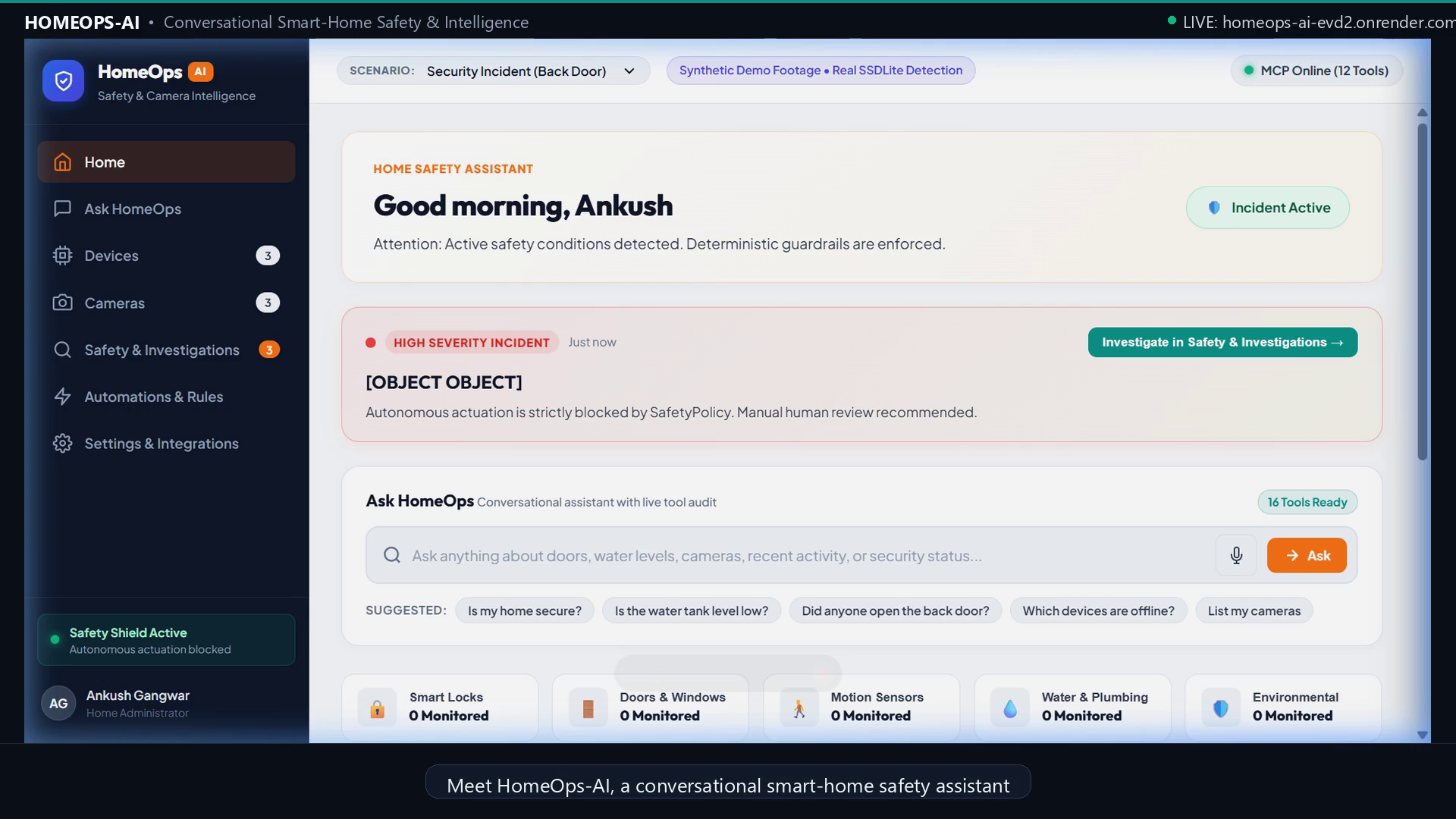
HomeOps-AI is a conversational smart-home safety assistant that helps users investigate home activity and understand potential risks.
Natural-language interaction: Ask questions about home activity in a conversational interface.
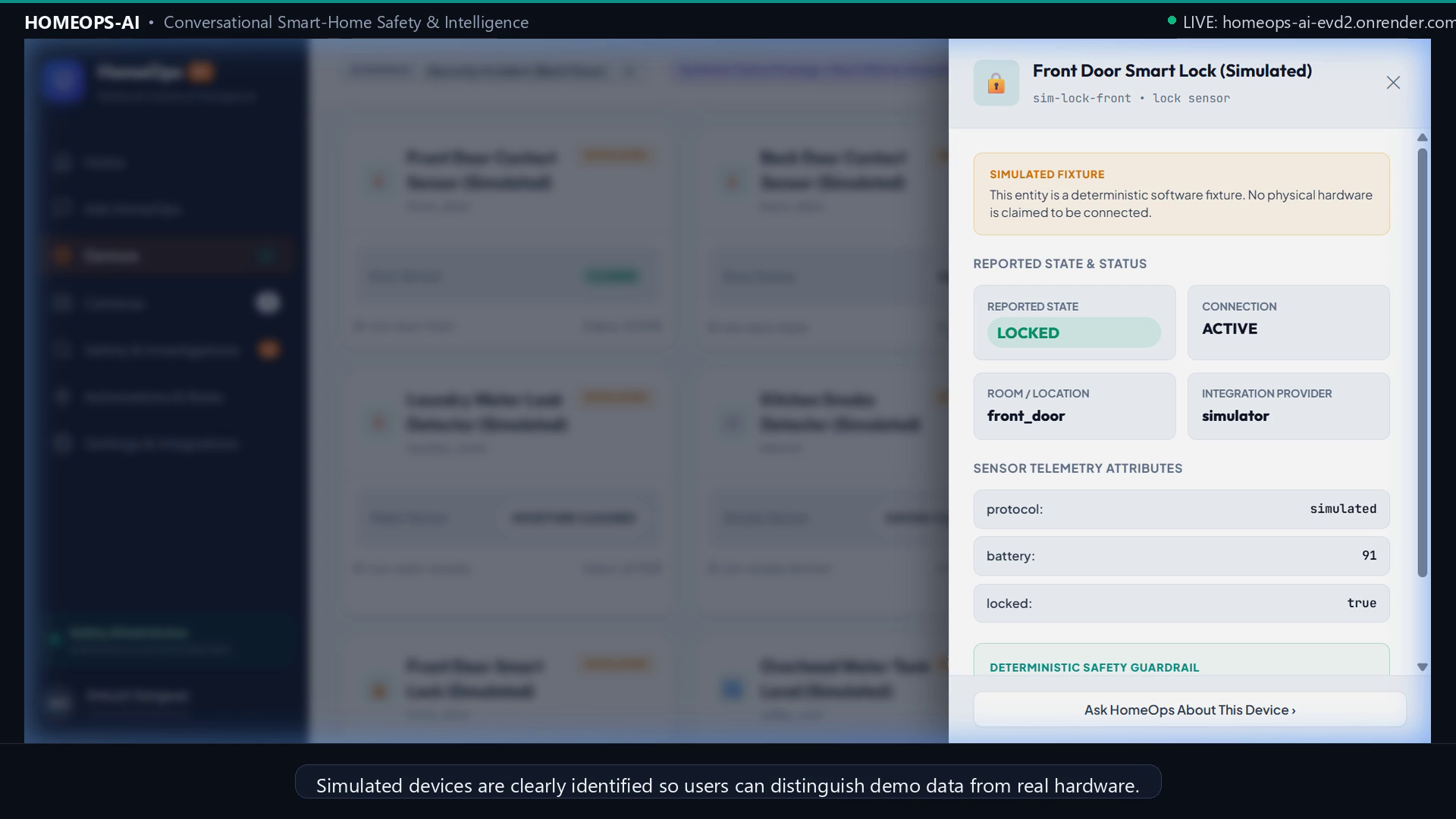
Device intelligence: Explore supported devices, their reported states, and available telemetry.
Safety investigations: Correlate relevant events and organize findings into understandable incident timelines.
Risk assessment: Evaluate potential threats and recommend practical next steps.
Camera workflow: Present available camera analysis and visual evidence where supported.
MCP integration: Expose home-state and investigation capabilities through Model Context Protocol tools.
Safety guardrails: Prevent unauthorized autonomous physical actions and keep safety-critical decisions under control.
Simulated fixtures are explicitly identified so users can distinguish demonstration data from real device integrations.
How we built it
We built HomeOps-AI with a Python and FastAPI backend and a responsive web interface using HTML, CSS, and JavaScript. The application follows a conversational workflow that connects user questions with structured home-state information, event investigation, risk assessment, and safety recommendations.
We integrated Model Context Protocol (MCP) to expose capabilities as tools that an AI agent can use to retrieve information and investigate incidents. Deterministic safety rules provide a separate control layer for sensitive actions, ensuring that the system does not autonomously perform potentially dangerous physical operations.
We also developed a multi-screen interface for home overview, conversational assistance, devices, cameras, safety investigations, automations, and integrations. The application is deployed on Render for demonstration.
Challenges we ran into
One of our biggest challenges was making the experience feel like a helpful assistant rather than another complicated smart-home dashboard. We had to organize technical information into clear, conversational explanations without hiding important evidence.
Another challenge was separating AI-driven interpretation from deterministic safety enforcement. A system can recommend an action, but that does not mean it should automatically execute it. We designed explicit guardrails to keep sensitive physical actions restricted.
We also had to distinguish simulated fixtures from actual integrations, handle incomplete or unavailable data responsibly, and make the interface communicate system status and investigation results clearly.
Accomplishments that we're proud of
We are proud to have built a working, deployed prototype that brings conversational interaction, structured incident investigation, risk assessment, and safety guardrails into one experience.
Our key accomplishments include:
A conversational interface for investigating smart-home events.
An MCP-based tool architecture for structured information retrieval and investigation.
A dedicated device explorer with detailed device views.
Safety investigation workflows that present findings in a human-readable format.
Deterministic guardrails that prevent unauthorized physical actions.
Clear labeling of simulated data to improve transparency.
Most importantly, we built the project around a simple principle: smart-home AI should help people understand risks and make safer decisions without removing human control.
What we learned
We learned that building a useful AI agent requires more than connecting an LLM to tools. The system also needs reliable data, clearly defined tool boundaries, understandable outputs, and deterministic safeguards for high-impact actions.
We also learned the importance of designing around real user questions instead of exposing every technical detail at once. Transparency about simulated data, unavailable integrations, and system limitations is essential when building applications related to safety and security.
What's next for Homeops-AI
Our next steps are to expand integrations with real smart-home platforms such as Home Assistant, improve event correlation across connected sensors, and strengthen camera analysis with validated visual evidence.
We also plan to improve the assistant's ability to explain why a risk was identified, provide more personalized recommendations, and support configurable household safety policies. Additional testing, evaluation of AI responses, and stronger integration-level reliability checks will help us move toward a more dependable real-world system.
Our long-term vision is to make HomeOps-AI a trustworthy conversational safety layer for smart homes—one that helps people understand what is happening, why it matters, and what they can safely do next.
Built With
- ai/llm-tool-integration
- css
- deterministic-safety-guardrails
- fastapi
- ffmpeg
- html
- javascript
- model-context-protocol-(mcp)
- python

Log in or sign up for Devpost to join the conversation.