-
-
Demo
Inspiration
Smart-home assistants are good at understanding requests, but household actions need clear safety boundaries. A delivery or visitor can arrive while someone is on a work call, caring for a family member, or away from the door. Automatically opening access is convenient, but it can also be unsafe.
HomeHandoff was created to make these situations easier to handle without giving an assistant uncontrolled access.
What HomeHandoff Does
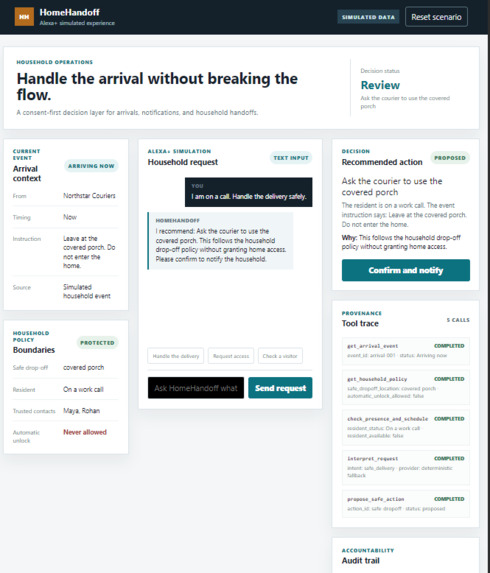
HomeHandoff is a simulated Alexa+ household experience that turns an arrival into a consent-based handoff.
A resident can ask:
“I am on a call. Handle the delivery safely.”
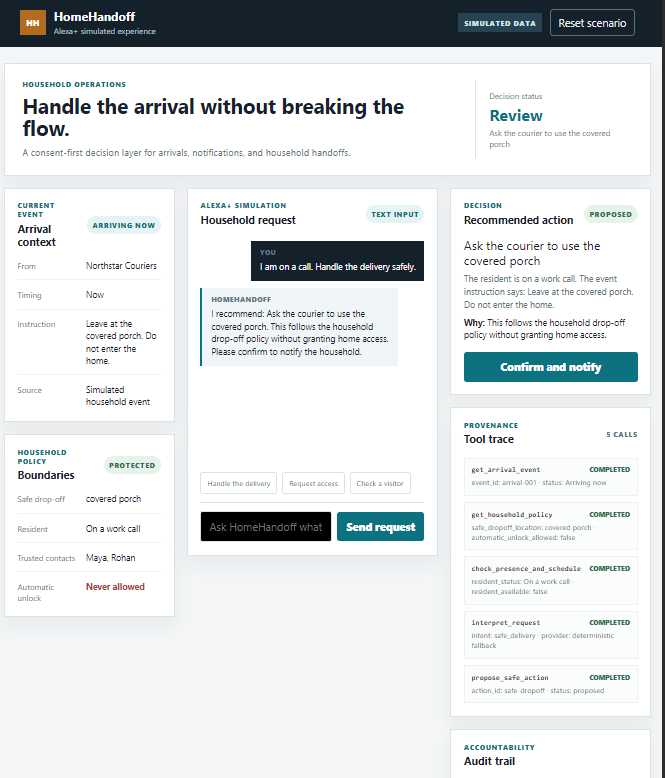
HomeHandoff checks the arrival event, household policy, resident availability, and trusted contacts. It then proposes a safe action, explains why it was selected, asks for confirmation, sends a simulated household notification, and records the decision in an audit trail.
High-risk requests such as unlocking the door are refused when the policy does not allow them.
How It Was Built
The application uses Python, FastAPI, Pydantic, HTML, CSS, and JavaScript. The backend separates language interpretation from policy enforcement and external actions.
The main tools are:
get_arrival_eventget_household_policycheck_presence_and_schedulepropose_safe_actionnotify_householdwrite_audit_record
The Alexa+ integration path includes a self-hosted MCP server using the official Python MCP SDK and Streamable HTTP. The web interface provides a reviewer-friendly simulated Alexa+ experience.
Household events and device state are clearly labelled as simulated. No real door is unlocked and no live device action is performed.
What I Learned
The most important design decision was keeping AI at the interpretation boundary. Typed tools and deterministic policy rules remain authoritative, so a model cannot invent household state or directly perform a high-risk action.
I also learned that a useful device experience needs more than a conversational response. It needs visible provenance, confirmation, refusal behavior, and an audit trail.
Challenges
The hackathon supports several Amazon device ecosystems, but live Ring, Fire TV, and Bee access was not available during development. I therefore chose the Alexa+ simulated-experience route allowed by the rules and built the MCP path so verified device or service adapters can be added later.
The demo uses deterministic simulated data so the complete workflow can be replayed reliably during judging. The project makes the boundary between simulated records, policy decisions, and future live integrations explicit.
Built With
- amaxonalexa+
- css3
- fastapi
- html5
- javascript
- jinja
- mcp
- modelcontextprotocol
- opensource
- pydantic
- python
- streaablehttp

Log in or sign up for Devpost to join the conversation.