Inspiration
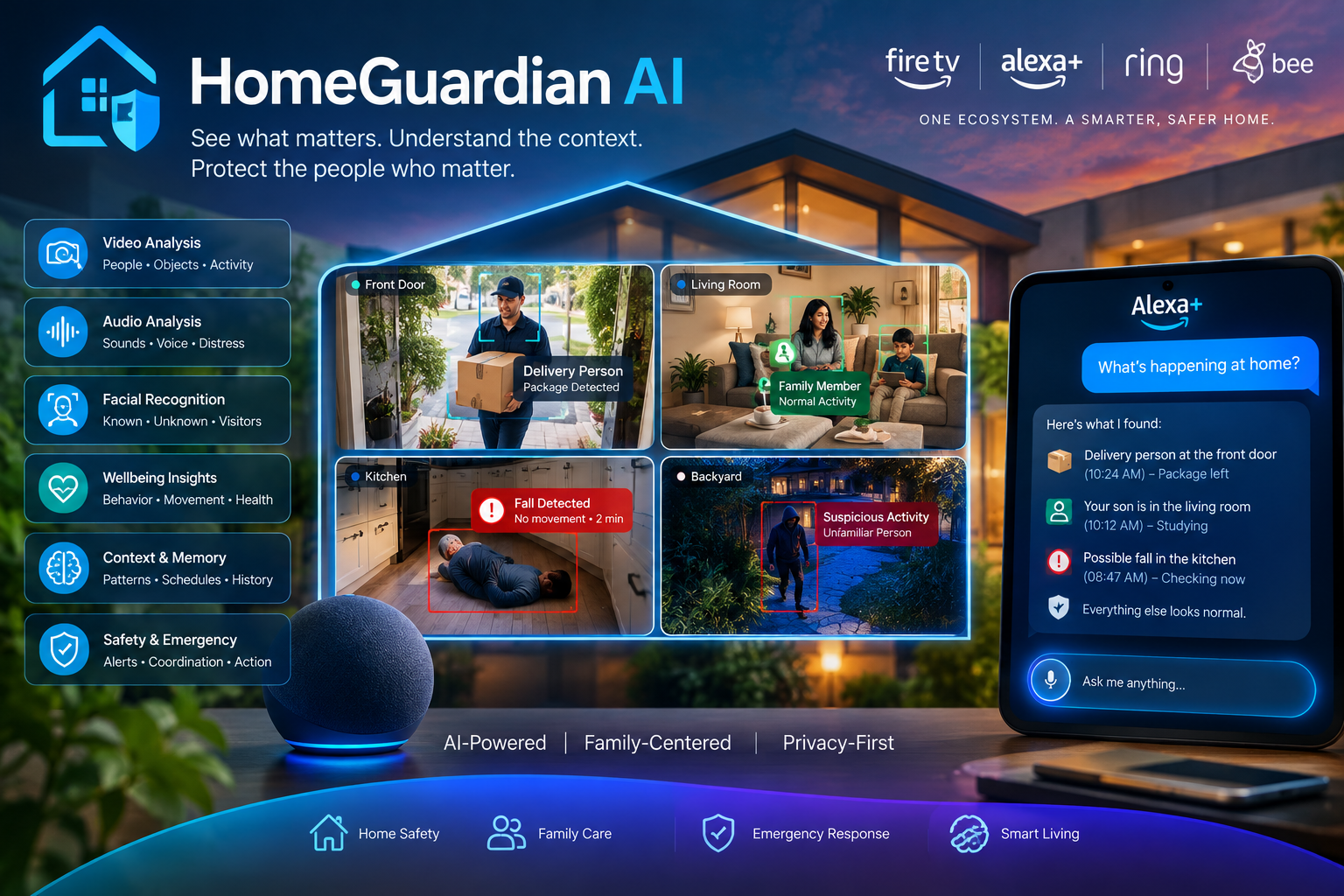
A smart home can detect a person, a motion event, a sound, or a door opening. But detecting an event is not the same as understanding what is happening.
A notification saying "motion detected" leaves the family to determine whether it was a family member coming home, a delivery, an unexpected visitor, or a potentially serious situation.
We wanted to build something different: an AI Home Brain that understands the context of household activity and helps families identify what actually matters.
HomeGuardian AI was inspired by a simple question:
What if a home could understand the difference between an ordinary event and an event that genuinely needs attention?
This led us to develop a privacy-first home intelligence platform that brings together multimodal sensing, contextual event processing, family safety, conversational interaction, and intelligent coordination.
Our vision extends beyond conventional home surveillance. We want to transform individual cameras, microphones, sensors, and smart devices into a coordinated intelligence system that can observe authorized activities, recognize meaningful patterns, explain potential concerns, and help families respond appropriately.
The goal is not to generate more notifications. It is to make household information more meaningful, understandable, and actionable.
What it does
HomeGuardian AI is a native C++-based home intelligence and family safety platform under active development.
Its architecture brings together authorized camera/video, audio, household events, historical context, and contextual reasoning to support a unified understanding of activities throughout the home.
The current implementation includes a functioning C++ event-processing foundation, consent enforcement, correlation rules, alert management, persistent event storage, and a conversational web interface connected to the backend. Physical camera/audio processing and additional integrations are being developed and validated progressively.
The platform is organized around five major capabilities.
1. Whole-Home Intelligence
HomeGuardian is designed to provide awareness beyond the front door.
Its multimodal architecture is being developed to support:
- People and household activity
- Authorized camera and video events
- Audio and environmental sounds
- Voice and spoken interactions
- Visitor and delivery events
- Unusual or unexpected household activity
- Falls and potential safety incidents
- Changes from normal household patterns
- Animal and environmental activity observations
Instead of treating every observation independently, HomeGuardian correlates signals using timestamps, event types, contextual information, and configurable rules.
The current C++ engine implements event processing, time-window correlation, and alert generation. Further work is integrating real-world sensing and machine-learning inference into this existing processing foundation.
The long-term objective is to move from isolated event detection toward meaningful whole-home understanding.
2. AI Front Door Intelligence
HomeGuardian's front-door intelligence capability is being designed to interpret visitor activity rather than simply report motion.
With appropriate sensing, enrollment, authorization, and consent, the system aims to distinguish between:
- Enrolled family members
- Authorized visitors
- Delivery-related activity
- Unknown visitors
- Repeated or unusual doorstep activity
Instead of reporting:
"Motion detected."
HomeGuardian aims to provide contextual notifications such as:
"A delivery person appears to have arrived and left a package at the front door."
Or:
"An unknown visitor has been detected at the front door, with repeated knocking observed."
These examples illustrate the intended contextual experience. Actual visitor classification and camera-based interpretation are being developed as part of the multimodal integration roadmap.
3. Family Wellbeing Insights
With explicit consent and appropriate privacy controls, HomeGuardian is designed to help identify observable changes in household activity and behavior that may warrant attention.
Relevant signals can include:
- Changes in movement and activity
- Unusual inactivity
- Observable movement difficulties
- Changes in voice and speech patterns
- Unusual interaction patterns
- Potential falls or visible distress
- Meaningful departures from established activity baselines
HomeGuardian does not claim to diagnose medical or mental-health conditions through cameras, microphones, facial expressions, or voice analysis.
Instead, the intended system identifies observable changes, considers uncertainty, and helps families decide when a human check-in may be appropriate.
For example:
"There appears to be an unusual change in activity compared with the normal pattern. You may want to check in."
The objective is to create a wellbeing and safety assistant that supports human judgment rather than replacing it with unsupported automated conclusions.
4. AI Family Concierge
HomeGuardian is being developed as a conversational interface to the household's contextual event history.
The Home Brain organizes household observations, relevant state, alerts, and historical activity so users can ask meaningful questions rather than manually reviewing individual sensor notifications.
Example questions include:
"What's happening at home?"
"What happened while I was away?"
"Was there anything unusual?"
"Who came to the door?"
"Is everyone okay?"
The current implementation provides a conversational web interface connected to the native C++ backend through a controlled integration bridge. It supports household status and alert-summary queries.
Broader event retrieval, richer conversational reasoning, and genuine Alexa+ integration are part of the ongoing development.
Our objective is for the assistant to explain household events using actual authorized observations, with clear distinctions between recorded evidence, inferred context, and recommendations.
5. AI Emergency Coordinator
HomeGuardian is being designed to combine multiple observations before escalating possible safety incidents.
For example, a future multimodal fall-detection workflow could involve:
- A camera observes a possible fall.
- Audio analysis detects an impact-like sound.
- Subsequent observations indicate limited movement.
- The Home Brain correlates the available signals.
- The system identifies a possible safety incident and communicates the supporting evidence.
- Configured notification or caregiver workflows can be initiated where supported and authorized.
Instead of reporting only:
"Motion detected."
The intended system can explain:
"A possible fall was observed, accompanied by an impact sound and limited movement afterward. This may require attention."
The current C++ engine already provides the underlying event-correlation, alert-generation, deduplication, and persistence capabilities. Real-world fall recognition, multimodal classification, and caregiver escalation are further implementation targets.
Throughout the design, HomeGuardian prioritizes explainable alerts, user authorization, and human confirmation for consequential decisions.
How we built it
HomeGuardian AI is being implemented as a modular, portable, native C++ home intelligence platform, with a local-first processing architecture and independent integration layers for cameras, audio devices, conversational assistants, and supported smart-home services.
Our engineering approach is to build a real, testable system in stages rather than create a disconnected presentation of future capabilities.
The architecture separates the native intelligence engine from operating-system dependencies, communication protocols, device integrations, and user interfaces.
This allows the same core processing logic to be developed for Ubuntu/Linux, compatible embedded Linux hardware, and Android environments using the Android NDK.
1. Native C++ Home Brain
The foundation of HomeGuardian is a C++20 event-processing engine built using CMake and a modular architecture.
The implemented core includes:
- Structured household event models
- Event schema validation
- Consent-aware event delivery
- Time-window event correlation
- Rule-based contextual event processing
- Alert generation and prioritization logic
- Alert deduplication and cooldown policies
- Persistent event and alert records
- Configurable data retention
- Recovery and lifecycle management
Instead of generating isolated notifications, the Home Brain processes structured observations and evaluates relationships between events.
The current implementation uses deterministic correlation rules. More advanced multimodal machine-learning inference and AI reasoning are being integrated into this foundation.
2. Multimodal Video and Audio Integration
HomeGuardian is being developed to accept authorized video and audio observations from compatible devices, including Android smartphones functioning as remote CCTV cameras.
The planned media architecture supports:
- Camera and microphone acquisition with user consent
- Video frame processing
- Audio-stream processing
- Timestamped observations
- Bidirectional audio communication
- Remote camera connectivity
- Event extraction for the Home Brain
- Device-specific processing and compatibility checks
The development environment includes Ubuntu/Linux, Docker, Android integration components, and native C++ processing interfaces.
Camera and audio processing are being integrated through platform-specific acquisition components while preserving the portability of the core application.
A central design goal is to process sensitive media locally whenever practical rather than continuously forwarding raw household video to cloud servers.
3. Privacy, Consent, and Security
Privacy controls are implemented within the core architecture rather than added only at the user-interface level.
The current system includes:
- Explicit consent enforcement
- Fail-closed event delivery boundaries
- Configurable capture enablement
- Credential-protected integration interfaces
- Local-only communication boundaries for development
- Secure credential storage
- Event and alert audit records
- Configurable retention policies
If monitoring is disabled or authorization is withdrawn, the processing boundary is designed to prevent further unauthorized delivery.
Our architecture also separates secure remote connectivity from media processing.
We are exploring an Oracle VPS-based VPN and authentication gateway for remote access, with direct encrypted media transport wherever networking conditions allow. Routine video processing and storage are intended to remain on authorized local devices or the HomeGuardian host.
This is an architectural target, not a claim that every remote-connectivity component is already deployed.
4. Event Memory and Persistent Context
HomeGuardian uses SQLite for local structured persistence.
The implemented persistence layer supports transactional records, schema migrations, configurable retention, and recovery.
This gives the Home Brain access to event history and supports contextual questions such as whether similar events have occurred recently.
The longer-term design extends this foundation toward household activity baselines, richer contextual memory, and personalized event interpretation, subject to user consent and data minimization.
5. Alexa+ Conversational Integration
HomeGuardian is being developed with Alexa+ as a target conversational integration platform.
The existing implementation includes a read-only Alexa-oriented contract, credential-protected bridge interfaces, and a functioning browser-based conversational experience connected to the C++ engine.
This integration allows the current interface to retrieve backend-generated status and alert summaries.
Our broader Alexa+ integration architecture is being designed around:
- Natural-language access to household context
- Structured HomeGuardian tool interfaces
- Model Context Protocol (MCP) integration
- Authenticated tool invocation
- Household activity summaries
- Explainable safety alerts
- Supported device-control workflows
A standards-compliant MCP server using Streamable HTTP is an identified development target. It is not presented as already deployed in the current public repository.
We are also investigating integration with qualified Alexa Built-in environments and supported Amazon devices. Direct native software deployment on consumer Echo hardware remains subject to Amazon's platform restrictions and authorization.
Our objective is to keep the C++ engine independent of the conversational interface so that Alexa integration can evolve without requiring changes to the underlying detection and correlation system.
6. Web Dashboard and Development Interface
HomeGuardian includes a browser-based interface for interacting with the application.
The interface communicates with the native C++ backend through a controlled local bridge and displays system status, event-processing results, alert summaries, and event history.
During development, reproducible test-generated household observations are used to validate the actual C++ processing pipeline, consent behavior, and persistent alert handling without requiring physical sensors for every test.
These tests execute real application logic; they are not a substitute for subsequent hardware and end-to-end integration testing.
The web interface provides an accessible way to inspect the application while additional camera, audio, and Alexa+ integrations continue.
7. Testing and Engineering Validation
HomeGuardian is being developed with automated C++ and integration testing.
The engineering workflow includes:
- Unit testing of core components
- Event-pipeline tests
- Consent-enforcement tests
- Alert deduplication tests
- Persistence and recovery tests
- Integration-boundary tests
- Reproducible development scenarios
- Build and regression validation
Development focuses on verifying actual processing behavior, failure handling, and data protection rather than relying solely on architectural claims.
The longer-term engineering roadmap includes hardware-based video/audio validation, authenticated remote-device testing, platform portability checks, and real Alexa integration testing.
8. Technology Stack
The current implementation and development environment includes:
- C++20 — native core processing and application logic
- CMake — build and project configuration
- SQLite — persistent event and alert storage
- nlohmann/json — structured JSON processing
- spdlog — application logging
- Catch2 — C++ automated testing
- Node.js — local web and integration bridge components
- HTML, CSS, and JavaScript — browser-based conversational interface
- Linux / Ubuntu — native execution environment
- Android NDK / JNI — Android integration and portability work
Additional technologies under development or evaluation include OpenCV, ONNX Runtime, WebRTC, MCP, authorized Alexa integrations, compatible Ring APIs, and secure remote connectivity.
Amazon services and cloud components will be incorporated where they provide a supported and demonstrable benefit.
The result is a real software foundation being progressively extended toward a complete multimodal home intelligence platform.
Challenges we ran into
The biggest challenge was determining how to make multimodal intelligence useful without turning it into another source of excessive notifications.
A smart home can generate enormous amounts of sensor information. The difficult part is determining which events are related, which events are ordinary, and which may require attention.
We therefore structured HomeGuardian around the processing model:
Observe → Understand → Correlate → Assess → Explain → Act
Implementing this approach required separating the responsibilities of observation collection, event validation, correlation, persistence, and alert generation.
Another major challenge was ensuring that privacy restrictions are enforced throughout the system.
A camera permission or user-interface switch alone is not sufficient. Event delivery and processing must also respect the current authorization state.
We addressed this by incorporating explicit consent enforcement and fail-closed behavior within the C++ processing architecture.
A further challenge is device diversity.
Different cameras, Android devices, audio backends, and operating systems expose different formats, capabilities, and permission requirements. A portable intelligence engine therefore needs well-defined acquisition interfaces and platform-specific adapters.
Responsible wellbeing analysis is also a significant engineering concern.
Visual and audio observations may support useful safety insights, but uncertain inferences should never be presented as reliable medical or psychological diagnoses.
For this reason, the system is designed to separate evidence, inference, severity, and recommended actions.
Finally, integrating a native C++ application with conversational platforms requires clear boundaries between the internal application engine and external APIs.
We are addressing this through modular integration contracts and independently testable communication interfaces.
Accomplishments that we're proud of
Our most important accomplishment is building a functioning native C++ foundation for HomeGuardian rather than leaving the project only at the architecture-design stage.
We have implemented and documented:
- A structured household event model
- Consent-controlled event delivery
- Time-window event correlation
- Alert deduplication and cooldown behavior
- SQLite-backed persistent event history
- Credential-protected integration boundaries
- A reproducible application development and testing workflow
- A browser-based conversational interface connected to the actual backend
We are particularly proud of the separation between observation, correlation, and action.
The target multimodal architecture brings together:
Vision + Video + Audio + Voice + Context + Memory + AI Reasoning + Conversational Interaction
These capabilities are being integrated progressively, with each processing component designed to contribute to a shared contextual event model.
For example, the intended multimodal system may eventually correlate:
Camera: Possible fall observed
Audio: Impact-like sound detected
Video: Limited movement afterward
Context: Activity differs from an established baseline
Assessment: Potential safety incident requiring attention
Rather than generating multiple unrelated notifications, the Home Brain is designed to combine supporting observations into one interpretable event.
Our current implementation establishes the event-correlation, alert-processing, and persistence foundation needed for such workflows. The full real-world multimodal inference scenario remains an ongoing implementation objective.
We are also proud that the system treats privacy and consent as engineering requirements from the beginning.
What we learned
We learned that building a useful AI home system is less about detecting everything and more about understanding context.
A collection of accurate sensors does not automatically create an intelligent home.
The value emerges when observations can be organized, correlated, interpreted, and explained in ways that help people make decisions.
We also learned that a portable core architecture is essential.
By separating C++ application logic from operating-system dependencies, device-specific media acquisition, and external assistant integrations, HomeGuardian can evolve without requiring the entire system to be rewritten for each hardware platform.
Another important lesson is that safety-related AI needs clear boundaries between:
Observation → Inference → Recommendation → Action
Each stage has different requirements for evidence, confidence, user permissions, and human oversight.
Responsible design becomes especially important when a system interacts with personal spaces, voices, faces, household routines, and wellbeing.
Working toward Alexa+ and MCP integration has also reinforced the value of structured tool interfaces.
A conversational assistant becomes more useful when it can obtain trustworthy application state, retrieve relevant events, and explain results from actual processing systems rather than relying on unsupported generated answers.
Finally, we learned that reliable implementation depends on reproducible testing, transparent progress reporting, and careful separation of completed functionality from capabilities still under development.
What's next for HomeGuardian AI
Our next objective is to expand the current native C++ implementation into a fully integrated, privacy-first home intelligence platform.
Our development roadmap includes:
- Complete authorized real-camera and microphone acquisition
- Integrate two-way audio with compatible mobile CCTV devices
- Expand local video and audio analysis
- Add validated object, animal, and household activity detection
- Develop richer multimodal event correlation
- Introduce personalized household activity baselines
- Improve potential fall and safety-event identification
- Implement authenticated MCP tool interfaces
- Expand genuine Alexa+ conversational integration
- Investigate qualified Alexa Built-in hardware support
- Integrate supported Ring and smart-home device interfaces
- Improve secure remote access using VPN-based connectivity
- Extend Linux, Android, and ARM64 portability
- Add caregiver and elderly-care assistance workflows
- Strengthen consent controls and family-level permissions
- Produce explainable event reports with supporting evidence
- Evaluate environmental and animal-behavior anomalies without making unsupported disaster-prediction claims
Our long-term goal is to build an AI Home Brain capable of coordinating authorized sensing, local intelligence, household context, and conversational interaction in one dependable system.
We believe the next generation of smart homes should do more than connect devices or deliver individual alerts.
They should help people understand their surroundings, recognize meaningful changes, and make informed decisions while remaining in control of their privacy.
A home should not just tell you that something happened. It should help you understand what happened, why it matters, and what you can do next.
HomeGuardian AI — See what matters. Understand the context. Protect the people who matter.
Built With
- alexa+
- amazon
- amazon-web-services
- api
- c++
- mcp
- postgresql
- react
- rest
- ring
- websockets

Log in or sign up for Devpost to join the conversation.