-
-
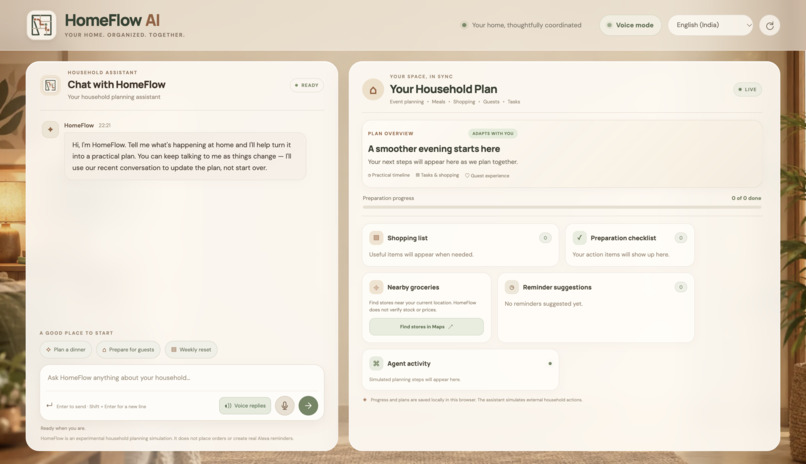
DashBoard
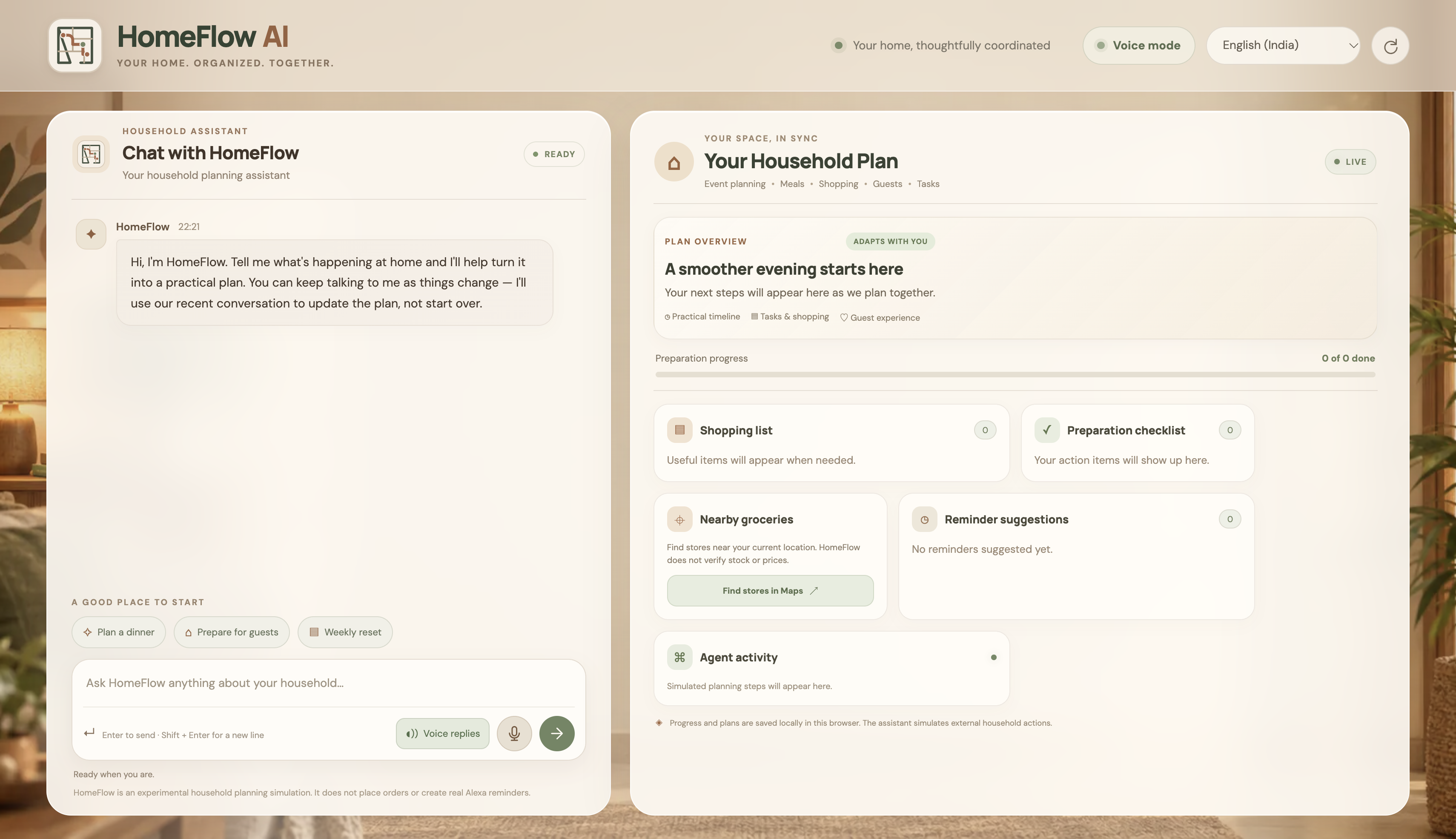
Inspiration
HomeFlow AI was inspired by a simple everyday problem: preparing a home for guests involves much more than making a checklist. Planning meals, managing groceries, coordinating preparation time, keeping track of the budget, and making guests feel welcome can quickly become overwhelming.
I wanted to build a household AI agent that could help bring these activities together through natural conversation. Instead of giving users a one-time list, I wanted HomeFlow to let them continue the conversation, introduce new requirements, and update their plans as their circumstances change.
What I Built
HomeFlow AI is a conversational household planning agent developed for the Alexa+ simulated-experience track of the Amazon Developer Hackathon 2026.
Users can type or speak household requests, such as planning a dinner for guests. HomeFlow generates a structured plan that can include menu suggestions, a preparation timeline, grocery requirements, approximate budget guidance, household tasks, reminder suggestions, and ideas to improve the guest experience.
The key idea is that planning continues after the first response. For example, a user can tell HomeFlow that two guests are vegan, that certain ingredients are already available at home, or that the budget has changed. The application sends the recent conversation and existing plan with follow-up requests so the AI can revise the plan instead of treating each message as an unrelated question.
The dashboard brings the conversation and household plan together. Users can update checklist progress, explore nearby grocery stores through Google Maps search, and view relevant recipe photos when suitable matches are available.
How I Built It
I built HomeFlow using Python and Flask for the backend, Groq's API for AI-powered plan generation, and HTML, CSS, and JavaScript for the interactive dashboard. Browser speech capabilities provide voice input and spoken responses where supported, while TheMealDB is used for best-effort recipe image lookups.
I also added request validation, structured plan normalization, local checklist actions, preservation of existing progress, and automated tests for important application behavior.
Throughout development, I focused on turning AI-generated suggestions into something a user can actually work with: an evolving household plan with visible tasks, shopping needs, preparation steps, and progress.
Challenges I Faced
One of the biggest challenges was API reliability. During early development, Gemini repeatedly returned service-unavailable errors, which made longer planning requests unreliable. I evaluated alternatives and moved the final implementation to Groq, while adding bounded request handling and clearer error behavior.
Voice interaction was another challenge. Browser speech recognition can interrupt or truncate longer commands when a speaker pauses naturally, and behavior varies across browsers. I worked on improving voice capture while keeping typed input available as a fallback.
I also encountered environment configuration issues, frontend chat regressions during UI updates, and cases where generic food imagery did not match the requested dish. These problems taught me to validate API configuration explicitly, test frontend and backend behavior separately, preserve working functionality during changes, and match visual results to the user's actual request.
What I Learned
This project taught me that building a useful AI agent involves much more than connecting a language model to a user interface. Context management, structured responses, error handling, state preservation, clear feedback, and realistic testing are all important to making an agent dependable.
I also learned to prioritize a complete user journey over adding features for their own sake. A well-designed interface matters, but the strongest experience comes when the assistant understands a changing situation and helps the user make practical progress.
What's Next
HomeFlow AI is a working prototype that demonstrates a conversational, agentic household planning experience. It is submitted through the Alexa+ simulated-experience path and does not claim to be a live Alexa Skill or MCP server.
My goal is to continue developing HomeFlow toward a more capable household assistant that can better coordinate everyday routines, adapt to changing household needs, and help people spend less time organizing their homes and more time enjoying them.

Log in or sign up for Devpost to join the conversation.