-
-
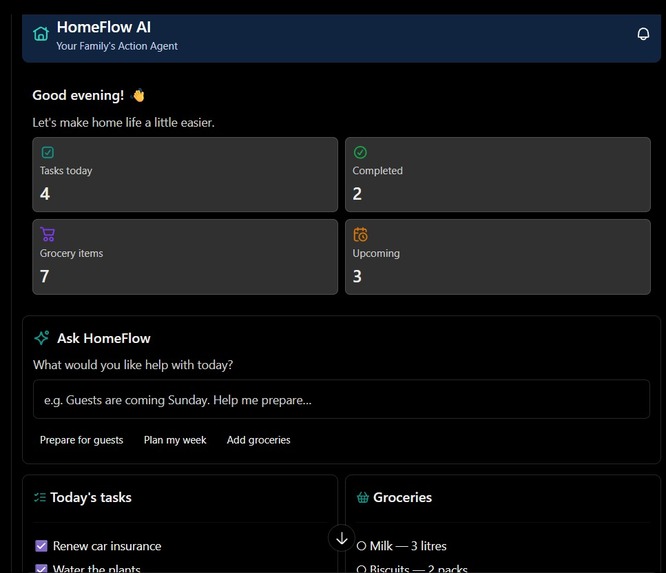
It is front view.
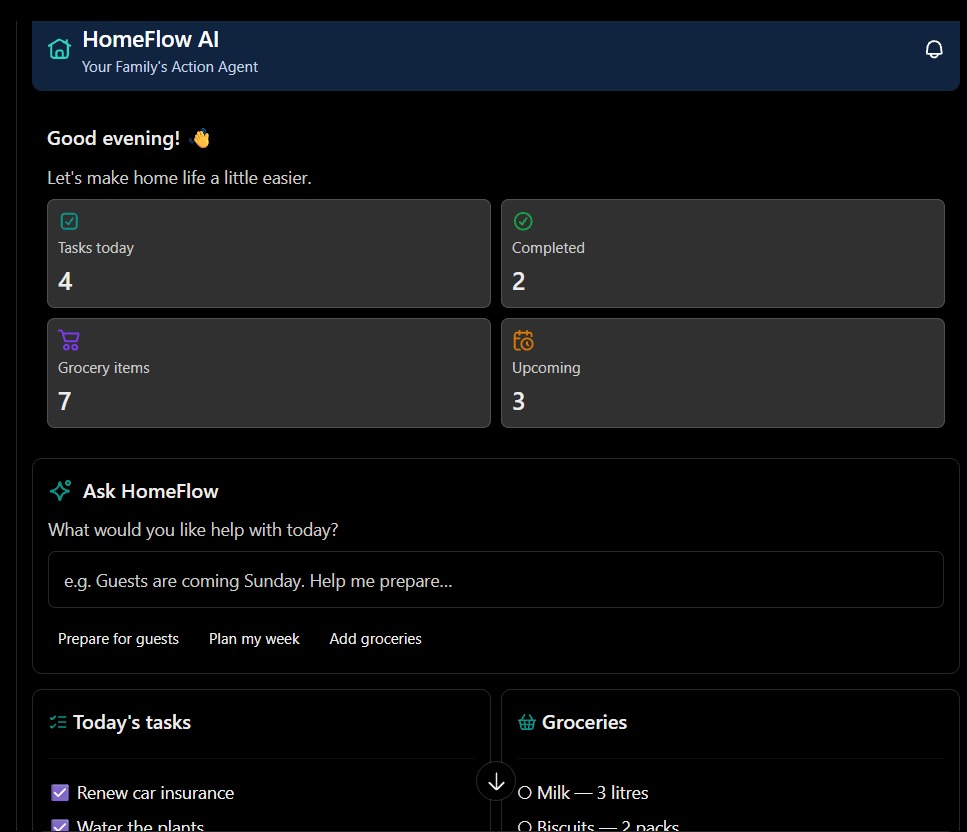
Inspiration
Managing a household involves coordinating everyday tasks, groceries, and shopping plans. These activities are often scattered across different tools, making it difficult to stay organized and keep track of what needs to be done.
We built HomeFlow AI to explore how conversational AI and tool integration can make household management simpler, more organized, and more reliable.
What It Does
HomeFlow AI is an AI-powered household management assistant that transforms natural-language requests into structured household plans and actionable tasks.
Instead of manually organizing every detail, users can describe what they need, review AI-generated suggestions, and approve proposed actions before execution.
Key features include:
- Conversational AI Assistant: Uses Google Gemini to understand household requests and generate relevant plans.
- Household Dashboard: Provides a centralized workspace for organizing household responsibilities.
- Task Management: Helps users track everyday tasks and preparation activities.
- Shared Grocery List: Keeps grocery items organized in one place.
- Shopping Workspace: Helps organize shopping-related activities and preparation.
- Human-in-the-Loop Approval: Allows users to review proposed actions before approving them.
- MCP Tool Integration: Connects the AI workflow with household tools through the Model Context Protocol (MCP).
How We Built It
We developed HomeFlow AI using React and Vite for the frontend, with Node.js and Express.js powering the backend. Google Gemini handles AI-powered planning, while MCP enables the assistant to interact with connected household tools.
Prisma and MySQL support database operations and persistent household data. The application is deployed on AWS EC2 running Ubuntu, with Caddy handling HTTPS and access protection, and systemd managing the application service.
Our workflow separates AI-generated recommendations from action execution. The assistant prepares a plan, presents proposed actions for review, and requires approval before carrying out supported changes.
Challenges We Faced
One of our biggest challenges was making AI-generated plans useful without giving the AI unrestricted control over household actions.
We designed an approval-based workflow to keep users involved in decisions and help prevent unintended actions. Integrating the AI model, backend services, database, and MCP tools into a consistent workflow was another key engineering challenge.
Deploying the application on a cloud server and configuring secure HTTPS access also required attention to reliability and deployment security.
What We Learned
Building HomeFlow AI taught us how to move beyond a basic chatbot and develop an AI application that combines natural-language understanding, structured planning, tool integration, and user-approved execution.
We learned that a useful AI assistant needs more than intelligent responses. It also needs reliable integrations, clear action boundaries, validation, and meaningful user control.
What's Next
Our next steps include adding individual user authentication, supporting multiple households, expanding supported integrations, improving recurring task planning, and exploring verified smart-home capabilities.
Our goal is to make household management more intuitive by allowing people to focus on their needs while AI helps organize the steps required to achieve them.
Built With
- amazon-web-services
- api
- caddy
- context
- css3
- ec2
- express.js
- gemini
- javascript
- model
- mysql
- node.js
- prisma
- protocol
- react
- rest
- tailwind
- typescript
- ubuntu
- vite

Log in or sign up for Devpost to join the conversation.