-
-
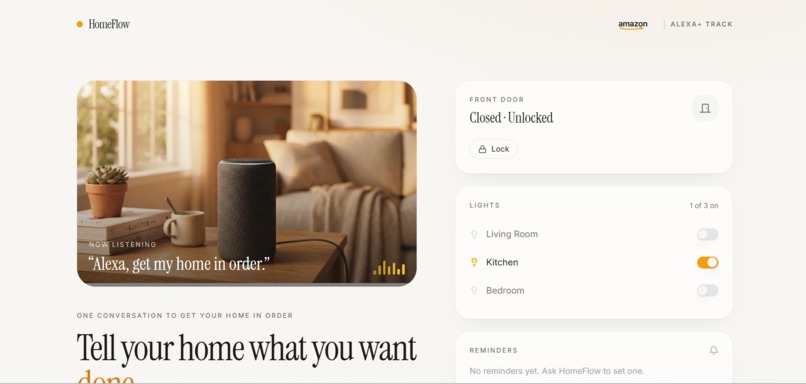
Dashboard
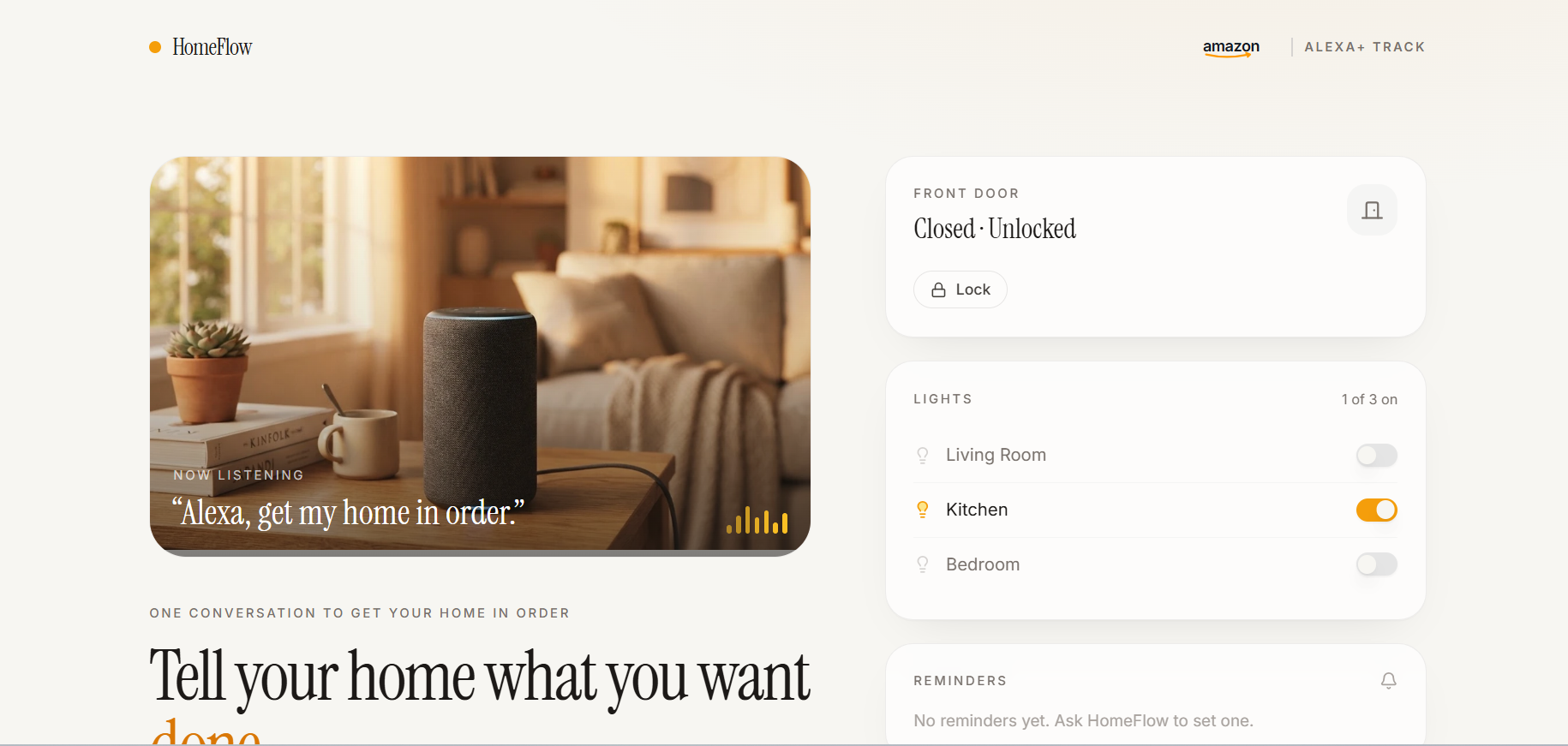
Inspiration
Managing a connected home often means thinking about individual devices instead of the outcome we actually want. We wanted to explore a more natural approach: instead of telling a smart home exactly which buttons to press, simply tell it what you want accomplished. That led us to HomeFlow, a conversational home assistant designed around goals rather than commands. A request such as “Check the front door, turn on the living-room light, and remind me to lock the door tonight” should feel like one conversation, not three separate smart-home tasks. Our inspiration was the idea that an assistant should understand the intent behind a request, create a plan, coordinate different tools, and return a simple result.
What it does
HomeFlow is an Alexa+ simulation that turns natural-language household requests into actionable plans. A user can ask HomeFlow to:
- Check the simulated front-door status
- Control simulated home lights
- Create reminders
- Add household tasks
- Combine multiple actions into a single request
- Show the assistant's plan and activity history
How we built it
HomeFlow was built as a lightweight web application focused on demonstrating an agentic Alexa+ experience.
The application has four main layers:
Conversational interface A simple web interface accepts natural-language requests and displays the assistant's response.
Intent and planning layer The assistant analyzes the request and breaks it into individual steps. This allows one user request to trigger multiple actions.
Simulated home tools We created tools representing common smart-home capabilities such as checking the door, controlling lights, creating reminders, and creating tasks.
Home state and activity layer The application maintains a simulated home state and activity history so users can see the results of each action.
We designed the architecture so the simulated tools can eventually be replaced or extended with real services and APIs.
Challenges we ran into
One of our biggest challenges was designing an interaction that felt conversational without making the user learn a rigid set of commands. We also had to think about how an assistant should handle requests containing multiple goals. Instead of treating every sentence as one action, HomeFlow needed to identify the individual tasks, determine their order, and execute the appropriate tools. Another challenge was keeping the experience understandable. Agentic systems can perform many operations behind the scenes, so we chose to expose the plan and activity history. This makes the assistant's behavior easier for users to understand. Finally, we wanted the prototype to remain simple enough to demonstrate reliably while still representing a realistic path toward a more capable home assistant.
Accomplishments that we're proud of
We're proud that HomeFlow turns multiple household actions into a single conversational interaction. We're especially happy with:
- Goal-oriented rather than device-oriented interaction 2.Multi-step request planning
- A visual representation of home state
- Simulated tool execution
- Activity history for transparency
- A responsive interface designed around the assistant experience
- An architecture that can be extended beyond the initial prototype
What we learned
We learned that building an agentic experience isn't only about making an AI understand language. The surrounding product experience matters just as much. Users need to understand what the assistant is doing, what changed, and whether the requested outcome was actually completed. We also learned that multi-step automation creates opportunities for assistants to become much more useful. A single request can coordinate several tools without forcing the user to understand the underlying implementation. Finally, designing around a clear user outcome helped us make better decisions about both the interface and the architecture.
What's next for HomeFlow
Our long-term vision is simple: HomeFlow should let people describe what they want their home to accomplish, rather than making them learn how to operate every device individually.
Built With
- css
- github
- html
- javascript
- mitlicense

Log in or sign up for Devpost to join the conversation.