Inspiration
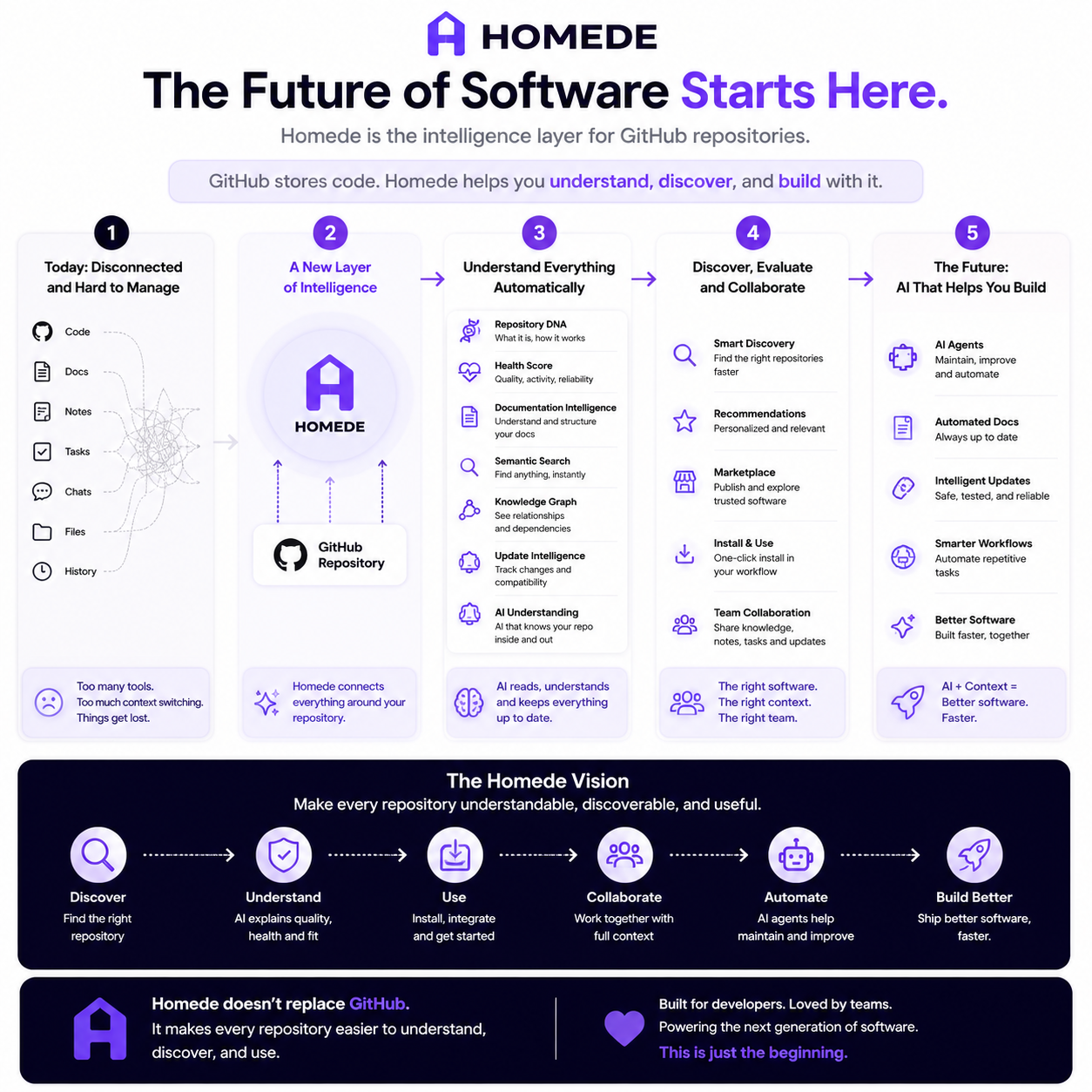
I have always saved my projects on GitHub. Over time, GitHub became my personal library of ideas, experiments and completed work. The problem was not saving projects—it was finding and understanding them later.
When I returned to an older repository, I often had to read the README, search through folders and inspect the code before I could remember what the project did. Discovering other people’s work was just as difficult. Search engines and AI assistants could recommend repositories, but they usually gave me a collection of links. After opening those links, I still had to decode each repository myself.
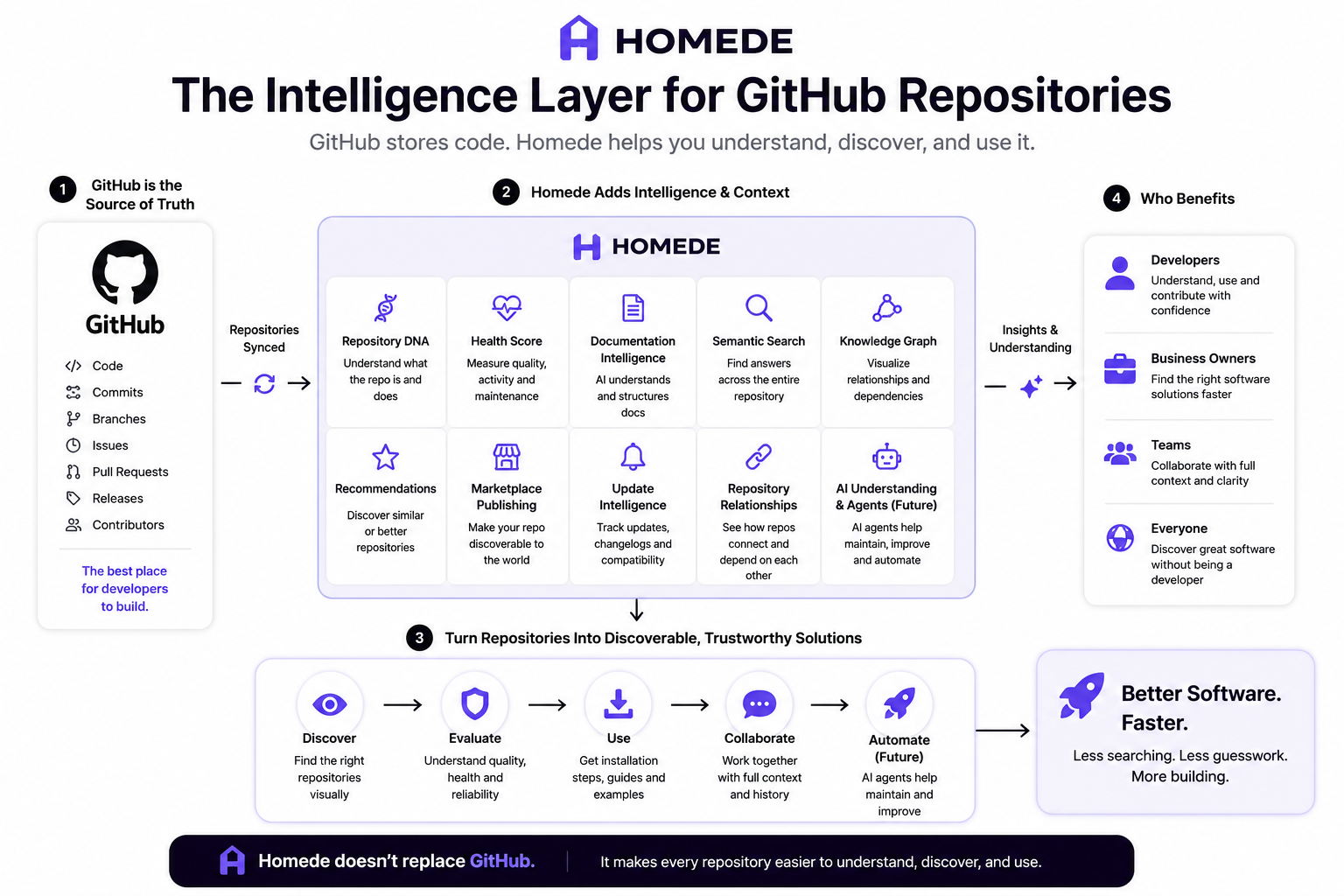
I wanted a simpler way to see what a project was, what technology it used, how active it was, what documentation it contained and whether it was relevant to me.
That became the original idea for Homede: a layer on top of GitHub that makes repositories easier to discover, understand and use, and help solo developers to monotise there projects, there are 1000, of repositories there that no one has seen, but if they were put on homede made available these would then have traction.
As AI-assisted development becomes more common, the idea grew. Independent developers, home developers and “vibe coders” are creating more software than ever, but their projects can be difficult for other people to find and understand.
Homede does not replace GitHub. GitHub remains the source of truth for code, while Homede adds the understanding, organisation and intelligent tools around it.
What it does
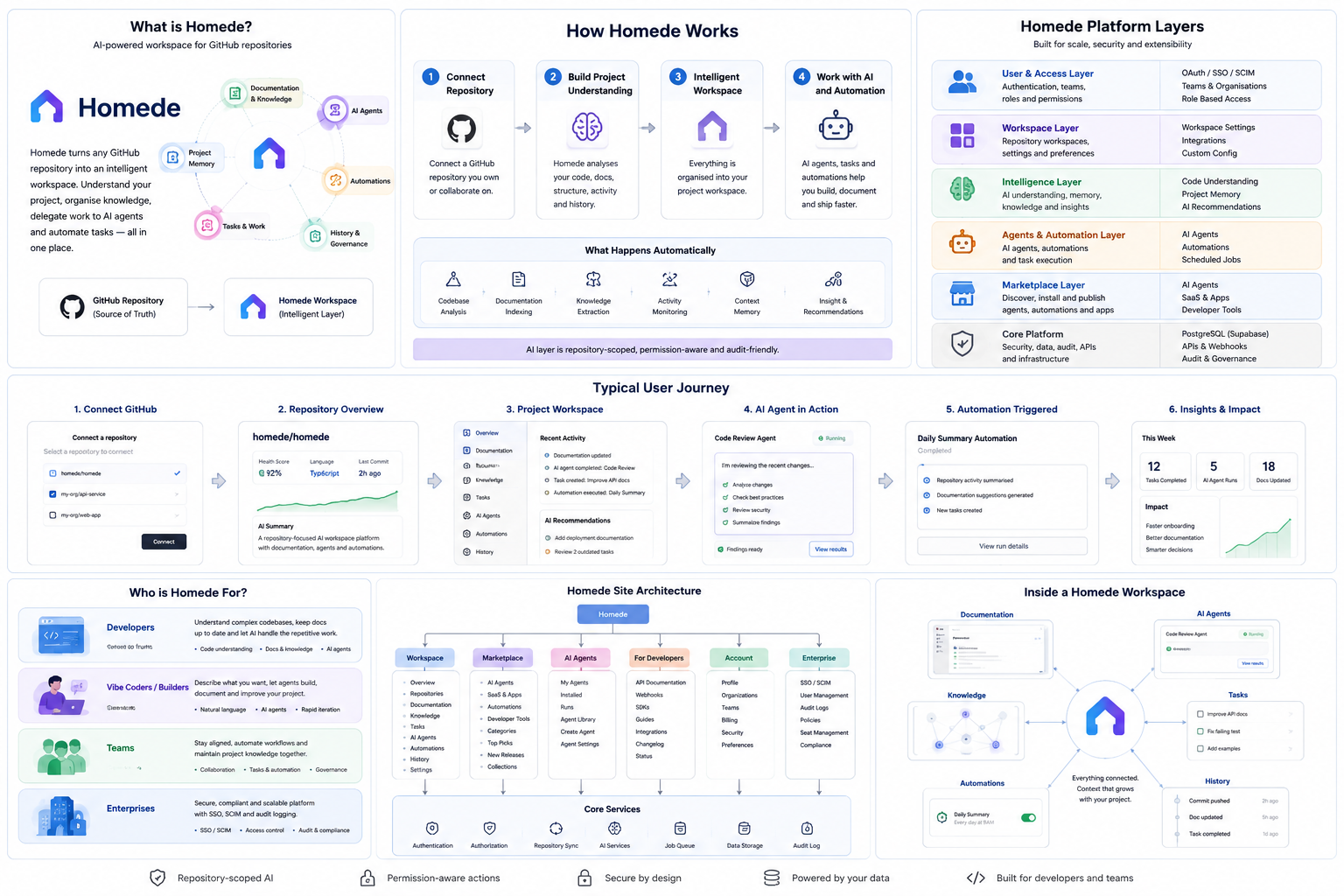
Homede turns GitHub repositories into intelligent project workspaces. Allows developers, solo vibe coders the ability to show there product in a way git hub can not. They can monitise there projects in a way git hub can not.
After connecting a repository, users can bring its documentation, knowledge, tasks, files, history, AI assistance and automation together in one place. Instead of repeatedly searching through folders and disconnected tools, users get a clearer view of the project and its context.
Homede includes:
- Repository-focused workspaces
- Project and repository discovery
- Documentation and knowledge management
- Repository memory
- Contextual AI assistance
- Specialised AI agents
- Multi-agent workflows
- Tasks and project organisation
- Event-driven automation
- Marketplace publishing and discovery
- GitHub integration
- Enterprise identity and licensing
- Access reviews and governance
- Audit history and evidence generation
The marketplace extends the workspace by helping users discover AI agents, automations, developer tools, SaaS products and other software.
The goal is simple: help people find, understand, build and share software without losing project knowledge across different applications.
How we built it
Homede was not built in one weekend. It was a project over many months, whenever i had a chance to code and get free tokens. Chat GPT was by assistant and advisor in all this, as i pay that which was money well spent, i used codex and cursor. With cursor it used mainly codex and claude some grok and its own composer. This mainly was due to me not able to afford the codex tokens as the window for coding for homede was always small. Cursor in this regard which I pay for made a big difference in completing alot of homede.
The frontend was built with React, TypeScript and Vite. The backend uses TypeScript and Node.js, with PostgreSQL and Supabase providing database and platform services.
Homede integrates with GitHub and uses REST APIs, background services and an event-driven automation system. Its production infrastructure includes Docker, PM2 and Nginx.
I originally approached Homede as a better way to organise and discover GitHub repositories, and allow solo developers to market there products. As I continued building and using it, I realised that the deeper problem was project understanding as git hub is too complicated. Vibe coders are not developers and homde de was the easier approach. This changed the product from a marketplace or directory into a repository-centred workspace.
The platform was developed incrementally. I added repository workspaces, documentation, knowledge, memory, AI agents, multi-agent coordination, automation, marketplace features and enterprise controls while preserving clear responsibilities between each part of the system.
GitHub remains responsible for repositories and source code. Homede manages the additional project intelligence, workspace information, automation state and collaboration features.
OpenAI GPT-5.6 and Codex served as engineering partners during development, in Cursor assistant by other AI including parts of claude, simply becuase i did as much free tokens and through cursor as much as i could cheaper for me as could not afford Codex API. They assisted with:
- Architecture discussions
- Frontend and backend implementation
- Debugging and refactoring
- Database migrations
- Automated tests
- Documentation
- Security reviews
- Production certification
AI accelerated the work, but I remained responsible for the product vision, priorities, architecture, testing, deployment and final approval of every change.
Challenges we ran into
One of the hardest challenges was understanding what Homede should become. It started with Marketplace then a AI workspace, and then allowing solo developers to monitise there products.
Some early ideas appeared useful but did not solve the real problem. I sometimes spent days developing something before realising that it added complexity without making projects easier to understand. Learning to remove or redesign those ideas was an important part of the process.
Another challenge was keeping the architecture consistent as Homede grew. Authentication, repository access, licensing, governance, automation and AI could easily have created competing sources of truth. I repeatedly reviewed and refactored the design so that every service retained a clear responsibility.
Automation also presented difficult production issues. Homede uses a durable event-outbox and dispatcher architecture. During deployment, the dispatcher repeatedly failed because the production database was missing required migrations. The error was originally displayed as:
[object Object]
This hid the real cause. I improved safe error reporting, checked the live schema, applied the pending migrations and confirmed that the automation outbox and claim function were available.
The production database also contained an older organisation schema. A later migration expected newer columns, so I created a compatibility fix instead of replacing or damaging existing data.
Public presentation was another challenge. The original homepage made Homede look mainly like a marketplace. I redesigned it to communicate the actual product journey:
GitHub repository
→ Project understanding
→ Intelligent workspace
→ Contextual AI and automation
→ Marketplace extensions
Moving from development to a public deployment also required careful migration controls, production builds, health checks, smoke tests, rollback planning and live-service verification.
Accomplishments that we're proud of
I am proud that Homede has grown from a personal problem into a working, publicly deployed platform.
Important accomplishments include:
Turning GitHub repositories into intelligent workspaces
Building AI assistance around repository context
Creating specialised and coordinated AI-agent workflows
Connecting documentation, knowledge, memory, tasks and automation
Building a marketplace that extends the workspace
Creating a durable event-driven automation platform
Adding enterprise identity, licensing and governance
Preserving one authoritative repository-access model
Building access reviews, decisions, exceptions and evidence packs
Supporting retention controls and legal holds
Creating a Governance Admin interface
Developing automated certification and live verification
Deploying the frontend, backend and database successfully
Completing the Phase 8.5 migration ledger at 86 migrations
Passing all 26 Phase 8.5 A–Z certification checks
Publishing a tagged Phase 8.5 release
Redesigning the homepage around the true purpose of Homede
The greatest accomplishment is not one individual feature. It is that the different parts work together as one platform while GitHub remains the source of truth for the code.
What we learned
The most important lesson was that finding a repository is not the same as understanding it.
A collection of links may help someone discover projects, but it does not explain which project is suitable, how it works or where to begin. Repository discovery needs context and understanding.
I also learned that AI becomes much more valuable when it has relevant project context. Generic AI can answer a prompt, but repository-aware AI can provide answers connected to the project’s documentation, structure, history and objectives.
Another lesson was that architecture becomes increasingly important as a product grows. Adding a feature quickly can create much more work later if it duplicates permissions, identity, billing or project state.
Production deployment taught me that passing local tests is not enough. The live database, migrations, permissions, background services, environment configuration and historical data must also be verified.
Working with GPT-5.6 and Codex showed me how AI can act as a genuine engineering partner. It can help explore ideas, implement changes and find problems, but human judgement is still needed to define objectives, verify claims, assess risks and decide what belongs in the product.
Most importantly, I learned that building a product is a continuous process of research, implementation, testing, failure, correction and improvement.
What's next for Homede
The next step is to put Homede in front of more real users and learn from how they use it.
I want to improve the first-time experience so that users can connect a repository and quickly understand what Homede has discovered about it.
Future work includes:
Improving repository discovery and comparison
Deepening repository intelligence
Expanding contextual AI capabilities
Refining multi-agent collaboration
Improving documentation and knowledge workflows
Creating more automation templates
Expanding marketplace publishing and discovery
Improving onboarding for independent and AI-assisted developers
Adding organisation hierarchy and delegated administration
Developing analytics and executive reporting
Strengthening backup and disaster recovery
Continuing security, scalability and performance testing
Gathering feedback from developers, teams and enterprise users
Homede will continue to complement GitHub rather than replace it.
The long-term goal is to make Homede the place where people naturally go to discover a project, understand it, work on it and share it with others.
One intelligent home for every project.
Built With
- agents
- ai
- api
- automation
- codex
- docker
- github
- gpt-5.6
- html5
- javascript
- multi-agent
- nginx
- node.js
- oauth
- oidc
- openai
- pm2
- postgresql
- react
- rest
- saml
- supabase
- systems
- typescript
- vite


Log in or sign up for Devpost to join the conversation.