Inspiration
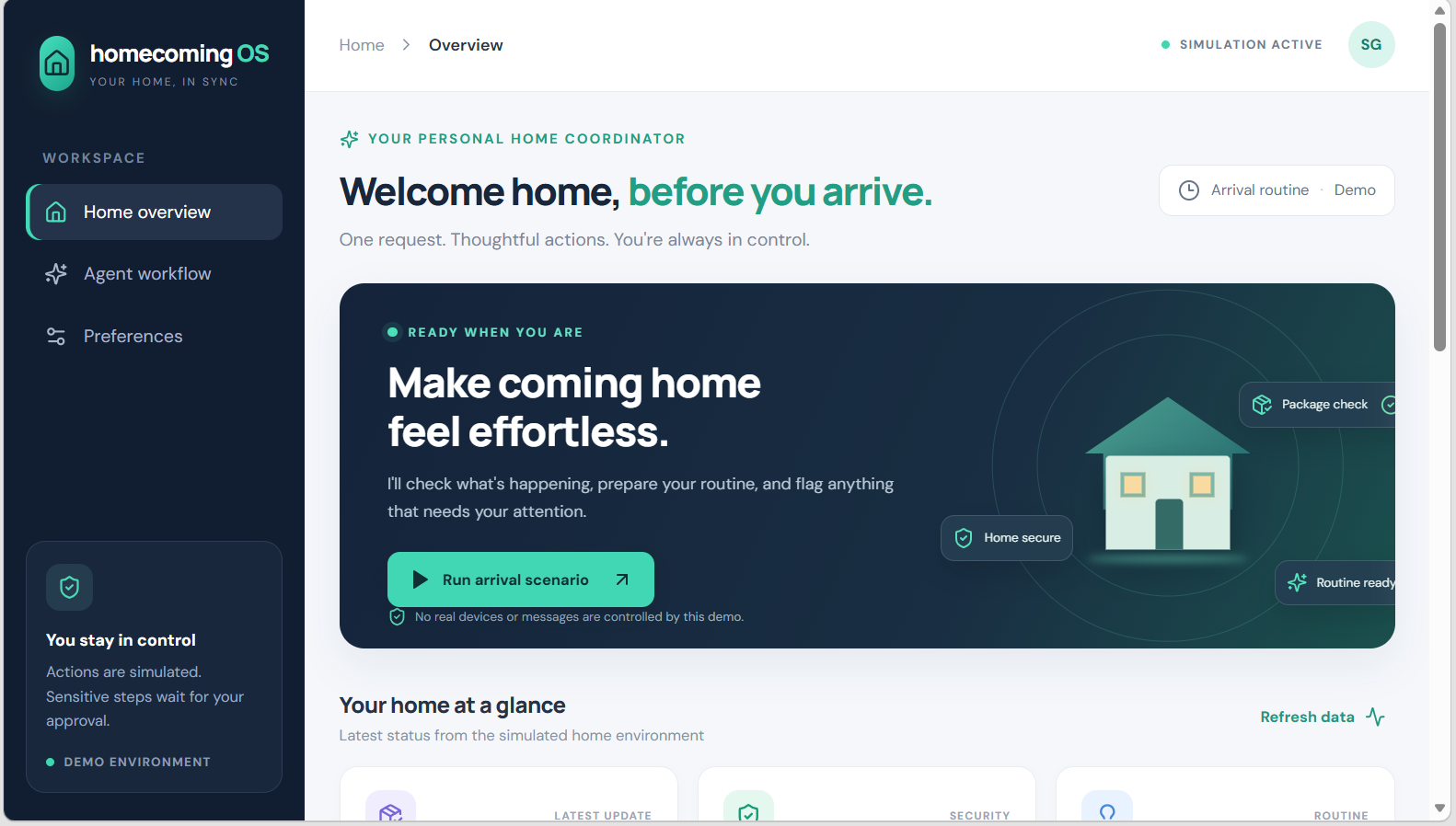
Coming home should feel effortless, but coordinating deliveries, preparing the home, remembering personal preferences, and keeping household members informed can involve multiple disconnected tasks. We envisioned Homecoming OS, an AI-powered homecoming assistant that turns a natural-language request into an organized, preference-aware action plan while keeping the user in control.
What it does
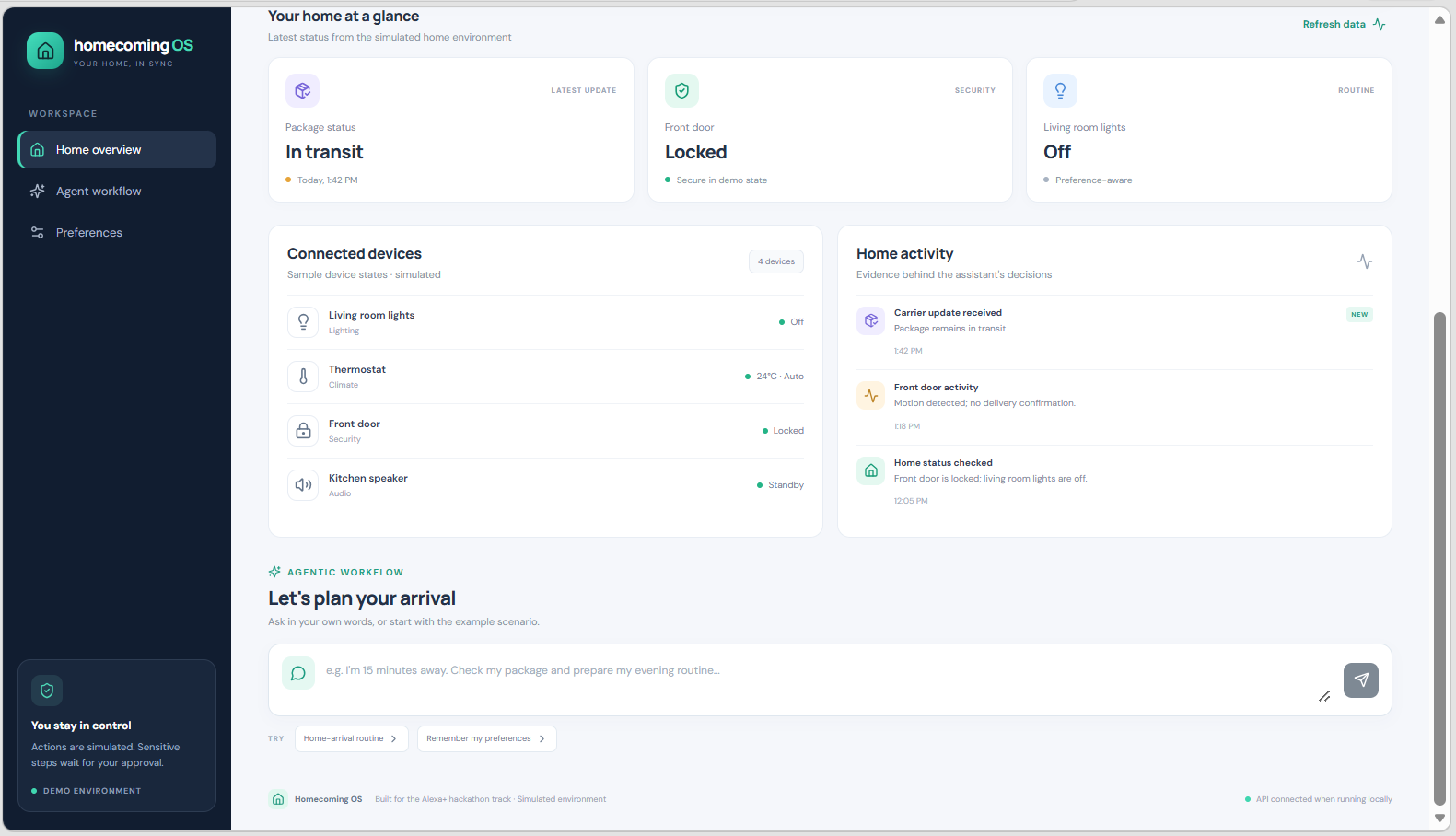
Homecoming OS demonstrates an agentic workflow for managing home-arrival scenarios. A user can request an arrival routine in their own words or try a sample scenario. The system checks simulated home and delivery records, summarizes the available evidence, and creates an ordered plan.
The current prototype can:
- Check simulated package and doorbell status before reporting a delivery.
- Prepare an evening routine while respecting a user's lighting preferences.
- Draft a roommate update without sending it automatically.
- Present pending actions for user approval or rejection.
- Carry preferences forward in the workflow, such as asking before messaging and keeping lights off before 7 PM.
How we built it
We built Homecoming OS as a web-based prototype with a React frontend and a JavaScript/Node.js backend. The interface presents the agent's reasoning workflow, evidence checks, ordered actions, approval controls, and remembered preferences. The backend supplies simulated home and delivery data to demonstrate how an assistant could coordinate tasks.
The project is designed around an important principle: an AI assistant should not just plan actions; it should respect user preferences and seek approval before sensitive actions.
Challenges we faced
One of the main challenges was demonstrating useful automation without pretending that simulated data represented real-world device or delivery access. We addressed this by making the evidence checks and simulated environment visible in the interface.
Another challenge was organizing several dependent tasks into a clear workflow while distinguishing completed steps from actions that still require approval. We focused on making the sequence, evidence, and approval state understandable to the user.
What we learned
Building Homecoming OS helped us explore how agentic workflows can combine context, evidence, planning, and human approval. We learned that trustworthy automation requires more than generating a response: it needs clear action states, transparent evidence, and boundaries around what the system is allowed to do.
What's next
Future work could include real smart-home integrations, verified delivery-service data, persistent user preferences, and voice-based interaction. These capabilities would require additional integrations and testing beyond the current simulated prototype.
Built With
- agentic
- ai
- api
- artificial
- express.js
- home
- human-in-the-loop
- intelligence
- javascript
- node.js
- react
- rest
- smart
- vite
- web


Log in or sign up for Devpost to join the conversation.