-
-
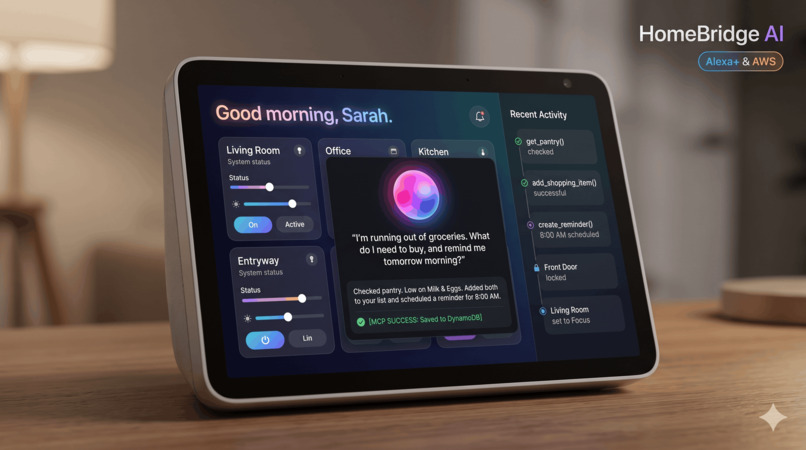
HomeBridge-AI
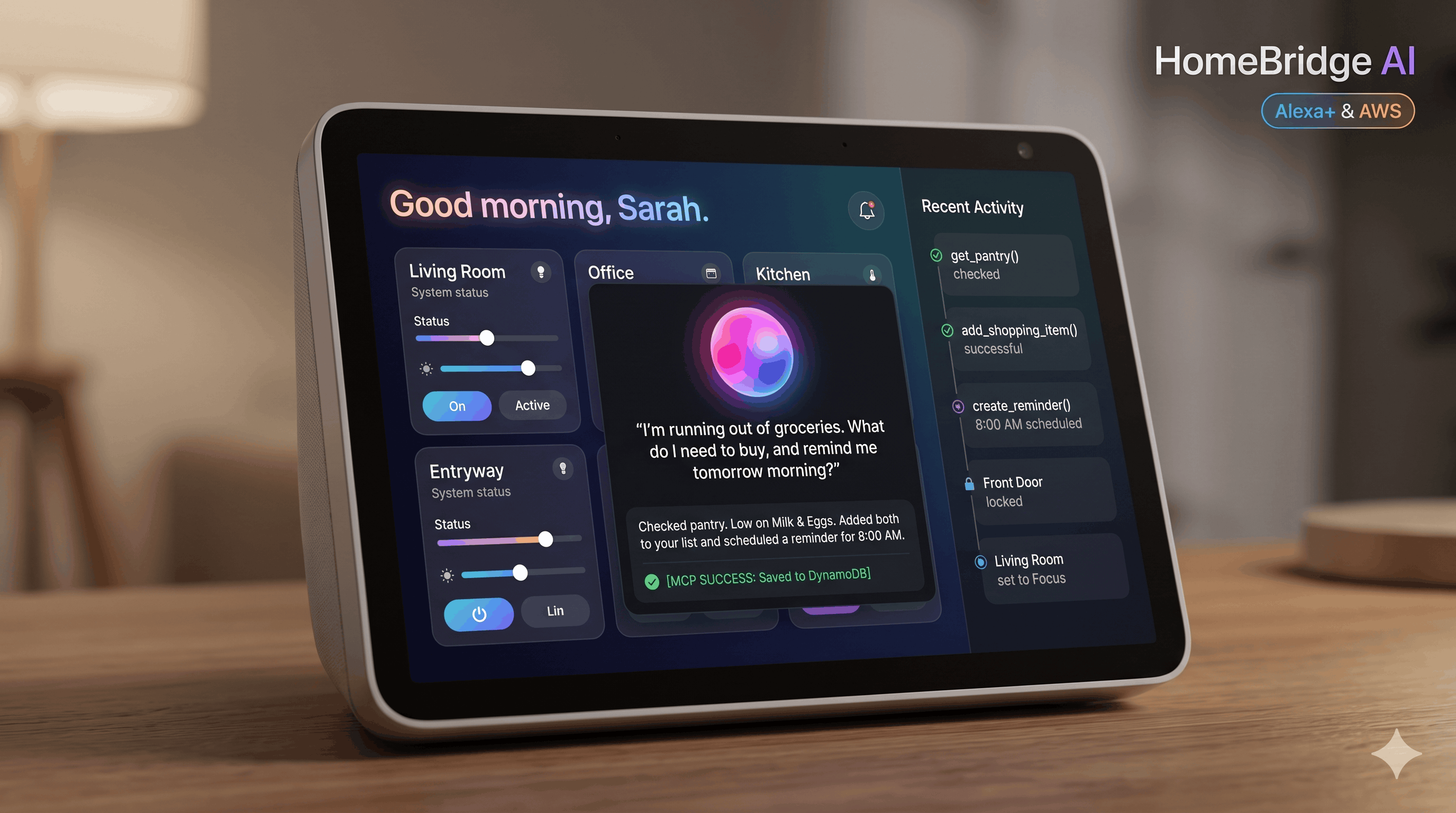
Inspiration## Inspiration
Managing everyday household tasks often requires jumping across multiple disconnected apps—one for tracking pantry inventory, another for writing shopping lists, and yet another for scheduling reminders.
We were inspired by the vision of Alexa+ and the open Model Context Protocol (MCP) to build a unified solution: HomeBridge AI. We wanted to create a conversational assistant that handles complex, multi-step household requests in a single natural sentence—without making false assumptions or hallucinating actions.
What it does
HomeBridge AI is an intelligent voice/chat home assistant that converts natural-language household requests into real, verified backend actions.
When a user says:
"I'm running out of groceries. What do I need to buy, and remind me tomorrow morning?"
HomeBridge AI sequentially:
- Queries Pantry Inventory: Calls
get_pantryto check current stock and identify items markedLOW. - Updates Shopping List: Calls
add_shopping_itemto save low-stock items into persistent storage. - Schedules Reminders: Calls
create_reminderto create a verified reminder entry. - Responds with Confirmation: Only confirms actions to the user once the backend database successfully returns a positive response.
How we built it
We built HomeBridge AI using a decoupled, agentic architecture tailored for the Alexa+ track and AWS Builder mini-challenge:
- Model Context Protocol (MCP) Server: Built a Python server using FastMCP exposing tools (
get_pantry,add_shopping_item,create_reminder) over Streamable HTTP/SSE. - Reasoning Agent (Amazon Bedrock): Integrated Amazon Bedrock (Claude 3.5 Sonnet) via the Converse API to dynamically discover tools, plan multi-step execution paths, and enforce deterministic tool validation.
- Persistent Household Storage (AWS DynamoDB): Utilized Amazon DynamoDB tables (
HomeBridge_Pantry,HomeBridge_ShoppingList, andHomeBridge_Reminders) to manage real state changes. - Interactive Web Simulator: Built a dual-pane web UI demonstrating real-time natural language dialogue on the left alongside live MCP tool execution logs and DynamoDB state updates on the right.
Challenges we ran into
- Ensuring Grounded Confirmations: Eliminating model hallucinations so the assistant never claims an item was added or scheduled without a verified success response from the MCP backend.
- Multi-Intent Tool Orchestration: Designing tool input schemas and system prompts that allow Bedrock to seamlessly daisy-chain multi-turn tool calls (read $\rightarrow$ plan $\rightarrow$ write) within a single request.
Accomplishments that we're proud of
- Successfully implemented a fully functional FastMCP server following the open MCP specification.
- Created a zero-hallucination execution workflow powered by Amazon Bedrock and DynamoDB.
- Built a transparent Web Simulator that makes agentic tool calls and cloud database writes clearly visible for hackathon judges.
What we learned
- How open protocols like MCP allow AI agents to safely interact with real-world infrastructure and backend databases.
- Techniques for structured output handling and function calling using Amazon Bedrock's Converse API.
What's next for HomeBridge AI
- Smart Expiration Alerts: Proactively notifying users before perishable pantry items spoil.
- Native Alexa+ Skill Packaging: Deploying the MCP server for official Alexa+ device integration.
- Aisle-Based Shopping Optimization: Automatically grouping shopping list items by supermarket departments to streamline grocery trips.
What it does
How we built it
Challenges we ran into
Accomplishments that we're proud of
What we learned
What's next for HomeBridge AI — Intelligent Assistant
Built With
- amazon-bedrock
- amazon-dynamodb
- amazon-web-services
- boto3
- claude-3-5-sonnet
- fastapi
- fastmcp
- html5
- mcp
- python


Log in or sign up for Devpost to join the conversation.