Inspiration
When seniors return home after hospitalization, family members often become their primary caregivers. They notice changes in appetite, mobility, memory, and behaviour, but may not know how to communicate these observations to healthcare professionals.
We created CareOS to bridge the gap between everyday care at home and professional healthcare support.
What it does
CareOS is an AI-assisted care coordination platform connecting family caregivers and nurses.
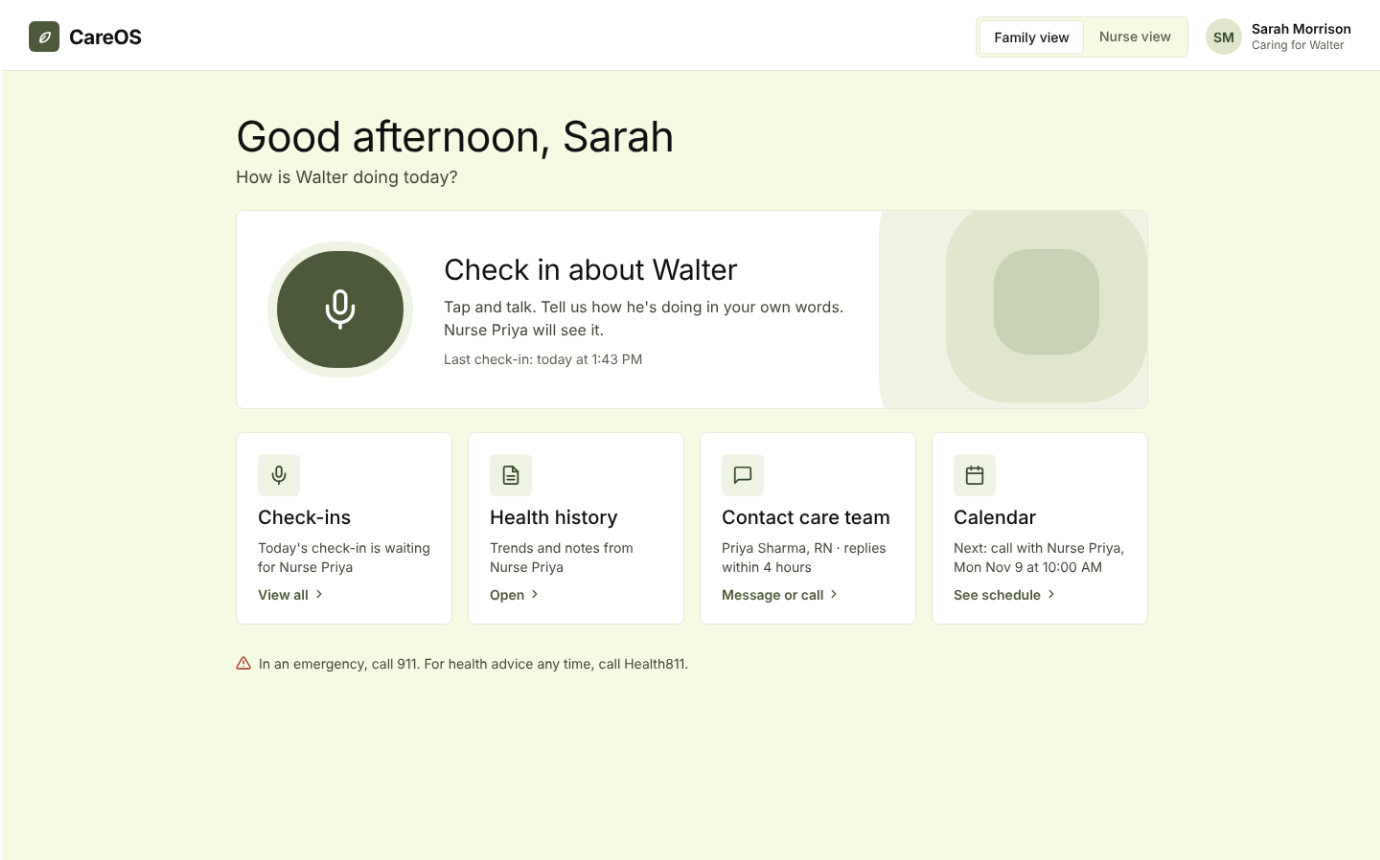
- For families: Voice check-ins make it easier to report changes in a loved one's condition without completing complicated forms.
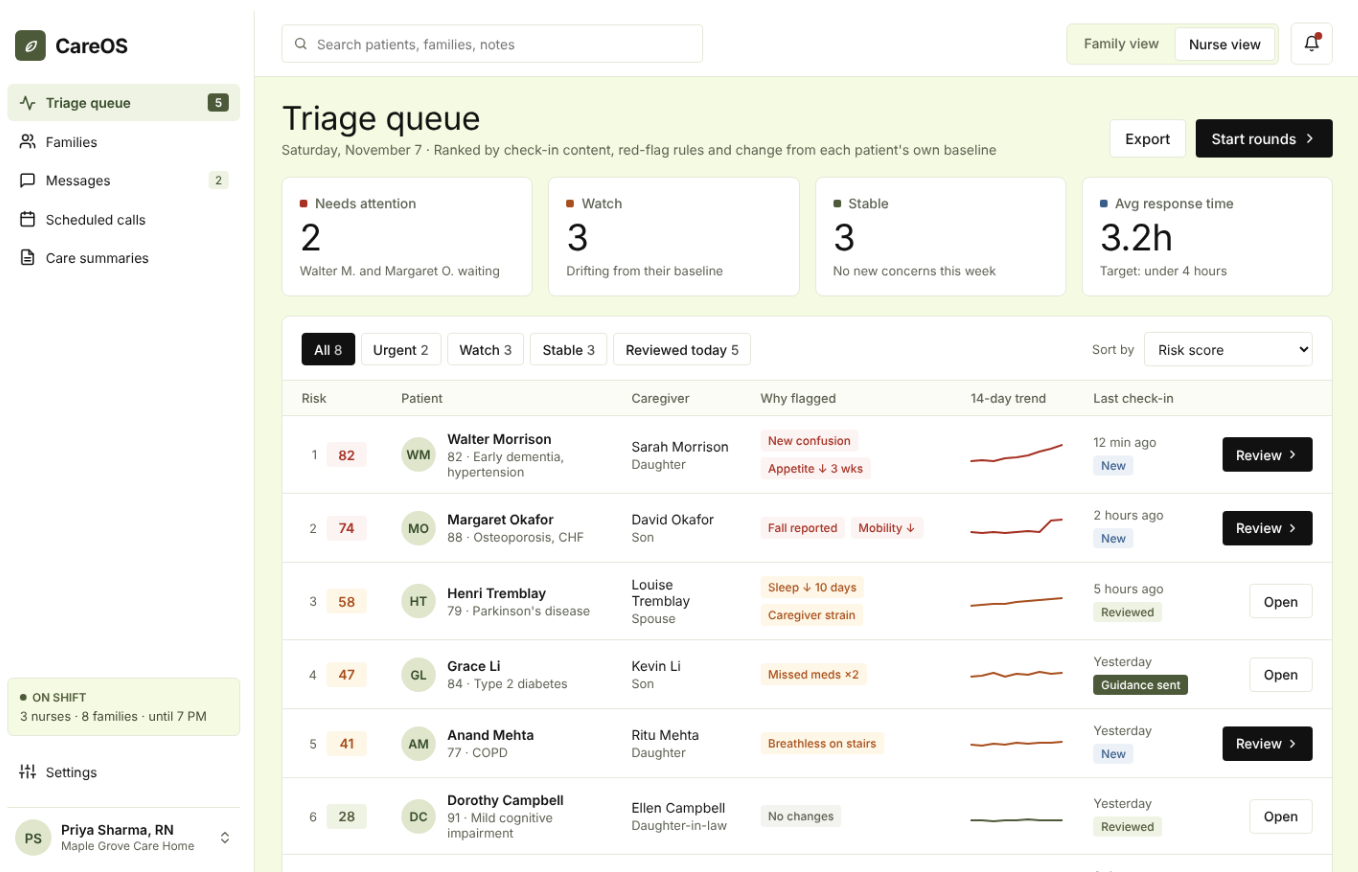
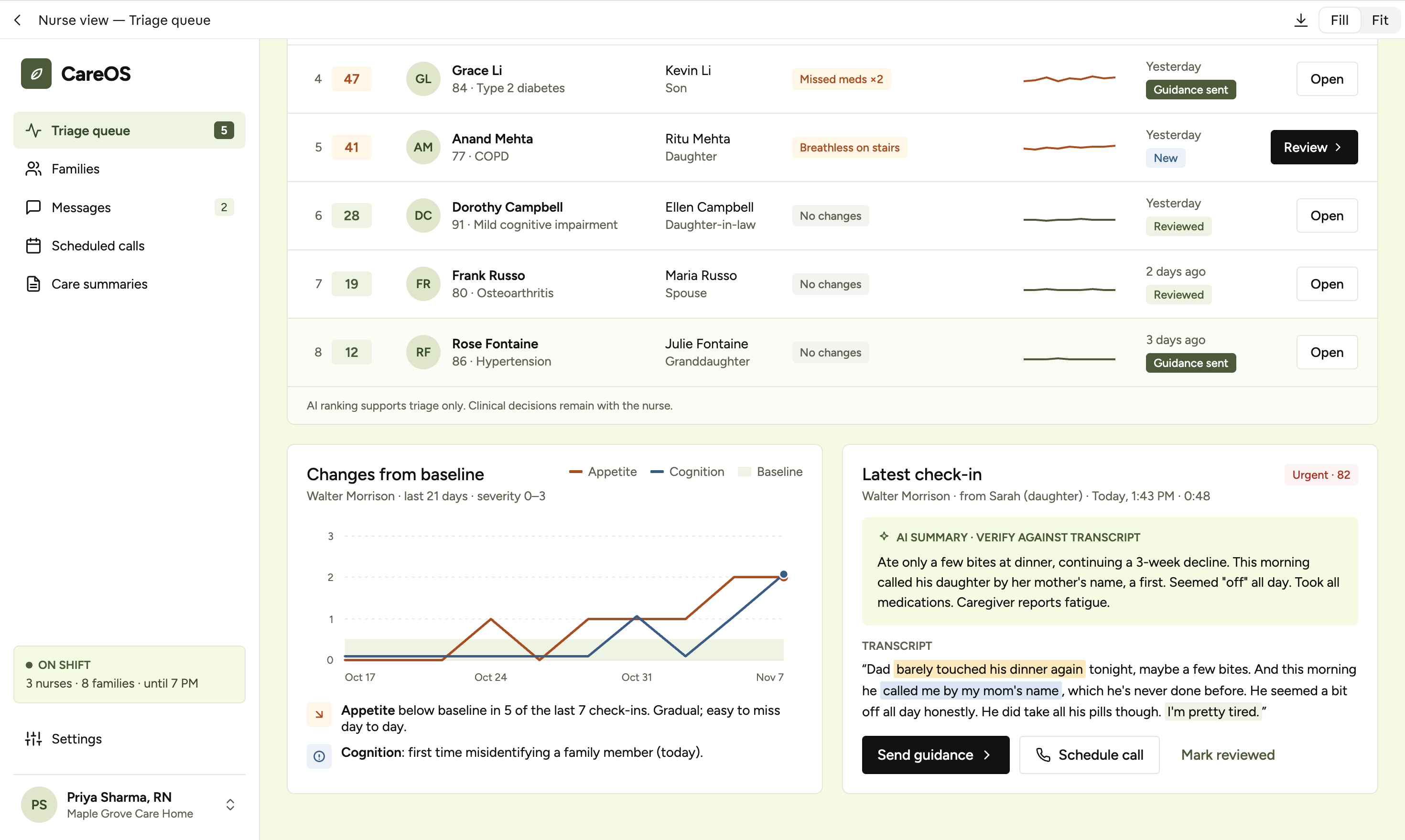
- For nurses: A prioritized review queue organizes patient updates, highlights changes from their usual baseline, and shows the observations behind each finding.
- For care transitions: Nurse-verified records and family-reported observations can be organized into a shareable care summary.
What makes CareOS different is its focus on changes over time, rather than isolated symptoms.
The system also considers caregiver well-being, recognizing that the person providing care may need support too.
How we built it
We developed CareOS using React, TypeScript, Vite, and Tailwind CSS for the frontend and TypeScript with Hono for the backend API.
We used PostgreSQL 16, Prisma 7, and Docker to build the database infrastructure, with Zod for data validation and Vitest for testing.
Our system is organized around three components:
- Caregiver reporting: A voice-based check-in workflow that collects everyday observations.
- Structured analysis: A prototype pipeline that organizes reports into eight care domains and uses transparent, rule-based scoring to compare observations against a patient's recent baseline.
- Nurse review: A workflow designed to display prioritized concerns, supporting evidence, trends, and follow-up actions.
We used fictional patient records and seeded check-ins to develop and test the system. The current prototype uses simulated transcripts and rule-based extraction, with real AI transcription and language-model processing planned for further development.
Challenges we ran into
Our biggest challenge was finding a meaningful problem that existing healthcare technology hadn't already addressed.
We explored several ideas, including discharge coordination, medication reconciliation, and AI clinical documentation. Through research and conversations with PointClickCare mentors, we discovered that many related solutions already existed.
After several iterations, we focused on the communication gap between family caregivers and healthcare professionals after hospital discharge.
We also faced the challenge of designing a system that could organize caregiver information without overwhelming nurses or relying on AI to make clinical decisions.
Accomplishments that we're proud of
- Designed connected family and nurse experiences around a complete care-coordination workflow.
- Built a backend API with PostgreSQL, Prisma, and structured patient records.
- Developed rule-based scoring and baseline comparison logic for explainable review prioritization.
- Incorporated caregiver strain alongside patient-related observations.
- Created synthetic patient scenarios and backend tests to support prototype development.
- Prioritized traceability by linking findings to their original caregiver observations.
What we learned
We learned that innovation starts with understanding existing solutions and identifying what's still missing.
Our discussions with PointClickCare mentors helped us understand the importance of fitting technology into real healthcare workflows.
We also learned that healthcare AI must be explainable, clinically responsible, and designed to support human decision-making rather than replace it.
What's next for CareOS
Our next steps include:
- Completing and refining the connected caregiver and nurse interfaces.
- Integrating real speech-to-text and AI-powered extraction of caregiver observations.
- Improving personalized trend analysis and review prioritization.
- Testing scoring rules and workflows with healthcare professionals.
- Adding secure authentication and appropriate privacy protections.
- Exploring future integration with PointClickCare's clinical workflows.
Our goal is to make everyday caregiver observations more useful to healthcare professionals while supporting continuity of care for seniors recovering at home.
CareOS: Discharged from the hospital. Not disconnected from care.
Built With
- docker
- hono
- postgresql
- prisma
- react
- tailwind-css
- typescript
- vite
- zod
