Inspiration
63 million Americans look after a family member (AARP, 2025), and 16.2 million older Americans live alone (ACL, 2023). Many of those parents already have a Ring doorbell, right where their day meets the outside world. But a security doorbell talks in motion alerts, about forty a day, so the son or daughter who set it up mutes them within a week. Then the things they actually worry about slip by. Did the aide come today? Is the pharmacy bag still on the step? Who was at the door at 10:41 PM?
What it does
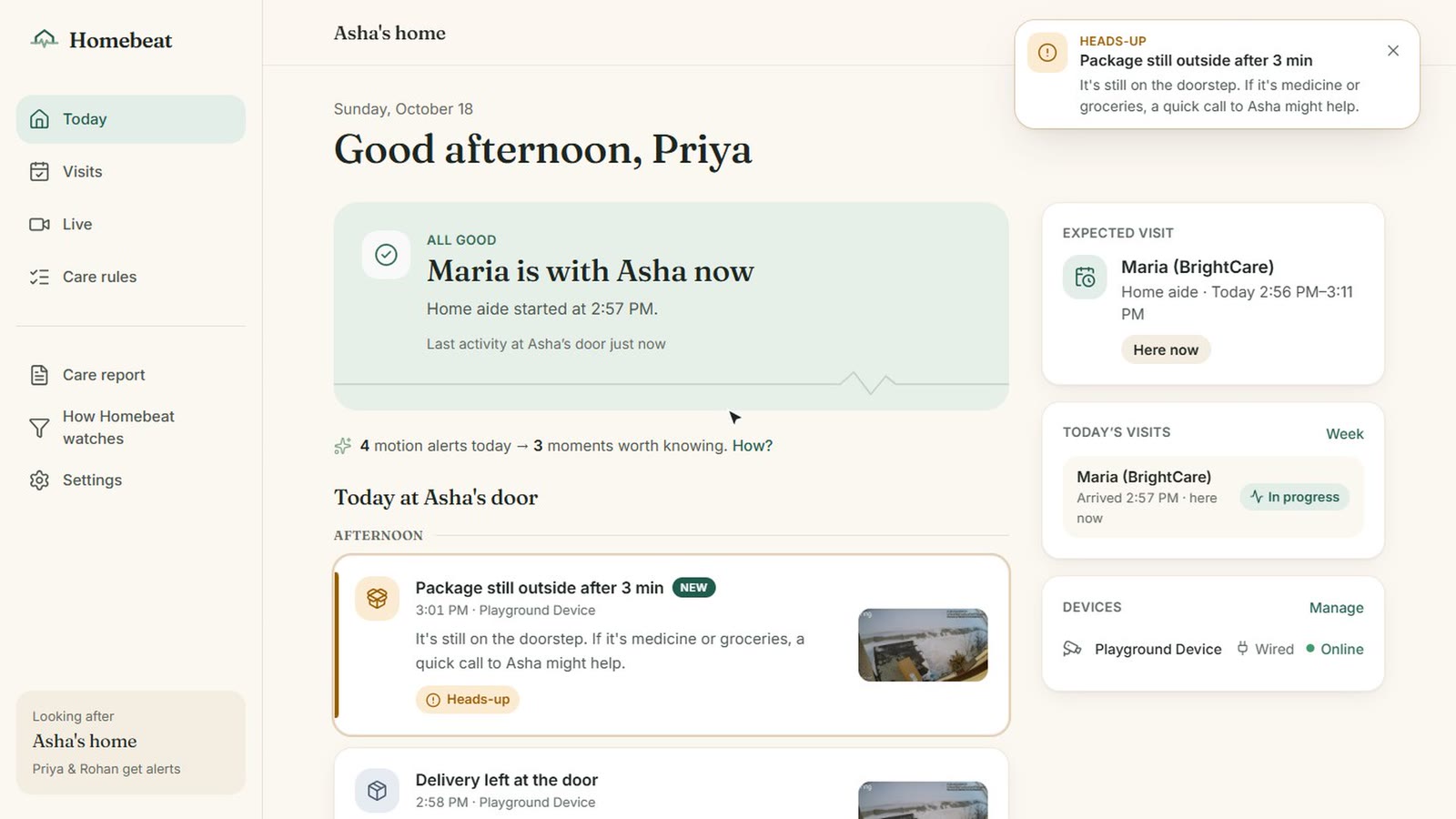
Homebeat is a Ring Appstore app for the family of a parent who lives alone. It reads the parent's Ring doorbell and turns motion into a few calm moments:
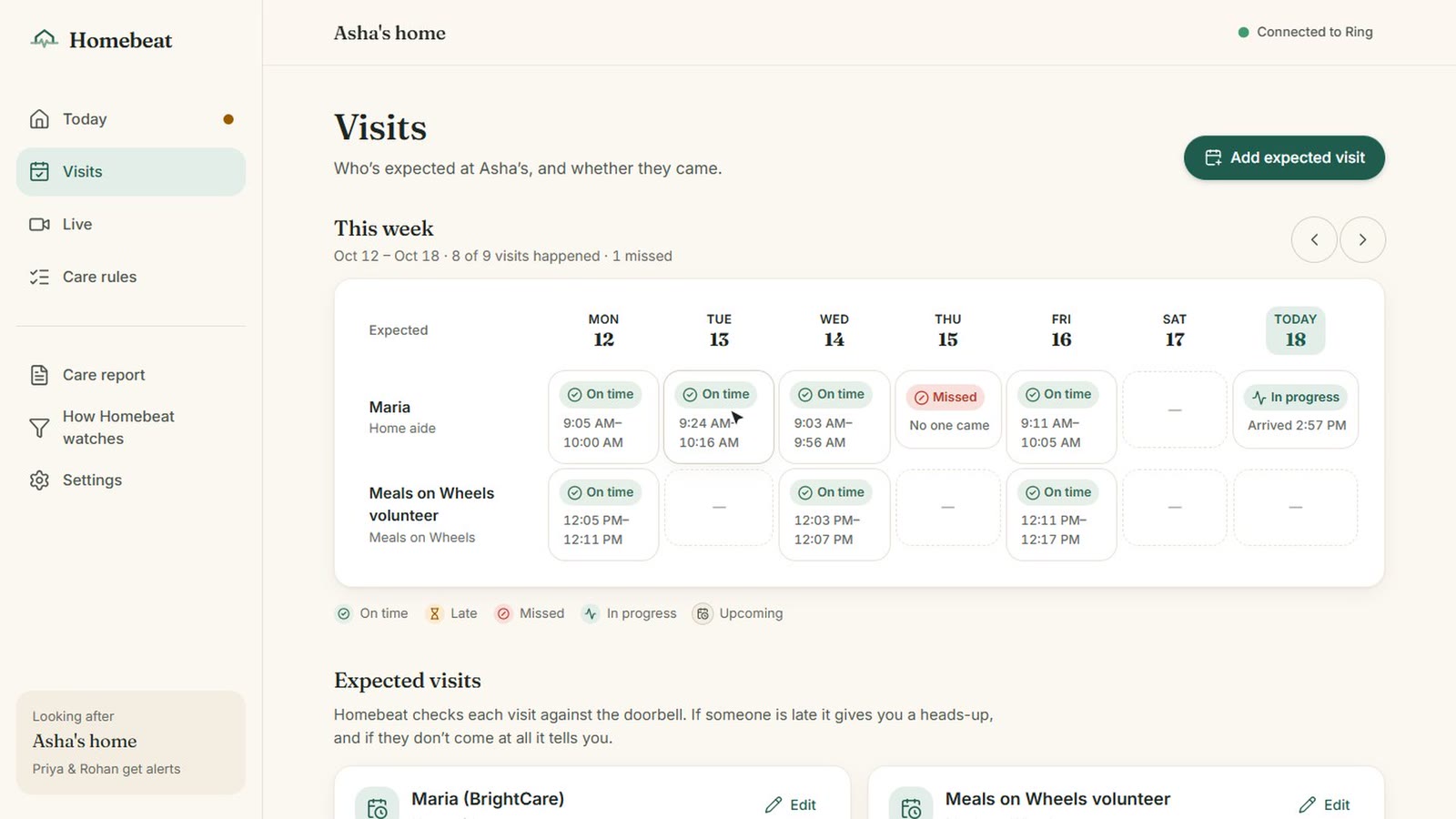
- Visits: the aide, nurse or meal delivery is expected in a time window. Homebeat confirms the arrival from Ring events (the aide's car, a care uniform, a doorbell press), flags late and missed visits, and gives the aide a one-tap check-in link as a second signal.
- Deliveries: a parcel left on the step is checked again later with a fresh Ring snapshot of the same view. Still there? One heads-up to the family, and a soft tone on the parent's Ring Chime.
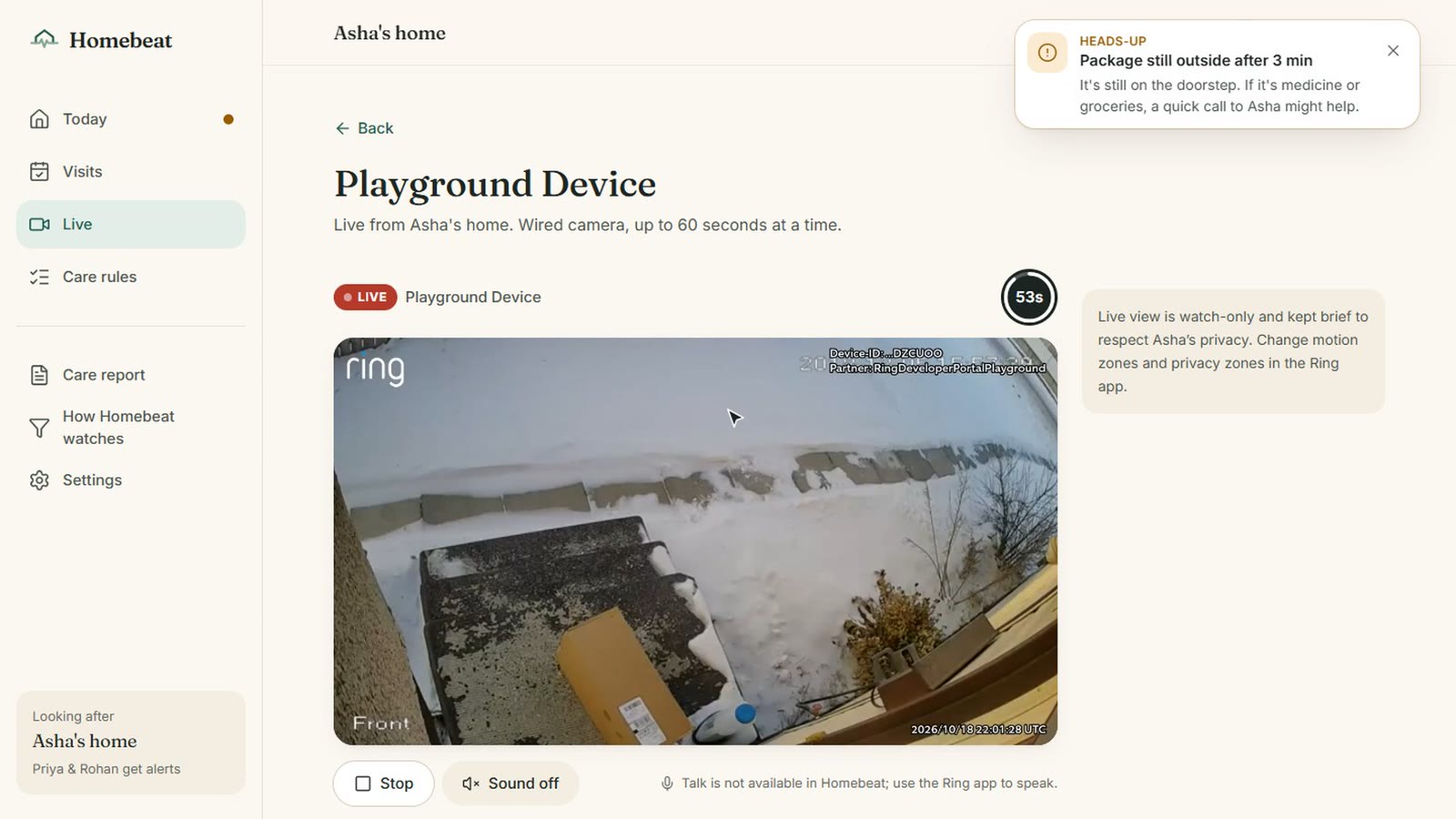
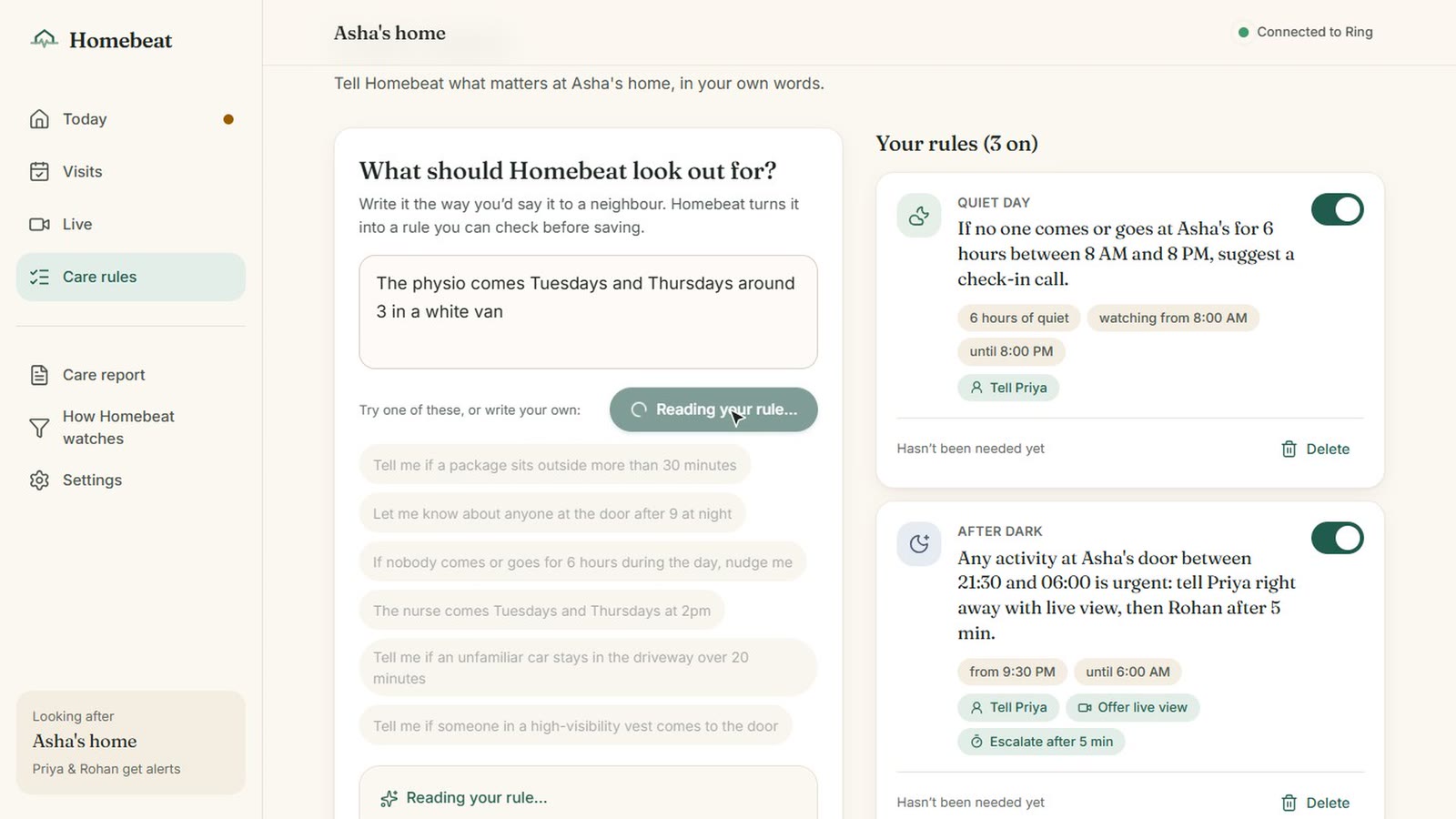
- After dark: anyone at the door during quiet hours is urgent, with live view and escalation to a sibling.
- Quiet days: nobody in or out for hours means "might be a good time to call."
- Plain-English rules: "The physio comes Tuesdays and Thursdays around 3 in a white van" becomes a rule card the family reads before saving.
- A daily digest and a weekly care report for siblings or the care agency.
No face recognition, ever. Homebeat describes uniforms, parcels and cars, never who someone is.
How we built it
- The Ring Partner API, end to end: devices with status and capabilities, Event History, image snapshots and clips (303 to a pre-signed URL, with 416/425 backoff), WHEP live view proxied by the server with the device's session limit, chime playback, the Users API, OAuth token exchange and refresh, one-way account linking, and HMAC-verified webhooks acknowledged in milliseconds.
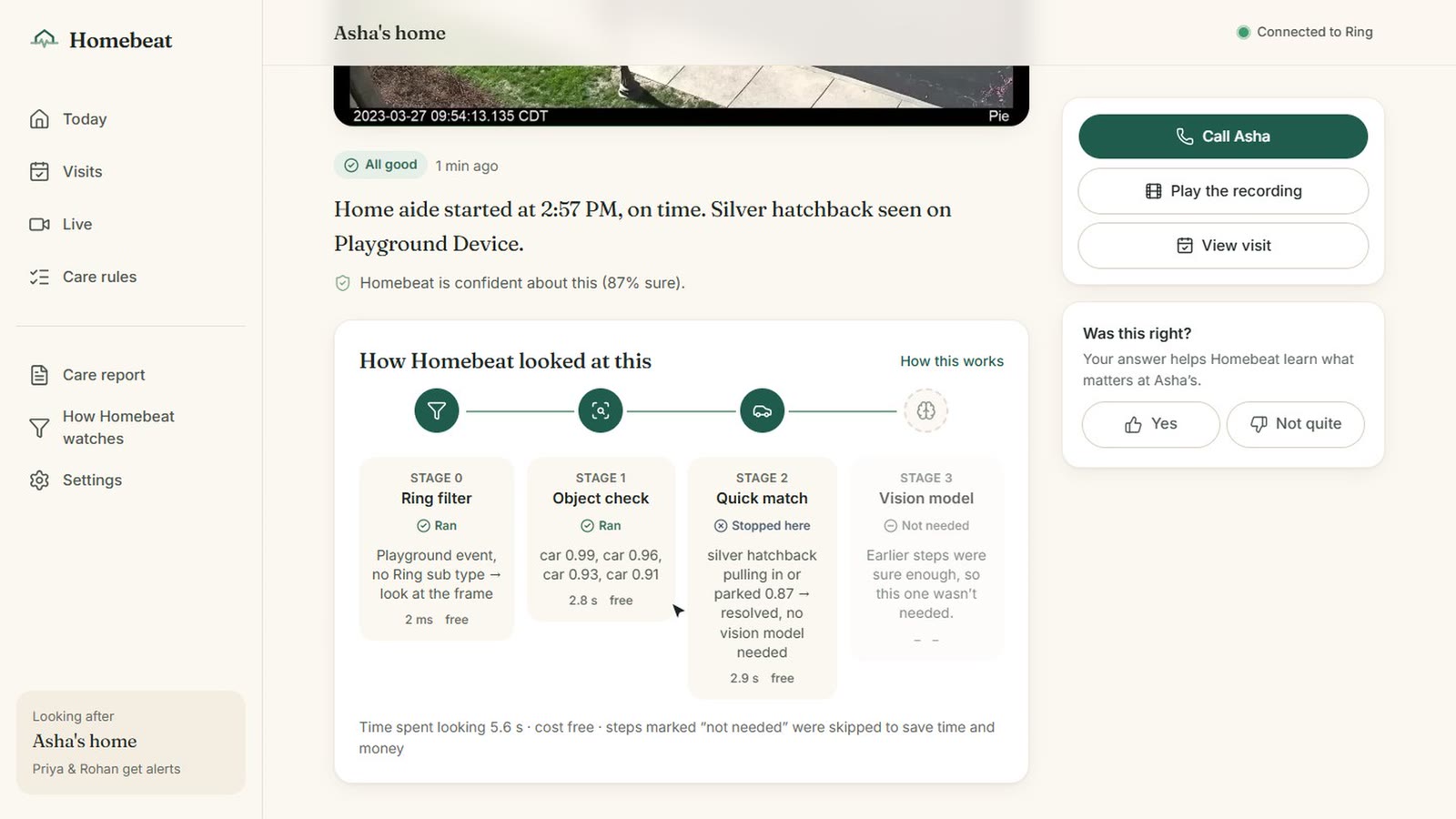
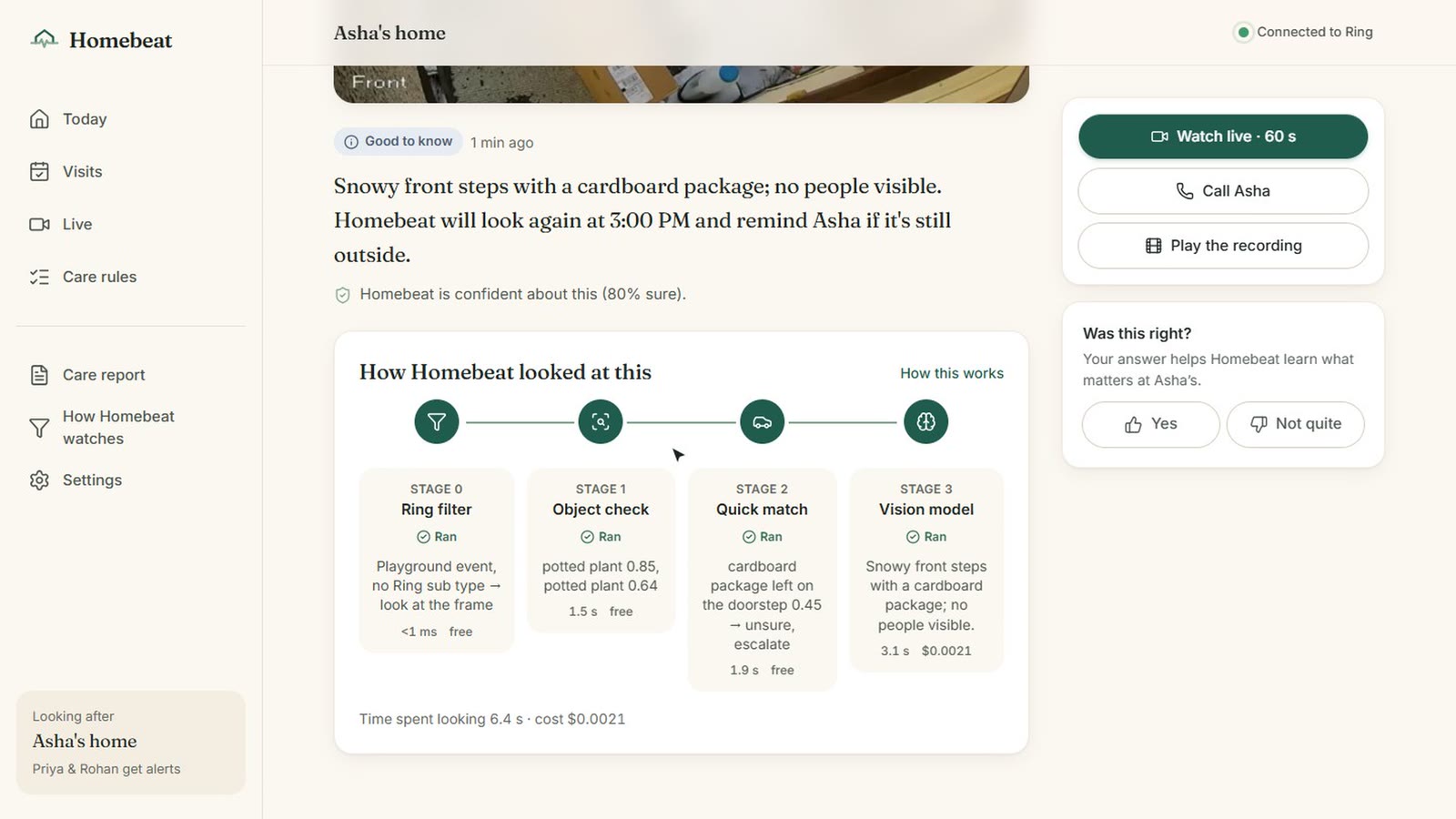
- Ring's Computer Vision Guidelines as running code: a four-stage funnel. Ring's own label first (free), then an on-device object check (YOLOS-tiny), an on-device zero-shot match (CLIP: "a home care worker in scrubs carrying a bag", "the aide's silver hatchback"), and a vision model only when it's still unclear. Every moment shows its own trace: stage, time and cost.
- Ring's UX design guide: passwordless account linking, a device confirmation screen, graceful handling of end-to-end-encrypted devices, WCAG 2.2 AA.
- Stack: Node 24, Fastify, TypeScript and SQLite on the server, transformers.js for the on-device models, and a React 19 + Vite + Tailwind PWA with live updates over SSE.
Tested on the real Ring API
No Ring hardware was used: everything ran against the Ring Developer Playground. The Vehicle clip matched the aide's car on a free on-device step ("Maria arrived, on time"). The Package clip became "Delivery left at the door" after one vision call ($0.0021), and later "Package still outside". The Motion clip (birds at a feeder) was dropped on the server. On the real Playground frames, the funnel gave the same answers as sending every frame to a vision model (6 of 6) with a sixth of the vision calls. Across all 17 labelled frames it got 17 right with 10 calls, against 12 of 17 when every frame goes to the model.
Challenges we ran into
The Playground's simulated events are live views (on_demand) with no sub_type and no webhook, so Homebeat classifies them itself. Media is only readable after the token's issue time, a fractional timestamp returns 403 "Cannot authorize", and the Playground device went offline mid-session. All three sample clips play on one device, so a "is the package gone?" re-check could compare against the wrong scene; Homebeat now checks that it's looking at the same view (CLIP image similarity) before deciding anything. All 16 findings are in the friction log.
Accomplishments that we're proud of
A care product that is honest about what it knows. Every moment explains itself, cost follows the events that matter instead of raw motion, and the hard cases (encrypted devices, missing media, a camera showing another view) fall back gracefully instead of guessing.
What we learned
Ring's CV guidelines are a real design document: following them literally gave the right architecture. And an hour against the live Playground beat days of reading; half of Homebeat's fixes came from that first hour.
What's next for Homebeat
Ring Appstore certification, partner chime audio ("There's a package at your front door"), care-agency reports with EVV-style evidence, and a family app for siblings on iOS and Android.
Built With
- claude
- clip
- fastify
- node.js
- react
- ring-appstore-mcp
- ring-developer-playground
- ring-partner-api
- sqlite
- tailwindcss
- transformers.js
- typescript
- vite
- webrtc
- whep
- yolos

Log in or sign up for Devpost to join the conversation.