-
-
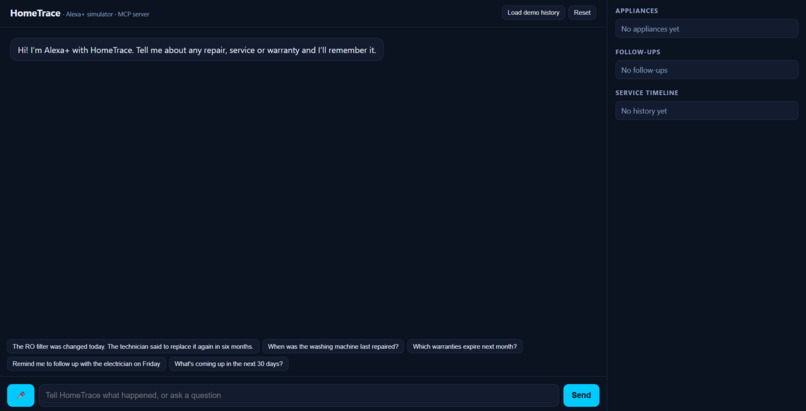
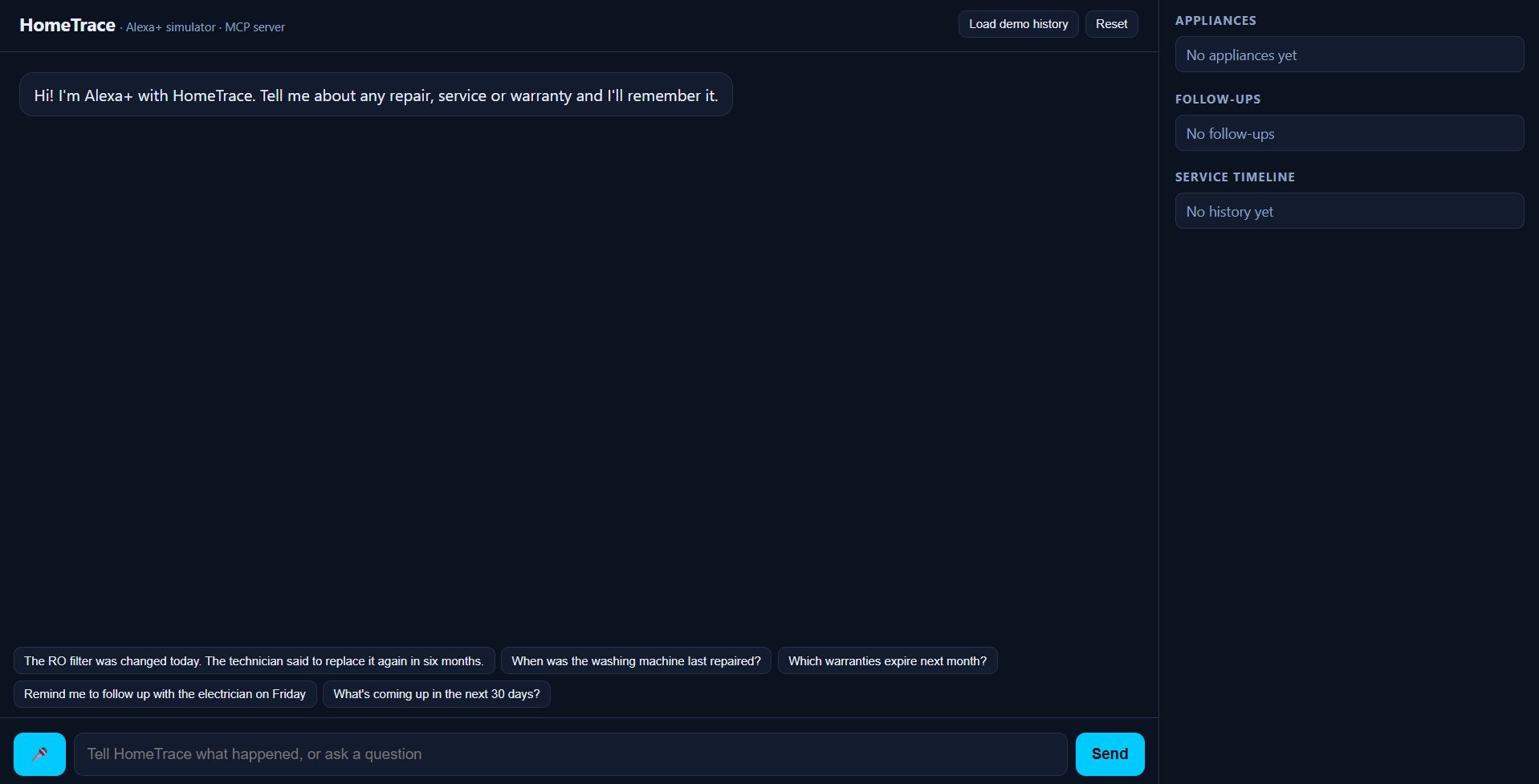
Initial Dashboard: A unified dashboard for conversational assistance, appliance records, follow-ups, and household service history.
-
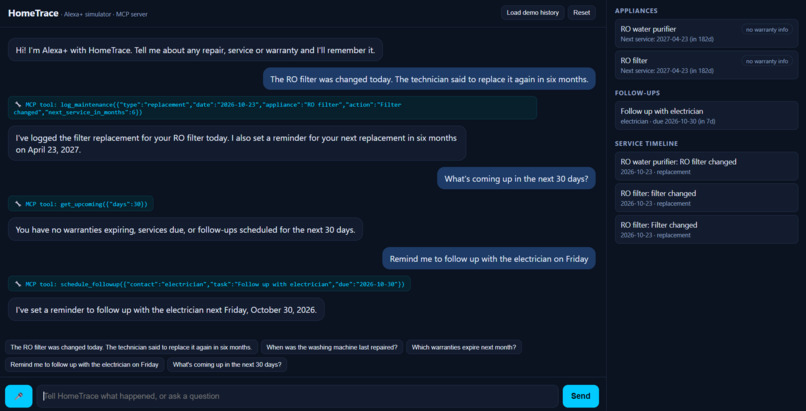
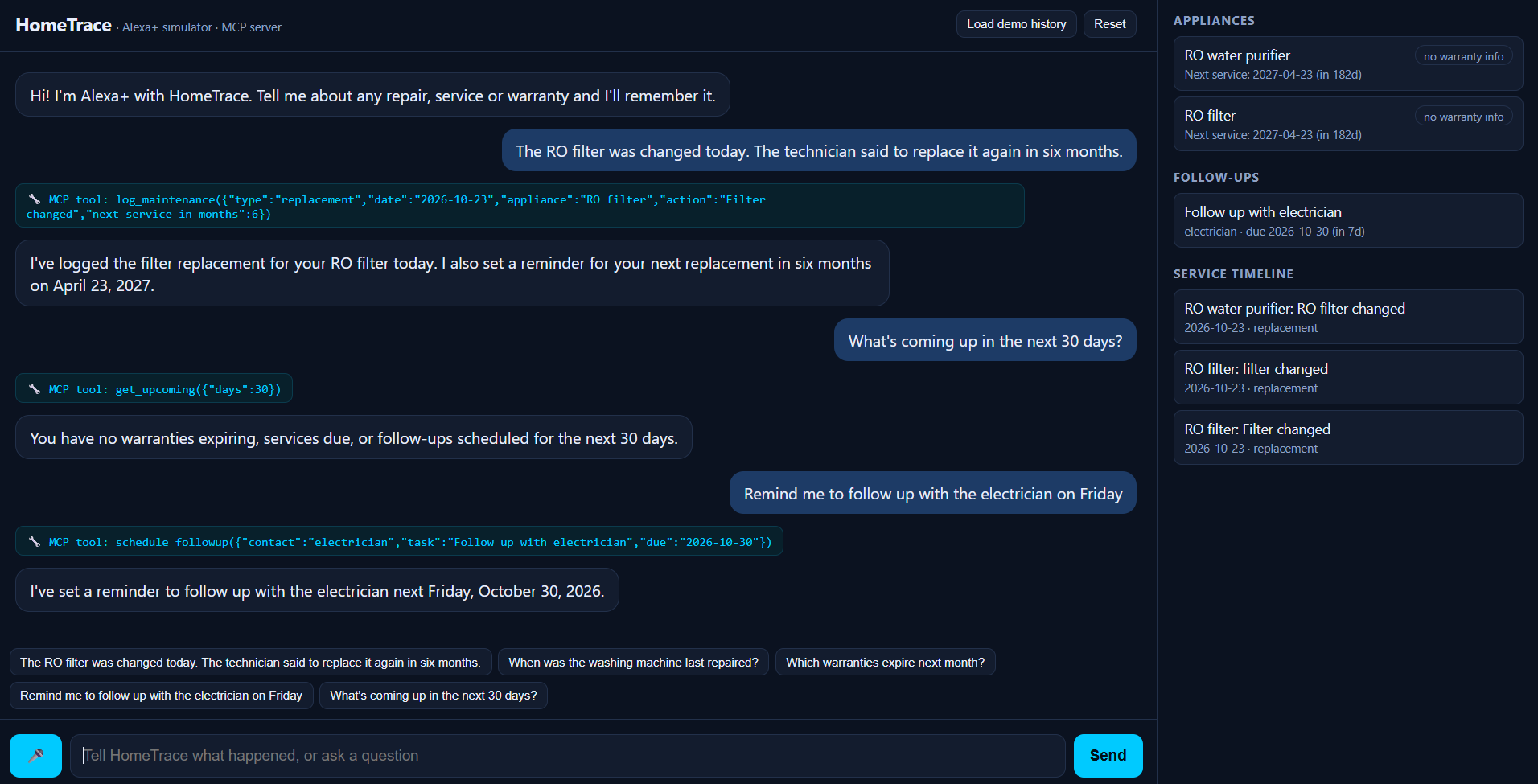
Follow-Up Timeline: Track pending follow-ups, appliance maintenance events, and service history in one convenient dashboard.
-
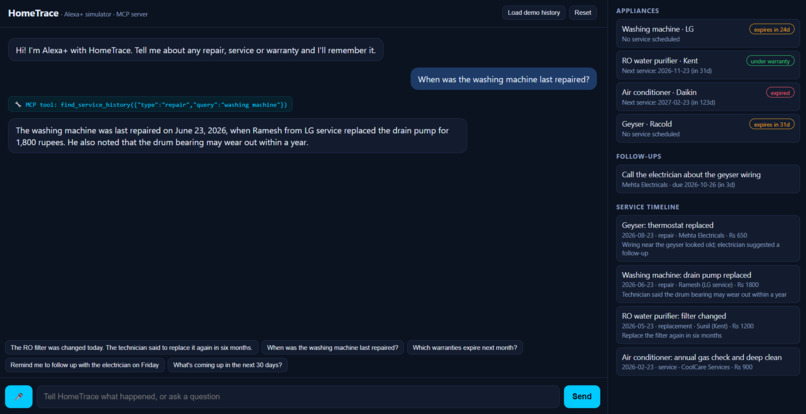
Repair History: HomeTrace retrieves past repairs, including service dates, costs, technician details, and repair notes.
-
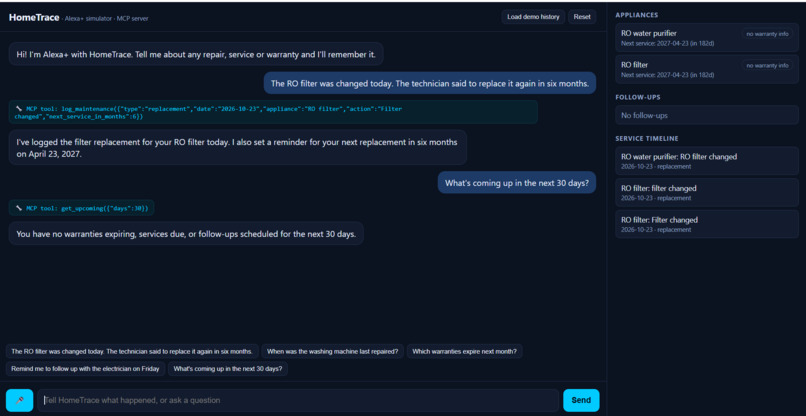
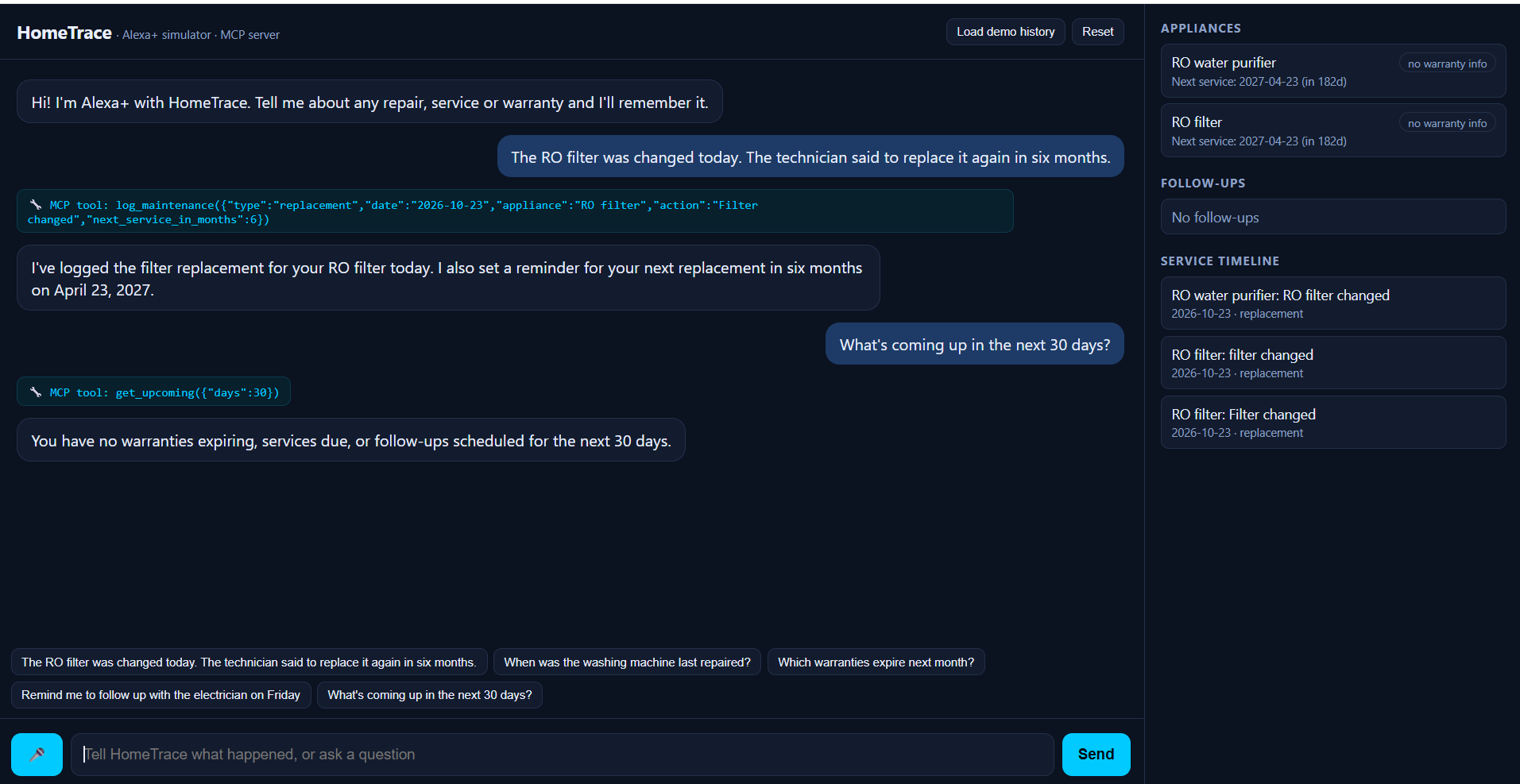
Maintenance Logging: Log appliance maintenance, schedule replacement reminders, and check upcoming services using natural language.

HomeTrace — Your Smart Household Assistant
Inspiration
Managing a home involves many small but important responsibilities: keeping track of maintenance, remembering warranty information, maintaining household records, and following up on tasks. These details can become difficult to organize when they are scattered across different places.
I built HomeTrace to explore how conversational AI and connected tools can make household management simpler, more organized, and more accessible. The vision is to create a household assistant that allows people to interact naturally with their home information instead of manually searching through records and reminders.
What it does
HomeTrace is a smart household assistant prototype designed to help users manage household information through a conversational interface.
Key capabilities include:
- Maintenance history: Keep track of household maintenance records and previous activities.
- Warranty checks: Retrieve and check stored warranty information.
- Household logging: Record important household information and activities.
- Follow-ups: Support follow-up workflows for household tasks.
- Conversational AI: Use Gemini-powered tool calling to interpret requests and connect them with relevant functionality.
- Connected tools: Use the Model Context Protocol (MCP) to connect the assistant with supported tools and backend operations.
The project explores how a conversational household assistant can go beyond answering questions and help users interact with useful, structured household information.
How we built it
HomeTrace was built using JavaScript and a Node.js backend. The application uses Express for server-side functionality and integrates Gemini-powered tool calling with an MCP client.
The backend includes an MCP endpoint using Streamable HTTP transport, enabling compatible clients to communicate with the available tools. Persistent-state APIs support household information and related workflows. An Alexa+-style simulator provides a way to demonstrate the assistant experience.
The architecture combines a conversational interface, AI-driven tool selection, and backend operations to demonstrate how a household assistant can translate natural-language requests into useful actions.
Challenges we faced
One of the main challenges was connecting conversational AI with actual application functionality. A useful assistant needs more than generated responses: it must identify the user's intent, select the appropriate tool, and handle the resulting information correctly.
Integrating Gemini with MCP required attention to tool communication, server configuration, and the flow of information between components. Another challenge was organizing household data so that features such as maintenance history, warranty checks, and follow-ups could work together coherently.
Testing these workflows helped us validate the main functionality and identify areas for further improvement.
What we learned
Building HomeTrace strengthened our understanding of backend development, API design, AI tool calling, MCP integration, and persistent application state. It also showed us the importance of making AI systems useful through reliable tools rather than relying on conversation alone.
The project gave us an opportunity to explore how conversational interfaces can support everyday tasks and how an assistant-oriented architecture can be extended with additional capabilities.
What's next
Future improvements could include deeper integration with Alexa+, more robust household profiles, proactive maintenance reminders, richer integrations with household services, and stronger handling of errors and permissions.
HomeTrace is a step toward a more connected and conversational way of managing everyday household responsibilities.
Built With
- ai
- amazon-alexa
- api
- backend
- conversational
- css
- express.js
- gemini
- gen-ai
- html5
- javascript
- mcp
- node.js


Log in or sign up for Devpost to join the conversation.