
Inspiration
Home Safe was inspired by the problem of getting home safely, especially when walking through unfamiliar areas at night. Most navigation apps optimize for speed, but they do not clearly show which route feels safer. I wanted to build a route planner that compares not only the fastest path, but also safer alternatives using safety data, route scoring, and AI-assisted analysis.
What it does
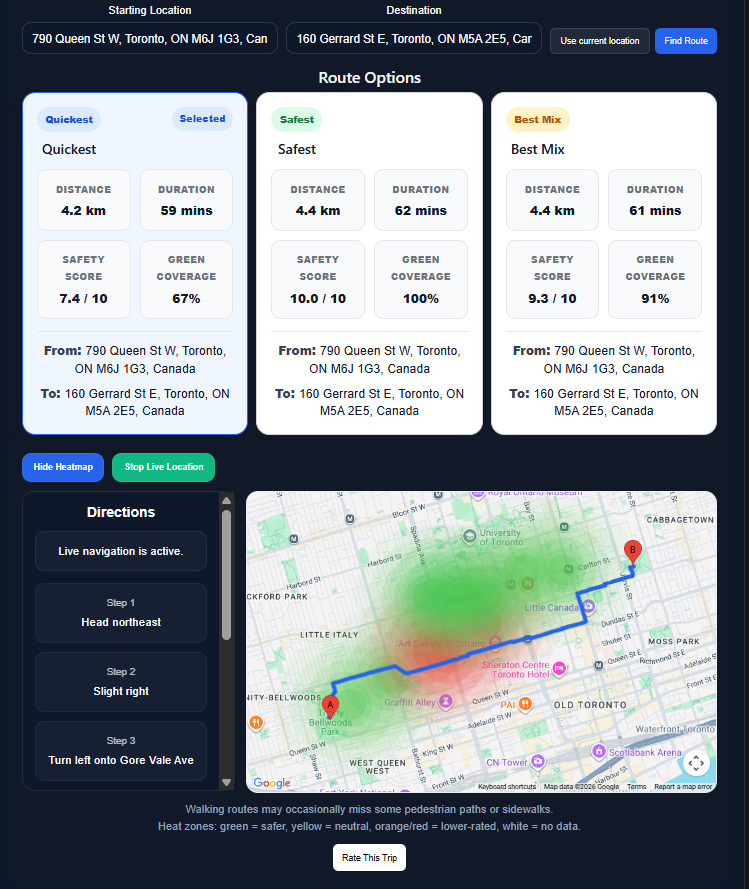
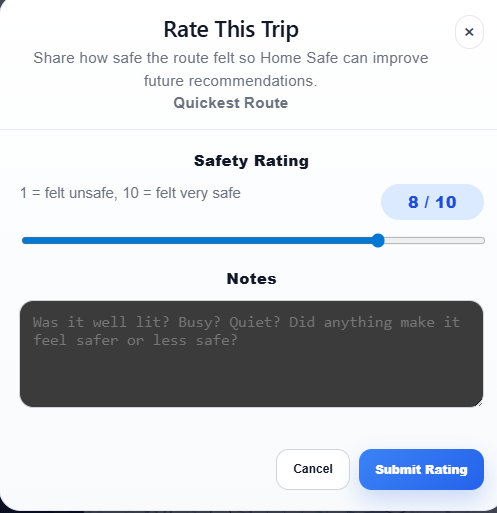
Home Safe is a safety-aware walking route planner. A user enters a starting location and destination, and the app compares multiple route options: the quickest route, the safest route, and a balanced route. The app shows the route on an interactive Google Map, displays route cards, provides directions, and uses a safety heatmap to visualize safer and riskier areas. Users can also submit trip ratings, which are stored and used to update local safety data. The safety score is based on route cells and ratings, with Zerve used as an AI/data intelligence layer for enhanced safety scoring.
How I built it
I built Home Safe as a full-stack web application. The frontend uses React and Vite, with Google Maps for route visualization, location search, route drawing, and heatmap display. The backend uses Express.js to handle route requests, safety scoring, ratings, and database communication. PostgreSQL stores safety reports, ratings, and safety cells. Docker Compose is used to run the app locally with the frontend, backend, and database as separate services. I also integrated Zerve as the AI/data scoring layer. Zerve is used to support advanced safety intelligence by scoring route cells based on safety-related features. The app is designed so the backend can call the Zerve scoring API and combine that output with local safety data. For deployment, I use Vercel for the frontend, Render for the backend and database, and Zerve for the safety intelligence API. For the demo, I am running the app locally so that all services can be shown reliably in one controlled environment.
Challenges I ran into
One major challenge was combining route planning with safety scoring. Google Maps can return walking routes, but ranking them by safety required my own backend logic and database structure. Another challenge was setting up Docker, PostgreSQL, and environment variables correctly across local development and deployment. I had to make sure the frontend, backend, database, Google Maps API, and Zerve API all communicated properly. I also ran into deployment issues with external services, including keeping Render, Vercel, and Zerve configuration aligned with the local version of the app.
Accomplishments that I'm proud of
I am proud that Home Safe works as a full-stack safety-focused navigation app rather than just a basic map project. It includes route comparison, safety heatmaps, user ratings, database-backed safety cells, and a Zerve-powered intelligence layer. I am also proud of building the project as a solo developer, handling the frontend, backend, database, Docker setup, API integration, and deployment workflow myself.
What I learned
I learned how to build a full-stack geospatial application that combines mapping, routing, databases, and AI-assisted scoring. I also learned more about Docker, PostgreSQL schemas, environment variables, deployment debugging, and how to connect an external AI/data platform like Zerve into a real web app.
Most importantly, I learned that building a useful safety app is not just about showing a map. It requires combining user experience, data modeling, backend scoring, and responsible use of location-based data.
What's next for Home Safe
Next, I want to improve the Zerve safety model with more real-world public safety signals, including time of day, density, transit access, and reported incidents. I also want to improve route ranking so the safest route can avoid risky areas more intelligently.
Future improvements include user accounts, saved routes, better mobile support, richer safety reports, and more reliable deployment across Vercel, Render, and Zerve.
Built With
- css
- docker
- docker-compose
- express.js
- git
- github
- google-maps
- google-places
- google-routes-api
- html
- javascript
- node.js
- postgresql
- react
- render
- rest-api
- vercel
- vite
- zerve


Log in or sign up for Devpost to join the conversation.