-
-
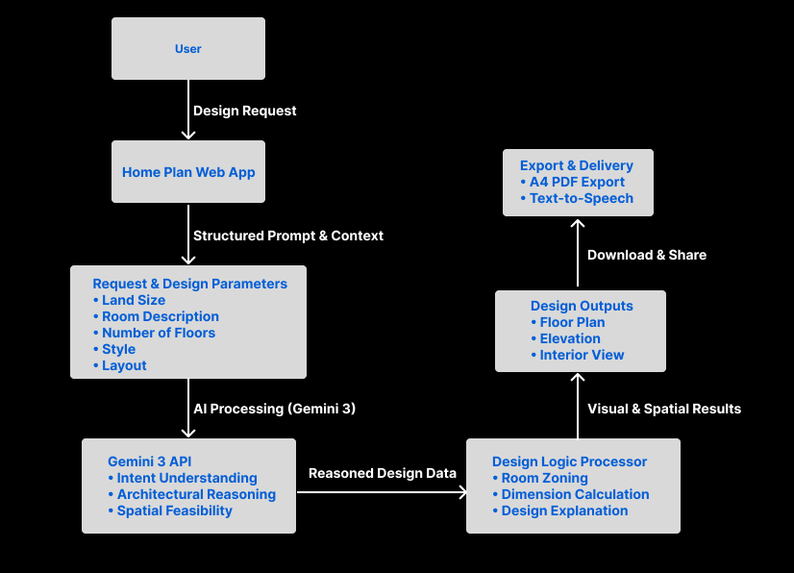
Home Plan Diagram
Inspiration
Designing a home is often a complex and time-consuming process that requires architectural knowledge, spatial reasoning, and clear communication between homeowners and designers. Many people struggle to translate their needs—such as land size, room requirements, and lifestyle preferences—into a realistic and buildable home design.
Home Plan was inspired by this gap. We wanted to create an AI-powered platform that helps users quickly explore spatially feasible home designs using simple text or voice input, while still respecting real-world architectural logic and dimensions.
The goal is not just to generate beautiful visuals, but to help users understand whether a design actually makes sense to build.
What it does
Home Plan is an AI-powered home design assistant that generates realistic and dimensionally accurate house designs based on user input.
Users can:
- Describe their land size and room requirements using text or voice
- Automatically start from a default prompt using the Set Prompt feature
- Choose:
- Number of floors
- Architectural style
- Layout type
Architectural styles include multiple predefined options as well as a My Location option. When My Location is selected, the system dynamically adjusts the architectural style to the user’s location by analyzing climate, geographic conditions, cultural context, and local materials.
The platform generates:
- A top-view floor plan with exact room dimensions
- A front elevation design
- An interior perspective with real-scale furniture
- A design reasoning summary explaining layout decisions, trade-offs, and limitations
All results can be exported as an A4 PDF, and the design explanation is also available via text-to-speech for better accessibility.
How we built it
Home Plan was built by combining:
- Google AI Studio for multimodal AI capabilities (text, voice, and image generation)
- A structured prompt system that converts free-form input into constraint-aware architectural instructions
- A clean and intuitive web-based UI for fast interaction
Key design principles:
- Spatial feasibility over pure aesthetics
- Explicit dimensional reasoning (meters, room sizes, circulation)
- Separation between user intent (prompt + dropdowns) and AI reasoning
The system processes:
- User prompt and UI selections
- Spatial allocation logic (rooms first, carport later)
- Visual generation aligned with the calculated layout
- Explanation output prepared for both reading and audio narration
Gemini 3 Integration
Gemini 3 serves as the core intelligence behind Home Plan, enabling multimodal interaction, architectural reasoning, and realistic design generation.
Home Plan uses the Gemini Live API to support voice-based input. Users can describe their land size, room requirements, and preferences using natural speech, which is processed by Gemini 3 to extract structured design intent. This significantly lowers the barrier for non-technical users and makes early design exploration more intuitive.
Architectural style selection includes multiple predefined styles as well as a special My Location option. When users select My Location, Home Plan automatically derives geographic context through Google Maps grounding. This retrieval process is handled by Google AI Studio using the Gemini 2.5 Flash model, which is optimized for fast, lightweight, location-based context extraction.
The resulting location context is then passed to Gemini 3, where architectural decisions are dynamically adapted based on:
- Local climate and weather patterns
- Geographic conditions
- Cultural context
Locally relevant construction materials
- For visual output, Home Plan uses Gemini 3’s image generation capabilities through the Nano Banana image model to produce multiple design views from a single structured prompt. These include a top-view floor plan, front elevation, and interior perspective. All visuals are guided by explicit spatial constraints such as room dimensions, circulation paths, and land size, ensuring the results are architecturally feasible rather than purely aesthetic.
- For accessibility, the generated design reasoning is converted into audio using Gemini 2.5 Flash Text-to-Speech. The use of Gemini 2.5 Flash for this feature is automatically selected by Google AI Studio, as it is optimized for low-latency speech synthesis and does not require complex reasoning.
Through this architecture, Gemini 3 handles all high-level reasoning, intent understanding, and design intelligence, while Gemini 2.5 Flash supports performance-critical tasks such as maps grounding and text-to-speech. This clear separation allows Home Plan to deliver a responsive, intelligent, and context-aware home planning experience.
All architectural feasibility checks, spatial reasoning, and design decision-making are exclusively driven by Gemini 3.
Challenges we ran into
One of the biggest challenges was preventing unrealistic designs. Generative AI can easily create visually appealing results that ignore real-world constraints, such as circulation space, room proportions, or land limits.
Other challenges included:
- Ensuring bedroom dimensions strictly match user input
- Handling cases where requested rooms exceed land capacity
- Balancing image resolution for A4 PDF export while keeping performance efficient
- Designing prompts that guide the AI to explain why a design works, not just what it looks like
Accomplishments that we're proud of
- Successfully enforcing real-world spatial logic in AI-generated designs
- Creating a prompt system that non-technical users can easily modify
- Integrating design visuals with clear architectural reasoning
- Providing both visual and audio outputs to improve accessibility
- Producing designs that are not only inspiring, but also practical and build-aware
What we learned
Through this project, we learned that:
- AI becomes far more valuable when paired with clear constraints
- Users trust designs more when they understand the reasoning behind them
- Good UX is just as important as good AI
- Multimodal output (visual + text + audio) significantly improves user comprehension
- AI can act as a design thinking partner, not just a generator
What's next for Home Plan
In future iterations, Home Plan will introduce optional premium features for users who require deeper visualization and advanced decision support.
Planned premium enhancements include:
- Interior perspective generation for every room to evaluate comfort, functionality, and layout consistency.
- AI-generated interior walkthrough videos for immersive home exploration.
- Construction simulation videos that explain building sequences and feasibility.
To further support practical planning for all users, Home Plan also plans to provide:
- High-level home construction budget estimation with indicative material quantities (e.g., floor tiles, cement, sand, stone).
- Recommended material catalogs aligned with architectural style and design context.
- Furniture reference catalogs with real-scale sizing to validate interior layout consistency.
To ensure sustainability, the free version of Home Plan will remain accessible and may include non-intrusive advertisements.
These enhancements will be introduced gradually, guided by user feedback and real-world usage insights.
Built With
- aistudio-google
- gemini-api

Log in or sign up for Devpost to join the conversation.