-
-
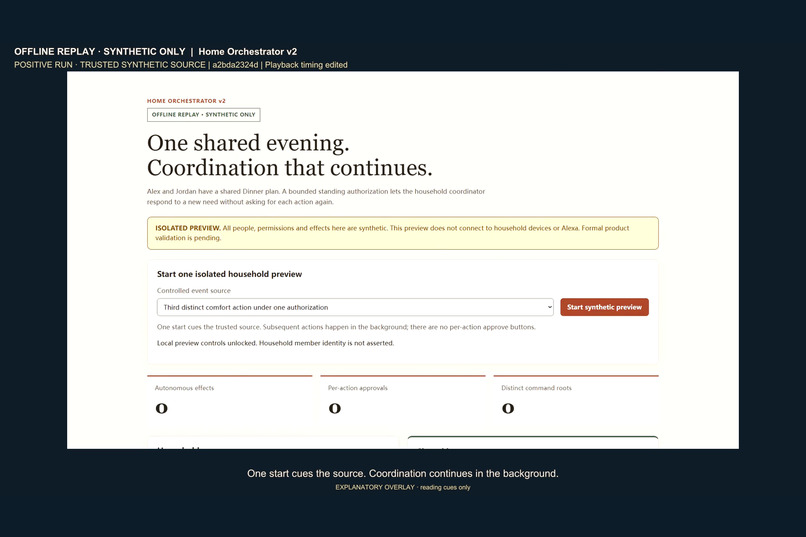
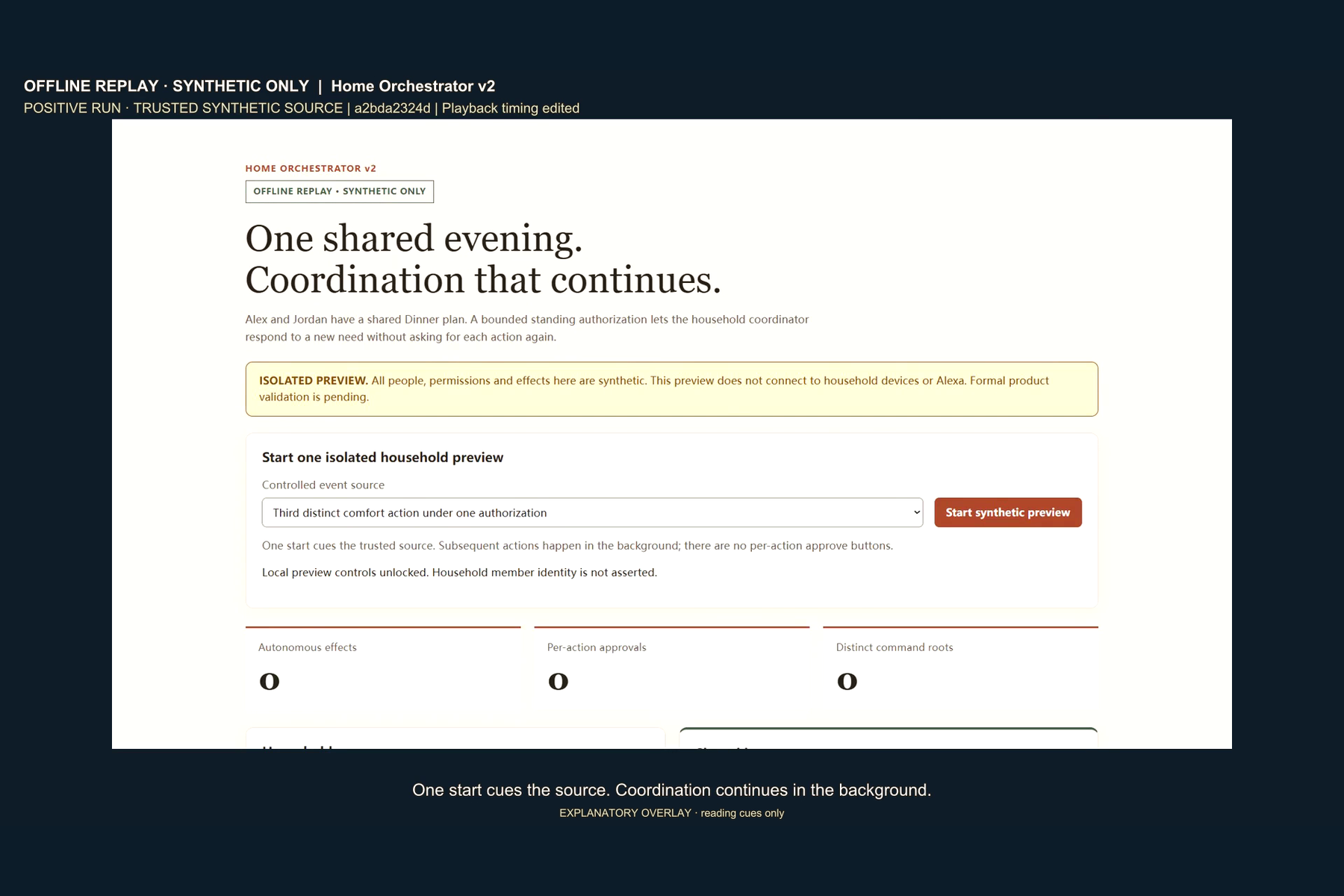
Offline synthetic household preview with explicit Start and bounded authorization.
-
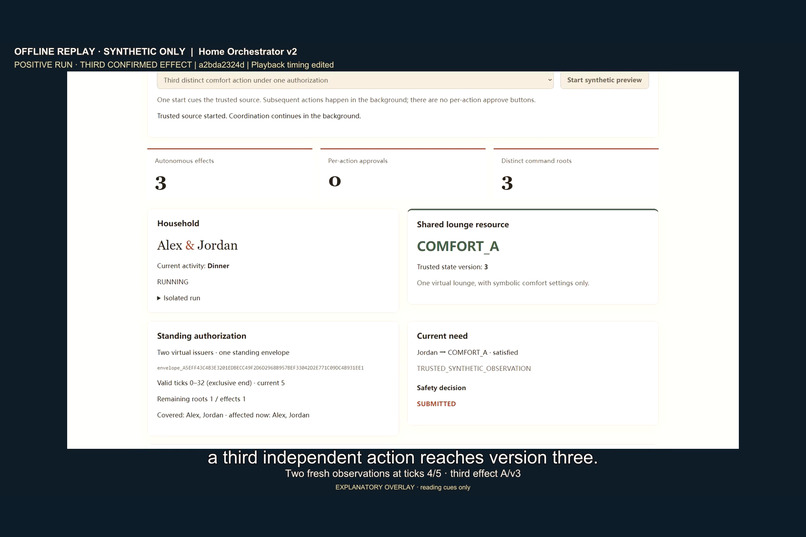
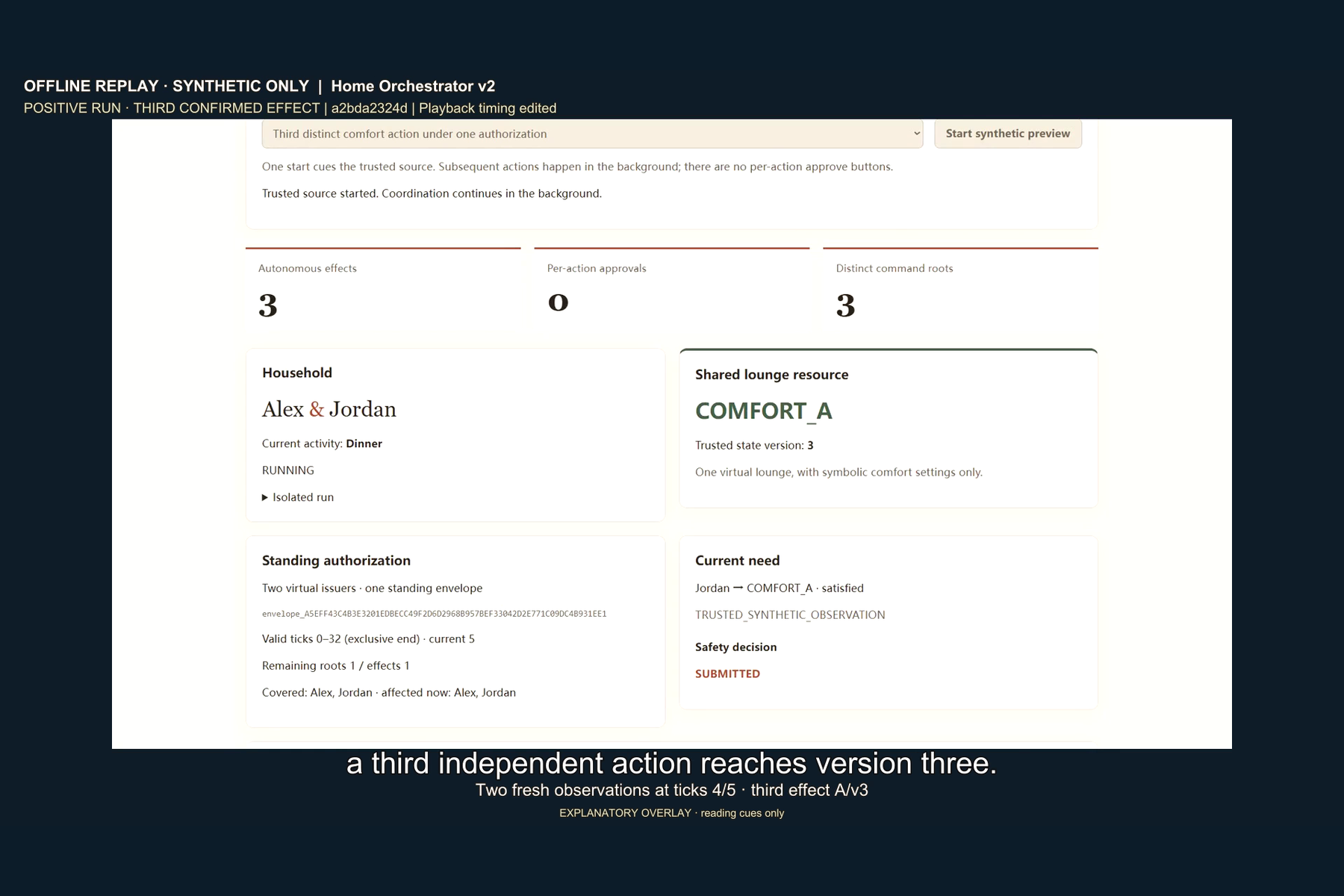
Three autonomous comfort effects, three distinct command roots, and zero per-action approvals.
-
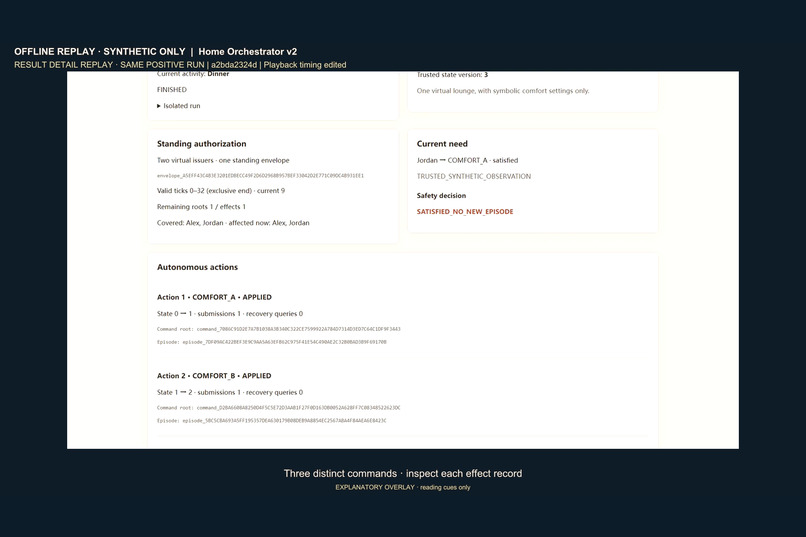
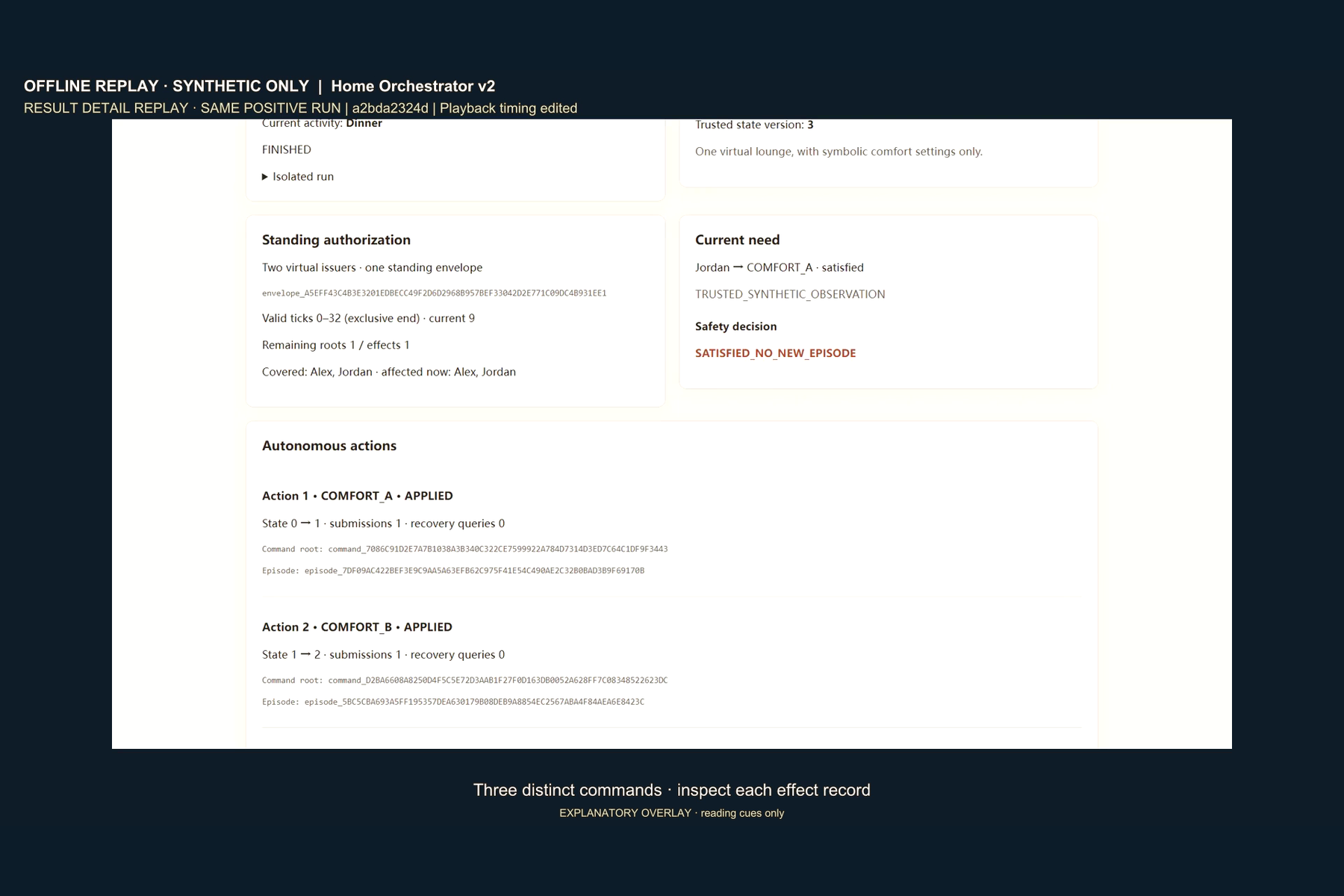
Applied action records, state transitions, and bounded standing authorization.
-
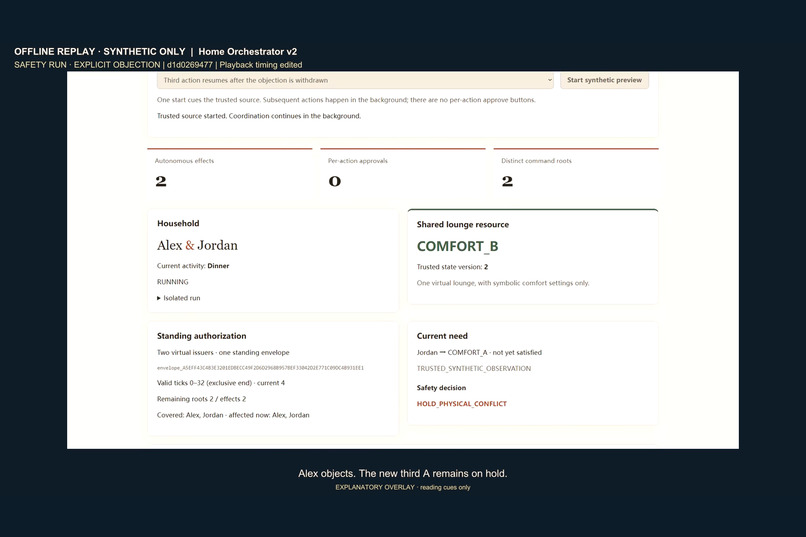
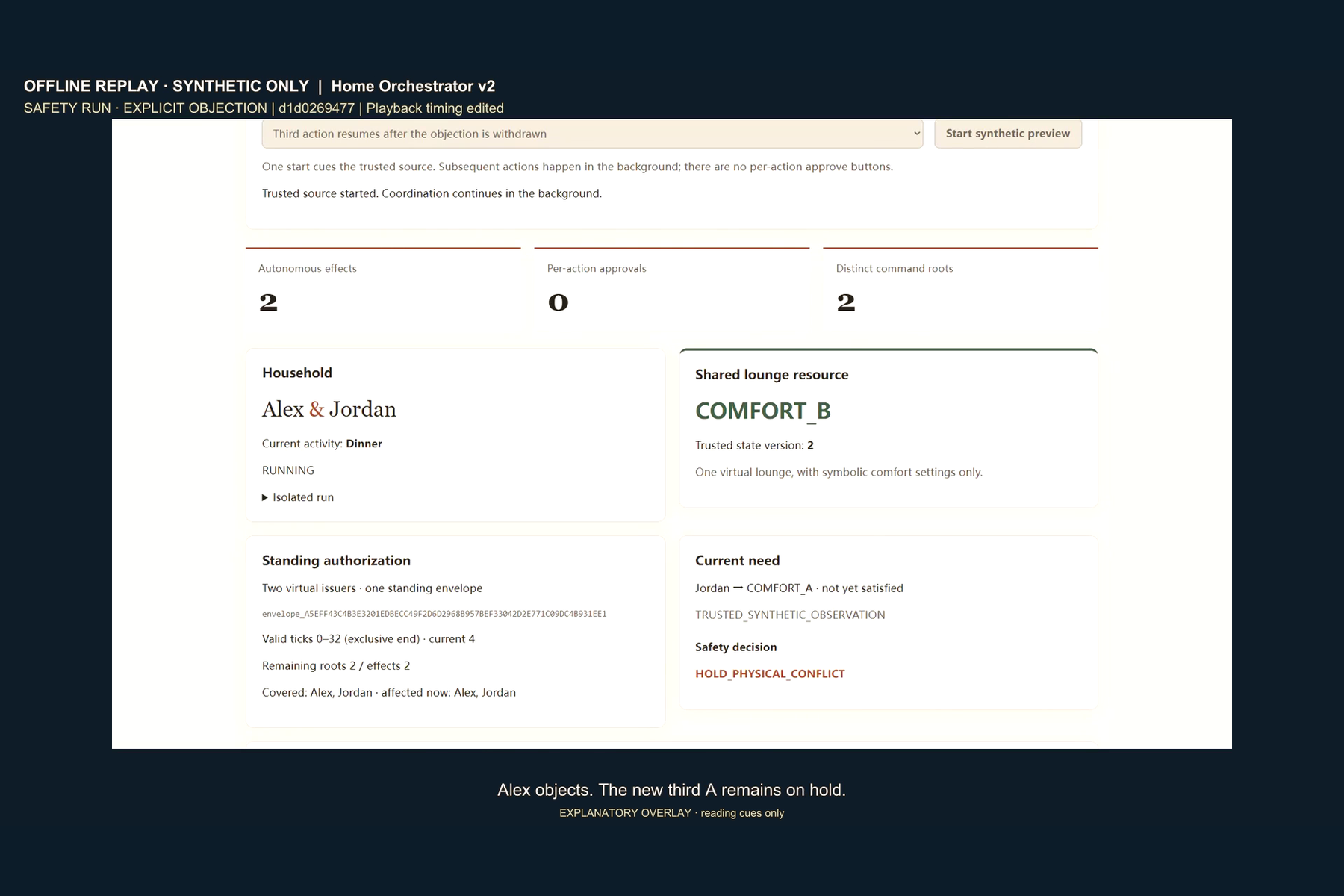
An objection triggers a safety hold, preventing the third action from proceeding.
Inspiration
What it does
How we built it
Challenges we ran into
Inspiration
A home is a shared environment, not just a collection of devices waiting for commands. When multiple people share a space, their needs may change or conflict. Requiring approval for every small adjustment creates friction, but allowing unlimited automation creates new safety risks.
Home Orchestrator v2 explores a different question: Can a household coordinator act independently within clearly defined permission boundaries, while remaining accountable and knowing when to stop?
What it does
Home Orchestrator v2 is a local, deterministic simulation of an Alexa+-style household coordination experience.
The demonstration follows two virtual household members, Alex and Jordan, during a shared dinner activity. They share one virtual lounge resource governed by a bounded standing authorization.
After the user explicitly starts the demonstration, trusted synthetic observations drive the coordinator to respond to changing comfort needs.
A representative run demonstrates:
- Autonomous coordination: Three distinct comfort actions, COMFORT_A → COMFORT_B → COMFORT_A, without separate approval prompts for every action.
- Bounded authorization: Actions must remain within the permitted scope, duration, and limits.
- Safety-first behavior: Conflicting needs or objections can place actions on HOLD.
- Controlled recovery: An appropriate trusted synthetic update can allow the coordinator to reconsider a previously blocked action.
- Traceability: The interface shows authorization, safety decisions, applied effects, resource state versions, and an audit timeline.
The system demonstrates how ongoing coordination can work without removing meaningful human control.
How we built it
The prototype uses Python and FastAPI for its local backend, with HTML, CSS, and JavaScript for the browser interface.
A deterministic synthetic event source generates changing household needs. The coordination logic evaluates these observations against standing authorization and safety constraints before submitting commands to a virtual state authority.
The system uses distinct command identities, state versions, and audit records to make actions observable and reduce accidental duplicate effects.
A portable Windows package provides a local launcher, browser-based controls, explicit Start, scene switching, and normal shutdown.
Challenges we faced
The main challenge was balancing autonomy with safety.
The coordinator needed to perform meaningful work without repeatedly requesting approval, but it also had to respect conflicting household preferences, authorization limits, and safety holds.
Other challenges included preserving action traceability, handling audit-output failures safely, and making the local Windows experience straightforward to start and stop.
Accomplishments
We built a working synthetic prototype that demonstrates multiple coordinated actions under one bounded authorization, safety holds and recovery, a traceable action history, and a downloadable Windows experience.
We also tested targeted failure conditions, including scenarios where both primary and emergency audit-file outputs were unavailable. These tests helped verify that new actions were not admitted after the detected failures.
What we learned
Useful autonomy is not simply the ability to act without asking. It requires explicit boundaries, reliable stopping behavior, and enough evidence to explain what happened.
A successful autonomous coordinator must be able to act, pause, recover, and account for its decisions.
What's next
Future work includes real device adapters, deeper household identity and permission management, broader recovery testing, and exploration of actual Alexa+ integrations.
This version deliberately focuses on proving the coordination and safety model before attempting real-world deployment.
Current scope
This is an offline synthetic prototype, not a production-ready smart-home system. Household members, permissions, observations, and device effects are simulated. There is no live Alexa connection, physical device control, or runtime language model.
The demonstration video shows the core synthetic coordination behavior. The GitHub repository provides the source code, documentation, and downloadable Windows demo.

Log in or sign up for Devpost to join the conversation.