-
-
Home Huddle Logo
-
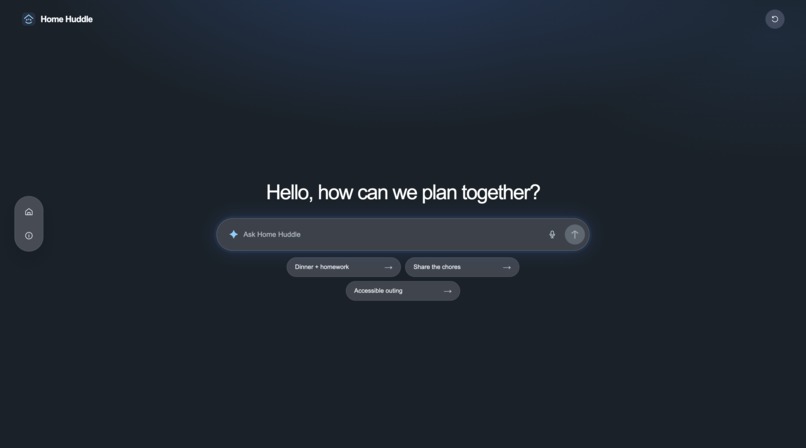
Home Huddle Demo Main Page
-
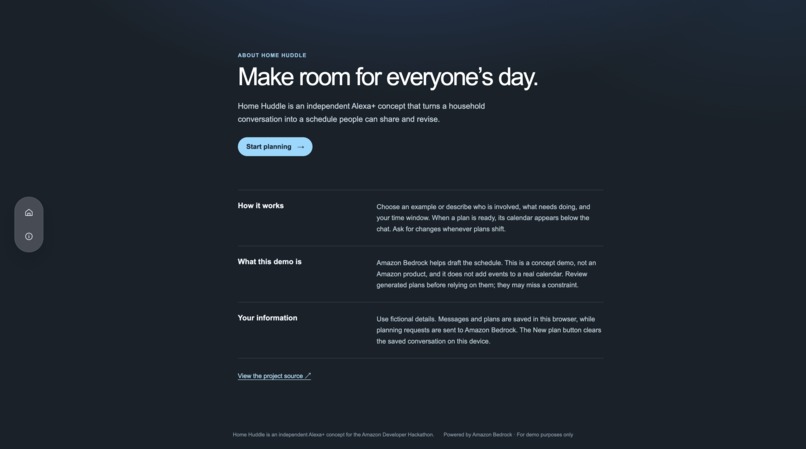
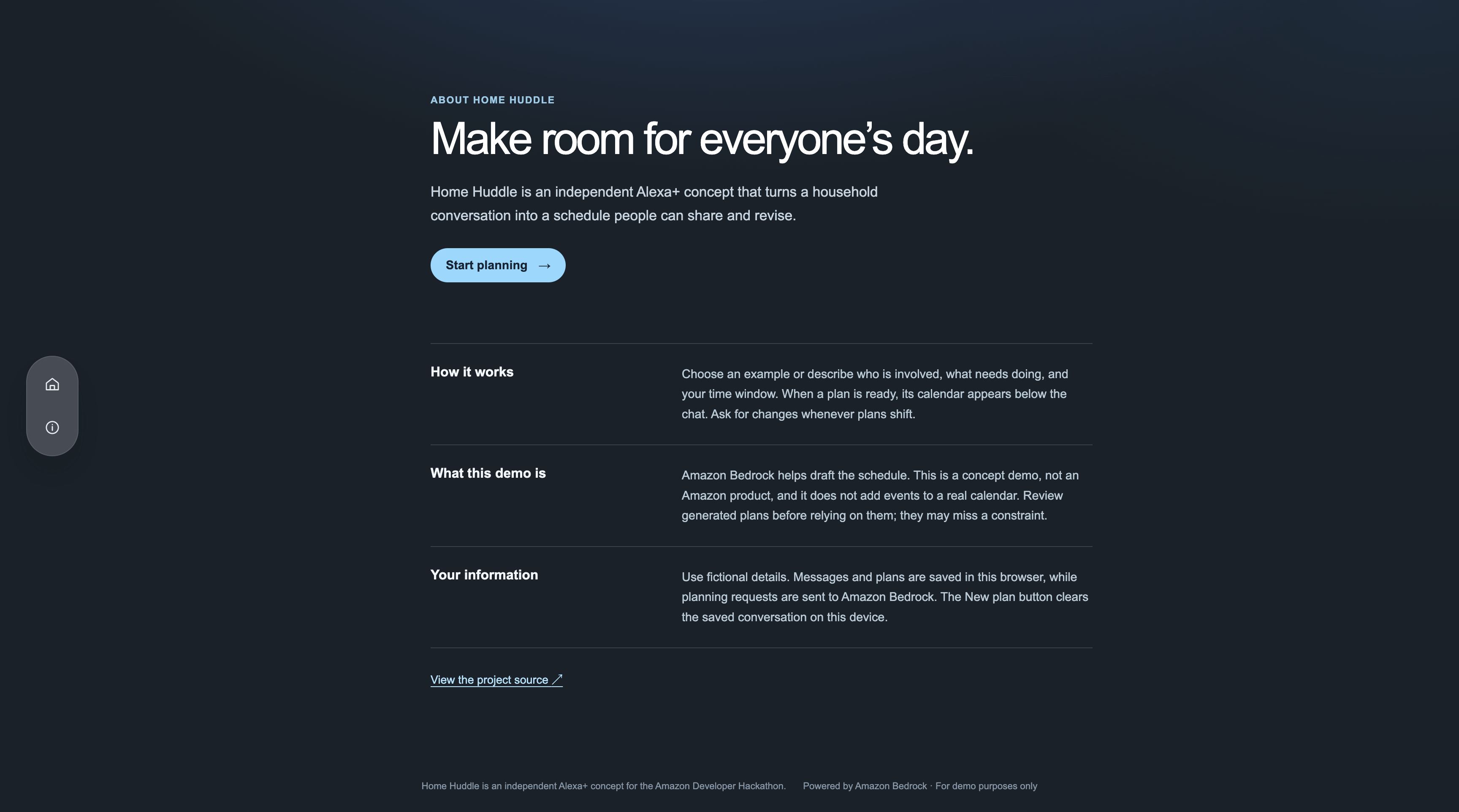
Home Huddle Demo About Page

Inspiration
Household planning is more than making a to-do list. Different people have different availability, some activities depend on others, and everyone still needs a break. I wanted to explore an Alexa+ style conversation that helps a household agree on a workable plan and adjust it when the day changes.
What it does
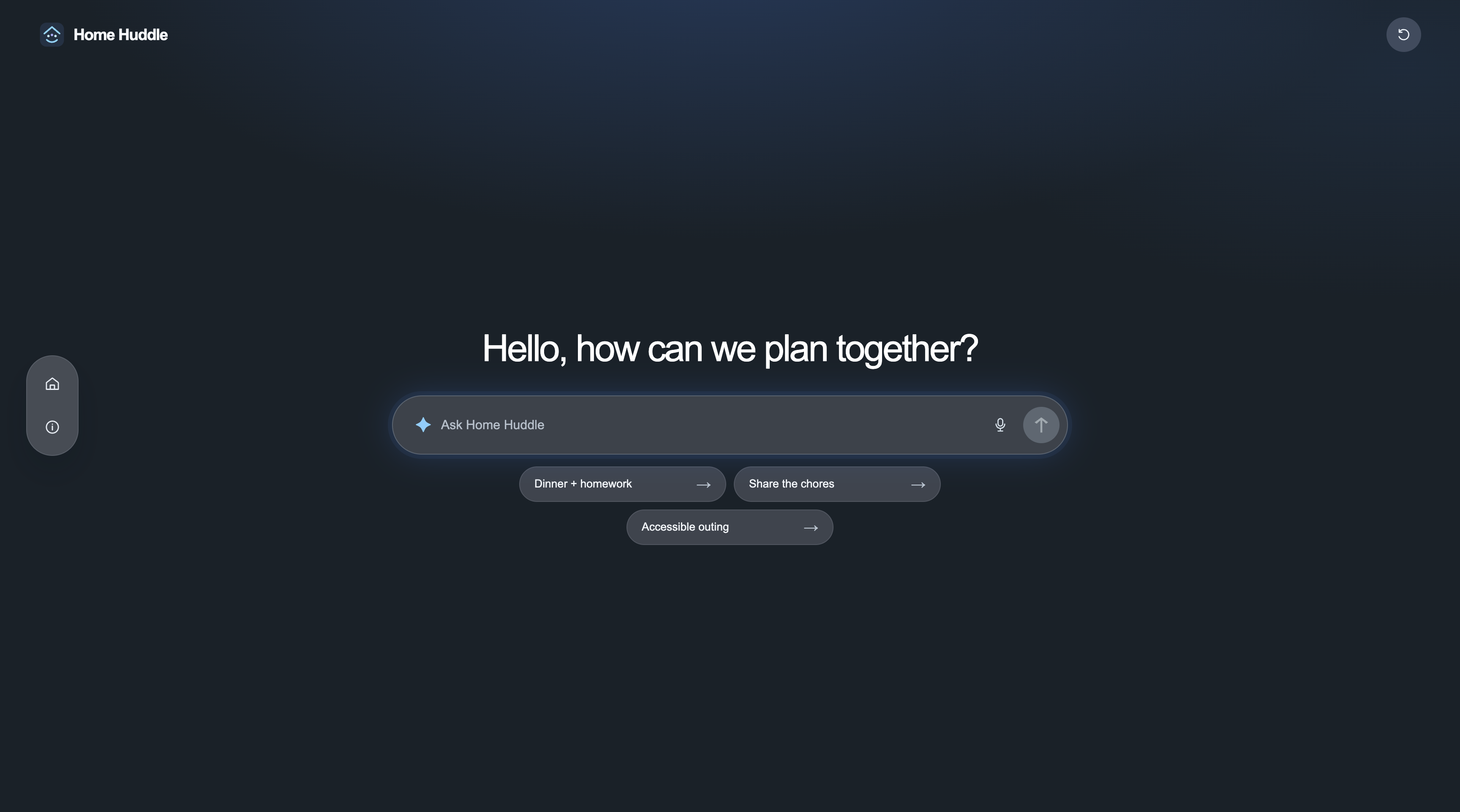
Home Huddle is an independent Alexa+ web simulation powered by Amazon Bedrock. Describe who is involved, what needs to happen, and the time available. Nova 2 Lite interprets the request and proposes a schedule. For a custom request, the app shows the captured activities, timing, order, and assumptions for review before you accept the plan. If it missed something, you can correct the requirement and review another draft.
The calendar shows activities by person or in one shared view, including plans across multiple days. Open an activity to change its date, time, duration, or people, or ask for a revision in chat. Review the before-and-after changes, choose Apply or Keep current, and undo the last accepted revision if needed. Download an .ics calendar file or create a seven-day, read-only snapshot link. Calendar exports are copies, not live synchronization. Browser dictation is optional; typing supports the complete flow.
The 1:45 demo walks through a real custom request for Alex and Sam: plan their parallel chores before a shared break, review and accept the draft, inspect the calendar, shorten the kitchen task, approve the revision, and export the accepted schedule.
How I built it
The React and TypeScript client is built with Vite and hosted on GitHub Pages. A Node.js API runs locally with Express or on AWS Lambda. The hosted API uses its IAM role to call Nova 2 Lite through Bedrock Converse; credentials stay out of the browser.
Custom planning separates requirement interpretation from schedule generation. The server retains the captured checklist and checks proposed schedules for timing, assignment, ordering, availability, and other captured constraints. Zod validates data structures. Specific edits also have checked local paths, and model requests have bounded repair attempts and a maximum of three actual model calls per request.
DynamoDB atomically tracks the public demo's shared model-call quota and stores opt-in, expiring plan snapshots. CloudWatch supports troubleshooting, and AWS Budgets supplies spending alerts. Terraform defines the AWS resources. The public demo is intended for fictional details: conversation state stays in the browser, planning requests are sent to Bedrock, and anyone with a snapshot link can view that snapshot until it expires.
What I am proud of
The interaction makes review a real step: the user sees what the model understood before accepting a custom plan, then sees exactly what a revision would change. I also created Conversation Display Kit, a separate MIT-licensed React library for chat, status, prompt suggestions, and reviewable agent actions. Home Huddle consumes its 0.3.3 package from the source repository; it is not published to npm.
Challenges and lessons
Valid JSON is not enough to make a schedule correct. Earlier tests exposed missed constraints, overlapping activities, and revisions that did not preserve accepted changes. That led to server-owned requirements, stricter checks, targeted regression tests, and explicit human review. The checker verifies captured requirements; it cannot prove the model understood every word of the original request.
Bedrock onboarding also required connecting authentication, region, tool schemas, and the correct Nova inference-profile ID. I documented concrete setup and deployment friction, workarounds, and suggestions in the linked friction log. OpenAI Codex assisted with development, review, tests, and documentation; I checked changes with automated tests and limited live runs.
What's next
The working demo and walkthrough are available now. Next are broader independent live-planning evaluation and usability testing, followed by authenticated household access and stronger privacy and abuse controls before using real household data. Automated unit, browser, package, and accessibility checks cover important flows, but they do not establish broad live-planning reliability or replace user testing.
Try Home Huddle · Watch the walkthrough · Source · Conversation Display Kit · Verification · Friction log
Built With
- amazon-bedrock
- amazon-cloudwatch
- amazon-dynamodb
- amazon-nova-2-lite
- aws-budgets
- aws-iam
- aws-lambda
- axe
- conversation-display-kit
- express.js
- github
- ics
- luxon
- node.js
- playwright
- react
- terraform
- testing-library
- typescript
- vite
- vitest
- web-speech-api
- zod


Log in or sign up for Devpost to join the conversation.