-
-
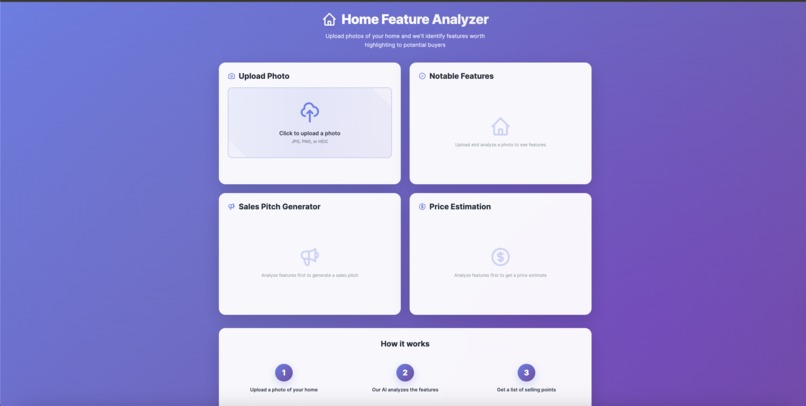
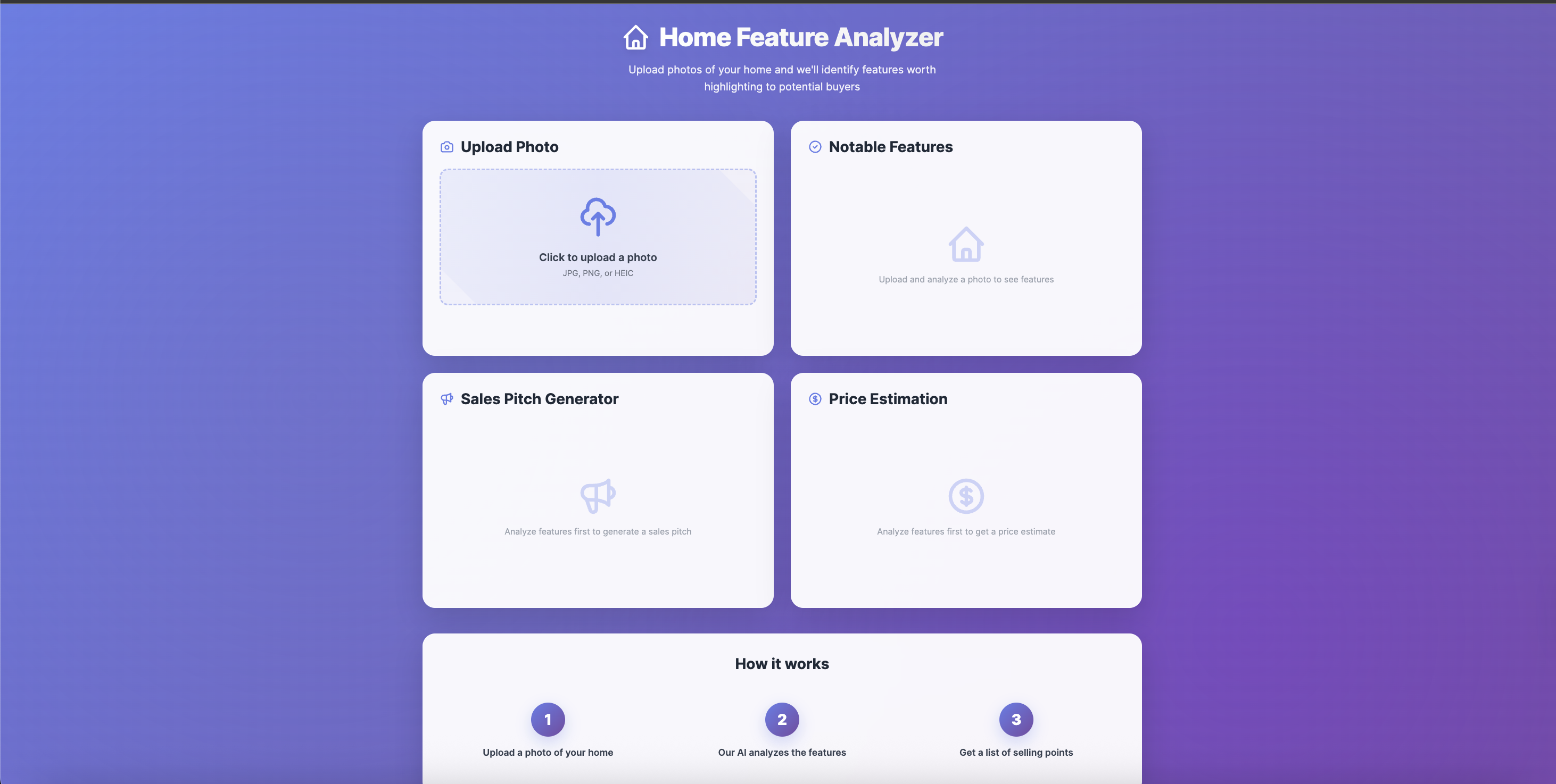
Homepage
-
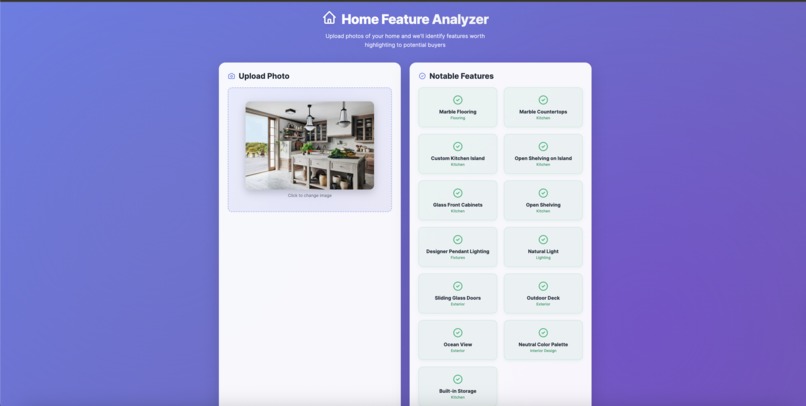
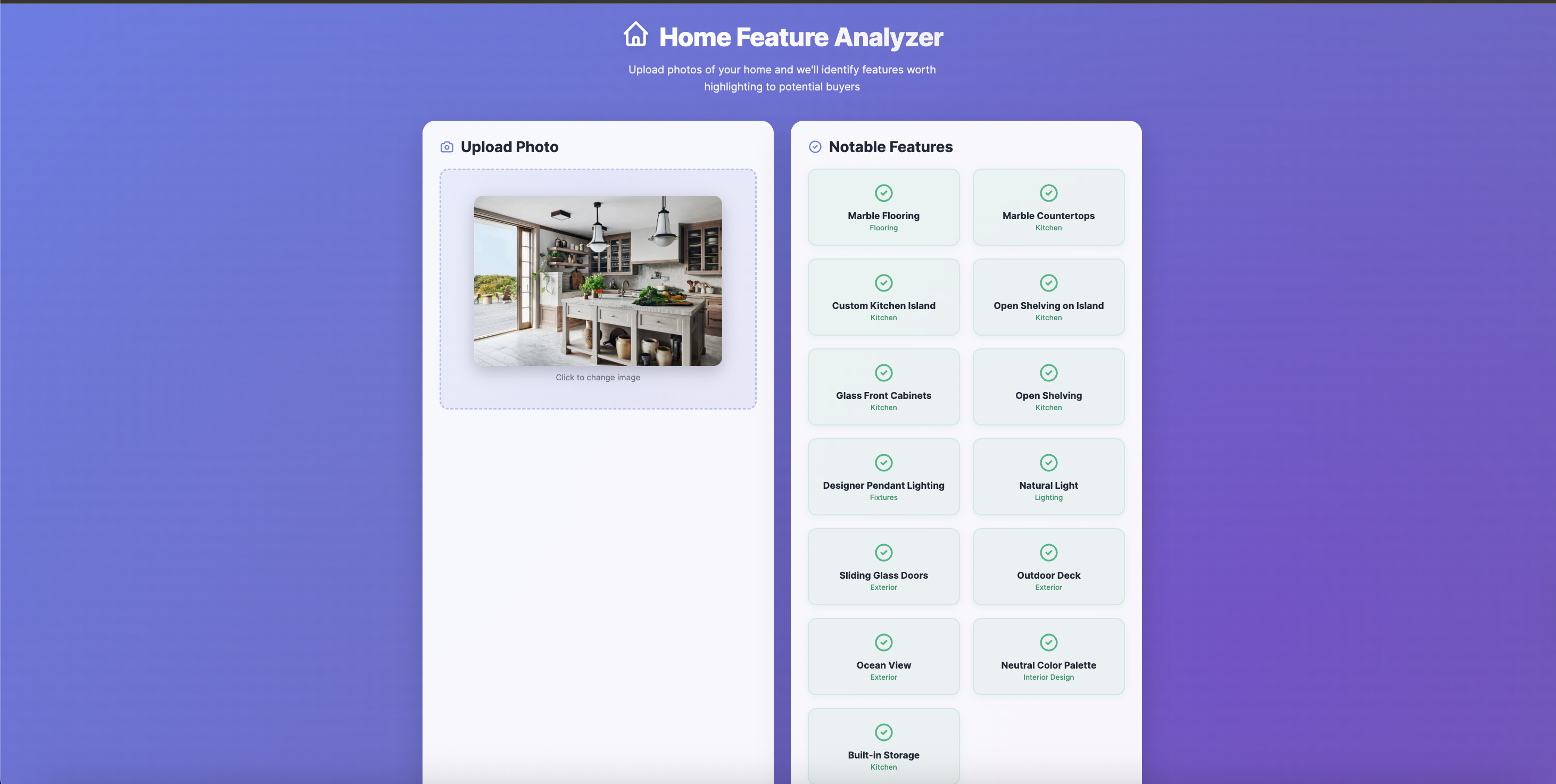
Homepage with images and Notable features
-

Sales Pitch and Estimator
-

How it works
-

Virtual Tour Creator
-
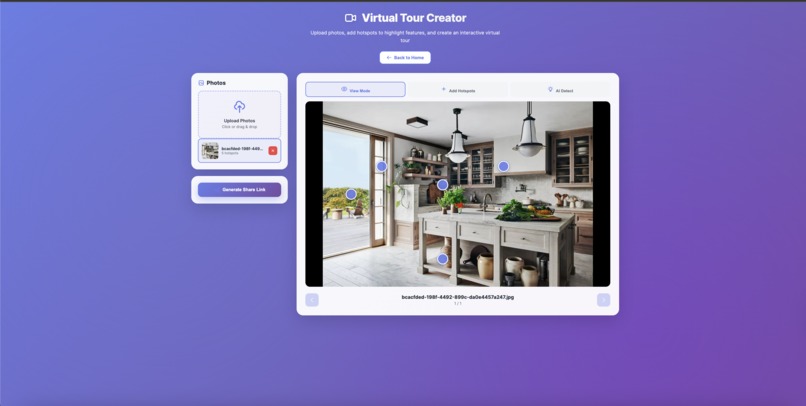
Virtual Tour Creator with Image




Inspiration
As senior Computer Science students, neither of us have any background in real estate, but we saw a big problem with data entry and domain knowledge friction. We realized that writing an effective listing description requires specialized, time-consuming knowledge to identify and correctly phrase key selling points from just looking at photos. Our inspiration was simple: Build an AI tool that gives non-experts the immediate expertise of a seasoned realtor's copywriter.
What it does
The Home Feature Analyzer is an automated pipeline that eliminates manual feature identification and copywriting for property listings. The process is fully automated:
Image Upload: A user uploads any photo (interior or exterior) of a property.
Feature Extraction: The application uses the Gemini API to analyze the image and return a structured JSON list of all notable selling features, categorized by room or type (e.g., {"feature": "Granite Countertops", "category": "Kitchen"}).
**Sales Pitch Generation: **This structured data is immediately fed back into Gemini with a specialized prompt to generate a concise, persuasive, and marketing-ready sales pitch.
**Feature Valuation (The Estimator): **For a basic set of features (e.g., pool, new roof), we implemented a simple internal estimator function that assigns a nominal, illustrative dollar value. This gives the user an immediate, data-driven idea of how much a specific feature contributes to the home's perceived market value.
The end product is a professional description generated in seconds, solving a human knowledge gap
How we built it
This project utilizes a classic client-server architecture centered around the Gemini API:
Frontend (HTML/CSS/JavaScript): Handles the user interface, including file uploading and displaying the asynchronous results with clear loading states.
Backend (Python/Flask): Serves as our primary API controller. It manages CORS, accepts the image upload, and orchestrates the two required sequential API calls.
**Gemini API: **Because of its advanced instruction-following capabilities and multimodal (vision) capabilities, we employ the Gemini-1.5-flash model. To accomplish a data pipeline, it was essential to create two separate prompts: one that required structured JSON from the image and another that required imaginative text from the JSON.
Challenges we ran into
Guaranteed JSON Output: The model sometimes includes markdown fences (`json) around the JSON output, which breaks standard parsing. In order to consistently extract the JSON payload and guarantee that the downstream copywriting phase always received clean, structured data, we created backend string cleaning (Python).
Sequential Latency: Chaining two separate API calls (analysis and writing) caused a noticeable lag. To enhance the user experience and control wait times, we concentrated on putting in place distinct, consecutive loading states on the frontend.
Accomplishments that we're proud of
The use of AI to effectively close a sizable domain knowledge gap is what we are most proud of. We demonstrated that advanced AI models like Gemini can be shaped to immediately absorb and apply specific professional knowledge by developing a tool as CS students that serves as the assistant to a real estate specialist.
As proof of successful API chaining, we are also pleased of the sophisticated, dual-pass API architecture, which converts unstructured visual data into structured feature data and then into imaginative text output.
What we learned
Structured Prompting: In order to make the model act like a trustworthy data parser (returning only JSON), we discovered how crucial it is to create clear, constraint-based system instructions.
Multimodal Data Pipelines: We learned how to construct a series of AI operations in which the outcome of one model pass serves as the crucial input for the one that follows right away.
Cross-Domain Problem Solving: We verified that the most effective method for rapidly entering and resolving issues in domains where we, as generalists, lack specialized professional knowledge is to use core AI techniques.
What's next for Home Feature Analyzer
Local Data Grounding: Use the Google Search grounding tool to incorporate current, local context (e.g., citing recent comparable sales or nearby schools) into the pitch generating process.
Users can swiftly rank the generated features using feature voting and prioritization, ensuring that the sales pitch only covers the top three selling factors.
Photo Comparison Mode: Use logic to compare two photographs (such as "old kitchen" and "new kitchen") and highlight the importance of the most current remodeling in the generated copy.

Log in or sign up for Devpost to join the conversation.