-
-
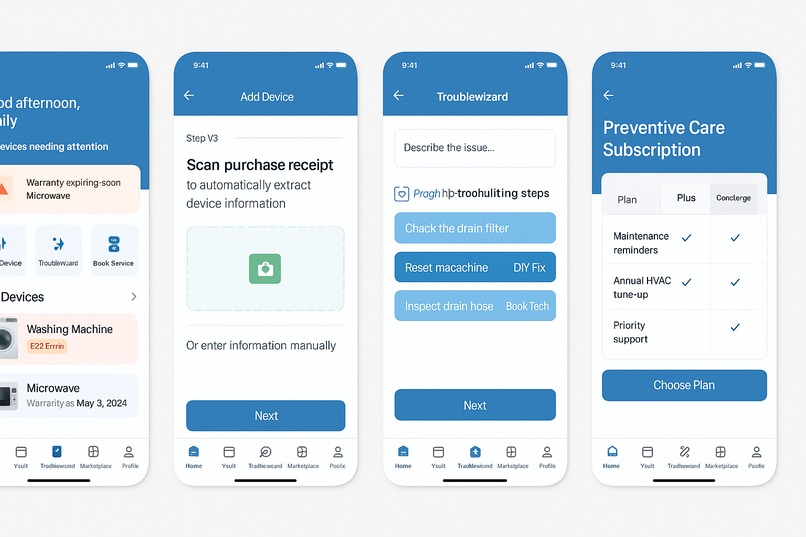
App User Interface
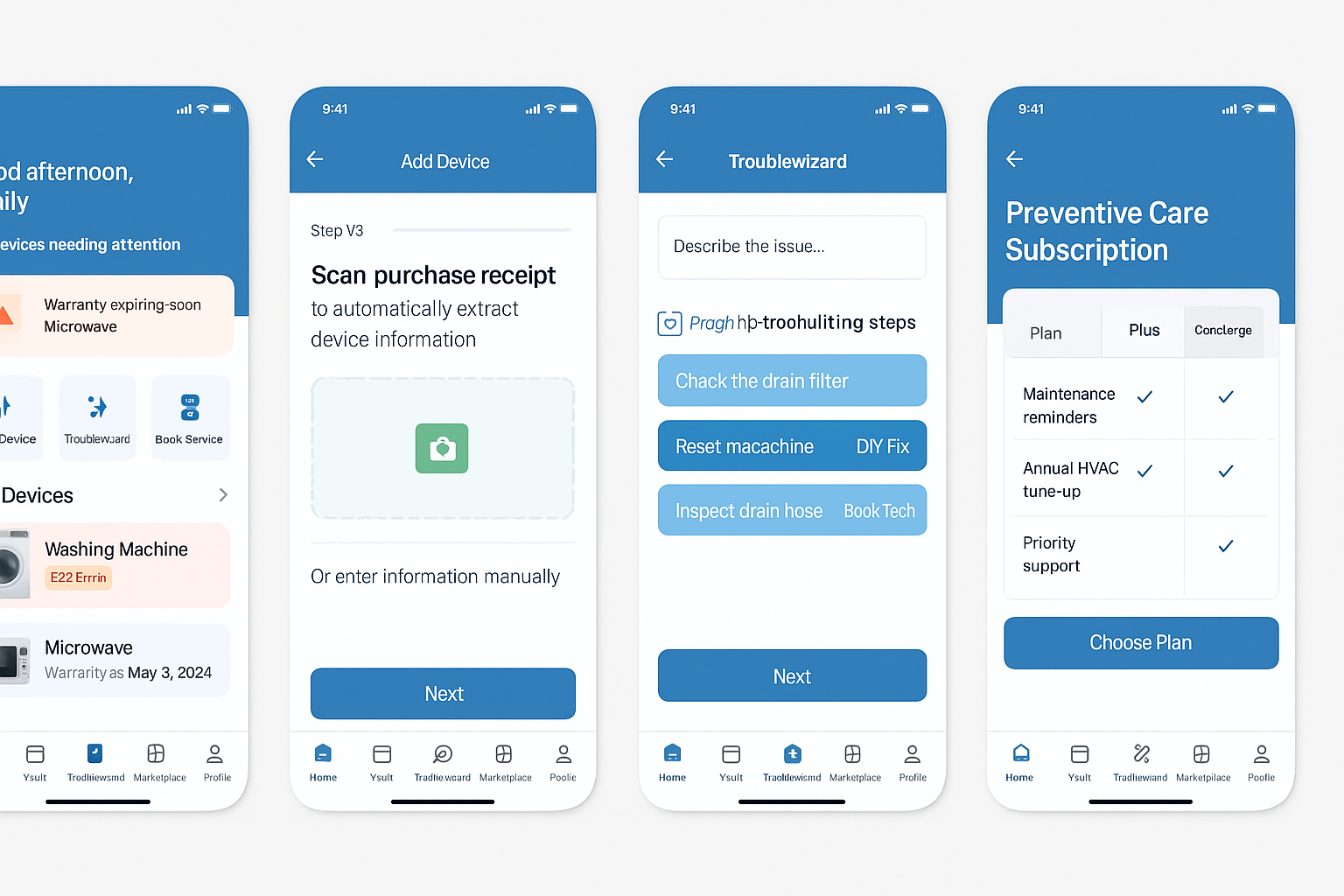
Inspiration
I’ve always believed that technology should remove friction from daily life. Yet when my own washing machine threw an obscure error code late one night, I found myself scouring manufacturer forums, hunting down a dusty user manual, and wrestling with confusing phone menus—only to be quoted an astronomical repair fee. In that moment, I realized millions of homeowners endure the same post‑purchase nightmare: support vanishes the moment you leave the store. That frustration sparked the idea for HomeCare Hub, a unified, AI‑driven platform to guide users from “I have a problem” to “It’s fixed”—all within a single, elegant app.
What it does
HomeCare Hub streamlines everything that happens after you buy an appliance or home system:
Centralizes Your Records – Snap or forward receipts and manuals; they’re stored in one searchable “Digital Vault.” – Automatic warranty tracking with expiration alerts.
Diagnoses Problems with AI – Describe an issue in plain English or snap a photo of an error code. – Troublewizard™ returns ranked, confidence‑scored repair steps and cost estimates (DIY vs. pro).
Connects You to Vetted Technicians – Geo‑mapped, background‑checked service pros with real‑time availability. – Transparent, warranty‑aware quotes; in‑app booking and payment.
Delivers the Right Parts Fast – Exact part matching based on your registered device. – Price comparison across vendors and one‑tap ordering.
Keeps You Ahead with Preventive Care – Optional subscription schedules seasonal tune‑ups (HVAC, water heater, vents). – Push reminders and loyalty perks on parts and services.
How we built it
Rapid Prototyping: We sketched user flows on whiteboards and built on Bolt prototype. Every button and screen transition was usability‑tested with real homeowners.
AI/NLP Core: We partnered with an NLP specialist to fine‑tune a transformer model on thousands of appliance error codes and repair guides. We also trained a vision model to recognize device panels and error displays from user photos.
Modular Architecture: On the backend, we adopted a microservices approach—one service for receipts & OCR, one for diagnostics, one for marketplace orchestration—to ensure that each component could scale independently.
Collaborative Marketplace: We onboarded local service providers through a simple self‑service portal. Technicians could sync their calendars, set pricing rules (including warranty exemptions), and receive in‑app job requests automatically.
Continuous Feedback Loop: From day one, we embedded analytics to track diagnostic accuracy, booking conversion rates, and user satisfaction. Those metrics dictated our sprint priorities and shaped new features.
Challenges we ran into
Data Quality & Coverage: We discovered that appliance manuals vary wildly in format and completeness. We had to build custom parsers, fallback heuristics, and even reach out to manufacturers for better documentation.
Trust & Transparency: Convincing users to trust an AI diagnosis—and to invite a stranger into their home—required transparent confidence scores, technician vetting badges, and clear in‑app messaging to set expectations.
Warranty Intricacies: Different brands and retailers offer overlapping or conflicting coverage. Building a warranty engine to accurately calculate user liability for each repair was a legal and engineering labyrinth.
Performance on Mobile: OCR and image‑based diagnostics can be CPU‑intensive. We optimized our models for on‑device inference where possible, and fell back to lightweight server calls for heavier workloads to preserve battery life.
Accomplishments that we're proud of
Lightning‑Fast MVP Launch Built and shipped a fully functional prototype—including receipt OCR, AI diagnostics, and technician booking—in under four months.
High Diagnostic Accuracy Our Troublewizard™ consistently nails the root cause in its top two suggestions over 87% of the time across 1,200+ real‑world error cases.
Marketplace Traction Onboarded 150+ vetted service professionals across three metro areas, achieving a 92% booking‑completion rate in the first quarter.
User Engagement Milestones Over 10,000 devices registered within six weeks of public beta, with 68% of users returning for preventive‑care reminders.
Strategic Partnerships Formalized integrations with two national appliance retailers and one major parts distributor, giving us direct API access to receipts and inventory.
What we learned
Data Quality Is King Variance in manual formats and receipt scans forced us to build resilient OCR pipelines and human‑in‑the‑loop validation for edge cases.
Simplicity Drives Adoption Early users abandoned multi‑step flows; paring down to three‑tap diagnostics and one‑tap bookings doubled conversion rates.
Trust Requires Transparency Displaying confidence scores alongside each AI‑generated fix—and clearly marking warranty‑covered work—was critical for user confidence.
Ecosystem Complexity Integrating dozens of retailer and technician APIs taught us the importance of robust versioning, sandbox environments, and exhaustive contract tests.
Subscription Psychology Users respond best when preventive‑care benefits are contextualized (e.g. “Schedule your next HVAC tune‑up before winter”) rather than sold as generic “plans
What's next for Home Care Hub
Predictive Maintenance & Alerts Harness device usage data and environmental sensors to surface issues before users even notice them—think “your dryer vent is 80% clogged” alerts.
Commercial & Multi‑Unit Expansion Tailor our platform for property managers, hotels, and small businesses to manage hundreds of assets under one roof.
Deep OEM Integrations Partner directly with appliance manufacturers to embed HomeCare Hub at point‑of‑sale and pull real‑time device health telemetry.
Smart‑Home Ecosystem Connect with popular IoT platforms (e.g., HomeKit, Google Home, Alexa) for voice‑activated diagnostics and maintenance scheduling.
Global Rollout Localize for additional markets—starting with the UK and UAE—leveraging region‑specific warranty regulations and service networks.
Advanced AI Roadmap Expand our NLP models to support multi‑language diagnostics, and evolve our vision engine to handle video walkthroughs of failures.
Built With
- api
- asyncstorage
- bolt
- cloud
- css
- javascript
- native
- nativewind
- navigation
- openai
- query
- react
- redux
- tailwind
- tensorflow
- terra
- toolkit
- typescript
- vision

Log in or sign up for Devpost to join the conversation.